

If you’re selling products internationally in 2026, VAT compliance is non-negotiable. Starting January 1, 2026, EU and UK tax authorities are enforcing stricter rules, including the VAT in the Digital Age (ViDA) package, which changes tax reporting for ecommerce businesses. Here’s what you need to know:
- New Rules and Deadlines:
- France mandates structured e-invoicing by September 1, 2026.
- A €3 customs duty on low-value parcels (under €150) entering the EU starts July 1, 2026.
- Key VAT Requirements:
- Non-EU sellers must register for VAT from their first EU sale.
- OSS (One-Stop Shop) simplifies reporting for cross-border sales.
- IOSS (Import One-Stop Shop) applies to goods under €150.
- Penalties for Non-Compliance:
- Fines up to 20% of EU turnover.
- Average VAT audit costs €15,000.
- Marketplace account suspensions and customs seizures are possible.
To stay compliant, understand your obligations, track inventory locations, and use tools like OSS/IOSS for streamlined reporting. Missing these updates could lead to costly mistakes.
VAT Basics and What They Mean for Ecommerce
What Is VAT and How Does It Differ from U.S. Sales Tax?
Getting a handle on VAT (Value-Added Tax) is essential for staying compliant in the evolving ecommerce landscape of 2026. VAT is a consumption tax applied at each stage of the supply chain. In ecommerce, the destination rule applies: VAT is charged based on the customer’s location, not the seller’s. For instance, a U.S. company shipping goods to Germany must charge German VAT.
This approach contrasts with U.S. sales tax, which is applied only at the final point of sale and depends on meeting an economic nexus threshold, typically $100,000 in sales or 200 transactions in a state. VAT, however, often requires non-U.S. sellers to register as soon as they make their first sale.
| Feature | EU/UK VAT | U.S. Sales Tax |
|---|---|---|
| Authority | National (EU-coordinated) | State and local |
| B2C Pricing | Tax-inclusive | Tax added at checkout |
| Non-Resident Threshold | Often $0 (immediate) | Economic nexus (e.g., $100,000) |
| B2B Mechanism | Reverse charge | Exemption/resale certificates |
| Reporting Frequency | Monthly or quarterly | Monthly, quarterly, or annually |
For B2B transactions within the EU, the reverse charge mechanism shifts the responsibility for VAT to the buyer, provided their VAT number is valid in the VIES system. If the number is invalid, the seller becomes liable.
"Most U.S. DTC brands are still treating EU VAT like it’s 2019. One return per quarter, done. ViDA changed that for B2B transactions – you now need transactional-level digital reporting in near-real-time for business customers." – Sarah Elgazzar, Head of International Compliance, Avalara
Key VAT Rules for Cross-Border Ecommerce in 2026
In 2026, EU VAT rates range from 17% in Luxembourg to 27% in Hungary, with an average of about 21%. EU-based sellers benefit from a €10,000 annual threshold for cross-border B2C sales. If their sales stay below this amount, they can apply their home country’s VAT rate. Once they exceed it, they must charge VAT based on the customer’s country. However, this threshold doesn’t apply to U.S.-based sellers, who may need to register for VAT from their very first sale.
| Jurisdiction | Registration Threshold | Standard Rate |
|---|---|---|
| European Union | €10,000 (EU sellers only; $0 for non-EU) | 17%–27% |
| United Kingdom | £85,000 (nil for non-resident digital services) | 20% |
| Australia | A$75,000 | 10% |
| Canada | C$30,000 | 5% GST + provincial rates |
| Norway | NOK 50,000 | 25% |
| Switzerland | CHF 100,000 | 8.1% |
VAT obligations are also tied to where inventory is stored. For example, using Amazon FBA warehouses in Germany or Poland typically requires local VAT registration, regardless of total sales volume or whether you use the OSS system.
These rules provide the groundwork for understanding how marketplace platforms influence VAT compliance.
How Marketplaces Factor Into VAT Compliance
Platforms like Amazon and eBay play a significant role in VAT compliance under the deemed supplier rules. In specific cases – like when non-EU sellers sell to EU consumers or when imports are valued at €150 or less – the marketplace takes on the VAT responsibility as the seller of record.
While this reduces your direct VAT obligations, it creates additional compliance challenges. Your systems must differentiate between marketplace sales, where VAT is handled by the platform, and direct sales through your website, where you remain responsible. Failing to manage this distinction can lead to errors like double-reporting, which tax authorities may catch through DAC7 data-matching tools.
The VAT in the Digital Age (ViDA) package, which began rolling out in January 2026, increases the scope of platform liability. Starting July 1, 2026, the OSS system will also cover domestic B2C sales made by non-established businesses.
The next section will break down VAT registration and reporting, helping you streamline your compliance efforts.
sbb-itb-e2944f4
VAT Registration and Reporting Requirements for Ecommerce in 2026
When You Need to Register for VAT in the EU, UK, and Other Markets
For U.S. sellers, VAT registration kicks in with your very first sale in the EU. Non-EU sellers are required to register for VAT as soon as they make their first sale within the EU market. If you’re storing inventory locally, like in Amazon FBA warehouses, you’ll need to register for VAT in that country, regardless of your sales volume or participation in the OSS scheme. The registration process can take anywhere from 4 to 12 weeks, and it’s typically longer for non-EU sellers. To avoid delays, aim to start the process 2–3 months before moving your stock.
In the UK, the VAT registration threshold for resident businesses is £85,000. However, for non-resident sellers offering digital services, there’s no threshold – registration is mandatory from the very first transaction. Additionally, countries like France, Spain, Italy, and Poland require non-EU businesses to appoint a fiscal representative who will share the legal responsibility for VAT compliance. Simplifying this process is where OSS and IOSS schemes come into play.
OSS and IOSS: How These Schemes Simplify VAT Reporting
Without schemes like OSS or IOSS, selling across the EU could mean juggling up to 27 separate VAT registrations. These systems are designed to streamline the process.
With OSS (One-Stop Shop), you can register in a single EU member state and file one quarterly return that covers all your cross-border B2C sales within the EU. A single payment is made to your registration country, which then distributes the VAT to the relevant member states. IOSS (Import One-Stop Shop), on the other hand, is tailored for imported goods valued at €150 or less. VAT is collected at checkout, speeding up customs clearance and avoiding surprise fees for your customers.
"The OSS is designed to simplify the European VAT return filing system for businesses… by eliminating the need for VAT registration in EU countries you sell to, but do NOT store goods in." – hellotax
For OSS registration, timing is key. It becomes effective at the start of the quarter following your registration, so make sure to register before the next quarter begins. Non-EU sellers looking to use IOSS must appoint an EU-based intermediary, with both parties sharing full liability for any VAT debts. Even if you have no eligible sales in a quarter, you’re still required to file a nil return to maintain your enrollment.
| Scheme | Scope | Filing Frequency | Threshold |
|---|---|---|---|
| Union OSS | Intra-EU B2C distance sales | Quarterly | €10,000 (EU-established only) |
| Non-Union OSS | Services to EU consumers by non-EU sellers | Quarterly | None |
| IOSS | Imported goods ≤ €150 to EU consumers | Monthly | None |
| Local VAT | Domestic sales, B2B, stock storage countries | Varies | None (non-residents) |
How to File VAT Returns and Keep Accurate Records
OSS returns are due by the end of the month following each quarter (e.g., Q1 returns must be filed by April 30). IOSS returns, however, are filed monthly. All OSS returns must be submitted in euros, so if your sales were made in other currencies, you’ll need to use the European Central Bank’s exchange rate from the last day of the reporting period.
Accurate record-keeping is essential. Both OSS and IOSS require you to maintain records for at least 10 years.
"OSS and IOSS require records to be kept for 10 years, and local VAT rules may also impose long retention periods, so a 10-year archive is a strong practical baseline for EU VAT compliance." – Brenda Varela, hellotax
To stay organized, consider using a "three-bucket" system to track OSS-eligible cross-border sales, local VAT obligations, and imports. Reconcile your settlement reports with your bookkeeping every month. Tax authorities are increasingly using automated systems to cross-check OSS filings, domestic returns, and DAC7 marketplace data for discrepancies.
2026 EU Ecommerce: VAT Rate Changes, Anti-Green Washing and CBAM
Penalties and Risks of VAT Non-Compliance in 2026
Non-compliance with VAT rules in 2026 poses serious financial and operational risks, as stricter regulations and enhanced enforcement mechanisms come into play.
Common VAT Penalties and Enforcement Patterns
Failing to comply with VAT obligations can result in penalties of up to 20% of your total EU turnover, with audits potentially adding administrative costs averaging €15,000. Under DAC7, digital platforms are now required to automatically report sellers who exceed 30 transactions or €2,000 in annual earnings. This increased transparency enables authorities to identify discrepancies more efficiently. Additionally, marketplaces may suspend accounts of non-compliant sellers, potentially halting business during critical periods like peak season – a disruption that could cost far more than compliance fees.
High-Risk Situations for Ecommerce Sellers
Ecommerce businesses face heightened risks in specific scenarios:
- Storing inventory abroad without local VAT registration: For instance, if you store stock in an Amazon FBA warehouse in Germany or Poland, you are obligated to register for VAT in those countries, regardless of sales volume.
- Misusing the OSS scheme: The OSS is designed for cross-border B2C transactions. If you sell from locally stored stock, you must file a local VAT return instead.
- Incorrectly applying a 0% VAT rate: Before applying a 0% rate to a business customer, their VAT ID must be verified in the VIES system. Failing to do so could leave you responsible for unpaid taxes if the VAT number turns out to be invalid.
"Where your stock goes, your EU VAT obligations usually follow." – Brenda Varela
These missteps can also complicate customs procedures, compounding compliance challenges.
How Customs and VAT Rules Interact
VAT and customs compliance are becoming more intertwined, meaning errors in one area often lead to issues in the other. Starting July 1, 2026, a €3 duty will apply to low-value ecommerce imports (valued at €150 or less) entering the EU, eliminating the duty-free status many U.S. sellers previously relied on. Misclassifying goods under the Harmonized System (HS) code is another frequent error. Using incorrect codes can lead to duty overpayments of up to 25% and cause shipment delays at the border.
Repeated customs violations come with escalating consequences, including fines ranging from 1% to 6% of the total value of goods imported over the past 12 months. Persistent non-compliance could result in the loss of "trusted trader" or Authorized Economic Operator (AEO) status. In severe cases, goods may be seized, and customs fraud could lead to criminal charges.
| Risk Factor | Operational Impact | Financial Impact |
|---|---|---|
| HS Code Misclassification | Customs delays, shipment holds | Up to 25% duty overpayment |
| DAC7 Discrepancy | Marketplace account suspension | Audit-triggered back taxes and interest |
| Repeated Customs Violations | Loss of "Trusted Trader" status | Fines of 1%–6% of annual import value |
| VAT Evasion | Seizure of goods, criminal charges | Up to 100% of unpaid tax |
How to Stay VAT Compliant as an Ecommerce Seller
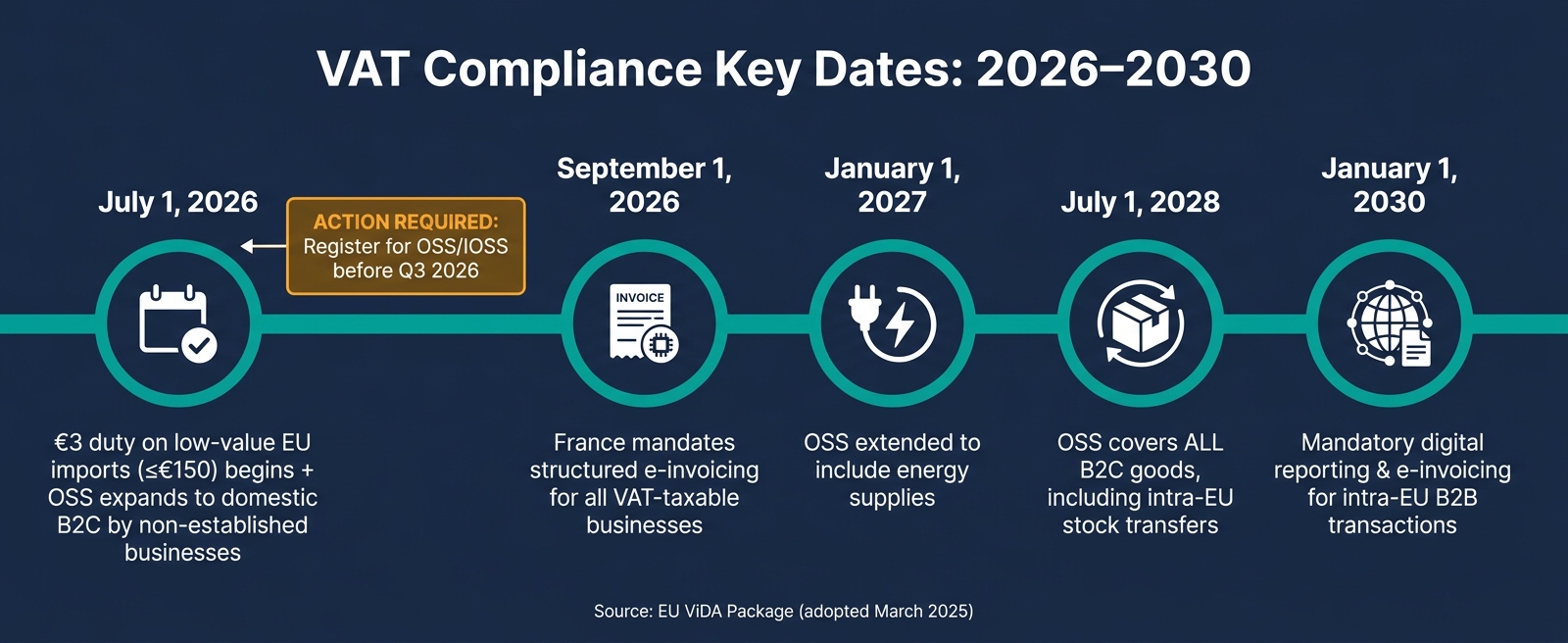
VAT Compliance Timeline for Ecommerce Sellers: 2026–2030
Using Automation Tools to Manage VAT
Tracking VAT manually becomes nearly impossible when you’re managing over 500 orders a month or selling on multiple platforms. Tools like Avalara, TaxJar, Quaderno, and Stripe Tax can simplify this process by calculating VAT in real time based on the customer’s exact location. This is especially important since EU VAT rates vary between 17% and 27%. By centralizing data from platforms like Amazon and Shopify, you can avoid the hassle of reconciling information manually.
A helpful tip: aim to reconcile your orders, payment processor data, and bank statements by the 10th of each month. Regular internal checks can save you from costly compliance investigations.
"If your filings don’t match what platforms report, you’re far more likely to face a compliance check." – TaxRavens
Automation also helps you determine whether the OSS (One-Stop Shop) or IOSS (Import One-Stop Shop) scheme is the best fit for your business model.
When and How to Use OSS and IOSS
Choosing the right VAT scheme depends on where your goods are stored and shipped. Here’s a quick guide:
| Scheme | Best For | Filing Frequency | Key Threshold |
|---|---|---|---|
| OSS | Intra-EU B2C distance sales | Quarterly | €10,000 (EU-established) |
| IOSS | Imported goods valued at €150 or less | Monthly | None |
| Local VAT Return | Domestic sales, stock storage, B2B | Varies | None (triggered by storage) |
For EU-based sellers with cross-border B2C sales under €10,000 annually, you can apply your home country’s VAT rate. However, exceeding that threshold means charging VAT based on the customer’s location. The OSS simplifies this process by allowing a single quarterly filing for all EU transactions.
The IOSS is tailored for low-value imports (under €150), ensuring VAT is collected at checkout so customers aren’t surprised by extra charges upon delivery. Non-EU sellers using IOSS need an EU-based intermediary to cover their VAT obligations.
Keep in mind that OSS and IOSS don’t apply to the UK. Since Brexit, UK sales require separate VAT registration and compliance with Making Tax Digital software requirements.
Regularly reviewing VAT rules ensures your approach stays effective as regulations shift.
Keeping Up with VAT Rule Changes
VAT regulations are constantly evolving, and the next few years will bring significant updates. The VAT in the Digital Age (ViDA) package, adopted in March 2025, introduces changes through 2030. A major update takes effect on July 1, 2026, when OSS expands to include domestic B2C sales by non-established businesses. By July 2028, OSS will cover all B2C goods, including stock transfers between EU countries, potentially reducing the need for multiple local registrations.
Here’s a timeline of key changes:
| Effective Date | Update |
|---|---|
| July 1, 2026 | OSS expands to cover domestic B2C supplies by non-established businesses |
| September 1, 2026 | Mandatory structured e-invoice reception for all VAT-taxable businesses in France |
| January 1, 2027 | OSS extended to include energy supplies |
| July 1, 2028 | OSS to cover all B2C goods, including intra-EU stock transfers |
| January 1, 2030 | Mandatory digital reporting and e-invoicing for intra-EU B2B transactions |
Staying on top of these updates helps you avoid compliance issues and penalties. Set aside time each quarter to review VAT changes, and keep an organized audit folder. This folder should include VAT registrations, filed returns, payment confirmations, sales reports from platforms, and records of inventory movements. Remember, OSS and IOSS rules require you to retain these records for at least 10 years.
How Emplicit Supports Ecommerce VAT Compliance

VAT compliance can be a tricky part of running an ecommerce business, as it impacts everything from where your inventory is stored to how marketplace data is reconciled. Emplicit integrates VAT compliance into the daily operations of your business, ensuring no important detail is overlooked.
Emplicit’s Marketplace Management and VAT Support
Emplicit’s marketplace management tackles the operational challenges that lead to VAT exposure. For instance, programs like Amazon FBA Pan-EU can trigger VAT registration requirements when stock moves across EU warehouses outside the OSS framework. Emplicit tracks these stock movements, identifying exactly where VAT registration is needed and ensuring it’s only done in the necessary jurisdictions.
To avoid unnecessary delays or costly mistakes, every SKU is assigned a 6-digit HS code and the correct VAT rate. Emplicit also keeps a close eye on marketplace VAT reports, such as Amazon’s VAT Transactions Report, to determine when the platform acts as the "deemed supplier" and when the seller remains liable. This approach eliminates risks like double-reporting or missed VAT obligations, helping you maintain compliance across multiple markets.
But that’s not all – Emplicit uses data-driven strategies to further minimize VAT risks.
Using Data to Monitor and Reduce VAT Risk
Emplicit employs a triangular reconciliation approach, which cross-references order data, PSP flows from platforms like Stripe and PayPal, and bank statements. This method ensures brands have an audit-ready VAT position well before filing deadlines.
Conclusion: Staying on Top of VAT Compliance in 2026
By 2026, staying compliant with VAT regulations will require vigilance and adaptability. Tax authorities in the EU and UK are now equipped with AI-driven auditing tools capable of detecting mismatches between VAT filings and bank deposits almost instantly. This level of precision can have a direct impact on your financial outcomes.
Failing to comply doesn’t just result in penalties – it can cost up to 18% of your transaction value through fines, back taxes, and missed opportunities to benefit from VAT schemes. Considering that cross-border ecommerce is expected to reach $7.4 trillion by 2026, successful businesses will prioritize VAT processes as a core operational function, not an afterthought.
To navigate the evolving landscape of VAT compliance in the latter half of 2026, here are some critical steps to focus on:
- Keep track of where your inventory is stored.
- Use OSS (One-Stop Shop) and IOSS (Import One-Stop Shop) to simplify VAT reporting for cross-border sales.
- Meet mandatory e-invoicing requirements, like France’s September 1, 2026 deadline.
- Maintain records for at least 10 years.
- Prepare for the €3 customs duty on low-value parcels, effective July 1, 2026.
- Stay informed about the planned expansion of Single VAT Registration in 2028.
FAQs
Do I need EU VAT registration from my first sale?
Yes, they do. Non-EU businesses are required to register for VAT as soon as they make their first taxable sale to an EU consumer. Unlike some regions, there is no minimum sales threshold for registration.
Additionally, if you store inventory in any EU country – whether through services like Amazon FBA or a third-party logistics provider (3PL) – you must register for VAT in every country where your goods are stored. This requirement applies regardless of how much you sell. Companies like Emplicit can assist in navigating these regulations and ensuring compliance as your business expands internationally.
When should I use OSS vs IOSS?
Use OSS if you store inventory within the EU and sell to consumers (B2C) across EU member states. It streamlines VAT reporting by allowing you to file a single quarterly return, covering all applicable sales.
Use IOSS for shipments sent from outside the EU to EU consumers, provided the order value is €150 or less. This system collects VAT during checkout, helping to prevent surprise customs fees and ensuring a smoother delivery experience for your customers.
How does inventory location affect my VAT filings?
If you’re storing inventory in a foreign country, you’re typically required to register for VAT in that country, no matter how much you sell. This is because keeping stock locally creates a VAT responsibility that the One-Stop Shop (OSS) scheme doesn’t address. Once your inventory is stored in a specific location, you must submit domestic VAT returns for any sales made from that site.
To help with this, Emplicit provides ecommerce services designed to streamline inventory management and ensure compliance with VAT regulations across multiple fulfillment centers.