
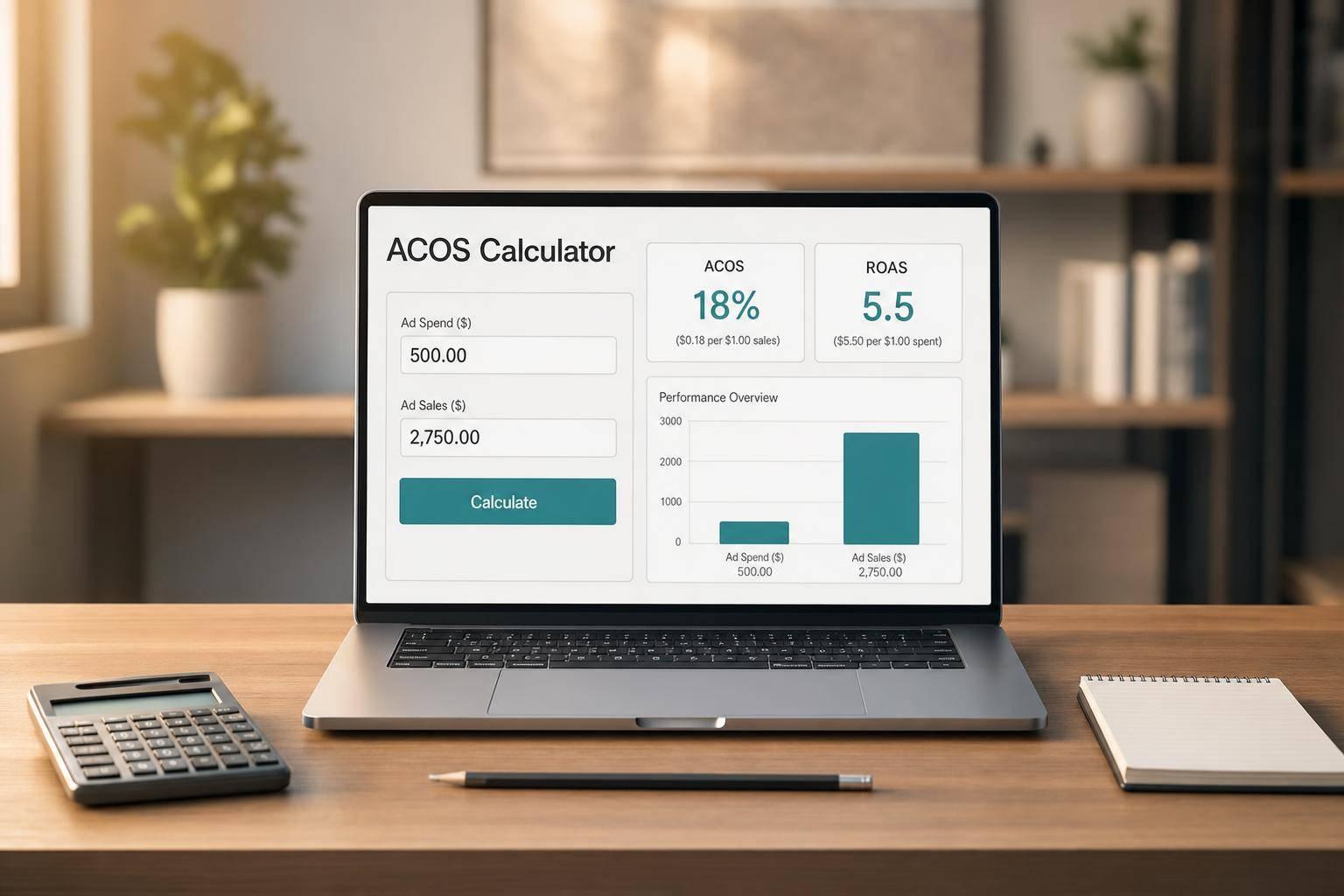
ACOS Calculator for Ecommerce Advertising
For marketplace sellers and ecommerce advertisers, keeping a close eye on ad efficiency is part of staying profitable. An ACOS Calculator makes that job much easier by showing how your ad spend compares to the sales it generates. Instead of manually working through percentages, you can quickly calculate performance, check return signals like ROAS, and plan budgets with more confidence.
Why ACOS Matters
Advertising Cost of Sales is one of the most useful metrics for PPC and marketplace campaigns. A lower percentage usually means you’re spending less to generate revenue, but the right target depends on your margins, goals, and stage of growth. If you’re launching a product, your acceptable ACOS may look very different from a mature campaign focused on profitability.
Plan Spend and Sales More Clearly
This tool does more than basic math. It also helps with reverse planning, so you can estimate the maximum ad budget allowed for a target ACOS or calculate the sales needed to support current spend. That makes the calculator useful for day-to-day optimizations, budget reviews, and campaign forecasting. If you sell on Amazon, Walmart, Etsy, or your own store, an ACOS Calculator can help turn raw ad numbers into clearer decisions.
FAQs
What does ACOS mean, and why does it matter?
ACOS stands for Advertising Cost of Sales. It shows how much you spend on ads to generate attributed revenue, expressed as a percentage. For example, a 20% ACOS means you spent $20 in ad spend to make $100 in sales. Sellers use it to judge efficiency, compare campaigns, and decide whether ad performance fits their margins.
Is a lower ACOS always better?
Usually, a lower ACOS means your ad spend is working more efficiently relative to sales. That said, lower isn’t automatically better in every situation. Some campaigns are designed for growth, product launches, or ranking, so a higher ACOS may be acceptable for a period of time. The real benchmark is your profit margin, because profitability depends on whether your advertising cost leaves enough room after fees, product cost, and other expenses.
What’s the difference between ACOS and ROAS?
They measure the same relationship from opposite directions. ACOS tells you ad spend as a percentage of sales, while ROAS tells you how many dollars of sales you generated for each dollar spent on ads. If your ACOS is low, your ROAS is generally higher. Many advertisers look at both because ACOS is great for margin-based decisions, while ROAS is often easier to scan when comparing campaign returns.