
Affiliate marketing connects brands with creators who earn commissions for driving product sales. In 2025, this strategy generated $12 billion through platforms like Amazon, TikTok, and Walmart. Each platform offers unique strengths:
- Amazon: Best for high-intent shoppers with its vast product catalog and trusted reputation. Affiliates earn 1–10% commissions, and the program includes tools like personalized storefronts.
- TikTok Shop: Excels at discovery-driven purchases, with conversion rates of 8–12%. Creators earn 10–30% commissions and use features like shoppable video tags and live shopping.
- Walmart: Offers a 3-day cookie window (longer than Amazon’s 24 hours) and commissions up to 18%. It’s ideal for reaching budget-conscious shoppers.
Key strategies include targeting niche audiences, optimizing content for each platform, and monitoring compliance with FTC disclosure rules. By leveraging the strengths of these platforms, brands can maximize affiliate revenue while tailoring campaigns to each audience.
12 BEST Affiliate Marketing Programs You Need To Join in 2025
sbb-itb-e2944f4
Affiliate Marketing on Amazon
Amazon holds a massive 48–50% share of the global affiliate network market. With around 9.7 million sellers and an extensive product range, it’s a goldmine for affiliates looking to monetize their content. The platform supports two main programs: Amazon Associates, designed for traditional content creators, and the Amazon Influencer Program, tailored for social media personalities.
Amazon Associates Program Overview
Amazon Associates operates through a straightforward tracking system. Affiliates create "Special Links" that track purchases for commission. The standard tracking period, or attribution window, lasts 24 hours after a user clicks the link. However, if an item is added to the cart within that timeframe, the commission window extends up to 89 days, provided the purchase is completed.
To maintain eligibility, affiliates must generate three qualifying sales within the first 180 days. Additionally, participants must have a website with at least 10 original posts published in the last 60 days, and the content cannot target children under 13. Commission rates vary by product category, ranging from 1% for Amazon Fresh and health products to 10% for luxury beauty items. Payments are issued about 60 days after the end of the month in which they’re earned, with options for direct deposit (minimum $10), Amazon gift cards (minimum $10), or checks (minimum $100 with a $15 fee).
As of March 2026, the average annual income for an Amazon affiliate in the U.S. is $98,928, with top earners making up to $136,000. For instance, Hugo Guerreiro, founder of The Men Hero, earned $963.69 in revenue just seven months after launching his men’s fashion blog in April 2021.
Amazon Influencer Program
The Amazon Influencer Program builds on the Associates model but is specifically designed for social media creators. Rather than embedding individual product links, influencers receive a personalized storefront with a vanity URL (e.g., amazon.com/shop/username). This setup allows creators to promote multiple items across platforms – like Instagram or TikTok – using a single "link-in-bio" approach.
The main difference lies in eligibility. While the Associates Program is open to anyone with a website or social media presence, the Influencer Program requires an established following and active engagement on platforms such as YouTube, TikTok, Instagram, or Facebook. Amazon reviews your social media accounts before approval. Once accepted, influencers can earn "onsite commissions" from content displayed directly on Amazon while still benefiting from the 24-hour cookie window and the 89-day cart extension.
How to Succeed on Amazon
Now that you know the basics, here’s how to maximize your success. Start by focusing on sub-niches, like "home gym equipment for small spaces", to establish authority and reduce competition. Create detailed content that aligns with buyer intent – think in-depth product reviews, "best of" lists, and comparison guides.
Take advantage of Amazon’s built-in tools to simplify your workflow. Use SiteStripe on desktop or GetLink on mobile to generate affiliate links directly from product pages without navigating back to your dashboard. For international traffic, enable Amazon OneLink to automatically redirect visitors to their local Amazon storefront, ensuring you don’t miss out on commissions from global audiences.
"Affiliate marketing is about adding your own insight and perspective and becoming an authority for a particular niche or problem." – Arun Grewal, Founder, Coffee Brewing Pro
To capture users ready to buy, target "transactional" keywords like "buy" or "discount" and "commercial" keywords such as "best of" or "review". With mobile commerce projected to make up 59% of total retail ecommerce sales by 2025, ensure your site is mobile-friendly and loads quickly. Finally, always include clear FTC disclosures near affiliate links to stay compliant and avoid account suspension.
Affiliate Marketing on TikTok Shops
TikTok Shop made waves in 2024, pulling in a massive $15.8 billion in U.S. sales and claiming 68.1% of gross market value (GMV) sales across all social media platforms. What sets TikTok Shop apart is its seamless integration of discovery, persuasion, and checkout – all within the app.
TikTok Shop Affiliate Program Overview
Joining TikTok’s Affiliate Program comes with a few requirements. Creators need at least 5,000 followers, must be 18 years or older, and their accounts must be in "good standing." Sellers, on the other hand, need to maintain a Shop Performance Score (SPS) of 3.5 or above to unlock affiliate features.
The program offers three types of collaborations:
- Open Collaboration: Products are visible to all eligible creators.
- Target Collaboration: Sellers invite specific creators and negotiate rates.
- Shop Collaboration: A universal commission rate applies to all shop products.
Commission rates vary widely, from 1% to 80%, but most sellers stick to 10–15% when testing the waters. To attract top-tier creators who put in more effort, rates typically jump to 20–30%.
TikTok Shop also provides tools to make affiliate marketing straightforward. Shoppable video tags link directly to products, the Showcase Tab on creator profiles highlights promoted items, and LIVE shopping lets creators promote products in real-time. Creators can even request free product samples from sellers for authentic reviews. Starting in April 2024, TikTok added a 6% referral fee per order for U.S. sellers.
Now that the program basics are covered, let’s dive into how TikTok’s Creator Marketplace connects brands with influential creators.
Using TikTok Creator Marketplace
The TikTok Creator Marketplace is a goldmine for brands. It allows them to filter creators by location, reach, and engagement, while also providing first-party data like audience demographics and past campaign performance. Leaderboards such as "Creators by branded content" and "Creators by organic content" help brands identify both seasoned partners and rising stars.
In 2025, 93% of brands expected creators to take a bigger slice of their marketing budget, and 64% of TikTok users said they’d buy a product after seeing a creator promote it. Affiliate creators played a huge role, driving about 40% of TikTok Shop’s total sales that year. The platform processed over $33 billion in global merchandise volume, a jump of more than 150% from 2024. For example, one U.S. beauty brand increased creator commissions from 12% to 25% for 30 collaborators and saw a 3.2x boost in revenue per creator.
Armed with these insights, here’s how to step up your TikTok affiliate campaigns.
How to Run Effective TikTok Affiliate Campaigns
TikTok Shop boasts conversion rates of 8% to 12%, far outpacing the 2–4% seen in traditional ecommerce. The majority of GMV in the U.S. comes from in-feed shoppable videos (70%), with LIVE shopping contributing 17% and direct shop page purchases making up 13%.
To maximize engagement, use a "Hook → Problem → Solution → Call-to-Action (CTA)" structure in your videos:
- 0–3 seconds: Grab attention with a product highlight or "wow" moment.
- 3–6 seconds: Introduce a relatable problem.
- 6–15 seconds: Show how the product solves the problem.
- 15–20 seconds: Wrap up with a strong CTA.
Make sure your product is front and center in the first two seconds – don’t save the big reveal for the end. Incorporate items naturally into everyday content, like "Get Ready With Me" videos, and always mention the yellow basket product tag both visually and verbally.
"A video with 500,000 views and 10 sales performs worse than one with 50,000 views and 100 sales. Optimize your affiliate program around creators who drive purchases, not just attention." – Luke Bae, Syncly
New affiliates should spend a day or two engaging with TikTok as regular users before posting promotional content to avoid being flagged as spam. Focus on "GMV per video" as your key success metric instead of vanity metrics like likes or views. To amplify results, use Spark Ads to boost high-performing organic content while keeping its engagement history intact.
Tarte Cosmetics is a standout example, generating over $40 million in TikTok Shop revenue in 2025, with 88% of that coming from affiliate creators rather than the brand’s own accounts.
Affiliate Marketing on Walmart
Walmart’s affiliate program offers a strong opportunity for creators and marketers, thanks in part to its 3-day cookie window – a significant edge over Amazon’s 24-hour window. Combine that with 429 million monthly visitors to Walmart.com, $600 billion in annual revenue, and the added convenience of in-store pickup, and you have a platform with serious potential for conversions, backed by consumer trust. Let’s take a closer look at the program’s structure and the benefits it offers.
Walmart Affiliate Program Overview
The Walmart Affiliate Program is completely free to join, with no hidden costs like membership fees or monthly subscriptions. Using Impact Radius for tracking, affiliates can monitor their sales, impressions, clicks, and commissions all in one place. Applications are typically approved within 24 hours, and affiliates receive weekly updates featuring banners, links, and product highlights.
Commission rates vary by product category, ranging from 1% to 18%. For example, business and personal checks offer the highest rate at 18%, while contact lenses provide 10%. Popular categories like clothing and home goods generally pay around 4%, while electronics and video games sit at the lower end with 1%. Payments are processed on a net 60 basis, meaning affiliates receive their earnings roughly two months after a sale. The program operates on a last-click attribution model, ensuring the affiliate responsible for the final click gets the credit.
One standout feature is Walmart’s SDK tool, which allows affiliates to embed "Buy Now" buttons directly on their websites. This feature lets visitors add items to their carts immediately, improving conversion rates. Additionally, the 3-day cookie window gives customers a full 72 hours to complete their purchase after clicking your link – offering affiliates a better chance to earn commissions.
Walmart Creator Program Features
For established influencers, Walmart offers an exclusive Creator Program. Unlike the open affiliate program, this invite-only initiative is geared toward creators with proven traffic and conversion records. It includes perks like direct brand collaborations, sponsored content opportunities, and campaign support.
Participants in the Creator Program gain access to a specialized dashboard for identifying high-commission products, which helps maximize earnings. A browser plugin simplifies the process of creating trackable links directly from Walmart.com. The program also integrates analytics tools and provides easy sharing options for platforms like TikTok, Instagram, and YouTube. A unique advantage here is Walmart’s in-store pickup option, which allows affiliate links to convert even when customers opt for same-day pickup instead of delivery.
How to Succeed on Walmart
To optimize your earnings, focus on product categories with higher commission rates, like clothing, home and garden, baby items, and health & beauty, which typically pay around 4%.
Timing is everything. Align your campaigns with Walmart’s major sales events, such as "Rollbacks", "Deal of the Day", Black Friday, and Back-to-School season (July–August), to tap into peak shopping periods. Content like "Walmart vs. Amazon" comparisons or "Best [Product] Under $50" guides often perform better than single-product reviews, as they appeal to shoppers seeking value.
For better SEO, use Google’s "People also ask" feature to find relevant questions and topics to address in your content. Writing in-depth product reviews that include ratings, features, pricing, pros and cons, and alternatives can help establish trust and drive conversions. If you’re a video creator, posting product reviews or "hauls" 3–5 times per week on platforms like TikTok, Instagram Reels, and YouTube Shorts can significantly expand your audience.
Don’t forget compliance. Always include clear disclosures such as "#WalmartPartner" or "paid link" next to affiliate links to stay in line with FTC guidelines. With a low payout threshold of just $10, the program is accessible even for smaller creators. By combining these strategies with efforts on Amazon and TikTok, you can maximize your overall affiliate revenue potential.
Commission Structures and Costs Across Platforms
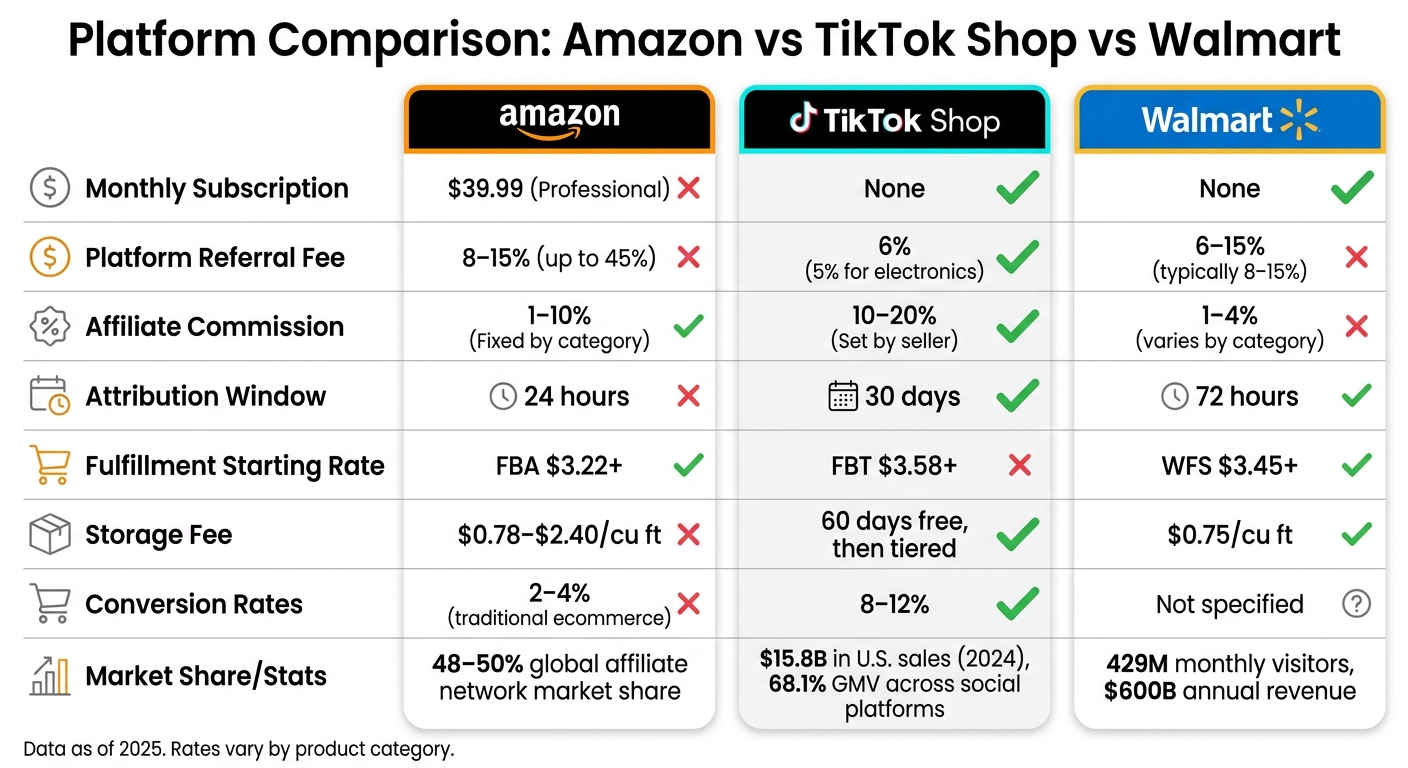
Amazon vs TikTok Shop vs Walmart Affiliate Marketing Comparison 2025
Understanding the complete cost structure of each platform – covering commission rates, fees, fulfillment costs, and attribution windows – can help you make better decisions about where to allocate resources.
Platform Comparison Table
Here’s a quick look at how the major platforms compare when it comes to their fees and commission structures. For example, Amazon charges professional sellers $39.99 per month and offers fixed affiliate commissions between 1–10%, depending on the product category. TikTok Shop, on the other hand, skips the subscription fee but allows sellers to set their own affiliate rates, usually between 10–20%, in addition to a 6% platform referral fee. Walmart also has no subscription fee, with affiliate commissions ranging from 1–4% based on product categories – for instance, about 3% for books and 2% for groceries.
| Feature | Amazon | TikTok Shop | Walmart |
|---|---|---|---|
| Monthly Subscription | $39.99 (Professional) | None | None |
| Platform Referral Fee | 8–15% (up to 45%) | 6% (5% for electronics) | 6–15% (typically 8–15%) |
| Affiliate Commission | 1–10% (Fixed by category) | 10–20% (Set by seller) | Approximately 1–4% (varies by category) |
| Attribution Window | 24 hours | 30 days | 72 hours |
| Fulfillment Starting Rate | FBA $3.22+ | FBT $3.58+ | WFS $3.45+ |
| Storage Fee | $0.78–$2.40/cu ft | 60 days free, then tiered | $0.75/cu ft |
The differences in these structures can have a big impact on profitability. For example, Walmart’s 72-hour attribution window increases delayed conversions by 21% compared to Amazon’s 24-hour window. TikTok Shop offers the longest attribution period at 30 days, giving affiliates more time to earn commissions.
"TikTok Shop pays more per creator-driven sale (10–20% commission vs Amazon’s 1–10%) and has a far longer 30-day attribution window."
– Rowfix Learn
How to Evaluate Costs for Your Business
To get a clear picture of profitability, it’s essential to consider platform-specific costs beyond just the headline commission rates. For instance, on TikTok Shop, the total fees can climb to 32% when you add the 6% referral fee, a 6% shipping fee, and a 20% affiliate commission. On Amazon, total costs, including FBA fees, can reach up to 40% when factoring in referral fees, fulfillment, and storage. If you’re selling on TikTok and offering competitive commissions, keeping your Cost of Goods Sold (COGS) below 40% of your selling price is a smart move.
Commission rates also vary widely by product category. Amazon offers 4.5% for books, while Walmart pays 3%, but Walmart outperforms Amazon for groceries (2% vs. 1%). This means you might want to send traffic for electronics and groceries to Walmart, leveraging its longer attribution window and better rates, while Amazon could be a better choice for books and media. For lower-priced items, like those costing $12, platform fees can take up to 36% of the sale price before commissions are even added.
Before committing resources, use tools like the Amazon Profitability Calculator or TikTok Shop Profitability Calculator to model your costs. Don’t forget to include additional expenses such as payment processing fees (usually 2.9% + $0.30 per transaction), return handling fees (around $3 per item on TikTok), and storage overages. Keep an eye on creator return rates too – a return rate above 25% might eat into your profits, especially since TikTok commissions are non-refundable after the 15–31 day settlement period.
"The only sustainable commission rate is one derived from your own unit economics – worked backward from your target net margin."
– Syb Vanke, SFN AI
Managing Campaigns Across Multiple Platforms
If you’re looking to grow affiliate revenue on platforms like Amazon, TikTok, and Walmart, you’ll need a strategy that balances platform-specific tactics with centralized operations. This involves aligning recruitment, performance tracking, and scaling efforts while keeping tabs on inventory, budgets, and relationships with affiliates.
Recruiting and Managing Affiliates
Each platform attracts a different crowd, so understanding where to find the right affiliates is key. On TikTok, you can start with "Open Collaboration", setting a public commission rate (10–15%) to attract a broad range of creators. Once you spot high performers, move them to "Target Collaboration", offering private invites and higher commissions (20–30%+). This approach worked wonders for Love & Pebble, a skincare brand, which saw a 1,194% jump in sales and a 3.2x ROAS in 2025 by using Spark Ads to amplify top creators’ content.
Focusing on micro-influencers – those with 10,000 to 500,000 followers and engagement rates above 3% – can be a game-changer. These creators often drive 2–3x higher conversion rates compared to cold traffic. For example, when one beauty brand increased commissions from 12% to 25%, creators ramped up their posting frequency from 1–2 videos to 4–5 within three weeks, leading to 3.2x higher revenue per creator.
To avoid "sample fraud" on TikTok, consider a rebate system. Under this model, creators buy the product at full price and only receive a rebate after posting an approved video. For smoother communication, migrate top affiliates from DMs to platforms like Slack or Discord, provide clear legal guidelines, and enforce minimum pricing to maintain your brand’s reputation.
Tracking and Improving Campaign Performance
Once affiliates are onboarded, tracking their performance across platforms like Amazon, TikTok, and Walmart becomes the next challenge. TikTok alone requires monitoring four dashboards: Ads Manager (for attribution), Seller Center (for commerce activity), Affiliate Center (for payouts), and your internal reporting system. To streamline this, set aside 60 minutes every Friday to review GA4 traffic spikes alongside affiliate network conversions and social analytics.
Standardize your tracking by using consistent UTM parameters and Sub-IDs across platforms. Don’t overlook "dark social" conversions – users who find your product in a TikTok video but later search for it on Google or Amazon. You can track this "halo effect" by monitoring brand search volume spikes in Google Search Console.
When allocating ad spend, focus only on affiliate content that has proven organic demand. For TikTok, prioritize videos with a steady 2–3% product click rate and high rewatch times before boosting them with Spark Ads. A healthy Spark Ad typically achieves an RPM between $25 and $60. Also, keep in mind that mobile traffic often converts 20–30% lower than desktop traffic, so optimize your site with faster load times and larger buttons.
Using Platform Tools to Scale
Scaling across platforms becomes much easier with the right tools. A multi-channel order management system (OMS) like Skubana, Sellbrite, or ChannelAdvisor can sync inventory across Amazon FBA, Walmart WFS, and TikTok FBT, ensuring you don’t oversell or miss orders.
When allocating ad budgets, start with 70% on Amazon, 20% on Walmart, and 10% on TikTok, adjusting based on ROI as you analyze performance. Walmart, for instance, is growing 30% annually and has far less competition compared to Amazon, making it a promising platform with only 150,000 sellers versus Amazon’s 2 million.
For quicker expansion, tools like Helium 10 (priced at $39–$279/month annually) offer features like "Listing Converters", which allow you to transfer Amazon listings to TikTok Shop in seconds. However, always optimize listings for each platform’s algorithm instead of simply copying and pasting content.
TikTok’s Spark Ads are a great way to scale affiliate content. Unlike traditional ads, Spark Ads preserve social proof like likes and comments, leading to 30% higher completion rates and 142% higher engagement rates.
For brands managing campaigns across multiple platforms, partnering with a service provider like Emplicit can simplify operations. They ensure each channel is optimized while keeping strategies aligned with your inventory and advertising goals. With the right tools and approach, managing cross-platform campaigns becomes far more streamlined and effective.
Compliance and Best Practices
Managing affiliate campaigns on platforms like Amazon, TikTok, and Walmart comes with a maze of rules and regulations. The FTC holds sellers accountable for the actions and statements of their affiliates. In late 2025, the FTC issued its first-ever fines exceeding $100,000 to individual creators for failing to disclose social commerce partnerships properly, marking a shift toward stricter enforcement.
Disclosure and Transparency Requirements
The FTC requires disclosures to be clear, noticeable, and impossible to miss. For videos, this means verbal disclosures paired with on-screen text overlays – relying solely on a platform toggle or burying "#ad" in a caption doesn’t cut it. On TikTok, activating the "Commercial Content Disclosure" toggle is mandatory, but the FTC also insists that disclosures be integrated directly into the content itself.
Disclosures must appear in every single post, not just in a profile bio or a link page. For live shopping, the FTC expects sellers to display a persistent on-screen banner and provide verbal reminders every 10–15 minutes.
"The biggest compliance mistake TikTok Shop sellers make is assuming that creator-generated content is the creator’s compliance problem. It is not. If a creator makes an unsubstantiated health claim about your product, your seller account takes the hit." – AuditSocials
To stay on the right side of compliance, sellers should brief creators with a list of approved claims and prohibited language. Documenting your monitoring efforts can also show regulators that you’re making a genuine effort to follow the rules.
| Disclosure Methods | FTC Compliant? | TikTok Shop Compliant? | Notes |
|---|---|---|---|
| Verbal disclosure in video | Yes | Yes | Must occur at the start or during the content |
| On-screen text overlay | Yes | Yes | Should be readable and visible long enough to notice |
| Branded content toggle | No (Insufficient alone) | Yes (Required) | FTC requires inclusion directly in the video content |
| #ad in caption only | No | Insufficient | Doesn’t work for video content where captions may be ignored |
| Profile bio disclosure | No | No | Every post must include its own disclosure |
Once disclosures are in place, the focus shifts to preventing fraudulent practices.
Preventing Fraudulent Activity
Platforms monitor compliance through score systems to ensure sellers follow the rules. On TikTok, maintaining a Shop Performance Score (SPS) of 3.5 or higher is critical to accessing affiliate programs. Falling below 3.0 results in disqualification. Similarly, the Voice of Customer (VoC) index tracks customer feedback – if your VoC score exceeds 2.5 times the category average, you’re out.
Common violations include claims like "guaranteed results", fake before-and-after photos, false scarcity tactics (e.g., "only 3 left"), and misleading reference prices. Affiliates are also prohibited from making health-related claims such as "cures acne", implying FDA endorsements, or guaranteeing results for wellness products.
"The FTC does not accept ‘I didn’t know my affiliates weren’t disclosing’ as a defense. Sellers who enable affiliate promotion without disclosure monitoring systems are accepting enforcement risk they could easily mitigate." – AuditSocials
To mitigate these risks, monitor live streams in real time – either manually or with automated tools – to catch violations before platforms flag them. Regular audits of affiliate content and keeping a record of compliance efforts can also safeguard your business.
Building Authentic Partnerships
Strong partnerships with creators go beyond compliance – they’re built on trust and genuine product use. This approach, known as "involved" affiliate marketing, involves creators who actually use and recommend the products they promote. As of 2025, brands are working with 33% more micro-influencers annually because smaller creators often deliver better engagement and trust.
While TikTok’s "Open Collaborations" feature helps brands discover creators, "Targeted Collaborations" allow you to handpick creators who align with your brand values and messaging. This strategy reduces compliance risks and ensures more consistent, brand-safe content.
Before onboarding affiliates, evaluate their content history for red flags like excessive promotional posts, low engagement, or policy violations. Provide detailed briefs that focus on what not to do – like avoiding medical claims or forgetting to include the #ad tag – without stifling their creativity. By carefully vetting affiliates and offering clear compliance guidelines, brands can create partnerships that drive revenue while staying within the rules across Amazon, TikTok, and Walmart. For brands juggling these complex campaigns, working with a service provider like Emplicit can help maintain compliance while keeping messaging consistent.
Conclusion
Main Takeaways
Running affiliate campaigns on Amazon, TikTok, and Walmart isn’t about picking just one platform – it’s about using each one for its strengths. Amazon excels at capturing high-intent shoppers and driving volume. Walmart appeals to budget-conscious buyers, with less competition and fees that are typically 1–3% lower than Amazon’s. Meanwhile, TikTok Shop thrives on discovery-driven purchases, boasting conversion rates between 8% and 12% – a significant jump from the 2–4% seen on traditional ecommerce sites.
Top-performing brands don’t just replicate their listings across platforms. Instead, they tailor their strategies to each platform’s algorithm. For instance, they use Amazon FBA and Walmart WFS to secure trust badges, while collaborating with 50+ micro-creators on TikTok to maintain the content momentum the algorithm favors. These brands also treat commission rates as marketing investments, adjusting them strategically to motivate high-performing affiliates.
"Diversification is not about abandoning Amazon. It is about not being hostage to Amazon."
- Andrew Morgans, CEO of Marknology
Success in this space revolves around three key operational pillars: centralized inventory management to avoid stockouts across FBA, WFS, and TikTok fulfillment; platform-specific optimization that aligns with each marketplace’s ranking criteria; and strict compliance monitoring to avoid FTC violations and platform penalties. These strategies provide a clear roadmap for expanding affiliate campaigns effectively.
Next Steps
To scale your affiliate campaigns, start by optimizing your Amazon listings, advertising, and inventory systems. Once you achieve profitability, consider expanding to Walmart, which offers similar operational processes but with less competition. After establishing a strong presence on Amazon and Walmart, integrate TikTok Shop. Focus on recruiting creators who prioritize gross merchandise value (GMV) per video rather than vanity metrics like follower counts.
Run small-scale product tests across all three platforms to identify which delivers the highest ROI for your specific category. Pay close attention to metrics like click-through rates, conversion rates, and cost per acquisition to refine your strategy. Tailor your approach to fit each platform’s ranking factors and operational nuances.
For a more streamlined execution, consider partnering with Emplicit. They specialize in marketplace management, PPC optimization, and brand strategy across Amazon, TikTok Shop, and Walmart, allowing you to concentrate on product innovation and scaling your business.
FAQs
Which platform should I start with: Amazon, TikTok Shop, or Walmart?
Choosing the right platform comes down to what you’re aiming to achieve and the resources you have available. Amazon stands out for its massive customer base and dependable logistics network. TikTok Shop shines when it comes to discovery-based marketing and tapping into influencer-driven audiences. Meanwhile, Walmart is a strong choice for reaching budget-conscious shoppers and blending online sales with physical store presence. Many experts recommend beginning with Amazon to establish a foundation, then branching out to TikTok Shop for boosting brand visibility and Walmart for connecting with local and cost-focused customers.
How do I track and compare affiliate performance across Amazon, TikTok, and Walmart?
To effectively track and compare affiliate performance, consider using multi-touch attribution models. These models help you understand how customers interact with your brand across various platforms during their journey. Centralizing data with tools that automate tracking is key. Focus on monitoring metrics like impressions, click-through rates (CTR), return on ad spend (ROAS), conversion rates, and customer lifetime value (CLV) to get a complete picture of your efforts.
When it comes to TikTok, leverage tools like Ads Manager, Seller Center, Affiliate Center, and your internal reporting systems. Use these resources together to reconcile data on orders, revenue, and the impact of creators. This approach ensures you can accurately compare performance across platforms like Amazon, TikTok, and Walmart.
What’s the safest way to handle FTC disclosures with creators on TikTok?
To stay within FTC guidelines, creators should clearly disclose any sponsorships or affiliate links in their videos or captions. Use straightforward language like "Sponsored" or "Affiliate Link", and make sure these disclosures are easy to spot and understand. Following TikTok’s policies and FTC rules ensures transparency, builds trust with audiences, and helps avoid potential legal trouble. By incorporating these practices into campaigns, brands and creators can minimize compliance risks.