

If AI made your listing copy or images with little human input, you may not own much of it. That is the main point ecommerce teams need to know on July 14, 2026.
If I had to boil this article down, I’d say this:
- Pure AI output usually can’t get U.S. copyright protection
- Human input still decides what part of an asset can be claimed
- Copyright filings can fail if AI use is not disclosed
- Amazon already asks sellers to disclose some AI image use
- Training-data lawsuits still leave legal risk on the table
That means AI can help me draft faster, but I should treat AI output as a starting draft, not a finished asset I can lock down.
Here are the 5 moves the article says ecommerce brands should watch:
- Thaler v. Perlmutter: courts said AI-only works do not get copyright
- U.S. Copyright Office filing guidance: AI-generated parts must be disclosed
- U.S. Copyright Office AI report: human input is still the test
- Human-authorship rule: only people can be legal authors under current U.S. law
- Training-data disputes: output risk is still not settled
Can Amazon Sellers Use AI-Generated Images? Copyright, Likeness & Brand Registry Risks
sbb-itb-e2944f4
Quick Comparison
| Item | Main takeaway | What I’d do for ecommerce |
|---|---|---|
| Thaler v. Perlmutter | AI-only output is hard to protect | Don’t rely on raw AI copy or images as owned brand assets |
| USCO filing guidance | AI use must be disclosed in filings | Keep records of what a person wrote, edited, chose, or assembled |
| USCO AI report | Human input decides protectability | Make sure staff rewrite, edit, and direct final assets |
| Human-authorship rule | AI is not a legal author | Claim rights only in the human-made parts |
| Training-data disputes | Source risk is still unclear | Review AI vendors and save usage terms for audits |
A few numbers stand out from the article too. Amazon gives some Brand Registry owners 14 days to review AI title changes before auto-publication, and seller workflows now touch many channels at once, from Amazon to TikTok Shop to Walmart.
My short take: if I want stronger rights, I need a person to do more than light cleanup. I’d keep version history, prompts, source files, and review notes so I can show what the human part was.
5 AI Copyright Cases and Policy Moves Ecommerce Brands Should Track
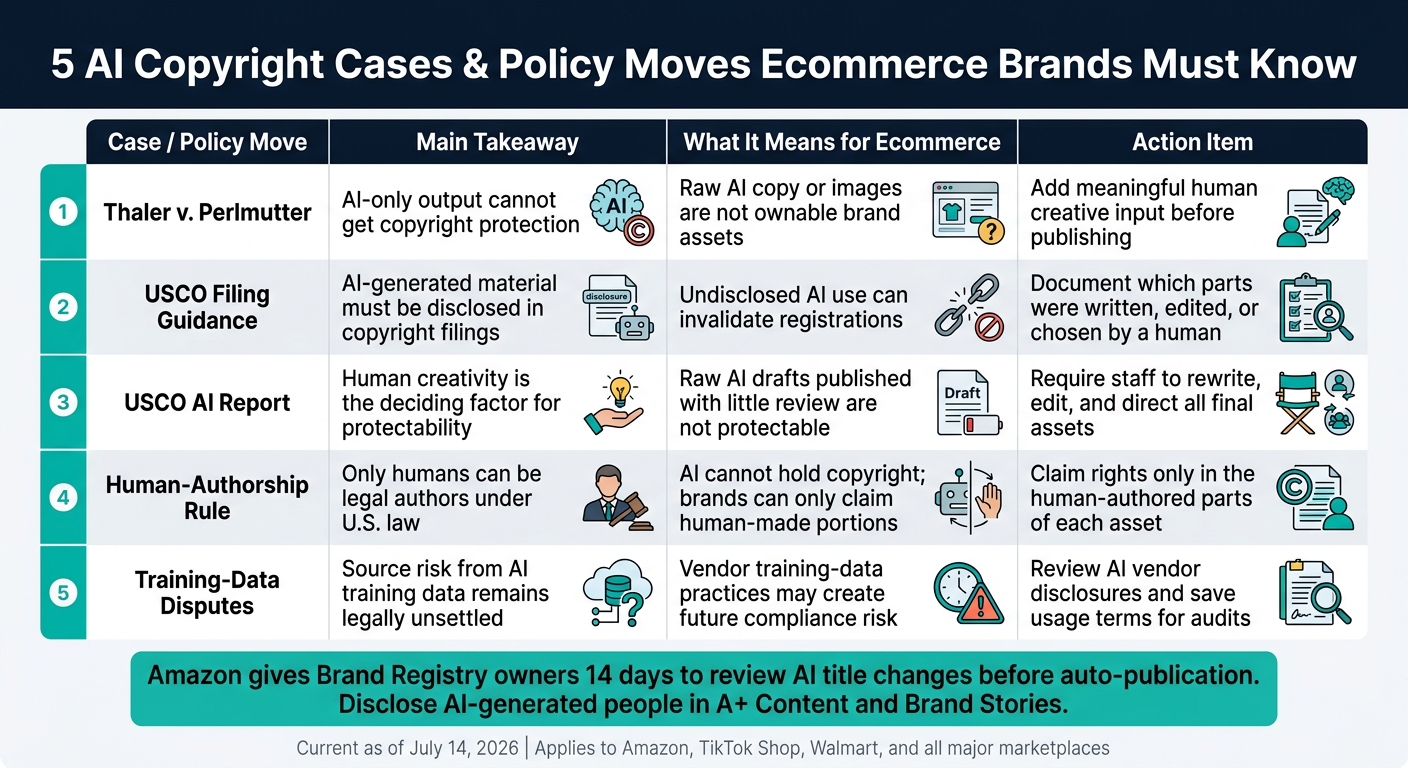
5 AI Copyright Cases Ecommerce Brands Must Know (2026)
These five moves shape what ecommerce teams can register, publish, and enforce.
Thaler v. Perlmutter: The D.C. Circuit rejected copyright for purely AI-generated work
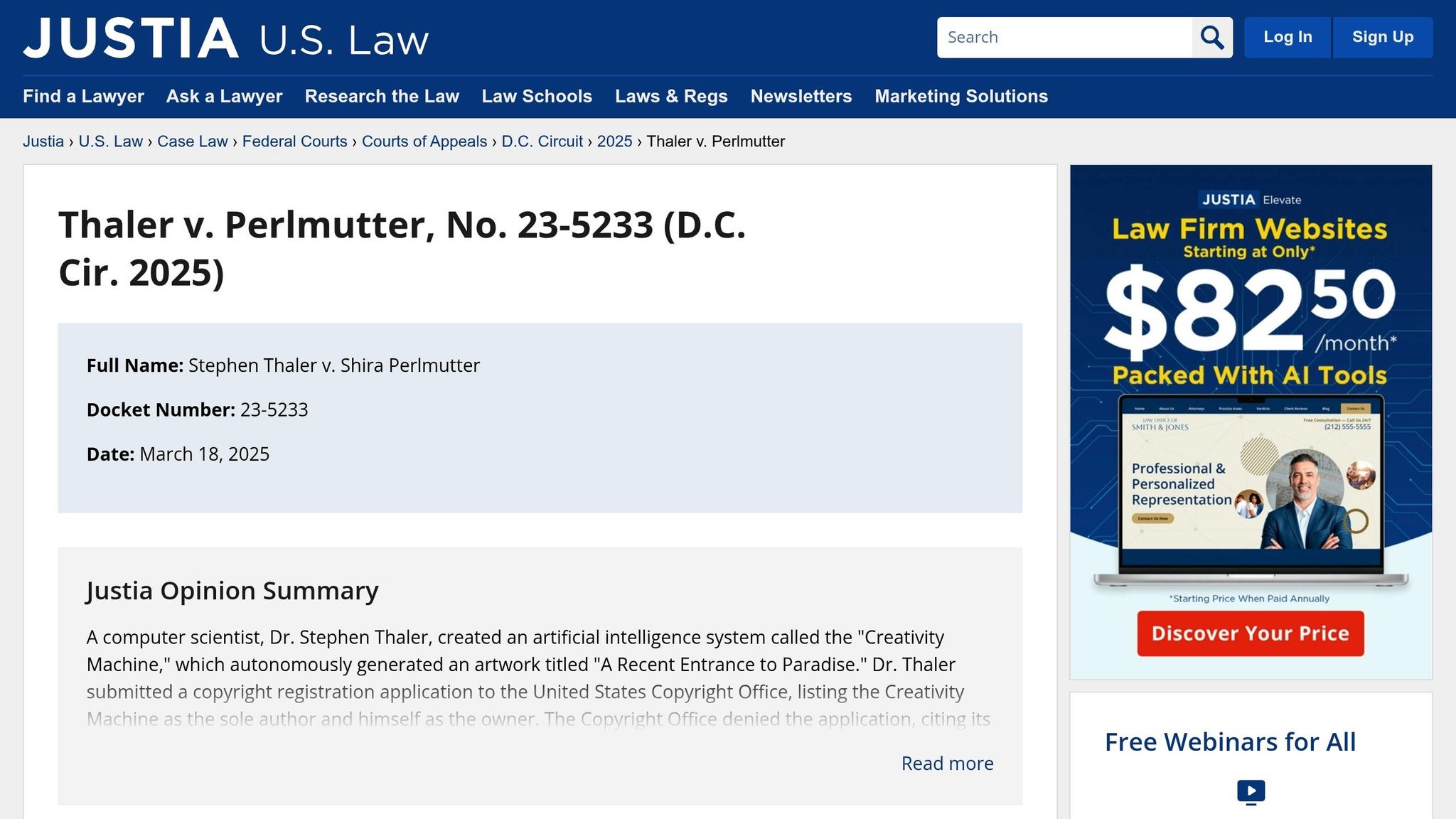
Work with no meaningful human creative input is tough to treat as a protected asset. That can include AI-made images, auto-drafted product descriptions, and A+ Content graphics that a person didn’t meaningfully edit.
The key point is simple: a person has to add meaningful creative input before copyright protection can attach. That input might be a selection, an edit, or a structural choice. For ecommerce listings, human editing is what turns an AI draft into something a brand can try to protect.
U.S. Copyright Office registration guidance: Applicants must disclose AI-generated material

Teams should document which parts of an asset were created, selected, or substantially revised by a person. If a listing image, product graphic, or storefront asset blends AI output with human work, registration and enforcement should focus only on the human-authored portions.
That makes disclosure part of two things at once:
- filing accuracy
- content approval
U.S. Copyright Office AI report: Human creativity remains the deciding factor
An AI-generated draft can still be useful. But it usually needs a writer to restructure, rewrite, and refine it. A raw AI output published with little or no meaningful review is far less likely to be protectable.
The same idea applies to images. Human-led background removal, layout choices, and compositing are not the same as publishing a fully generated scene. In plain English, content approval isn’t just a quality check. It’s also the point where protectability is either built or lost.
The more clearly teams log edits, the easier it becomes to claim rights later.
The Supreme Court left the human-authorship rule in place
The human-authorship rule still stands.
AI training disputes and the Copyright Office’s training-data report leave source risk unsettled
Even when authorship looks clear, source risk can still limit safe use. Training-data risk remains unsettled.
For brands, this means AI vendor review matters. Before relying on generated listings or visuals, teams should check vendors’ training-data disclosures and make sure AI-generated content could hold up in a future compliance audit.
What These Developments Mean for Marketplace Copy, Images, and Brand Protection
These rulings change three day-to-day workflows: drafting, image approval, and enforcement.
Copy: Treat AI drafts as inputs, not final assets
Treat AI copy as a starting point, not a final asset.
If you want a stronger ownership claim, a person needs to do more than light edits. Substantial human rewriting matters here. It also helps keep your brand voice steady, supports your keyword plan, and leaves you with a cleaner record if you ever need to show what can be protected.
The same idea applies to visuals too. Human input needs to be clear, and you should be able to show it.
Images: Document human direction, editing, and final assembly
For images, document who directed the work, who edited it, and who assembled the final version.
Amazon requires sellers to check a disclosure box when A+ Content and Brand Stories images include AI-generated people. So if you’re using AI, it’s smarter to use it for editing, enhancement, backgrounds, or layouts instead of generating the full scene from scratch. That makes the final asset look more clearly human-authored.
This paper trail should shape both the claims you file and the tools you choose.
Brand protection: Match takedown actions to what is actually protectable
Don’t use copyright takedowns for purely AI-generated copy. Without documented human authorship, that claim is weak.
A better move is to match the enforcement method to the actual issue. Use copyright claims for assets with clear human authorship. Use marketplace reporting tools for deceptive AI imagery or false product claims.
"Amazon’s not anti-AI. They’re anti-deception. There’s a big difference, and most sellers are conflating the two right now." – Tariq Hussain
What Ecommerce Teams Should Do Now
Build an AI content paper trail
Put those rules into a simple approval and record-keeping process.
Start saving records now. Keep prompts, pre-AI source files, version histories that show human edits, and designer notes that show human direction. If reviews or brand voice guides shaped the draft, save those too. For brands with large SKU counts, a structured content workflow makes this much easier.
Set approval rules for AI-assisted listings and creative
Use stricter review for higher-risk content.
Not every asset needs the same level of review. A title tweak usually carries less risk than a lifestyle image with AI-generated people. For regulated categories like health, beauty, supplements, baby, and pet products, a legal or brand lead should review AI-assisted copy and visuals before they go live. These categories carry the highest risk of implied claims or misleading visuals.
For standard product copy, keep a documented human review step before publishing. Amazon gives Brand Registry owners a 14-day window to review AI title changes before they’re automatically published.
Review registration and enforcement priorities by asset type
Use this split to match each asset to the right registration and enforcement path:
| Asset Type | Registration Priority | Best Enforcement Channel | AI Consideration |
|---|---|---|---|
| Product Photography | High | DMCA or marketplace reports | Use AI only for minor edits or backgrounds |
| Listing Copy | Medium | Marketplace reports; brand monitoring | AI drafts aren’t final protected assets |
| Lifestyle / Model Images | High | Marketplace reporting | Disclose AI-generated people and keep human-shot imagery where possible |
| A+ Content / Brand Story | Medium | Brand Registry protections | Use disclosure checkboxes for AI-generated images and photorealistic AI-generated people |
Conclusion: Use AI Faster, but Claim Rights More Carefully
These shifts all point in the same direction: human authorship still drives copyright, and AI use still brings disclosure duties and training-data risk.
Use AI for speed. That part makes sense. But before anything goes live, put a human in charge of the final review, the edits, and the call on what rights you can claim.
Document your process, disclose required AI use, and enforce only the rights you can prove.
FAQs
How much human editing is enough for copyright?
There’s no fixed rule for how much human editing is enough to secure copyright for AI-generated content.
The safer move is to keep your listing text and visuals original. Don’t copy, or even stay too close to, manufacturer pages or competitor listings. If you use AI, make sure a person shapes the ideas, sets the direction, and handles the final edit.
What records should I keep for AI-assisted content?
Keep clear records that show where your AI-assisted content came from and how you used it. If you use AI for images, say so in plain terms, and make sure those images match the product shown.
Save records such as:
- Draft versions
- Time-stamped files
- Software records
- Licenses and permissions
- Copyright registration numbers
- Proof that you were allowed to use any third-party material
If a dispute comes up or a marketplace reviews your listing, they usually want steady, verifiable proof. That can include invoices, authorization letters, and audit trails.
When should I disclose AI use in listings or images?
Disclose AI use whenever a marketplace asks for it. On Amazon, for example, you may see prompts asking whether you used AI for listing images or AI-generated people.
Even as the rules keep changing, being open about AI use helps protect customer trust and keeps you in line with platform policies. It’s better to be upfront than to hide it, since misleading content can lead to suppressed listings or account restrictions.