
Running out of stock or overstocking can cost Amazon sellers big money. AI demand forecasting changes the game by predicting sales using real-time data like social media trends, weather, and competitor pricing instead of relying solely on past sales.
Here’s why it matters:
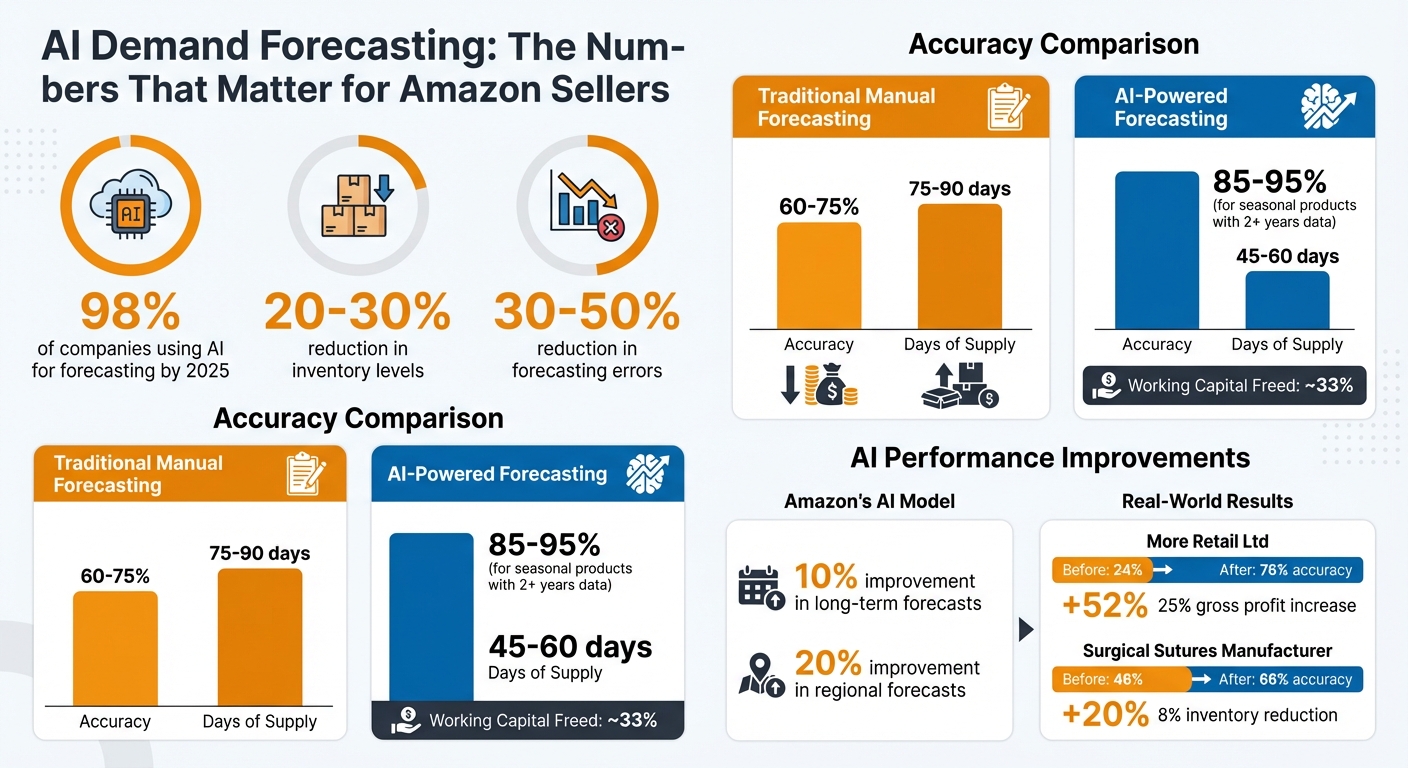
- 98% of companies using AI for forecasting by 2025 reduced inventory levels by 20–30% and errors by 30–50%.
- Stockouts hurt sales and rankings, while overstocking ties up cash and incurs storage fees.
- AI tools like Amazon Forecast and SageMaker Canvas use advanced algorithms to improve accuracy, cut inventory costs, and boost revenue.
Switching to AI doesn’t just save money – it helps sellers stay competitive in a fast-moving marketplace.
AI Demand Forecasting Impact: Key Statistics for Amazon Sellers
Common Demand Forecasting Problems for Amazon Sellers

Why Traditional Forecasting Methods Fall Short
Many Amazon sellers rely on static spreadsheets or basic moving averages that fail to account for the complexities of modern e-commerce. These methods often ignore critical factors like shifting promotional calendars, fluctuating search rankings, competitor pricing strategies, and inconsistent supplier lead times. By assuming stable demand, they miss sudden spikes or drops, leaving sellers unprepared. Typically, manual forecasting focuses on one or two variables – like recent sales history – while neglecting the broader picture that drives actual demand. For example, during a sudden surge in demand, relying on past averages can lead to costly miscalculations.
Traditional approaches also assume fixed supplier lead times and often analyze platforms in isolation, creating fragmented inventory insights. This becomes especially problematic for sellers managing stock across multiple platforms like Amazon, TikTok Shop, and Walmart. The result? Simultaneous stockouts and overstocking. On average, manual forecasting achieves only 60–75% accuracy, leaving a significant margin for error. These limitations often translate into operational headaches and missed opportunities.
The Cost of Inaccurate Forecasting
Inaccurate forecasting doesn’t just disrupt operations – it directly impacts profitability. Stockouts, for instance, don’t just result in lost sales. Amazon’s algorithm interprets them as reduced customer demand, which can tank your organic search rankings. As Lauren Stair from Helium 10 explains:
Amazon’s algorithm interprets stockouts as reduced customer demand and drops your organic ranking. Rebuilding that ranking after restocking takes weeks or months of additional advertising spend.
Each percentage point increase in your stockout rate translates to roughly 1% in lost revenue. For example, if manual forecasting leads to a 7% stockout rate compared to a 2% rate with AI-driven tools, that’s a direct 5% revenue loss.
Overstocking presents its own challenges. Excess inventory ties up cash that could otherwise fund product launches or marketing campaigns. On top of that, inventory carrying costs – like storage, insurance, and opportunity costs – can run between 20–35% of the inventory’s value. Amazon’s long-term storage fees are another burden, reaching as high as $6.90 per cubic foot for items stored over 365 days. These costs can quickly erode profit margins.
Reactive supply chain strategies also come with a hefty price. Companies relying on outdated methods can lose up to 10% of their annual revenue due to inefficiencies and missed opportunities. Traditional forecasting often requires maintaining 75–90 days of inventory, whereas more dynamic approaches can reduce this to 45–60 days. This reduction can free up approximately 33% of working capital, which can then be reinvested into growth initiatives.
sbb-itb-e2944f4
How AI Improves Demand Forecasting Accuracy
Real-Time Data and Market Responsiveness
AI has revolutionized demand forecasting by introducing demand sensing, which leverages near real-time data rather than relying solely on historical trends. This approach allows businesses to create more precise short-term forecasts, sometimes updating them daily or even hourly.
Modern AI systems can process over 200 external signals simultaneously. These signals include live point-of-sale data, weather updates, social media trends (like viral TikTok moments), Google search patterns, and economic indicators. This wealth of external data enables Amazon sellers, for instance, to adapt quickly to market shifts. It’s worth noting that 80% or more of supply chain data now comes from external sources like suppliers and third parties. As highlighted by the Kearney Supply Chain Institute and AWS:
Even the highest-quality internal data is, by itself, no longer sufficient for extrapolating the future.
This integration of external data has led to a 10–20% improvement in forecast accuracy, which can result in a 5–10% reduction in inventory and up to a 2% increase in revenue. Amazon’s AI forecasting model exemplifies this impact, achieving a 10% improvement in long-term national forecasts for deal events and a 20% improvement in regional forecasts for high-demand items. For seasonal products with at least two years of clean historical data, AI can achieve 85–95% accuracy, far exceeding the 60–75% range typical of manual methods.
Another key advantage of AI is probabilistic forecasting, which provides predictions at different confidence levels (e.g., P70, P80, P90). For example, choosing a P90 forecast means there’s a 90% chance that demand will not exceed the predicted level. This approach helps businesses minimize stockouts for critical items while managing storage costs effectively. By continuously refining forecasts with real-time insights, AI offers businesses a dynamic tool to navigate demand fluctuations.
Machine Learning and Model Improvement Over Time
AI models don’t just generate forecasts – they continuously learn and adapt to changing market conditions. Advanced algorithms like DeepAR+ (based on Recurrent Neural Networks) and CNN-QR (Convolutional Neural Network – Quantile Regression) excel at identifying complex, non-linear patterns in time-series data that traditional methods like ARIMA often miss. These systems can detect shifts in consumer behavior and market trends, automatically triggering retraining when performance drops.
AI platforms also use ensemble modeling, which combines the strengths of multiple algorithms (like ARIMA, Prophet, and DeepAR+) into a single, optimized forecast. They streamline feature engineering, automatically extracting critical signals – like holiday effects, weather patterns, and social media activity – without requiring manual input. With each cycle, the models adjust predictions based on actual outcomes, becoming smarter and more accurate over time.
The results speak for themselves. For example, More Retail Ltd. (MRL), a leading Indian grocery retailer, used Amazon Forecast to predict demand for fresh produce across 600+ stores. Their forecasting accuracy jumped from 24% to 76%, reducing waste by 30%, improving in-stock rates from 80% to 90%, and boosting gross profit by 25%. Similarly, a surgical sutures manufacturer using Amazon Forecast’s DeepAR+ algorithm for over 1,000 SKUs increased accuracy from 46% to 66% (a 20% improvement), reduced inventory by 8%, and maintained a 95% fulfillment rate.
These examples highlight how AI transforms forecasting into a strategic advantage, enabling businesses to reduce waste, improve inventory management, and enhance profitability.
AI Tools for Amazon Demand Forecasting
Amazon Forecast: Features and Capabilities
Amazon Forecast uses the same advanced technology that powers Amazon’s own demand planning. The platform’s Automated Machine Learning (AutoML) approach selects the best algorithm – or even combines multiple algorithms – tailored to your data, eliminating the need for prior machine learning expertise. This method can boost forecasting accuracy by up to 40% and cut production time by as much as 50%.
One standout feature is its probabilistic forecasting, which provides predictions at various confidence levels (e.g., 10%, 50%, 90%). This helps reduce risks like overstocking or lost sales. For example, you might rely on a 90th percentile forecast for high-demand promotional items to ensure availability, while using a lower percentile for items that are costly to store, such as bulky accessories. By combining time-series data with additional factors like pricing, promotions, and even weather, Amazon Forecast can be up to 50% more accurate than traditional, non-machine learning tools.
However, as of July 29, 2024, Amazon Forecast is no longer available to new users. While existing customers can still use the service, AWS now recommends Amazon SageMaker Canvas as an alternative for those needing similar capabilities. This shift has opened the door for other tools to address the forecasting needs of new sellers.
SageMaker Canvas for No-Code Forecasting
With Amazon Forecast no longer an option for new users, SageMaker Canvas steps in as a user-friendly, no-code solution. Designed for business analysts, it features a visual, point-and-click interface that allows users to create forecasting models without writing a single line of code. The platform tests and trains six different algorithms to find the most accurate model for your data.
SageMaker Canvas delivers up to 50% faster model building and 45% quicker predictions compared to Amazon Forecast. For instance, training time for 750 time series (up to 100 MB) dropped from 186 minutes to just 73 minutes. Its "Quick build" feature can generate models and explainability scores in under 20 minutes for datasets with fewer than 50,000 rows.
Unlike Amazon Forecast, which required three separate datasets, SageMaker Canvas simplifies the process by needing just one dataset containing a timestamp, target value (like sales), and item ID. It also includes a "Chat for data prep" feature, where you can use natural language prompts like "remove the $ sign from my data" to modify datasets. Additionally, the what-if analysis tool lets you explore scenarios – such as the impact of a 50% price discount – on future demand without having to retrain your model. This streamlined approach makes it easier for Amazon sellers to gain quick, actionable insights from their data.
Time Series Analysis with Amazon Forecast [FULL Workshop!]
Common Challenges When Implementing AI Forecasting
Overcoming technical and organizational obstacles is essential to fully benefit from AI forecasting.
Data Quality and System Integration
AI forecasting tools rely heavily on the quality of the data provided. As AWS puts it, "ML models are only as good as the data put into them, and it’s important to understand what the model needs". Amazon sellers often encounter data issues that can undermine even advanced AI models.
One major challenge is sparse and intermittent data. For instance, slow-moving products or new SKUs often lack enough data for clear pattern detection. A practical solution is to aggregate data into weekly or monthly intervals, which creates denser trends that are easier for AI to analyze.
Another common issue is ambiguous zero values. A zero in sales could mean no demand, a stockout, or simply missing data. Treating all zeros uniformly can skew the model, leading to underestimated demand. To fix this, replace zeros with null values in your dataset. This allows AI tools to apply logic that distinguishes between discontinued products and temporary stockouts.
The "cold start" problem is another hurdle, particularly for new product launches where historical sales data is unavailable. A useful workaround is to include metadata like color, size, and category. This helps the AI predict demand by comparing new items with similar ones. For sellers managing inventory across multiple regions or warehouses, creating a concatenated item_id – combining the product ID with a location ID – enables the AI to forecast demand separately for each location.
In addition to data quality, system integration can be a significant roadblock. Connecting Amazon Seller Central, inventory systems, and AI tools through robust, continuously updated data pipelines is crucial. As an AWS whitepaper explains, "The pipeline is expected to work seamlessly with the AI/ML models hosted in the consumption layer". Companies that have successfully implemented these techniques report a 10% to 20% improvement in forecasting accuracy, which translates to a 5% reduction in inventory costs.
Once data and system issues are resolved, the next challenge lies in preparing your team to work with these tools effectively.
Organizational Readiness and Human Review
The technical setup alone won’t ensure success – your team’s ability to interpret and act on AI insights is just as critical. A common issue arises when business and ML teams misunderstand AI outputs, which can delay decision-making. To avoid this, your operations team must be trained to understand the AI’s recommendations and integrate them into existing workflows.
Securing leadership support often requires demonstrating the tangible benefits of AI forecasting. For example, businesses leveraging AI-driven demand insights have achieved revenue increases of 2% to 3%. However, AI forecasting isn’t a "set it and forget it" tool. Continuous monitoring through MLOps is essential to adapt predictions as market conditions shift.
Human oversight remains indispensable. Before training an AI model, visualize your data at different granular levels and conduct backtesting across multiple timeframes to validate predictions. During critical periods like product launches or promotions, review forecasts to combine AI-driven insights with business expertise. The ultimate goal is to enhance decision-making by blending AI predictions with human judgment, not replacing it entirely.
Building a Reliable Demand Forecasting Strategy
Once you’ve established the technical foundation and ensured high-quality data, the next step is turning AI-driven insights into actionable inventory strategies. This means weaving AI forecasts into your daily decision-making process, balancing the precision of algorithms with the nuanced judgment of human expertise.
Using AI Predictions with Business Judgment
A practical approach is adopting a human-in-the-loop framework, where AI handles routine forecasting tasks while experts focus on strategic exceptions. As Relex Solutions explains, "Human expertise remains essential despite AI automation, especially when historical data is limited or market conditions shift unexpectedly".
To strike the right balance, adjust how much you rely on AI based on your product’s lifecycle. Let AI manage forecasts for stable items while reserving human judgment for new or seasonal products. External factors like port closures or regulatory changes – often missing from historical data – may still require manual overrides.
To measure the effectiveness of your approach, use Forecast Value-Added (FVA). This metric helps determine whether steps like manual adjustments or external data inputs improve the baseline AI forecast. Additionally, keep an eye on Days of Supply (DOS) to gauge inventory health. For instance:
- A DOS under 30 days paired with rising stockouts signals an overly aggressive AI model.
- A DOS over 90 days suggests excess capital tied up in inventory.
Aim for a DOS range of 45–75 days to keep inventory levels efficient without risking shortages. These adjustments allow AI-driven predictions to seamlessly integrate into your broader inventory management practices.
Inventory Management Best Practices
AI forecasting becomes even more effective when paired with a solid inventory strategy. Start by setting category-specific service level targets:
- 95–98% in-stock rates for your bestsellers.
- 90–95% for steady sellers.
- 85–90% for slower-moving products.
This approach balances profitability with availability, preventing overinvestment across all SKUs.
AI can also calculate dynamic safety stock levels, adjusting for changes in supplier lead times and demand variability. For sellers juggling inventory across platforms like Amazon, TikTok Shop, and Walmart, Multi-Channel Fulfillment (MCF) offers a smart solution. By pooling inventory into a single system rather than splitting it into silos, you can boost inventory turnover from 4–6 times a year to 6–9 times, speeding up capital flow by 50%.
To tie forecasting accuracy and human input to measurable results, monitor these key performance indicators (KPIs):
| KPI | Purpose | Target Range |
|---|---|---|
| MAPE (Mean Absolute Percentage Error) | Measures baseline forecast accuracy | 10–20% (lower is better) |
| FVA (Forecast Value-Added) | Evaluates human vs. AI contributions | Positive improvement over baseline |
| DOS (Days of Supply) | Tracks capital efficiency | 45–75 days |
| Stockout Rate | Reflects customer satisfaction | 2–3% for AI-optimized systems |
Consider implementing AI co-pilots that recommend reorder quantities for human review. This keeps the decision-making process grounded in business context while still leveraging AI’s ability to spot patterns. With overstocking and stockouts costing the retail sector about $1.1 trillion annually, a well-executed AI strategy can help you avoid these pitfalls and seize opportunities for growth.
Conclusion
By 2026, leveraging AI-powered demand forecasting won’t just be an option for Amazon sellers – it’ll be a financial game-changer. With U.S. retailers projected to spend $113 billion on technology budgets in that year, and nearly 46% of it going toward AI-enabled forecasting software, the message is clear: sellers who fail to adapt risk falling behind.
AI-driven forecasting systems offer tangible benefits. They can slash inventory holdings by up to 30%, reduce forecasting errors by as much as 50%, and significantly cut logistics costs. On top of that, 25% of companies already report that AI use cases like demand planning contribute over 5% to their EBIT. This isn’t just about small tweaks – it’s about freeing up capital locked in excess inventory and channeling it into growth opportunities.
Switching from static, reactive forecasts to dynamic, real-time demand sensing gives sellers a distinct advantage. AI models that incorporate real-time data – everything from viral TikTok trends to local weather conditions – help ensure the right products are stocked in the right fulfillment centers before competitors can react. As Stormy AI Blog explains:
Forecasting at the zip-code level is the difference between having the right product in the right place and paying $15 in shipping to move a $20 item.
These advancements are only the beginning of how AI is reshaping operational accuracy and business growth.
To put these insights into action, start with a 90-day pilot in a high-volatility product category. Use key metrics like MAPE (Mean Absolute Percentage Error) and FVA (Forecast Value Added) to measure success, and expand from there. Break down data silos, introduce a human-in-the-loop system for strategic oversight, and retrain your models quarterly to maintain their effectiveness. By combining AI insights with strategic decision-making, Amazon sellers can streamline inventory management and unlock sustainable growth opportunities.
FAQs
What data do I need to start AI forecasting?
To begin using AI for demand forecasting, start by collecting critical data that represents your business operations and the market environment. Key data points include historical sales records, inventory levels, and sales trends, which help AI evaluate past performance. Supplement this with insights such as product performance, customer behavior, and market trends to refine the accuracy of the forecasts. By taking this well-rounded approach, AI can generate detailed and adaptable demand predictions suited to your specific requirements.
How do I forecast demand for a new SKU with no history?
To predict demand for a new SKU without any historical data, AI-driven models tailored for cold start scenarios can be incredibly useful. Tools like neural networks excel at analyzing factors such as market trends, product lifecycle stages, and external data, offering a deeper understanding of potential demand. By pairing these insights with customized AI solutions, businesses can minimize prediction errors and achieve dependable demand forecasts – even for products with no sales history to rely on.
How often should I retrain my forecasting model?
Retraining your demand forecasting model on a regular schedule – whether monthly or quarterly – helps it stay in sync with shifting market trends and updated data. This practice keeps your predictions accurate and relevant to the latest patterns.