

AI transforms how businesses manage inventory and pricing, helping them work together instead of separately. This approach prevents costly mistakes like stockouts during promotions or overstock requiring heavy discounts. Retailers using AI report up to 5% revenue growth and 20% cost savings by dynamically adjusting prices based on demand and inventory levels. Key takeaways include:
- Dynamic Pricing: AI raises prices for high-demand, low-stock items and discounts overstocked products to avoid waste.
- Data-Driven Goals: Businesses can optimize metrics like net margin per warehouse space or cash flow, aligning pricing with inventory strategies.
- Improved Forecasting: AI achieves 80–90% accuracy in demand prediction, reducing errors and cutting safety stock needs by up to 30%.
- Controlled Implementation: Phased rollouts, human oversight, and safeguards like price floors and ceilings ensure stability.
For example, Target reduced out-of-stock incidents by 40%, while Walmart saved over $1 billion in a year using AI systems. By integrating pricing and inventory management, businesses achieve better profitability and efficiency.
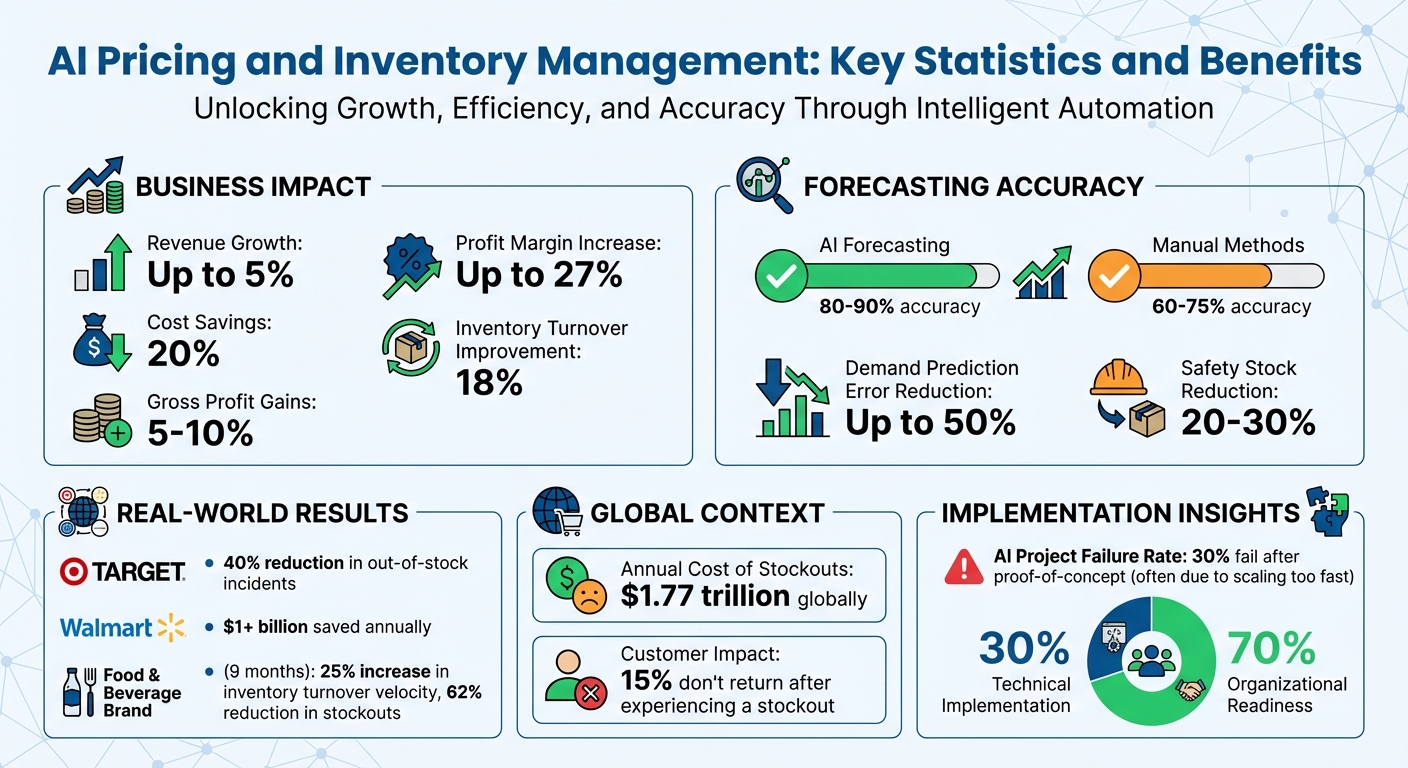
AI Pricing and Inventory Management: Key Statistics and Benefits
Set Goals and Metrics for AI Pricing
Define Your Business Objectives
Before rolling out an AI pricing system, it’s crucial to establish clear goals. Many traditional retailers focus solely on revenue, but this can backfire if inventory piles up or sells out too quickly. AI systems work best when they’re guided by objectives that strike a balance between pricing strategies and inventory management.
For example, rather than chasing pure revenue, you could aim to optimize net margin contribution per cubic foot of warehouse space. This ensures the AI prioritizes profitability while keeping storage efficient. If liquidity is a concern, you might shift focus to cash flow instead of gross margin.
Your long-term strategy should shape the AI’s decisions. If fostering customer loyalty matters more than short-term profits, you can implement rules to avoid price gouging during high-demand periods. Similarly, tailor your objectives to product performance: fast-moving items might need frequent, small price tweaks to protect margins, while slow-moving inventory might benefit from liquidation-focused strategies.
Choose the Right KPIs
Tracking the right metrics is essential to measure how well your AI aligns pricing with inventory goals. For inventory management, monitor metrics like:
- Sell-through percentage: How quickly products are selling.
- Weeks of supply and days of supply: Indicators of inventory health.
- Aged inventory levels: To spot overstock or items at risk of write-offs.
- Stockout rates: To ensure pricing doesn’t overly suppress demand.
On the pricing side, focus on indicators such as:
- Gross margin percentage: To understand profitability.
- Markdown percentage by category: To track discounting trends.
- Price realization: The gap between planned prices and what customers actually pay.
AI forecasting can achieve 80–90% accuracy, significantly outperforming manual methods, which typically range from 60–75%. To measure forecast accuracy over time, use the Mean Absolute Percentage Error (MAPE). Break down these KPIs by sales channel, store location, and customer type to reveal actionable insights.
Set Pricing Boundaries
AI pricing systems need guardrails to protect your brand and profitability. Start by setting absolute price floors – these should factor in costs like goods sold, shipping, and marketplace fees, while ensuring a minimum margin of 15% to avoid losses. On the flip side, define price ceilings to prevent excessive pricing. This is especially important to avoid issues like competing algorithms inflating prices or spikes during demand surges.
To prevent errors, incorporate circuit breakers. For instance, halt price changes if a product’s price fluctuates more than 20% within 24 hours. During the first 30–60 days of implementation, require human approval for any price changes exceeding 10%. Additionally, limit daily price adjustments to around 15% to maintain stability and avoid appearing predatory.
Once you’ve set these goals, KPIs, and boundaries, the next step is to build a strong data and technology framework to support your AI pricing system effectively.
sbb-itb-e2944f4
Build Your Data and Technology Foundation
Identify Required Data Inputs
To power AI pricing models effectively, you need both internal and external data. Internal data includes key metrics like historical SKU sales data broken down by day and channel, real-time inventory levels (on-hand and incoming), product pricing and discount history, promotional calendars, and customer acquisition and retention rates. On the external side, you’ll need inputs such as real-time competitor prices and stock status, market demand signals (e.g., Google Trends or category search volume), seasonal patterns, economic indicators, and even weather data for products sensitive to temperature changes.
For the best results, aim for at least 12 months of clean sales and inventory data, though 18 months is ideal for capturing trends like seasonality and price elasticity. Be vigilant about identifying anomalies – things like system migrations, viral social media boosts, or supply chain disruptions can skew the data. Also, ensure SKUs are unique and consistently structured, especially for products with variants. Clean, accurate data is a game-changer: AI forecasting can achieve 80–90% accuracy, compared to the 60–75% accuracy of manual methods. Considering that global stockouts cost retailers a staggering $1.77 trillion annually, and 15% of customers don’t return after experiencing a stockout, the stakes for accurate forecasting couldn’t be higher.
Once your data is ready, the next step is ensuring seamless integration through reliable connectivity.
Connect Your Data Systems
Direct API connections (like those available for Shopify or BigCommerce) are essential for avoiding manual errors and ensuring real-time data synchronization. If you’re managing thousands of SKUs, consider using GraphQL APIs or batching requests to avoid platform rate limits. For instance, Shopify allows just 2 requests per second. Additionally, implementing scrapers that send Slack alerts when data drops can help prevent stale or incorrect competitor data from compromising your model.
To streamline operations, unify data from systems like POS, warehouses, and suppliers into a centralized database after cleaning and transforming the inputs. This approach can deliver impressive results. For example, in 2022, a major food and beverage brand integrated pricing intelligence with its inventory system, leading to a 25% increase in inventory turnover velocity and a 62% reduction in stockouts in just nine months.
With a unified and reliable data pipeline in place, the next decision is whether to build a custom system or use a SaaS solution.
Select Your AI Deployment Method
When choosing how to deploy AI, you have two main options: custom systems or SaaS tools. Custom systems give you full control over the code and allow for tailored integration, but they come with higher upfront costs and require 10–16 weeks to build. On the other hand, SaaS tools like Prediko, Inventory Planner, or Flieber are quicker to deploy and have lower initial fees, though they offer less flexibility for customization.
"The pricing logic is yours to own and modify, not a black box controlled by a vendor." – Parker Gawne, Founder, Syntora
Whichever route you take, it’s critical to test your AI pricing model in a dry-run mode for at least a week. This allows you to compare the system’s suggested prices with human judgment before fully implementing it. This trial phase ensures the AI’s decisions align with your goals without jeopardizing your margins or customer trust.
AI Dynamic Pricing Software Explained: The New Necessity for Retail Success
Apply AI to Your Pricing Strategy
When your data foundation is ready, AI can take over to dynamically adjust prices, moving beyond the limitations of manual updates. This allows for smarter pricing decisions, incorporating factors like demand, inventory, and sales channels.
Use Demand-Based Pricing
AI excels at analyzing multiple factors – such as competitor prices, inventory levels, page views, conversion rates, and even external elements like weather or holidays – all at once to fine-tune pricing. Unlike static pricing rules, AI predicts how different price points affect demand, helping you meet goals like increasing margins or boosting sales volume. For example, if page views for a product spike and inventory is plentiful, AI might raise the price to take advantage of the increased interest. Retailers using AI-driven pricing have reported gross profit gains of 5% to 10% while also growing revenue sustainably. During pilot programs, revenue lifts of 3% to 7% in test markets are common. To refine these predictions, integrate customer transaction and loyalty data into the system.
Adjust Prices Based on Inventory Levels
AI can also help you align prices with inventory conditions. Overstocked items? AI can apply discounts to speed up sales. Low stock? It’ll keep prices higher to protect your margins. For instance, if inventory drops below a 14-day supply, raising prices by 5–8% can safeguard profits. On the flip side, products sitting in inventory for over 90 days might see gradual discounts – around 8% – to clear out older stock and reduce holding costs. Advanced systems can reprice thousands of SKUs in under two minutes, enabling updates every 15 minutes. To avoid losses during competitive pricing battles, set a minimum price threshold, such as cost plus a 20% margin.
Customize Pricing by Sales Channel
AI can also adapt pricing strategies to specific sales channels by pulling in real-time data from platforms like Amazon, Walmart, TikTok Shops, and Target. For example, on Amazon, AI ensures your pricing stays within the acceptable range to maintain Buy Box eligibility. On TikTok Shops, where viral trends can drive sudden demand spikes, AI predicts traffic surges and adjusts prices accordingly. Different channels may call for different pricing strategies: competitor-based pricing works well for commoditized goods, while value-based pricing helps preserve the appeal of private-label products. AI also ensures consistent pricing across platforms, which is critical for search algorithms that depend on stable price signals. To maintain this consistency, you can implement stability windows, keeping prices steady for 24 hours to 7 days.
"With AI-powered solutions, retailers can respond dynamically to both internal and external changes, while maintaining alignment with a clear, customer-centric pricing strategy." – BCG
Roll Out AI in Phases
Introducing AI pricing across your entire catalog all at once can be a gamble. A phased rollout lets you experiment, learn, and refine before committing fully. Start small, track results closely, and expand only when you’re confident the system is delivering consistent outcomes. The key is to divide the deployment into manageable stages that allow for careful monitoring and adjustments.
Test with Pilot Programs
Kick off by running the AI in shadow mode for 2–4 weeks. During this phase, the AI generates pricing suggestions without actually implementing them. This lets you compare its recommendations with your current manual pricing to identify potential issues. Once you’re confident in the system’s performance, extend the rollout to cover 10–20% of your catalog, a specific region, or a single sales channel.
Set clear objectives for this phase. For instance, aim for a 4% increase in category gross margin within three months. Use A/B testing to measure the AI’s impact by comparing results between a group using AI pricing and another group sticking with manual pricing. For inspiration, refer to examples in the Introduction showcasing retailers who’ve successfully adopted AI-driven pricing and inventory strategies. Keep in mind, though, that 30% of AI pricing projects fail after the proof-of-concept stage – often because companies scale too fast without enough testing.
Once the initial testing phase confirms the AI’s effectiveness, incorporate human oversight for high-stakes decisions.
Maintain Human Review Processes
AI shouldn’t be left to handle every pricing decision on its own. Introduce a tiered system where minor price adjustments happen automatically, but high-risk changes – like those exceeding 20% – are flagged for human review. Build safeguards into the system, such as price floors (based on the cost of goods sold plus a minimum 15% margin) and ceilings, to prevent runaway pricing.
A cautionary tale: In 2011, two competing algorithms on Amazon caused the price of a biology textbook to skyrocket to $23,698,655.93. One algorithm priced at 0.9983× the competitor, while the other set prices at 1.2705×, creating a feedback loop.
To add another layer of oversight, establish a "Red Team" or "Why Committee" that meets monthly to evaluate the AI’s most unusual suggestions. These groups ensure the pricing aligns with your brand’s strategy. Additionally, set up alerts to detect anomalies, such as price changes over 20% within 24 hours, so you can act quickly if something goes wrong.
Track Performance and Make Adjustments
Keep a close eye on financial, operational, and market metrics, as well as customer sentiment, to fine-tune your AI pricing system. Studies show that AI-powered pricing can boost profit margins by up to 27% and improve inventory turnover by 18%. However, don’t overlook qualitative feedback – customer service interactions and social media chatter can reveal potential damage to your brand’s reputation before it becomes evident in sales data.
Transparency is critical. With 68% of consumers believing dynamic pricing is "secretly exploitative", it’s essential to communicate clearly about your pricing strategies. Schedule regular reviews to compare AI-driven changes against your margin goals and inventory levels. Use these insights to refine the algorithm. As your confidence in the system grows, gradually expand its scope to new categories and automate model retraining, all while maintaining a steady governance process.
Link AI Pricing to Your Ecommerce Operations
AI works best when it’s fully integrated into key areas like inventory management, marketing, and multi-channel operations. By treating pricing and inventory as interconnected strategies, you can avoid waste, missed sales, and unnecessary stress on your operations.
Coordinate AI Pricing with Inventory Planning
AI demand forecasting can transform how you handle purchasing and restocking. Instead of sticking to fixed numbers, you can model demand as a function of price. For example, AI might predict selling 1,300 units at $20, but only 600 units at $30. This way, you can plan both inventory and pricing together, ensuring you have the right stock at the right price.
Dynamic pricing adjustments can also help you manage inventory in real time. If stock levels drop too low, AI can suggest price increases to slow demand, giving you time to restock. On the flip side, if you’re sitting on more than 90 days’ worth of supply, AI can recommend small discounts to move products faster. This approach reduces the risk of both overstocking and stockouts.
Here’s a real-world example: In July 2025, a food and beverage brand used 42Signals pricing intelligence to link pricing with inventory. When the system noticed 500 units of seasonal pumpkin string lights weren’t selling quickly, it triggered a 12% discount early. Over nine months, the brand saw a 25% boost in inventory turnover and cut stockout events by 62%.
AI forecasting also delivers impressive accuracy – typically between 80% and 90%, compared to the 60%–75% range of manual spreadsheet methods. This level of precision allows businesses to cut safety stock levels by 20%–30%, freeing up cash while still keeping shelves stocked. When pricing and inventory are integrated this way, operations run more smoothly, driving both revenue and efficiency.
Align Promotions with Inventory Availability
Promotional campaigns are most effective when they align with current stock levels and restocking schedules. AI can adjust ad spending and paid-search bids in real time, ensuring your promotional efforts focus only on products with sufficient inventory.
Before launching a big campaign, AI can run "what-if" simulations to help you prepare for potential challenges. For instance, it can model scenarios like a 20% spike in demand or longer supplier lead times. By tagging past promotions in your sales data, AI can also analyze their impact – such as a 30% discount leading to a 4× demand increase – and use that data to predict future outcomes. During the promotion, AI continuously updates stock level targets for each location, helping you maintain availability while avoiding excess inventory once the campaign ends.
This level of precision requires expertise, making it essential to collaborate with ecommerce professionals who can execute these strategies effectively.
Work with Ecommerce Specialists
Managing AI-driven pricing across platforms like Amazon, TikTok Shop, Walmart, and Target demands deep expertise.
Emplicit offers end-to-end ecommerce services, integrating AI pricing with inventory planning to maximize profitability across all sales channels. Their USA-based teams help brands synchronize pricing, inventory, and promotional strategies, ensuring stockouts are avoided while profits are optimized. With their tailored approach, they can help you navigate platform-specific challenges and keep your operations running smoothly.
Conclusion
AI-powered pricing strategies offer businesses a way to balance inventory control with cash flow optimization while cutting down on waste. By adjusting prices to manage demand – whether it’s slowing sales of low-stock items or using discounts to clear out overstock – companies can achieve better inventory control and reduce waste effectively. When pricing strategies align with inventory management, businesses often see noticeable profit increases.
AI forecasting plays a key role by cutting demand prediction errors by up to 50%. This accuracy reduces the need for excessive safety stock, freeing up working capital for other priorities. However, these benefits require careful preparation, including thorough data cleaning and phased implementation.
The success of AI-driven pricing depends heavily on data quality and a structured rollout plan. Experts recommend spending 2–3 months standardizing historical data before training AI models. According to Deloitte, only 30% of AI project success comes from technical implementation – the other 70% relies on organizational readiness and effective change management.
Human oversight remains critical. Businesses should establish strict controls, such as margin floors, price ceilings, and mandatory reviews for price shifts exceeding 10%. As Jonas Eifrém Strinnholm of Priceagent puts it:
"Strategy is not optimization. AI can optimize towards a goal, but it can’t set the goal".
Quarterly audits are also essential to refine pricing rules and adapt to changing market dynamics.
FAQs
What data do I need before using AI pricing?
Before diving into AI-driven pricing, it’s essential to collect and analyze critical data points. Start with sales history, competitor pricing, inventory levels, demand signals, and market trends. Additionally, take a closer look at customer behavior, supply chain specifics, and external factors influencing the market. Having this well-rounded dataset allows AI systems to forecast demand, adapt to shifts in the market, and fine-tune pricing strategies with precision.
How do I prevent AI from making extreme price changes?
To maintain stability and avoid sudden price spikes or drops, implement price caps to set clear maximum and minimum limits. Leverage explainable models to keep an eye on pricing decisions and ensure they’re logical and transparent. It’s also essential to maintain audit trails to document changes and quickly spot any unusual shifts. These measures help keep AI-driven pricing fair, safeguarding both customer trust and your bottom line.
How can I test AI pricing without risking revenue?
Testing AI pricing strategies can be done effectively with price simulation tools and controlled experiments.
- Simulations allow you to explore different pricing scenarios by factoring in elements like costs and demand. They help predict how these changes might influence your revenue and profit without impacting your actual sales.
- Controlled experiments, on the other hand, adjust prices within your live catalog in real-time. By analyzing the results as they happen, you can gather actionable insights while keeping revenue risks low.
Both methods provide a practical way to refine your pricing approach using data-driven insights.