

AI is transforming how businesses predict demand, especially for cross-border operations. Traditional methods, relying on past sales and basic percentage increases, often fail in today’s volatile markets. AI-driven tools are 50% more accurate, reducing errors by 20%-50% and cutting stockouts by up to 65%. These systems analyze real-time data from over 200 sources, including weather, social media, and economic indicators, providing precise SKU-level forecasts.
Key takeaways:
- AI predicts demand at specific locations and times, improving inventory accuracy.
- Regional differences, like holidays or economic shifts, are factored in automatically.
- Real-time updates allow businesses to respond quickly to trends or disruptions.
- Companies using AI report 5%-10% lower inventory levels and up to 2% revenue growth.
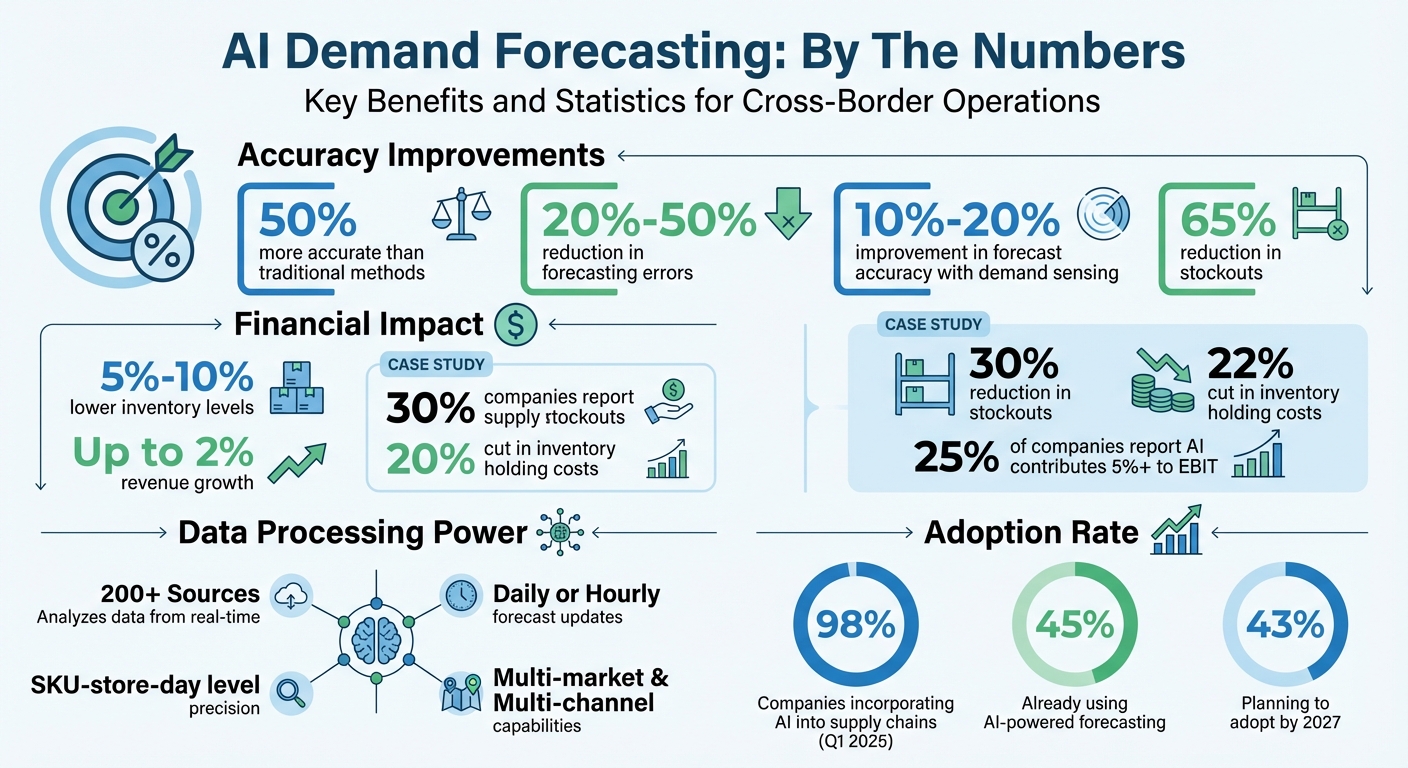
AI Demand Forecasting Benefits: Key Statistics and ROI Metrics
eClerx Talks: Predict What’s Next – Using AI to Forecast eCommerce Trends

How AI Improves Cross-Border Demand Forecasting
AI takes demand forecasting to a whole new level by analyzing massive datasets from diverse sources all at once. It doesn’t just rely on last year’s sales or simple percentage increases. Instead, it pulls in live weather updates, social media trends from platforms like TikTok and Instagram, macroeconomic data like the Consumer Price Index, and even competitor pricing strategies. This creates a comprehensive view of what’s influencing demand in each market.
Traditional forecasting methods often work at a broader level, like predicting demand for a category such as "women’s shoes", and only update forecasts monthly. AI, on the other hand, operates with much finer precision. It predicts demand down to the SKU-store-day level, meaning it can calculate exactly how much of a specific product is needed at a particular store on a given day.
What’s more, AI is constantly learning. As new data becomes available, the models automatically update themselves. This means they can quickly adjust when unexpected events – like viral social media trends or shipping delays – disrupt the market.
How AI Accounts for Regional Market Differences
Selling across borders means dealing with vastly different consumer preferences. A product that’s a hit in Texas might barely sell in Tokyo. AI handles these regional differences by factoring in location-specific variables. Advanced systems like Amazon‘s RSight use specialized tools to analyze demand variations down to granular levels, such as U.S. ZIP codes, ensuring forecasts reflect local nuances.
AI also incorporates details like local holidays, buying habits, and economic conditions. For example, it can tailor forecasts for Diwali in India, Golden Week in Japan, or Black Friday in the U.S. Tools like the AWS Weather Index even integrate real-time weather data to predict daily shifts in consumer behavior. If a heatwave hits Southern California, the system might increase forecasts for summer clothing and outdoor gear in that region. Amazon’s RSight model has also shown that as it processes more cross-regional data, its forecasting accuracy improves significantly.
By understanding these fine-tuned regional details, businesses can respond to market needs with speed and precision.
Real-Time Updates for Market Changes
Markets don’t operate on a fixed schedule, and neither does AI. Factors like currency shifts, new tariffs, or geopolitical events can change demand almost instantly. AI’s demand sensing capabilities use near-real-time data to create short-term forecasts, sometimes updating daily or even hourly.
When sudden events occur – be it a viral social media trend, a storm-related sales spike, or a regulatory update – AI systems cross-check internal data with external signals to determine whether the changes are temporary or long-term. This allows businesses to quickly adjust their inventory and pricing strategies.
The financial impact is hard to ignore. Companies using AI demand sensing have seen a 10%–20% improvement in forecast accuracy, a 5%–10% reduction in inventory levels, and even up to a 2% boost in revenue.
Key Features to Look for in AI Demand Forecasting Tools
Managing cross-border operations comes with its own set of challenges, especially when it comes to inventory management. To navigate these complexities, you need an AI forecasting tool that can handle multiple countries and marketplaces without requiring you to cobble together data from various sources.
With industry adoption growing, it’s clear that certain features are essential. These features are the foundation of effective AI demand forecasting for businesses operating across borders.
Multi-Market and Real-Time Forecasting Capabilities
Demand patterns can vary widely between platforms. For example, Amazon’s sales trends may look completely different from those on TikTok Shops or your own eCommerce site. This is where multi-market capabilities become crucial – they allow the tool to understand and adapt to the unique behaviors of each sales channel.
Real-time updates are another must-have. Unlike older models that rely on static data, modern AI systems continuously adjust forecasts as new information comes in, often overnight. These tools also pull in external data, like market trends or seasonal factors, to fine-tune predictions.
The best tools go beyond single-point predictions. They offer probabilistic forecasts, presenting scenarios like, "There’s a 10% chance you’ll sell 450 units, a 50% chance you’ll sell 500, and a 90% chance you’ll sell 550." This approach helps you strike the right balance – avoiding the pitfalls of over-forecasting (which ties up capital) and under-forecasting (which risks stockouts and lost sales). Integration with eCommerce platforms ensures these insights are immediately actionable.
Integration with eCommerce Platforms
For effective inventory management, seamless integration is more than a convenience – it’s a necessity. The right forecasting tool should connect directly with the platforms where you operate, such as Shopify, BigCommerce, Amazon, Walmart, and TikTok Shops. It should also sync with systems like ERP or WMS to create a unified view of your inventory and sales data.
This level of integration ensures automatic updates across all channels. For instance, when a sale is made or a return is processed, inventory data adjusts in real time, keeping everything accurate and aligned.
SKU-Level Demand Forecasting
Forecasting at the category level – like estimating demand for "women’s shoes" as a whole – just doesn’t cut it for cross-border operations. What you need are SKU-Store-Day level forecasts, which predict exactly how many units of a specific product will be required at a particular location on a given day.
This level of detail is especially important when dealing with long international lead times and distributed inventory. It allows you to minimize stockouts while making smarter use of your capital. For example, you can prioritize restocking fast-selling, high-margin items while delaying slower-moving products. AI-powered models can even reduce forecasting errors by 20% to 50% in situations with high seasonality or frequent promotions. The result? Better decisions at the individual product level and improved efficiency across your operations.
sbb-itb-e2944f4
How AI Forecasting Works in Cross-Border Operations
AI forecasting is transforming how businesses manage inventory, tackle supply chain hurdles, and fine-tune pricing strategies across international markets.
Optimizing Inventory Distribution
AI tools excel at pinpointing where inventory should be placed by analyzing real-time data. These systems consider factors like sales trends, promotional schedules, and even social media activity to offer daily recommendations for redistributing stock. For example, AI might suggest moving products between warehouses ahead of an expected surge in demand.
In February 2025, a global consumer goods company adopted Two.ai‘s Q-Predict models to address both overstocking and understocking issues in its regional warehouses. By training the system on sales data, logistics information, and external trends, the company received daily inventory redistribution suggestions. The results? A 30% drop in stockouts and a 22% cut in inventory holding costs. Similarly, a mid-sized skincare brand switched from manual spreadsheet forecasting to an AI-driven tool integrated with their ERP and Shopify store. Within just one quarter, they experienced a 30% reduction in stockouts and a 15% decrease in overstock levels.
AI also calculates dynamic reorder points and automates purchase orders or inventory transfers based on real-time demand and supplier lead times. This constant adjustment ensures businesses stay agile as new data comes in, laying a solid foundation for tackling broader supply chain challenges.
Improving Supply Chain Operations
Managing cross-border operations comes with its own set of challenges – customs delays, port congestion, and unpredictable shipping timelines, to name a few. AI tools help businesses get ahead of these issues by predicting potential disruptions before they happen. By analyzing historical data and external market indicators, these systems can forecast shipment delays and supplier lead times.
Modern AI systems also streamline documentation processes by using multilingual models to interpret customs forms and shipping documents, cutting down on processing delays. Machine learning further identifies issues like production delays or inventory mismatches, triggering corrective actions before they escalate.
This proactive approach marks a significant shift in supply chain management. As the Kearney Supply Chain Institute and AWS point out:
"Even the highest-quality internal data is, by itself, no longer sufficient for extrapolating the future".
AI-powered demand sensing, which combines live point-of-sale data with over 200 external signals, can boost forecast accuracy by 10–20% and reduce inventory levels by 5–10%. With smoother logistics, businesses can use AI to sharpen their pricing and market strategies even further.
Better Pricing and Market Strategies
AI integrates demand forecasts with real-time market data – such as competitor pricing, social media sentiment, and even regional weather patterns – to enable dynamic pricing strategies. These strategies help businesses remain competitive while safeguarding their profit margins.
Advanced AI tools also provide promotional impact simulations and "what-if" scenario modeling. For example, they can predict the effects of BOGO deals, bundles, or flash sales, while explaining how factors like price changes, holidays, or weather influence demand shifts.
For slower-moving inventory, AI helps businesses plan effective exit strategies by forecasting return rates and identifying the best timing for markdowns. When cash flow is tight, the system prioritizes high-velocity, high-margin products to ensure capital is used wisely. This precision is why roughly 25% of companies now report that AI-driven demand planning contributes more than 5% to their EBIT, making it a key player in cross-border forecasting success.
How to Choose the Right AI Tool for Your Business
Selecting the right AI forecasting tool for your business comes down to aligning its features with your specific needs. With 98% of companies incorporating AI into their supply chains as of Q1 2025, the market is saturated with options. The challenge lies in finding a tool that not only meets current demands but also adapts to the complexities of cross-border operations as your business grows. Here’s how you can evaluate tools that deliver accurate demand predictions while staying flexible for future growth.
Assessing Scalability and Customization Options
A good AI tool should grow alongside your business. Check if it can handle your SKU volume and warehouse network, particularly if you’re expanding internationally. Tools with native integrations for platforms like Amazon, Shopify, and Walmart can simplify operations by automating data synchronization.
Customization is equally important. Look for tools that can incorporate external data to refine and localize forecasts. Advanced systems often provide probabilistic forecasting, offering quantile-based predictions (e.g., 10%, 50%, 90%) to help you balance risks like stockouts versus overstocking. These tools should also address challenges like multi-currency management and customs requirements.
Human override capabilities are a must. Even the best AI can’t foresee sudden events like port closures or viral social media trends. As MIT Sloan researchers explain:
"If external influences (like port closures or regulatory changes) aren’t in the data yet, override the forecast".
The best tools also offer "impact scores", which show what’s driving the forecast, enabling you to make precise manual adjustments when needed.
| Feature | Importance for Scalability | Importance for Customization |
|---|---|---|
| Multi-Channel Sync | Helps manage growth across platforms | Ensures consistency across channels |
| External API Ingestion | Handles complex data inputs | Customizes models for local markets |
| SKU-Level Granularity | Supports larger product catalogs | Tracks niche products effectively |
| Quantile Selection | Balances capital risk as you scale | Aligns with your specific risk profile |
Evaluating Customer Support and Expertise
Features and performance are essential, but reliable customer support can make or break your experience with AI tools in dynamic cross-border markets. With 45% of companies already using AI-powered forecasting and another 43% planning to adopt it by 2027, strong vendor support is critical for success.
Choose vendors that provide dedicated experts with knowledge of cross-border challenges, such as VAT compliance, multi-currency tax systems, and customs documentation. Look for case studies that showcase their success in international markets . This combination of expertise and technology can turn your AI tool into a true operational partner, offering actionable insights like reorder alerts and margin risk warnings to help you navigate cross-border complexities.
Additionally, ensure the tool offers "explainability" – it should clearly show how factors like price changes, holidays, and weather influence its forecasts . Starting with a pilot program for one product category can be a smart way to test its accuracy against historical data before committing to a full-scale implementation.
For businesses managing intricate cross-border operations, working with full-service ecommerce providers like Emplicit can bridge the gap between AI capabilities and real-world execution. Their expertise in marketplace management, inventory optimization, and account health across platforms like Amazon, TikTok Shops, and Walmart ensures that your AI forecasts lead to measurable improvements. With the right mix of technology and human insight, businesses can reduce forecasting errors by 20% to 50%.
Conclusion
AI-powered forecasting is reshaping how businesses manage cross-border risks and protect profits. Unlike the outdated "last year plus 10%" approach, these advanced tools leverage dynamic systems to process dozens of real-time signals. From regional weather changes and social media chatter to competitor pricing and local holiday schedules, AI forecasting offers a smarter, data-driven way to predict demand. The results are impressive: error rates drop by 20% to 50%, and product unavailability can decrease by as much as 65%.
By delivering daily, SKU-specific forecasts, AI ensures inventory aligns closely with demand, reducing warehousing costs and freeing up capital. This precision not only minimizes the risk of stockouts but also safeguards profit margins – two critical factors for maintaining a competitive edge.
The benefits multiply when AI forecasting integrates seamlessly across your ecommerce ecosystem. By connecting marketplace platforms, marketing channels, warehouse management systems, and ERP tools, businesses can create a unified "single source of truth." This integration aligns merchandising, operations, and finance teams, enabling faster responses to market changes. As INT Global aptly puts it:
"Forecasting isn’t planning – it’s profit protection".
The most effective forecasting strategies pair AI’s computational power with human expertise. AI excels at generating baseline forecasts, but human judgment is crucial for scenarios like new product launches or sudden shifts in market conditions. Starting small – perhaps with a pilot program targeting high-velocity SKUs – lets businesses test and refine their approach before scaling up.
For cross-border operations, partnering with a full-service provider like Emplicit can turn predictive insights into actionable strategies. With expertise in marketplace management, inventory optimization, and account health across platforms like Amazon, TikTok Shops, and Walmart, they help bridge the gap between data-driven forecasts and profitable execution.
FAQs
How can AI improve cross-border demand forecasting for ecommerce businesses?
AI has transformed cross-border demand forecasting by diving deep into complex data patterns from various sources like real-time trends, marketing signals, promotions, and inventory metrics. Traditional forecasting methods often rely heavily on past sales or simple linear trends, which can miss the nuances of ever-changing markets. In contrast, AI leverages machine learning to create predictions that are not only more precise but also adaptable to the dynamic nature of international markets.
What makes AI stand out is its ability to continuously learn and improve with new data. This ongoing refinement helps businesses reduce errors in forecasting, which means fewer stockouts, less overstocking, and smarter inventory management. The result? A more streamlined supply chain and demand predictions you can rely on – critical advantages for ecommerce companies navigating the challenges of global competition.
What types of data do AI tools use for cross-border demand forecasting?
AI-driven tools for demand forecasting pull from a wide range of data sources to deliver precise predictions. These often include historical sales records, current market trends, inventory data, promotional activities, and external factors like economic indicators and regional purchasing habits.
By processing this mix of information, these tools uncover trends, predict shifts, and enable businesses to make smarter choices about inventory levels and pricing strategies – crucial for navigating the ever-changing world of cross-border eCommerce.
How can businesses integrate AI tools for demand forecasting into their existing systems?
To make the most of AI tools for demand forecasting, businesses should prioritize compatibility and automation. Look for tools that easily integrate with your existing systems, like ERP, inventory management, or sales platforms. Features like APIs or pre-built connectors can streamline this process, ensuring smooth data flow. Opting for cloud-based solutions is another smart move – they’re easier to deploy, can scale with your needs, and allow AI models to adapt to fresh data without causing workflow disruptions.
It’s also important to standardize data formats and protocols. This step can simplify integration and help improve the accuracy of forecasts. Automated data pipelines and monitoring systems are valuable for maintaining data quality and keeping AI models performing at their best. Lastly, make sure your team knows how to interpret and apply AI-driven insights. Proper training helps maximize the value these tools bring to your operations. Focusing on these strategies will set the stage for a seamless integration process.