

Want to optimize your pricing strategy? Here’s the key: Competitor analysis. In today’s fast-paced eCommerce world, pricing is a critical factor in standing out and boosting profits. By analyzing competitor prices, promotions, and market trends, you can set prices that attract customers and maximize your margins.
Key Takeaways:
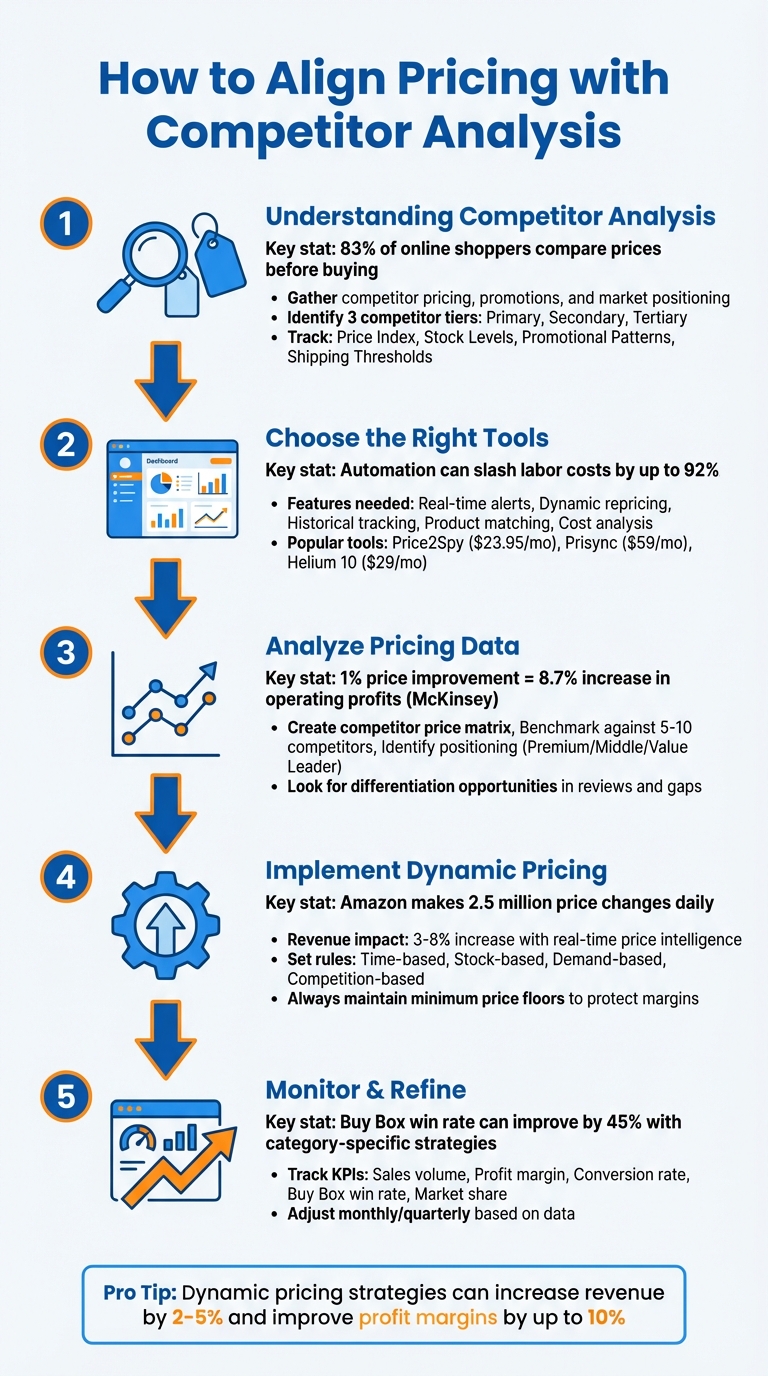
- Competitor data matters: Over 83% of online shoppers compare prices before buying.
- Dynamic pricing works: Tools that track competitors and adjust prices in real-time can increase revenue by 3–8%.
- Avoid common pitfalls: Pricing too low hurts margins; pricing too high risks losing visibility (like Amazon‘s Buy Box).
- Use the right tools: Software like Price2Spy, Prisync, or Helium 10 can automate tracking and provide actionable insights.
Quick Steps:
- Identify competitors: Group them into primary, secondary, and tertiary tiers.
- Track metrics: Focus on price index, stock levels, promotions, and shipping costs.
- Leverage automation: Use tools to monitor and adjust prices in real-time.
- Analyze data: Build a competitor price matrix to benchmark and refine your strategy.
- Implement dynamic pricing: Adjust based on demand, competition, and inventory.
Pro tip: A 1% price improvement can boost operating profits by 8.7% (McKinsey). Start analyzing competitors today to stay competitive and protect your margins.
5-Step Process to Align Pricing with Competitor Analysis
Prisync Training Hub #6 | What is Competitive Pricing? – Ecommerce #Pricing Program
Step 1: Understanding Competitor Analysis for Pricing
Competitor analysis for eCommerce pricing involves gathering and evaluating competitor pricing, promotions, and market positioning. But it’s not just about comparing price tags – it’s about understanding the bigger picture, including how customers perceive the value of competing offers.
This step is essential because a staggering 83% of online shoppers compare prices across brands before making a purchase. Without these insights, you might miss out on potential revenue when competitors raise prices or lose customers if they lower theirs. Your data collection should go beyond base prices. Include factors like shipping costs, promotional cycles (think flash sales or loyalty discounts), stock availability, and bundle deals.
Armed with this information, you can decide on one of three pricing strategies: premium pricing, price matching, or lower pricing to appeal to budget-conscious shoppers. Keep an eye on stock levels too – if competitors are running low, it might be a good time to increase your prices. To make your analysis more targeted, break down competitors into tiers based on their relevance to your business.
Identifying Your Key Competitors
To streamline your analysis, group your competitors into three tiers:
- Primary competitors: These are businesses selling identical products to the same audience. They serve as your direct pricing benchmarks.
- Secondary competitors: These sell either higher- or lower-end versions of your products, influencing your broader market positioning.
- Tertiary competitors: These offer related but different products to your audience, representing either future competition or potential partnership opportunities.
For example, Amazon and Walmart match prices on about 70% of identical products, while Target matches only 26%. Knowing where each competitor falls within these tiers helps you focus on the pricing moves that matter most.
Key Metrics to Track
Effective pricing analysis isn’t just about tracking sticker prices. There are four key metrics that can give you a clearer picture of your competitive position:
- Price Index: This shows your market position relative to the average market price over time.
- Stock Levels: Monitoring inventory levels can reveal opportunities to adjust your prices when competitors face shortages.
- Promotional Patterns: By analyzing promotional cycles, you can predict seasonal sales or flash discounts.
- Shipping Thresholds: Sometimes a lower base price with high shipping costs is less appealing than a slightly higher price that includes free shipping.
Here’s a quick breakdown:
| Metric | Why It Matters |
|---|---|
| Price Index | Tracks how your pricing compares to the market over time. |
| Stock Levels | Helps you identify chances to increase prices when competitors run low. |
| Promotional Patterns | Lets you anticipate sales trends and prepare for flash discounts. |
| Shipping Thresholds | Highlights the "true cost" to consumers, ensuring your pricing stays competitive. |
Step 2: Choosing the Right Tools for Competitor Price Tracking
Tracking prices manually just doesn’t cut it anymore. Marketplaces like Amazon are incredibly dynamic, with prices fluctuating multiple times a day and nearly 2,000 new sellers joining daily. By the time you manually record price data, it’s already outdated.
This is where automated competitor price tracking tools come in. These tools monitor thousands of products around the clock across multiple marketplaces. They not only save time but can also slash labor costs by up to 92%. Plus, automation eliminates human error and provides real-time alerts for price changes, flash sales, and stock shortages.
"A 1% price improvement can result in an 8.7% increase in operating profits, assuming no loss of volume." – McKinsey & Company
The right tool doesn’t just save time – it equips you with the precision needed to make smarter pricing decisions. Businesses using dynamic pricing strategies often see revenue increases of 2–5% and profit margin improvements of up to 10%.
Features to Look for in Pricing Tools
When choosing a competitor price tracking tool, focus on features that combine speed with actionable insights. Real-time monitoring and alerts are critical – you need immediate notifications when competitors adjust prices or launch promotions. Tools offering continuous tracking (instead of periodic snapshots) give you a competitive edge.
Another must-have is automated and dynamic repricing. Look for tools that allow rule-based adjustments, such as setting your price to always stay $1.50 below a specific competitor, while incorporating pricing floors to protect your margins.
Historical price tracking is invaluable for spotting trends like seasonal promotions or pricing cycles. Additionally, strong product matching capabilities are key – AI-powered tools can match products across marketplaces using SKUs, barcodes, or titles, even when product descriptions differ.
Don’t forget about comprehensive cost analysis. The best tools go beyond just tracking sticker prices – they also account for shipping costs, bundle deals, loyalty discounts, and stock levels. Finally, ensure the tool integrates seamlessly with major platforms like Amazon, Walmart, eBay, and Google Shopping, so your data stays synced and actionable.
| Feature | Why It Matters |
|---|---|
| Real-Time Alerts | Keeps you updated instantly on competitor price changes or stock shortages |
| Historical Trend Analysis | Helps predict seasonal pricing patterns and promotional cycles |
| Precise Product Matching | Matches product variants accurately across different retailers using AI |
| Dynamic Repricing | Automatically adjusts prices based on rules to maintain competitiveness |
| Stock Monitoring | Identifies when to raise prices as competitors run out of stock |
Once you know which features matter most, it’s time to explore specific tools that fit your business needs.
Examples of Competitor Analysis Tools
Several tools stand out for their ability to meet diverse business requirements. Price2Spy, starting at $23.95 per month, is known for its flexible reporting and pricing intelligence. Prisync, starting at $59 per month, offers robust stock tracking, dynamic pricing, and email alerts. For larger businesses, Skuuudle provides enterprise-grade features starting at $399 per month.
If Amazon is your primary platform, consider specialized tools like Helium 10. Starting at $29 per month, it offers features like Buy Box tracking, keyword research, and inventory management. Its "Black Box" and "Cerebro" features are particularly praised for simplifying Amazon analytics, earning it a 4.8 out of 5-star rating. Another popular option is Jungle Scout, which excels at Amazon research with tools like "Niche Hunter" and "Product Tracker".
"Amazon competitor price analysis helps you make smarter pricing decisions… automated repricing software can adjust prices instantly, so you win the Buy Box without triggering a price war." – Colin Palin, Product Manager, Repricer.com
Winning the Buy Box on Amazon is especially critical – it can boost sales by up to 83% compared to sellers who don’t. Tools like M2E Amazon Repricer (starting at $50 per month) offer automated repricing rules to help secure this valuable placement.
Choosing and setting up the right tool can feel overwhelming, especially when aligning it with your business strategy. If you need expert guidance, Emplicit can help you select and configure tools to maximize your competitive edge.
Step 3: Analyzing Pricing Data to Inform Your Strategy
Once you’ve gathered competitor data, the next step is turning those raw figures into a pricing strategy that works for your business. This is where companies can set themselves apart – moving beyond simply tracking prices to using the data for real strategic advantage. The goal here is to pinpoint your position in the market while identifying opportunities to either compete on price or stand out by offering extra value. This process lays the groundwork for building a detailed competitor price matrix.
Benchmarking Against Competitors
Start by creating a competitor price matrix. Use a spreadsheet to list your products alongside 5–10 key competitors, noting down their list prices, shipping costs, bundled deals, and any promotional details. To make comparisons meaningful, standardize the metrics. For instance, if you’re selling coffee, calculate prices on a cost-per-ounce basis. For services, break it down into hourly rates. This ensures you’re comparing apples to apples when evaluating pricing.
Context matters, too. A competitor’s price of $49.99 might seem appealing until you factor in a $12.00 shipping fee or realize it’s a temporary flash sale rather than their regular pricing. Use this information to determine your pricing approach. Are you positioning yourself as a Premium Option, where higher prices are justified by better quality or exclusive features? Or are you aiming to be a Value Leader, catering to budget-conscious shoppers? Perhaps you’re targeting the Middle Ground, balancing competitive pricing with a strong brand narrative.
| Positioning Strategy | Pricing Level | Primary Focus |
|---|---|---|
| Premium Option | Above Market | Superior quality, service, or exclusive features |
| Middle Ground | Market Parity | A strong brand story and unique value proposition |
| Value Leader | Below Market | High volume and price-conscious customers |
It’s also smart to track historical pricing trends. For example, if a competitor regularly slashes prices by 15% every July, you can plan your strategy in advance rather than scrambling to respond at the last minute.
Once you’ve established clear benchmarks, the next step is to dig deeper and uncover unique opportunities to differentiate your business.
Identifying Opportunities for Differentiation
Your benchmark data can reveal more than just how your prices stack up – it can highlight gaps in the market where competitors aren’t meeting customer needs. By plotting price against quality on a positioning map, you might spot areas where no one is currently active. This could signal demand for a super-budget option or an ultra-premium tier that isn’t being served.
Competitor reviews can also provide valuable clues. If customers consistently complain about slow shipping or poor service, you can justify charging more by excelling in these areas. Keep in mind that about 70% of consumers abandon a brand after just two bad experiences, so focusing on service can be a game-changer.
Another way to stand out is by rethinking how you package your products. If competitors sell items individually, offering curated bundles can create a sense of added value without hurting your profit margins. On the flip side, if bundling is the standard, selling items à la carte might attract shoppers who prefer flexibility.
Finally, pay attention to which sellers frequently win the Buy Box on platforms like Amazon. This reflects the price point Amazon’s algorithm considers most competitive at any given time. If competing on price alone isn’t feasible, focus on other factors like stellar seller ratings, faster fulfillment, or unique product variations. With Amazon accounting for 43% of U.S. online retail sales, mastering these dynamics can make a huge difference in your strategy.
sbb-itb-e2944f4
Step 4: Implementing a Dynamic Pricing Strategy
Once you’ve gathered pricing data, dynamic pricing lets you respond to market trends in real-time. This approach involves adjusting prices based on factors like competitor activity, demand shifts, and inventory levels. In today’s fast-paced ecommerce world, automation is a must. For instance, Amazon reportedly makes 2.5 million price changes daily, and with 90% of shoppers comparing prices online before making a purchase, staying competitive is vital. Companies that use real-time price intelligence have reported revenue boosts of 3–8% and margin improvements of 1–4%. To make this work, you’ll need clear rules for these adjustments.
Setting Dynamic Pricing Rules
Dynamic pricing rules take competitor insights and turn them into actionable strategies. These rules guide automated systems on when and how to adjust prices. For example, you could set a rule like, "Price = lowest market price + $5.00" or "Price = average market price × 1.125". This ensures consistent pricing strategies while keeping your market positioning intact.
Different rules can address specific scenarios:
- Time-based rules account for predictable traffic spikes, such as adjusting prices during peak shopping hours or days when competitor activity is high.
- Stock-based rules help you capitalize when competitors run out of inventory. If a competitor is out of stock, you could either hold your price steady or increase it slightly to take advantage of the demand shift.
Dynamic pricing isn’t one-size-fits-all. For instance:
- Demand-based pricing reacts to customer interest surges – think snow shovels in winter or umbrellas during a storm.
- Competition-based pricing focuses on matching or beating rival prices, especially for commoditized products where price is a key factor.
- Segmented pricing adjusts rates based on customer attributes, such as loyalty status or purchase history.
A solar and renewable-energy company recently adopted Salesforce Revenue Cloud with automated pricing rules to manage discounts and approvals. The results? A 20% boost in sales productivity, a 30% cut in quote generation time, and a 20% growth in revenue.
Balancing Profitability and Competitiveness
While dynamic pricing can help you stay competitive, it’s critical to set minimum price floors to protect your profit margins. For example, if your unit cost is $25.00 and you need a 20% margin, your floor should be $31.25. This ensures your automation tools don’t drop prices below sustainable levels during price wars. Sellers often make the mistake of focusing solely on lower prices, which can train customers to shop only for discounts and hurt your overall profitability.
Here’s a compelling stat: even a 1% improvement in price can lead to an 8.7% increase in operating profits, assuming sales volume remains steady.
"A strong competitor pricing strategy can help you remain competitive without sacrificing (all-important) profitability." – Colin Palin, Product Manager, Repricer.com
In 2023, a major U.S. online furniture retailer piloted a dynamic pricing system across 10,000 products. By using an algorithm that adjusted prices based on competitor availability and pricing, they achieved a 15% revenue increase and a 10% profit boost in just one month.
Another effective approach is using strategic loss leaders – low-margin items that drive traffic and market share – while maintaining healthy margins on the rest of your catalog. This allows you to compete aggressively on high-visibility products without undermining your overall profitability. The key is being deliberate about which products to discount and which ones will sustain your profits.
"Pricing smart doesn’t mean pricing cheap. It means being intentional, watching the market, and using tools and timing to stay ahead." – Natasha, Author, 42Signals
Step 5: Monitoring Performance and Refining Your Pricing Strategy
Dynamic pricing only works if you keep a close eye on its effects and adjust your approach as needed. Without consistent tracking, you risk losing sight of whether your pricing decisions are boosting growth or quietly eroding profits. By building on the strategies you’ve already implemented, continuous monitoring helps you maintain a competitive edge.
Key Performance Indicators (KPIs) to Track
To connect your pricing decisions to business outcomes, focus on tracking the right metrics. Sales volume is a clear indicator of how customers are reacting to your prices. A drop in sales after a price increase might mean you’ve hit the upper limit of what your market is willing to pay. Meanwhile, profit margin ensures you’re balancing growth with sustainability.
Another critical metric is your conversion rate, which shows how many visitors are willing to complete a purchase at your current price. If you’re attracting traffic but not converting it into sales, your pricing might be the issue. For marketplace sellers, the Buy Box win rate is especially important – category-specific strategies can improve this metric by up to 45%. Additional KPIs to monitor include market share (to gauge your competitive position), average order value (to measure customer spending per transaction), and customer acquisition cost (to ensure your pricing supports long-term growth).
| KPI | Importance in Pricing Strategy |
|---|---|
| Sales Volume | Tracks whether price changes are driving demand or turning customers away. |
| Profit Margin | Ensures your pricing covers costs and supports sustainable growth. |
| Conversion Rate | Measures how many visitors find your pricing acceptable enough to make a purchase. |
| Buy Box Win Rate | Key for Amazon sellers to determine if pricing is competitive for the "Featured Offer." |
| Market Share | Reflects your brand’s position and strength within the industry. |
Making Data-Based Adjustments
Pricing isn’t a "set it and forget it" task – it requires constant fine-tuning. Shift from occasional reviews to real-time monitoring that factors in changes like promotions and inventory levels. Use historical data to uncover seasonal trends and predict future pricing needs. The more data you analyze over time, the better you’ll understand patterns and opportunities. Competitor data is equally important; for instance, if a competitor runs out of stock, you might adjust your prices slightly higher to capture demand without resorting to steep discounts.
Automated tools can alert you to competitor price changes and stock updates, enabling quick, informed decisions. Experiment with A/B testing to find the price points that maximize conversions before rolling out changes more broadly. Regularly assess price elasticity – this will tell you how much demand shifts in response to price changes, helping you strike the perfect balance for revenue growth.
Set clear pricing guardrails to protect your strategy. For example, maintain competitive pricing on high-demand items while applying premium pricing to unique or differentiated products. This approach keeps you competitive where it counts without getting dragged into damaging price wars. Update your competitive analysis monthly or quarterly to stay aligned with market trends, but avoid overanalyzing to the point of inaction.
Conclusion
To stay competitive, pricing strategies need to be built on a solid understanding of the market, informed competitor analysis, and data-driven decision-making. By identifying key competitors and digging deeper than just sticker prices, you can implement dynamic pricing rules that protect your profit margins while keeping your offers attractive. According to McKinsey & Company, even a modest 1% improvement in price can lead to an impressive 8.7% boost in operating profits. This kind of strategic groundwork ensures you’re ready to adapt as the market evolves.
Automation plays a critical role in this process. Successful sellers use tools to track competitor pricing, analyze customer sentiment, and adjust their strategies in real time. This approach helps avoid the dreaded "race to the bottom" while focusing on delivering value through perks like exceptional service, faster shipping, or bundled deals.
Pricing isn’t something you set and forget. Markets are constantly shifting – whether it’s a competitor launching a new promotion or customer expectations changing. Keeping an eye on key performance indicators like sales volume, conversion rates, and Buy Box win rates allows you to make small, iterative adjustments that add up over time. Establishing clear pricing guardrails ensures your brand stays true to its positioning, while leveraging historical data helps you anticipate seasonal trends instead of merely reacting to market changes.
For ecommerce brands selling on platforms like Amazon, Walmart, TikTok Shops, and Target, managing pricing across multiple marketplaces can get overwhelming. That’s where Emplicit steps in. They specialize in creating data-driven pricing strategies that optimize your listings for Buy Box eligibility and manage PPC campaigns to target competitor keywords effectively. Their services include automated price tracking, inventory management, and account health monitoring – helping you stay competitive without compromising profitability.
A well-executed, data-backed pricing strategy, coupled with ongoing competitor analysis and dynamic adjustments, is the key to driving sustainable growth in today’s competitive ecommerce landscape.
FAQs
How do dynamic pricing tools help increase eCommerce revenue?
Dynamic pricing tools rely on real-time data – such as competitor prices, demand patterns, and inventory levels – to automatically adjust your product prices. This approach allows you to maintain pricing that’s both competitive and profitable, helping you optimize revenue.
By quickly adapting to market shifts, these tools enable you to secure the maximum price customers are willing to pay, boost conversion rates, and safeguard your profit margins. Incorporating dynamic pricing into your strategy is an effective way to remain competitive and ensure steady growth for your eCommerce business.
What happens if my prices are too high or too low?
Pricing your products too high can scare off potential customers, especially in a world where side-by-side comparisons are just a click away. If your price stands out as noticeably higher than similar offerings from competitors, you risk losing sales, shrinking your market share, and creating an image of being overpriced or offering less value than expected.
On the flip side, pricing too low might seem like a surefire way to draw in buyers, but it can backfire. Not only does it eat into your profits, but it can also make it tough to cover your costs. Over time, this approach can chip away at your brand’s perceived value, making future price increases a hard sell. The key is finding that sweet spot where your prices protect your margins without alienating customers.
Emplicit’s marketplace-management services are designed to help you nail this balance. By leveraging competitor analysis, they guide you toward a pricing strategy that avoids these common missteps, ensuring your profitability and market presence stay strong.
How can I choose the best competitor analysis tool for pricing my products?
To select the best competitor analysis tool, begin by pinpointing your pricing objectives. Are you targeting Amazon listings, multiple marketplaces, or your own ecommerce site? Once you’ve clarified your focus, look for tools with features that match your needs. These might include data depth (like pricing history, sales rank, or promotions), automation capabilities (such as AI alerts and reporting templates), and, of course, your budget.
For sellers on platforms like Amazon, tools designed specifically for marketplace metrics – such as sales velocity tracking or Buy Box monitoring – are often the most effective. If your needs extend beyond a single platform, you might benefit more from all-in-one tools that combine pricing analytics with marketplace management. After narrowing down your choices, make sure the tool integrates smoothly into your workflow to avoid disruptions.
If you’re feeling stuck or need help aligning a tool with your pricing strategy, Emplicit offers expert support to simplify the process. They can guide you toward data-driven decisions that fine-tune your pricing for better results.