

Pet parents have raised the bar. A simple "all-natural" label on pet food isn’t cutting it anymore. Here’s why:
- Transparency matters more than ever. Over 58% of pet owners feel labels are misleading, and 73% want detailed sourcing info – even via QR codes.
- Health-focused ingredients drive purchases. Claims like "supports digestion" or "improves joint health" influence 97% of buyers. Functional ingredients like probiotics, glucosamine, and omega-3s are in high demand.
- Sustainability is key. With 66% of pet owners concerned about climate change, eco-friendly packaging and responsibly sourced ingredients are priorities.
- Personalized nutrition is trending. Pet owners expect tailored solutions, from soft chews to condition-specific diets.
Pet parents now expect clear benefits, ethical practices, and proven results. Brands that meet these expectations stand out in a crowded market.
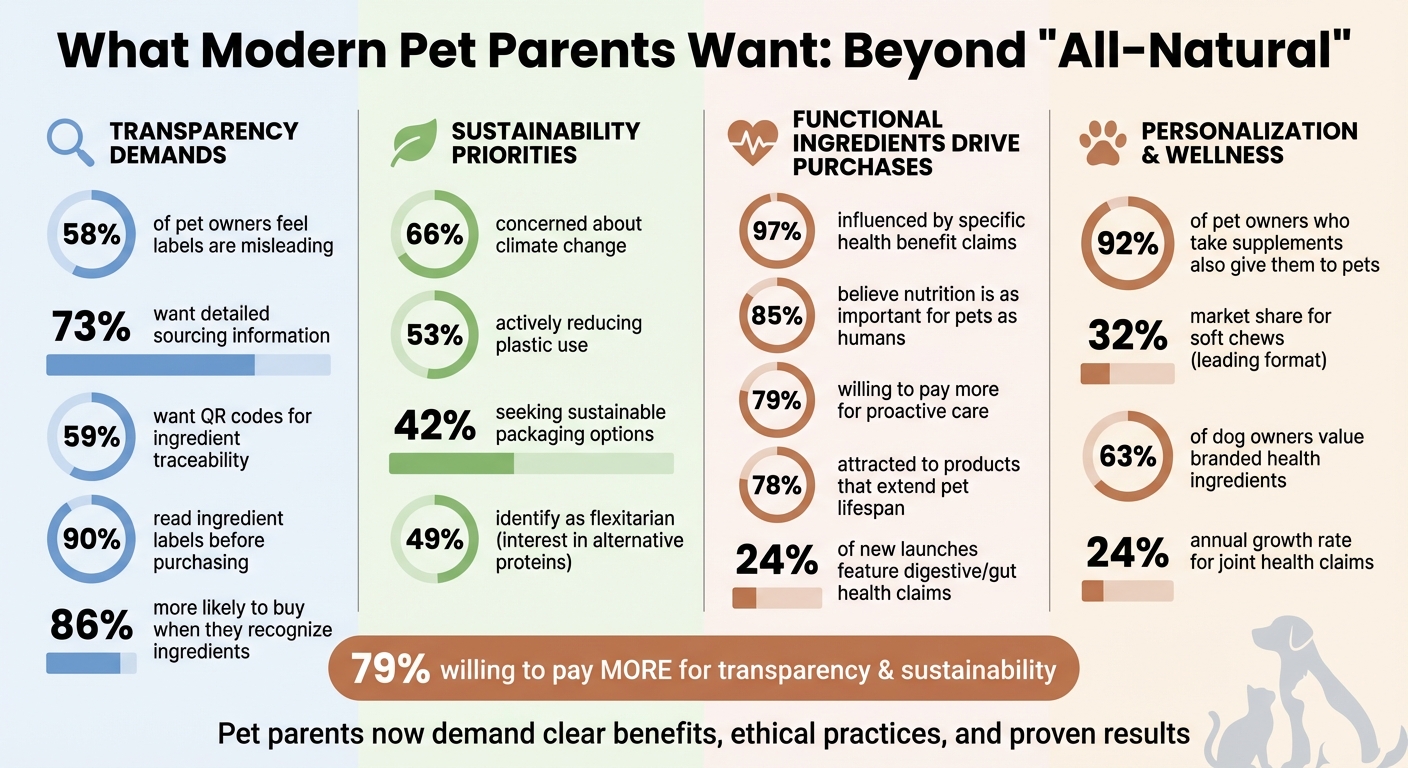
What Modern Pet Parents Want: Key Statistics on Transparency, Sustainability, and Functional Ingredients
Feeding Pets Like Family: Challenges in Emerging Pet Food Trends (presented by Petfood Industry)
sbb-itb-e2944f4
Sustainability and Eco-Friendly Practices: A Top Priority
Pet parents today are paying close attention to the environmental impact of the products they buy. In fact, 66% of pet owners say they’re concerned about climate change, a figure that’s 6% higher than among non-pet owners. This concern is clearly influencing their shopping habits: 53% are actively working to cut down on plastic use, and 42% are seeking out sustainable packaging options.
But it’s not just about personal values. Many pet owners associate eco-friendly products with better health, as these products often avoid synthetic chemicals and harmful toxins. By aligning environmental responsibility with pet wellness, brands can create a strong appeal for today’s conscientious consumers. This heightened awareness is also driving more scrutiny toward packaging choices and ingredient sourcing.
Eco-Friendly Packaging and Materials
Packaging has become a critical factor in purchasing decisions. Pet owners are gravitating toward recyclable materials like PET plastic, aluminum, and cardboard, as well as compostable options such as PLA and bagasse. Reusable systems, like refillable shampoo bottles or durable food containers, are also gaining traction as part of zero-waste routines.
However, vague claims won’t cut it. 58% of pet owners feel that current pet food labels are misleading, and many are wary of unsupported environmental claims. The key? Be specific. Instead of generic terms like "sustainable packaging", use precise statements such as "30% reduction in carbon emissions" or "100% recyclable aluminum." Third-party certifications, like B Corp or Cradle to Cradle, can further validate these claims and build trust.
"Sustainability can be a catch-all term, which makes it ripe for greenwashing and has led to consumer skepticism." – Jim Lamancusa, Executive Director, Pet Sustainability Coalition
Responsible Ingredient Sourcing
Just as important as packaging, ingredient sourcing is under the microscope. Pet parents want to know that the proteins, grains, and supplements in their pet’s food are responsibly obtained – without contributing to deforestation or depleting natural resources. This has fueled interest in alternative proteins like insect-based options (e.g., Black Soldier Fly Larvae) and plant-based ingredients, which appeal to the 49% of adults identifying as "flexitarian".
Mars Petcare is one company stepping up in this area. In 2024, they partnered with major suppliers like ADM and Cargill, along with experts such as Biospheres and Agreena, to implement regenerative agriculture practices across their supply chains in Europe and North America. Using tools like the USDA COMET Planner and Field-to-Market Fieldprint Platform, they’re tracking outcomes like carbon sequestration and soil health improvements. This kind of transparency, backed by measurable data, is exactly what modern pet owners are looking for.
Technology is also playing a role in meeting these expectations. 59% of pet parents want access to detailed ingredient sourcing information via QR codes. By offering this level of traceability, brands can share sourcing details without overhauling their packaging. It’s more than just selling a product – it’s about building trust with consumers who see their pets as family.
Transparency: Building Trust with Pet Parents
With 58% of pet parents believing current pet food labels are misleading, trust has become the cornerstone for top pet brands. Gone are the days when vague marketing terms could pass. Today’s pet owners want to know exactly what’s in their pet’s food, where it comes from, and how it’s made. And if brands can’t deliver that clarity? Pet parents are ready to move on.
The numbers back this up: 90% of U.S. dog and cat owners read ingredient labels before making a purchase, and 73% of pet owners prefer brands that disclose sourcing practices. This isn’t just a passing trend – it’s a shift in how people make decisions. Pet owners are scrutinizing their pets’ food with the same care they give their own, and they expect brands to meet their transparency standards. This means sharing detailed ingredient information is no longer optional – it’s essential.
Detailed Ingredient Disclosure
Pet parents are looking for more than a list of ingredients – they want to see ingredients they recognize and trust. Words like "chicken" and "sweet potato" resonate far more than "poultry by-product meal" or "processed grain by-products." In fact, 86% of consumers are more likely to buy a pet product when they recognize most of the ingredients listed.
But transparency doesn’t stop at naming ingredients. Pet owners also want to know where those ingredients come from and how they’re produced. 73% of dog owners believe brands should make it easier to trace ingredient origins, and 59% want sourcing details accessible via QR codes. Companies like The Honest Kitchen have set the bar high by using 100% human-grade ingredients and requiring suppliers to sign a Vendor Code of Conduct. These suppliers must pledge annually that their ingredients aren’t sourced from China and are produced under Good Manufacturing Practices.
"Clean label isn’t just about what’s in the bag, but where it’s coming from." – Karel Thurman, Commercial Director, BENEO Animal Nutrition
Transparency also extends to nutritional data and safety. 63% of pet parents want more detailed nutritional information, while 39% expect easy access to safety records and recall histories. QR codes are becoming a game-changer here, bridging the gap between limited packaging space and the need for detailed information. With 60% of younger pet owners (ages 25-34) scanning QR codes for product details, brands can use them to share everything from sourcing maps to manufacturing process videos, offering clarity without overwhelming the label.
Ethical Sourcing and Certifications
Transparency isn’t just about ingredients; it’s also about ethical practices. Pet parents are no longer satisfied with vague claims – they want proof. Certifications like B Corp, MSC (Marine Stewardship Council), Certified Humane™, and Fair Trade provide the kind of third-party validation that builds trust.
Take Open Farm, for example. They use 100% Certified Humane™ meats and sustainably sourced fish in line with Seafood Watch™ standards. In May 2025, they even launched North America’s first pet food bag recycling program in partnership with TerraCycle. These actions, backed by recognizable certifications, carry far more weight than generic phrases like "eco-friendly" or "responsibly made."
"Instead of using vague terms or buzzwords, companies should tell the story of their unique initiatives… Don’t be afraid to share your journey. None of us are perfect." – Jim Lamancusa, Executive Director, Pet Sustainability Coalition
Transparency isn’t just a marketing strategy – it’s a safeguard. In 2022, a U.S. pet food brand faced a $2.3 million recall due to undisclosed additives. On the flip side, brands that prioritize clear sourcing have 15% fewer supply chain disruptions compared to those that don’t. For pet food companies, transparency is about more than meeting consumer demand – it’s about ensuring safety and operational reliability.
Functional Ingredients: Targeting Pet Wellness
Pet owners today are looking for more than just basic nutrition – they want products that address specific health concerns for their furry companions. A whopping 85% of pet owners worldwide believe that proper nutrition and supplements are just as important for their pets as they are for themselves, and 79% are willing to pay extra for proactive care to avoid costly vet bills later on. This trend is backed by data: 97% of consumers say the specific health benefit listed on packaging influences their purchase decision. General claims like "supports overall health" no longer suffice. Pet parents want clear, targeted benefits, whether it’s improving digestion, easing anxiety, or supporting joint health. Additionally, 78% of global pet owners are drawn to functional products that could potentially extend their pet’s lifespan. This growing demand is paving the way for products that go beyond basic nourishment to address specific wellness needs.
Personalized Nutrition Trends
Pet owners increasingly expect tailored solutions for their pets, taking into account factors like age, breed, size, and health conditions. For example, a senior dog with arthritis has vastly different needs compared to a young, active kitten. This push for personalization has spurred the rise of specialized formulations and convenient supplement formats, such as soft chews.
Soft chews are now the leading supplement format, holding 32% of the market. Much like gummy vitamins for humans, these chews make it easier for pets to get the nutrients they need. Interestingly, 92% of pet owners who take supplements themselves also give supplements to their pets, reflecting the growing alignment between human and pet wellness routines.
Brands are stepping up with condition-specific offerings. For instance, in July 2025, General Mills introduced the "Love Made Fresh" line under its Blue Buffalo brand. This line caters to young pet parents who see their pets as family members deserving fresh, human-grade nutrition. This shift mirrors a broader trend: pet owners now shop for their pets the same way they shop for themselves, prioritizing recognizable ingredients, proven health benefits, and convenience.
As the demand for personalized nutrition grows, brands are focusing on ingredients that deliver measurable results for pet wellness.
Wellness-Boosting Ingredients
When it comes to product ingredients, pet parents have clear preferences. Digestive and gut health claims appeared on 24% of new cat and dog food launches in 2024, making it the top functional category. Ingredients like prebiotics, probiotics, and postbiotics are no longer niche – they’re mainstream. In fact, postbiotic inclusion in pet foods jumped by 41% in 2025.
One standout study from ADM in 2025 demonstrated the benefits of supplementing adult cats with heat-treated postbiotic Bifidobacterium longum CECT 7347 (marketed as PRIOME Gut Health) alongside Fibersol-2. The combination was shown to improve digestive health during dietary transitions. Science-backed claims like these resonate with pet parents: 63% of dog owners and 61% of cat owners value branded health ingredients because they trust the research behind them.
Joint health is another key focus area, with claims in this category growing at a 24% annual rate. Ingredients like glucosamine, chondroitin, and algae-sourced omega-3s are popular choices for supporting mobility, particularly in senior pets. Products featuring collagen peptides and omega-3s have also seen a 38% year-over-year rise, driven by their association with joint health.
| Health Concern | Key Functional Ingredients | Why It Matters to Pet Owners |
|---|---|---|
| Digestion & Gut Health | Prebiotics, probiotics, postbiotics, pumpkin, fiber | Supports microbiome balance, improves stool quality, boosts immunity |
| Joint & Mobility | Glucosamine, chondroitin, omega-3s, collagen peptides | Eases stiffness, supports aging pets, prevents mobility issues |
| Anxiety & Calming | L-theanine, ashwagandha, CBD, reishi mushrooms | Helps manage stress during travel, separation, or loud events |
| Skin & Coat | Omega-3s, algae oils, biotin | Reduces shedding, promotes a shiny coat, aids with allergies |
| Cognitive Health | Omega-3s, antioxidants, MCT oil | Supports brain health and sharpness in senior pets |
This shift toward functional ingredients isn’t just a passing phase – it’s about delivering real, tangible results. In fact, 85% of pet owners in the U.S. and Canada agree that high-quality pet foods can serve as preventive healthcare. Pet parents are no longer waiting for health issues to arise. They’re investing in their pets’ long-term wellness from the start and expect brands to provide ingredients that genuinely make a difference.
These advancements in functional ingredients are part of a larger movement toward transparency and ethical practices, setting a new benchmark for pet care.
"Pet humanization represents the most significant driver reshaping the industry, as owners increasingly view their companions as family members deserving human-grade nutrition and specialized care." – Mordor Intelligence
Ecommerce Strategies: Adapting to Pet Parent Preferences
As the push for transparency and sustainability intensifies, how a product is presented online has become more crucial than ever. Pet parents are not just shopping – they’re scrutinizing. With 90% of U.S. dog and cat owners reading ingredient labels before purchasing and 58% believing pet food labels are misleading, ecommerce sellers need to communicate clearly and effectively. Trust and clarity are no longer optional – they’re essential for driving sales.
Optimizing Marketplace Listings for Transparency
Empty claims like "eco-friendly" or "all-natural" won’t cut it anymore. Customers want specifics. Highlight measurable achievements, like "Packaging made with 85% post-consumer recycled (PCR) plastic" or "30% lower carbon emissions compared to 2020." These details resonate because they show tangible efforts.
Showcase certifications prominently. Labels like B Corp, USDA Organic, Certified Humane, MSC Certified, or Regenerative Organic Certified (ROC) add credibility. These third-party stamps of approval matter – 63% of dog owners actively seek products with branded ingredients, trusting the research and standards behind them.
Ingredient transparency is another trust-builder. Don’t just list "beef" or "fish." Specify origins with statements like "grass-fed beef from New Zealand farms" or "wild-caught Alaskan salmon certified by the Marine Stewardship Council." Adding QR codes to packaging can also help, offering detailed sourcing and sustainability information – something 73% of dog owners and 70% of cat owners are eager to access.
For packaging, clarity is key. Use How2Recycle labeling to explain recyclability. Terms like "100% curbside recyclable" or "Compostable in commercial facilities" guide customers on disposal. If your packaging uses innovative materials like seaweed-based films or algae inks, make sure to highlight these details.
"Instead of using vague terms or buzzwords, companies should tell the story of their unique initiatives, such as packaging, ingredients, energy, animal welfare, or another impact area." – Jim Lamancusa, Executive Director, Pet Sustainability Coalition
When listing functional ingredients, explain their benefits. Don’t just say "probiotics." Clarify how they help, like "contains heat-treated postbiotic Bifidobacterium longum to support digestive health during diet transitions." Use bullet points to emphasize outcomes like "Supports joint mobility in senior dogs" or "Reduces stress during separation with L-theanine and ashwagandha."
Finally, optimize listings for the search terms pet parents are using. Searches for "plant-based" pet food jumped 70.2% and "sustainable" rose 51.6%. If these terms apply to your product, weave them naturally into your titles and bullet points, but only if you can back them up with real data.
These details set the stage for a more targeted and effective digital strategy.
Using Emplicit‘s Expertise to Stand Out
Emplicit helps brands align with what today’s pet parents care about most. By managing listings on platforms like Amazon, Walmart, and Target, Emplicit ensures your product pages reflect the transparency, sustainability, and functionality that drive purchasing decisions.
With listing optimization, Emplicit highlights certifications, ingredient sourcing, and sustainability metrics in ways that resonate. This includes displaying third-party certification badges in A+ Content, crafting bullet points that focus on specific benefits, and using backend keywords to capture high-intent searches like "human-grade" or "regenerative agriculture."
Emplicit also optimizes PPC campaigns to complement these transparency-focused listings. Ad campaigns are tailored to target pet parents searching for attributes like "probiotic dog treats" or "sustainable cat food packaging." When landing pages deliver on these promises with clear, detailed content, conversion rates improve, and brand trust grows.
For brands juggling multiple marketplaces, Emplicit’s account health management ensures compliance with claims like "human-grade" (requiring USDA facility certification) or "organic" (adhering to USDA standards). Staying ahead of these regulations helps avoid costly missteps that could harm both account standing and consumer trust.
This approach not only meets the demands of modern pet parents but positions your brand as a standout in a crowded market. By combining optimized listings with strategic advertising, pet brands can appeal to the 79% of pet owners willing to pay more for transparency and sustainability. It’s not just about meeting expectations – it’s about leading the way in the ever-evolving pet care industry.
Conclusion: Meeting the New Standard for Pet Products
Pet owners today are looking for much more than products labeled "all-natural." They want science-backed, functional benefits, with 79% willing to pay more for healthier options and 85% considering nutrition a top priority. This shift in expectations is clear: pet parents demand transparency, proven ingredients, and solutions that address real health needs.
These changing demands are shaping the ecommerce strategies we’ve outlined. Successful brands are moving away from vague marketing claims and instead offering concrete proof – think third-party certifications, detailed ingredient sourcing, and clear links between functional ingredients and measurable health outcomes. This approach matters, especially since 97% of consumers depend on clear health benefit claims when making a purchase.
"Pet humanization represents the most significant driver reshaping the industry, as owners increasingly view their companions as family members deserving human-grade nutrition and specialized care." – Mordor Intelligence
The growing interest in functional treats and supplements, reflected in high single-digit growth rates, highlights a major trend: generic labels without real benefits just don’t cut it anymore. In fact, 79% of pet owners are willing to spend more on proactive care to avoid hefty vet bills later.
Meeting these expectations is no longer optional. With 54% of pet owners feeling overwhelmed by the variety of products on shelves, brands that emphasize transparency, sustainability, and functionality will stand out. By aligning your product listings with these evolving standards, Emplicit can position your brand to thrive in this competitive space.
FAQs
What do pet parents want to see on pet food labels today?
Pet owners today value clear and straightforward labels that spell out exactly what’s in a product and how it supports their pets’ well-being. They often scrutinize ingredient lists, favoring familiar and easily recognizable components over scientific-sounding or unfamiliar terms. Key details like the product name, full ingredient list, guaranteed nutrient levels, feeding guidelines, net weight, and a clearly marked "best-by" date are considered non-negotiable.
But it doesn’t stop there. Many pet parents now seek out additional information that aligns with their values. They’re interested in eco-friendly packaging, health-focused benefits (like support for digestion or joint health), and ethical certifications that ensure responsible sourcing and production. Keeping labels simple, honest, and informative goes a long way in building trust with these conscientious consumers.
How can pet food brands show they truly care about sustainability?
Pet food brands can show their dedication to sustainability by offering clear and reliable evidence of their practices. Displaying third-party certifications, such as USDA Organic, Certified Humane, or carbon-neutral labels, prominently on their packaging can go a long way in building trust with eco-conscious buyers. These certifications help shoppers easily identify genuine efforts while steering clear of greenwashing.
Another impactful step is prioritizing sustainable packaging. Using materials like recyclable, biodegradable, or refillable options sends a strong message. Including details such as recycling instructions or metrics like "90% post-consumer recycled content" on the packaging makes it simple for customers to recognize the brand’s commitment to reducing environmental impact.
Equally important is transparency in sourcing. Sharing information about where ingredients come from, mapping out supply chains, and incorporating certifications like fair-trade or regenerative agriculture can reassure customers that sustainability isn’t just a buzzword – it’s a fundamental part of the brand’s mission.
What makes functional ingredients in pet food so beneficial?
Functional ingredients in pet food provide more than just basic nutrition – they’re designed to support specific health needs. Whether it’s glucosamine to promote joint health, probiotics for a happy gut, or antioxidants to strengthen the immune system, these ingredients help pets stay healthier and more active. They also address common concerns like aging or particular health challenges, making them a go-to choice for today’s pet owners who want the best for their furry companions.
What’s more, these functional pet foods streamline the feeding process by blending essential nutrition with targeted supplements in a single, easy-to-serve formula. This approach not only ensures pets get consistent health support but also saves owners time and effort. With more people focusing on proactive, whole-body care for their pets, these wellness-driven options are gaining traction among those looking for premium solutions.
Related Blog Posts
- The Humanization of Pet Care Is Changing Amazon. Is Your Brand Keeping Up?
- What Happens to Pet Brands That Ignore Amazon’s New Ingredient Transparency Rules
- Pet Parents Will Pay 3x More for This One Thing (And Most Amazon Listings Don’t Mention It)
- The Pet Brands Winning on Amazon in 2025 Aren’t Playing the Same Game You Are