

The Amazon A10 algorithm has shifted how products rank on the platform, prioritizing organic engagement, relevance, and seller credibility over heavy reliance on ads. Unlike its predecessor, A9, A10 rewards sellers who focus on external traffic, buyer intent, and account health. This means:
- External traffic from platforms like Google, TikTok, and blogs now carries more weight than Amazon PPC campaigns.
- Seller authority – account age, feedback, return rates, and order defect rates – plays a major role in rankings.
- Organic sales are weighted higher than ad-driven sales, emphasizing long-term trust over short-term spending.
To succeed in 2025, sellers must optimize listings with intent-driven keywords, improve click-through rates (CTR) using compelling visuals and descriptions, and drive traffic from outside Amazon. Monitoring metrics like organic traffic, conversion rates, and account health is crucial for staying competitive.
Key takeaway: A10 rewards sellers who build trust, attract external traffic, and focus on relevance – making it essential to adapt your SEO strategy for better visibility and sales.
Why Amazon Ranking Changed Forever in 2025!
A10 vs. A9: What Changed
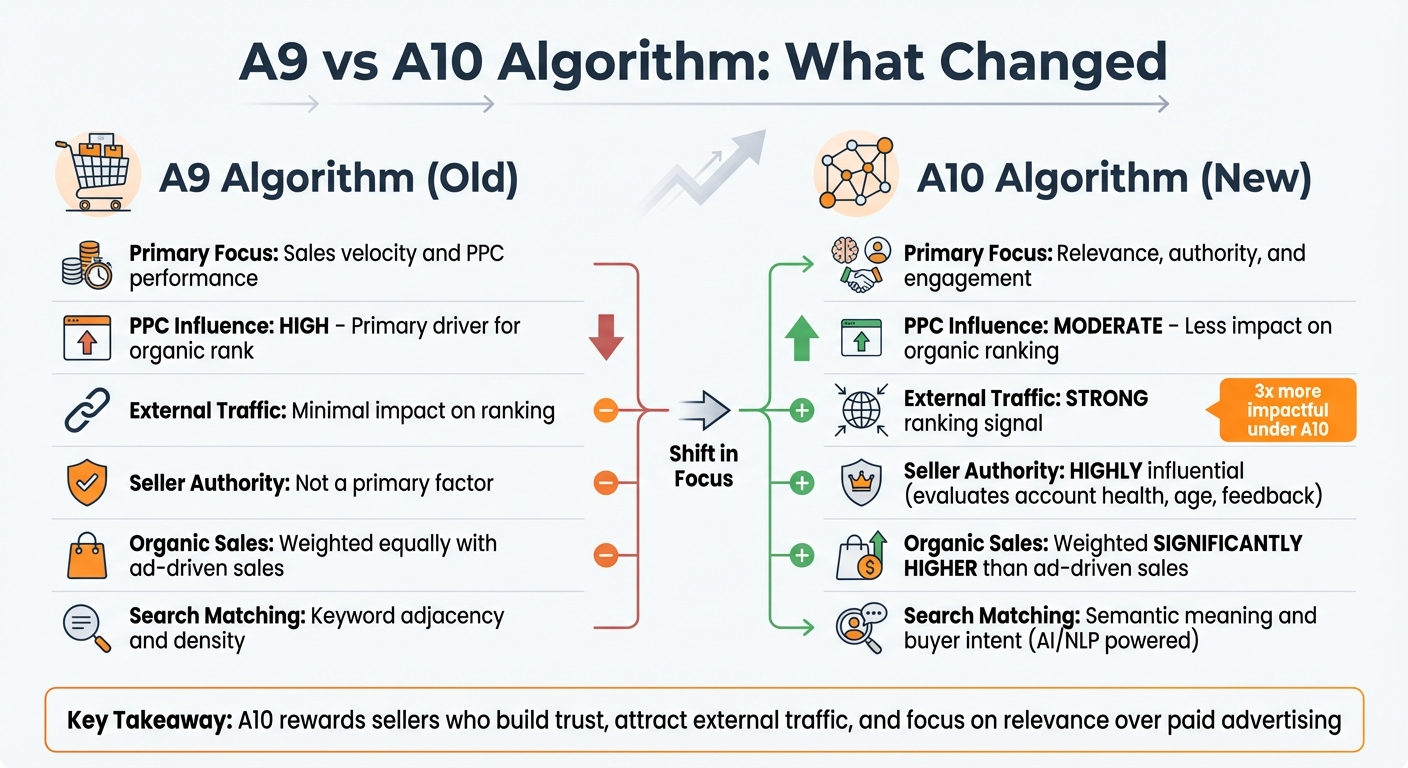
Amazon A9 vs A10 Algorithm: Key Ranking Factor Differences
New Ranking Priorities
The transition from A9 to A10 marks a significant shift in how Amazon determines product rankings. While A9 focused heavily on sales velocity and paid advertising performance, A10 places greater emphasis on factors like relevance, seller authority, and authentic engagement.
One of the standout changes is how external traffic now plays a more prominent role. Traffic from sources like social media, blogs, and Google Ads is three times more likely to influence rankings compared to relying solely on Amazon’s internal PPC campaigns.
"EXTERNAL TRAFFIC IMPACTS YOUR AMAZON RANKING."
– Bryan Fowler, President, Amazon Division, Intero Digital
Organic sales also carry much more weight under A10, signaling a shift toward encouraging sellers to focus on building long-term brand equity rather than relying predominantly on ad spend.
Another key addition is "Seller Authority", which evaluates factors like account age, feedback ratings, return rates, order defect rates, and the diversity of a seller’s product catalog. These new priorities emphasize trust and consistent performance, setting a new standard for how sellers should approach ranking optimization.
A9 vs. A10 Ranking Factors Comparison
| Factor | A9 Algorithm (Old) | A10 Algorithm (New) |
|---|---|---|
| Primary Focus | Sales velocity and PPC performance | Relevance, authority, and engagement |
| PPC Influence | High; primary driver for organic rank | Moderate; less impact on organic ranking |
| External Traffic | Minimal impact on ranking | Strong ranking signal |
| Seller Authority | Not a primary factor | Highly influential (evaluates account health, age, and more) |
| Organic Sales | Weighted equally with ad-driven sales | Weighted significantly higher than ad-driven sales |
| Search Matching | Keyword adjacency and density | Semantic meaning and buyer intent |
The table highlights how A10 has reshaped the ranking landscape. Under A9, sellers could rely on aggressive PPC campaigns to climb the rankings. With A10, the focus has shifted to rewarding sellers who build trust through consistent performance and attract customers from external sources.
"A10 seeks to reward sellers who build a brand on trust and sustained genuine engagement while punishing those who solely depend on strategies like paid ads and keyword stuffing."
– Ali ecommercewala, eCommerce Specialist
A10 also incorporates advanced AI and natural language processing to better understand the intent behind search terms. This means that simply cramming keywords into listings won’t help your ranking anymore – in fact, it could hurt it.
These updates pave the way for a deeper dive into how A10 specifically determines product rankings.
How the A10 Algorithm Ranks Products
The A10 algorithm has shifted its focus, prioritizing factors that better align with buyer behavior and seller credibility. By understanding how A10 evaluates products, you can fine-tune your strategy to improve rankings. The algorithm zeroes in on three main areas: how well your listing matches buyer intent, your ability to attract external traffic, and your seller authority. Let’s break these down.
Buyer Intent and Search Relevance
A10 digs deeper into the meaning behind shopper searches. For instance, when someone searches for "eco-friendly water bottle", the algorithm doesn’t just look for those exact words in your listing – it evaluates whether your product genuinely aligns with the shopper’s intent. This marks a departure from the keyword-heavy approach associated with A9.
The algorithm determines relevance by analyzing elements like product titles, backend search terms, bullet points, and descriptions. A standout metric here is Click-Through Rate (CTR), which signals how well your product resonates with shoppers. A higher CTR indicates that your listing effectively meets their needs. To improve CTR, use detailed long-tail keywords such as "BPA-free insulated water bottle for hiking", craft compelling titles, and include crisp, high-resolution images (at least 1,000×1,000 pixels).
External Traffic Sources
A10 gives considerable weight to traffic generated outside of Amazon. When your product gains traction through channels like Google Ads, social media, or email campaigns, it shows that your brand has appeal beyond Amazon’s ecosystem. Sales from these external sources often carry more influence on rankings compared to sales driven by Amazon PPC.
Tools like Amazon Attribution can help you track the effectiveness of external platforms – whether it’s TikTok, Instagram, email marketing, or Google SEO – in driving sales. This focus on external engagement underscores the algorithm’s preference for brands that demonstrate genuine demand and authenticity.
Seller Authority and Account Health
Seller reputation plays a more prominent role under A10. The algorithm evaluates seller authority based on factors like account age, feedback ratings, return rates, Order Defect Rate (ODR), and the diversity of your product catalog. Larger, well-established brands often have an edge, as their track record signals reliability.
"The lowest price is no longer the largest determining factor in winning the Amazon Featured Offer. Now the seller rating and account metrics are weighted highest."
– Maria Navolykina, Seller Labs
To strengthen your seller authority, focus on keeping your ODR low, reducing return rates, and avoiding A-to-Z claims. Using Fulfillment by Amazon (FBA) can also enhance your standing by ensuring Prime eligibility and reliable shipping – key factors that improve customer satisfaction. Additionally, maintaining consistent inventory levels is critical, as stockouts can severely impact both your seller authority and ranking stability.
SEO Strategies for the A10 Algorithm
To make the most of Amazon’s A10 algorithm, adjust your SEO approach to emphasize buyer intent, external traffic, and building seller credibility. Here’s how you can refine your strategy:
Keyword Selection for Buyer Intent
The A10 algorithm leans heavily on Natural Language Processing (NLP) to understand the intent behind a shopper’s search, not just the exact words they type. This means your keyword strategy should prioritize relevance over sheer search volume. Instead of relying on generic terms like "yoga mat", focus on intent-driven, specific phrases such as "non-slip yoga mat for hot yoga" or "organic dog treats for small breeds". These long-tail keywords not only target niche audiences but are also more likely to convert because they align closely with what shoppers are seeking.
For maximum impact, place your primary keywords within the first 50–80 characters of your product title – this is where A10 looks first. For instance, if you’re selling a water bottle, start with "Insulated Stainless Steel Water Bottle" rather than burying key terms further down the title. Tools like Amazon’s Brand Analytics and Product Opportunity Explorer can help you uncover high-intent search terms your competitors are ranking for.
In your backend "Search Terms" field, include synonyms, abbreviations, and alternative spellings (up to 250 characters). However, avoid duplicating words already present in your title or bullet points.
"Amazon’s algorithm prioritizes purchase likelihood above all else, making it fundamentally different from Google’s information-focused approach." – Hai Mag, Eva.guru
Improving Click-Through Rates
A strong Click-Through Rate (CTR) is a clear signal to A10 that your listing is relevant and engaging. To achieve this, start with a high-quality main image that fills at least 85% of a plain white background. Complement this with seven additional images (minimum resolution: 1,000×1,000 pixels) showcasing your product from multiple angles, in use, and with size references. Including a product video – like a demonstration or unboxing – can boost sales by an average of 10%.
Your product title and bullet points also play a crucial role in driving CTR. Keep bullet points concise, between 100 and 250 characters, and focus on benefits rather than features. For example, instead of stating "Polyester material", say "Sweat-resistant fabric keeps you dry during workouts". Use A+ Content to elevate your listing with lifestyle images, comparison charts, and product stories that resonate with shoppers. Since 94% of consumers avoid products with poor visuals or unclear descriptions, investing in professional content directly impacts your success.
Driving External Traffic to Listings
Optimizing for clicks is just the beginning. Driving external traffic to your Amazon listings is a powerful way to improve rankings. A10 views external traffic as a key ranking factor because it indicates demand for your product outside Amazon’s platform. Sales generated from platforms like Google, TikTok, Instagram, or email campaigns carry more weight than those from Amazon PPC alone.
To leverage this, consider running Google Ads targeting high-intent keywords, creating TikTok or Instagram Reels, and building an email or SMS list to bring loyal customers to your listings. Use Amazon Attribution to track which external channels are driving sales and conversions. This tool not only helps measure your ROI but may also qualify you for referral bonuses from Amazon.
Collaborating with micro-influencers or niche bloggers is another effective tactic. Encourage them to create "Top 10" articles or social media posts that link directly to your listings. Just make sure you have enough inventory before launching external campaigns – running out of stock can negatively impact your rankings.
sbb-itb-e2944f4
Monitoring A10 Algorithm Performance
Amazon updates its search rankings every hour, though there’s typically a 24–48 hour delay. To make the most of this, you’ll need to keep a close eye on key metrics and adjust your strategy based on precise data.
Performance Metrics to Track
Focus on your organic sales to PPC ratio. The A10 algorithm favors organic sales over paid traffic. Tools like Helium 10‘s Cerebro can help you find the right balance between organic and paid keyword rankings.
Pay special attention to external traffic sources. By signing up for Amazon Attribution (currently in beta), you can track which off-Amazon channels – such as Google Ads, TikTok, Instagram, or email campaigns – are driving conversions. Since A10 rewards listings that bring in new customers, monitoring external traffic helps you identify which channels are most effective.
Daily tracking of your Order Defect Rate (ODR), feedback scores, and Perfect Order Percentage (POP) is essential. Aim for a POP of 95% or higher, and make it a priority to respond to customer inquiries within 24 hours to maintain strong seller authority.
Here’s a breakdown of key metrics and their impact:
| Metric Category | Specific Metrics | Impact |
|---|---|---|
| Traffic | External Traffic, Impressions, CTR | Indicates demand from outside Amazon and the appeal of your listing |
| Sales | Organic Sales, Sales Velocity (7/30/90-day views) | Reflects natural relevance and steady demand |
| Performance | Conversion Rate, Return Rate | A high conversion rate shows the product meets customer expectations |
| Account Health | Feedback Rating, ODR, Perfect Order % | Builds "Seller Authority" and boosts trustworthiness |
| Logistics | In-stock Rate (keep above 95%), Shipping Speed | Ensures listings are Prime-eligible and ready for visibility |
Keep an eye on metrics like CTR (click-through rate) and dwell time (how long shoppers spend on your page). A high CTR signals that your listing is relevant and engaging. If you’re seeing a lot of impressions but a low CTR, it might be time to revisit your main image or title. On the other hand, if you have a high CTR but a low conversion rate, consider improving your A+ Content, adding comparison charts, or adjusting your pricing.
Using Data to Adjust Your Strategy
Once you’ve tracked these metrics, use them to fine-tune your approach. For example, if your FBA Analytics tab shows aging inventory or excess stock, this could hurt your seller authority. Setting up inventory alerts can help you avoid this issue. Additionally, tools like Google Search Console can provide insights into how your Amazon listings perform in external search results. Use this data to optimize for high-intent searches that bring more traffic from outside Amazon.
Enhancing your listings with A+ Content – such as lifestyle images, FAQs, or comparison tables – can significantly boost conversions. Studies show that adding A+ Content increases sales by an average of 6%, while products with video demonstrations see a 10% sales lift. If your product is priced higher than competitors, consider offering temporary discounts or coupons to improve sales velocity and rankings.
"External traffic is a major ranking factor in A10. The more customers you bring from outside Amazon, the better your organic rankings." – Savannah A, Customer Success and Marketing Analyst, Seller Labs
Finally, keep an eye on your competitors. Tools like Sellics can help you spot gaps in their keyword strategies or visual content that you can use to your advantage. If you notice competitors ranking for keywords you’re missing, add those terms to your backend Search Terms field (up to 250 characters) and test them in your title or bullet points. Reviewing your keyword distribution weekly ensures you stay competitive and don’t lose ground to others optimizing more aggressively.
Growing Your Amazon Business with Emplicit
Emplicit’s Ecommerce Services
Emplicit tailors its strategies to align with A10’s focus on organic engagement and seller credibility. By zeroing in on key ranking signals, their approach strengthens seller authority and promotes steady growth. Their marketplace management prioritizes crucial A10 factors like maintaining account health and ensuring inventory stability, which are essential for long-term success .
When it comes to PPC management, Emplicit takes a calculated approach that complements A10’s reduced reliance on paid advertising. Instead of depending on PPC to boost rankings, they use these campaigns strategically – for instance, to generate buzz for new products or to give underperforming listings a boost. The primary focus remains on driving organic sales, as A10 now prioritizes natural relevance over ad budgets. This shift marks a significant departure from the earlier A9 algorithm. By integrating these strategies, Emplicit provides a comprehensive, data-driven framework tailored to A10’s requirements.
Tailored A10 Optimization Strategies
Emplicit crafts customized strategies that focus on A10’s key metrics. Their listing optimization process incorporates buyer intent keywords and enhanced A+ Content, which can increase sales by about 10%. They also emphasize generating external traffic from platforms like Google, TikTok, Instagram, and email campaigns – sources that A10 rewards because they signal strong product demand to Amazon .
With tools like Amazon Attribution, Emplicit tracks the performance of off-platform traffic sources, helping you identify and invest in the ones that deliver the best ROI. They also prioritize account health management by monitoring tools like the Voice of the Customer dashboard, ensuring potential issues are addressed before they impact your rankings . Backed by U.S.-based account managers and support across platforms like Amazon, TikTok Shops, Walmart, and Target, Emplicit offers the resources and expertise to help scale your business while staying aligned with A10’s evolving guidelines.
Conclusion
The A10 algorithm marks a major change in how Amazon ranks products. Sellers can no longer rely solely on PPC campaigns to succeed. Instead, success hinges on organic engagement, building strong seller authority, and driving external traffic.
These changes aren’t just theoretical – they deliver real results. Recent data reveals that optimizing for the A10 algorithm can lead to a 28% increase in organic traffic. Listings enhanced with video content have shown a 10% boost in sales, while improved Q&A sections have driven conversion rates up by 8.3%. These adjustments can make the difference between being highly visible or fading into the background.
"The A10 algorithm is more than a challenge; it’s a roadmap for sustainable growth." – AMZScout
Amazon keeps its algorithm details under wraps, but we know it’s constantly evolving. For example, prices are updated over 2.5 million times daily, and the algorithm now uses Natural Language Processing (NLP) to understand search intent instead of just matching keywords. To navigate this complexity, sellers must focus on key performance metrics: maintaining conversion rates above 19%, return rates below 12%, and an in-stock rate above 95%. Each of these metrics ties directly into how products are ranked, emphasizing the importance of organic engagement and seller authority.
With the right strategies, the A10 algorithm becomes less of a hurdle and more of an opportunity. Whether it’s optimizing for buyer-intent keywords, tapping into platforms like TikTok and Instagram to drive traffic, or keeping your account health in check, a well-thought-out approach can turn the complexities of A10 into a competitive edge.
FAQs
How does driving external traffic impact Amazon A10 rankings?
Driving traffic from outside sources to your Amazon listings can play a huge role in improving your rankings under Amazon’s A10 algorithm. When your product gets clicks and engagement from platforms like Google, social media, or influencer campaigns, Amazon sees this as proof that your product is in demand and relevant to shoppers.
This means listings with steady external traffic often get a boost in visibility within Amazon’s search results, giving you an edge over competitors. Tapping into these external channels not only increases your product’s exposure but can also lead to more sales on Amazon.
How does seller authority influence rankings in Amazon’s A10 algorithm?
Seller authority is a crucial factor in how the A10 algorithm determines product rankings on Amazon. The platform gives preference to sellers with a solid reputation. This reputation is built on factors like strong seller ratings, reliable on-time shipping, and minimal return rates. Together, these elements demonstrate dependability and customer satisfaction, which in turn boost your product’s visibility.
To strengthen your seller authority, prioritize creating outstanding customer experiences. Ensure your inventory is accurate, and address any performance concerns as quickly as possible. These steps can make a noticeable difference in your product rankings and overall success on Amazon.
How can I improve my Amazon listings to match what buyers are looking for?
To make your Amazon listings resonate with potential buyers, start by using specific, long-tail keywords that align with what shoppers are actively searching for. Seamlessly weave these keywords into your product title, bullet points, and backend search terms to ensure visibility.
Craft benefit-focused copy that clearly explains how your product addresses customer needs or solves common problems. Pair this with high-quality lifestyle images to visually demonstrate your product in real-life scenarios. Positive reviews are another key element – they help establish trust and credibility with your audience.
Finally, consider driving external traffic to your listings. This not only increases visibility but can also improve your organic rankings over time. Companies like Emplicit excel at implementing these tactics, helping sellers unlock the full potential of their Amazon listings.