

Amazon‘s A9 algorithm is the backbone of its search engine, deciding which products appear when you search. In 2025, the algorithm has evolved significantly, with a stronger focus on external traffic, AI-driven search relevance, and performance metrics like sales velocity and conversion rates.
Key takeaways:
- Sales Velocity: Fast, consistent sales are the top ranking factor.
- Conversion Rates: Listings with high conversion rates (19% or more) perform better.
- Keyword Optimization: Use high-impact keywords in titles and backend search terms.
- External Traffic: Social media and Google Ads now influence rankings.
- Customer Reviews: High ratings (4.5+ stars) and steady review flow are crucial.
- Inventory Management: Maintain 60–90 days of stock to avoid ranking penalties.
With these updates, sellers must fine-tune their listings, leverage PPC campaigns, and ensure their products meet customer expectations to rank higher in Amazon’s search results.
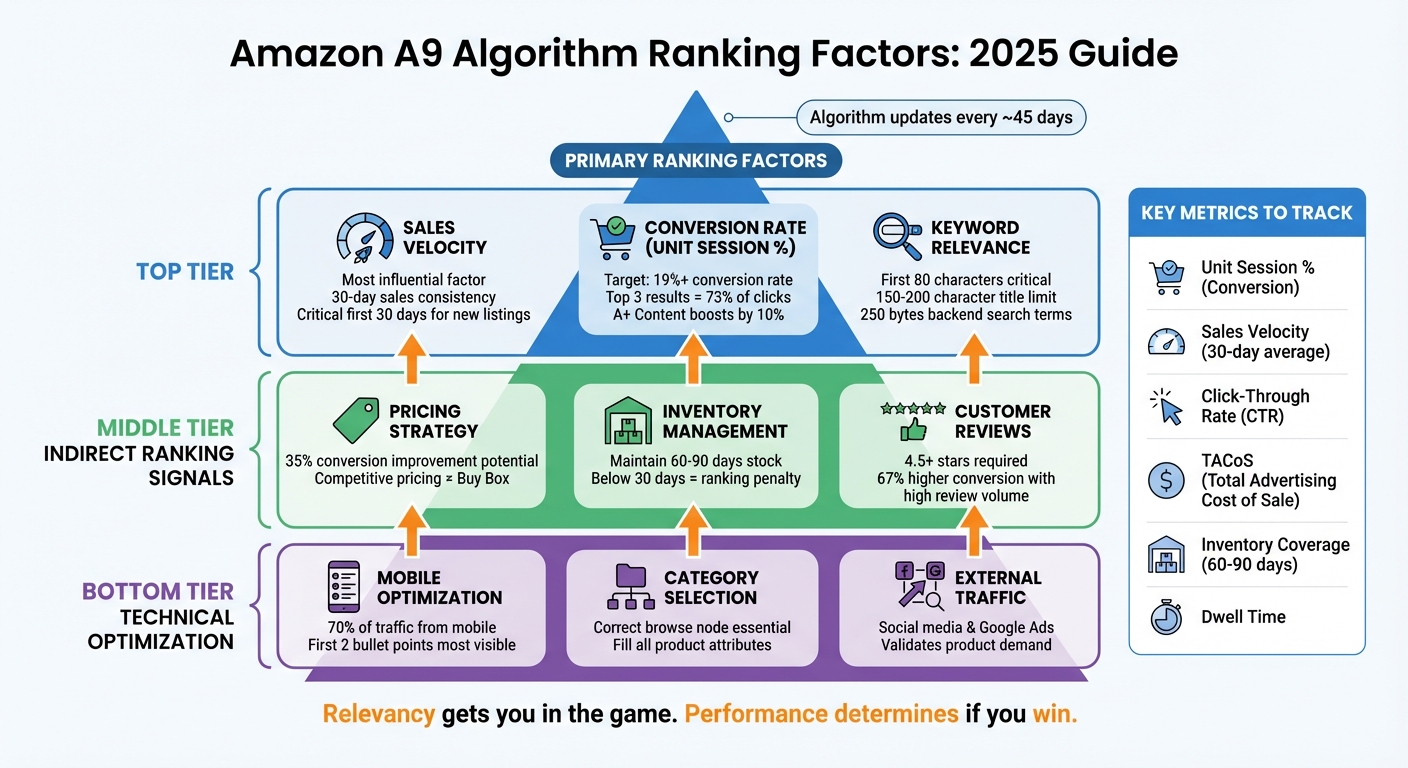
Amazon A9 Algorithm Ranking Factors 2025
Direct Ranking Factors for A9 in 2025
Sales Velocity and Performance Metrics
Sales velocity – how quickly and consistently your product sells – remains the most influential ranking factor in Amazon’s algorithm. Amazon prioritizes fast-moving products because they maximize revenue per search. The faster your product sells, the higher it ranks.
For new listings, the first 30 days are critical. During this "honeymoon period", Amazon gives your product a temporary ranking boost to gather performance data. At this stage, rankings are based on estimates, which are gradually replaced by real sales data. Using PPC (pay-per-click) during this window is key to generating the sales signals needed to establish a strong organic rank.
"Your PPC campaigns are not a marketing expense; they are a critical investment in training the A9 algorithm." – Headline Marketing Agency
Inventory management also plays a big role in maintaining sales velocity. To avoid penalties, ensure you have 60 to 90 days of stock in Amazon’s fulfillment network. If your inventory drops below 30 days of coverage, the algorithm may lower your rankings even before you run out of stock. Running out of stock doesn’t just pause progress – it resets it, forcing you to rebuild your ranking from scratch.
Strong sales performance lays the foundation for better conversions.
Conversion Rates and Their Components
Sales velocity might open the door, but conversion rates prove your product’s appeal.
Conversion rate, measured as Unit Session Percentage, combines factors like click-through rate (CTR), add-to-cart actions, purchases, and even dwell time. This metric acts as a key indicator of how well your listing meets customer expectations. In 2025, successful listings tend to maintain conversion rates above 19%. With the top three search results capturing 73% of all clicks for a keyword, your main image needs to grab attention instantly.
Adding A+ Content to your listing can boost conversion rates by up to 10% compared to listings without it. Use seven high-quality images that clearly show your product’s benefits. For mobile shoppers, emphasize the most important features in the first two bullet points.
However, high return rates – typically above 12% – can harm your ranking or even lead to listing suppression. Amazon’s algorithm evaluates not just the product but your ability to deliver on customer expectations.
Keyword Relevance and Optimization
While performance metrics drive rankings, keyword relevance ensures your product even shows up in the first place.
Keyword relevance acts as the initial gatekeeper. By 2025, Amazon’s algorithm has grown more sophisticated, using AI systems like COSMO and RUFUS to understand customer intent rather than just matching exact keywords.
"Relevancy gets you into the game. Performance determines if you win." – Headline Marketing Agency
To optimize your listing, include high-volume keywords within the first 80 characters of your title. Amazon now enforces a 150 to 200-character limit for titles in most categories, so make every word count. Use the full 250-byte limit for backend search terms, incorporating synonyms, misspellings, and long-tail phrases – but avoid repeating keywords already in your title or bullet points.
The algorithm also understands semantic relationships, so it knows that "laptop" and "notebook" refer to the same product type. Still, completing all structured data fields in Seller Central – like material, size, and color – is crucial. Missing these fields can make your product invisible when shoppers use sidebar filters. Amazon’s Product Classifier tool can help ensure you’ve selected the correct "Product Type" and filled out all relevant fields.
Finally, review your PPC Search Term Reports to identify which keywords drive the most conversions. Incorporate these terms into your front-end listing to strengthen organic relevance. The algorithm rewards listings that consistently align with customer intent. When combined with strong sales and conversion metrics, effective keyword optimization can significantly boost your A9 ranking.
🔍 Amazon SEO Evolution 2025: A9, COSMO, GEN AI, Rufus and more
Indirect Ranking Signals
In addition to direct performance metrics, factors like pricing, inventory, and customer reviews play a significant role in shaping your product’s visibility on Amazon.
Pricing Strategies for Better Conversions
Pricing has an indirect but powerful impact on key metrics. Competitive pricing can improve conversion rates by up to 35%. And when your conversion rates increase, Amazon’s algorithm is more likely to push your listing higher in search results. As Thomas Buckland, Founder of AmazonSEOConsultant, puts it:
"A9 heavily weights pricing factors in its ranking decisions".
Securing the Featured Offer (commonly known as the Buy Box) is highly dependent on maintaining competitive pricing. Tools like Amazon’s Automate Pricing can help you dynamically adjust your prices in response to competitor activity. Additionally, using the Manage Your Experiments tool allows you to A/B test different price points to find the optimal balance for boosting conversions. Promotions like coupons and flash sales can temporarily increase sales velocity, which is especially helpful for new listings trying to gain traction or for recovering from stockouts. However, before running discounts, it’s smart to use the Amazon Revenue Calculator to ensure your margins remain healthy.
These pricing strategies work hand-in-hand with direct sales efforts and lay the groundwork for effective inventory and fulfillment planning.
Inventory Management and Fulfillment
Amazon favors listings that are always in stock and ready for purchase. Keeping your inventory consistently available helps avoid penalties and maintain sales momentum. According to Canopy Management:
"Amazon rewards sellers who maintain at least 30 days of inventory coverage based on current sales velocity".
Leveraging Fulfillment by Amazon (FBA) can give you an edge by making your products eligible for Prime shipping and ensuring reliable delivery. If you opt for Fulfilled by Merchant (FBM), it’s essential to keep your Late Shipment Rate below 4% and your Pre-fulfillment Cancel Rate under 2.5%. Regularly check Seller Central’s dashboard to monitor restock thresholds and address stranded inventory issues. Planning ahead for peak shopping periods is also critical to avoid stockouts, which can disrupt sales momentum and hurt your rankings.
Customer Reviews and Ratings
Customer feedback is another cornerstone of Amazon’s A9 algorithm. While conversion rates and keyword relevance drive initial visibility, quality reviews solidify long-term performance.
Listings with a high volume of reviews are 67% more likely to convert, and products with an average rating of 4.5 stars or higher are seen as more reliable by shoppers. Looking ahead, Amazon’s AI shopping assistant, Rufus, integrates customer review data to answer shopper questions, making timely and detailed feedback even more crucial. The algorithm now places significant weight on review quality, sentiment, and "review velocity" – the steady flow of new reviews – which are all key to maintaining strong rankings.
To encourage reviews, use the "Request a Review" button in Seller Central to send Amazon-compliant review requests 5–7 days after delivery. For new products, enrolling in Amazon Vine can help you gather authentic, high-quality reviews from trusted reviewers. Always follow Amazon’s guidelines: avoid asking for positive reviews or offering incentives, and handle negative feedback professionally. A thoughtful response may even prompt customers to revise their reviews, improving your overall rating.
sbb-itb-e2944f4
Technical Optimization for A9
Getting your technical setup right is a game-changer when it comes to ranking on Amazon. By 2025, Amazon’s algorithm, A9, has become far more advanced in interpreting listing data, making precision in your technical details essential for success.
Search Term Indexing and Character Limits
Every listing field on Amazon has specific byte limits, and understanding these is key to optimizing your content. For mobile users – who make up about 70% of Amazon’s traffic – titles should ideally stay between 80 and 200 characters, with the first 80 characters being the most critical.
Amazon assigns different levels of importance to keywords depending on where they appear. Keywords in your title carry the most weight, followed by bullet points and then the product description. To make the most of this, front-load your most important keywords. Keep in mind that Amazon indexes only the first 1,000 bytes of your bullet points and the first 249–250 bytes of backend search terms. To maximize space, skip unnecessary punctuation, articles, and repeated words.
As Canopy Management explains:
"Amazon’s algorithm now emphasizes contextual understanding over simple keyword density, including stricter product title requirements… that align with how the AI interprets search intent."
It’s also worth noting that Amazon counts bytes – not characters – in backend keywords. Special characters like "é" can take up two bytes, reducing the total space you have. To cover all possible search patterns, include both numeric and text forms of specifications (e.g., "5 inches" and "five inches"). And don’t forget: using a high-quality main image (at least 1,000 x 1,000 pixels) enables zoom functionality, which can significantly influence conversions.
Finally, double-check that your product is listed in the most relevant category to boost its ranking potential.
Category and Browse Node Selection
Choosing the right category is more than just a checkbox – it directly impacts how visible your product is in search results. Amazon uses your listing’s keywords (especially in the title) to match your product to specific subcategories. If your keywords don’t align with your chosen category, Amazon might reassign your product to a different browse node.
Specificity is your best friend here. Picking a precise subcategory not only improves visibility in niche searches but also ensures your product appears in filtered results. Make sure to fill out all product attributes – like material, size, capacity, and special features – because these power Amazon’s search refinement filters.
As Headline Marketing Agency points out:
"If you haven’t correctly filled out the ‘Capacity’, ‘Material’, and ‘Special Feature’ attributes in the backend, your product will be invisible in that filtered search, regardless of how well-optimized your title is."
To ensure your product stays in the right category, regularly check your Category Listing Report in Seller Central. And when setting up PPC campaigns, review Amazon’s suggested keywords to confirm that your listing is properly indexed.
Once your indexing and categorization are on point, the next step is optimizing your listing for mobile users.
Mobile Optimization for Amazon
Since mobile traffic accounts for 70% of Amazon’s visits, your listing must be mobile-friendly to drive clicks and conversions. Mobile-optimized listings don’t just look good – they also perform better in terms of click-through rates and dwell time, both of which are critical for ranking.
Keep your product titles concise – ideally between 60 and 80 characters – so they display fully on smaller screens. Since images dominate mobile displays, your main image plays a huge role in attracting clicks. Use a "Descriptor + Benefit" format for bullet points (e.g., "Durable Build: Lasts for years") to highlight key features quickly. On mobile, only the first two bullet points are often visible without expanding the section, so make them count.
A+ Content is another powerful tool for mobile optimization. Features like comparison charts and high-quality visuals can boost dwell time and increase conversion rates by up to 10%. As Shai Belinsky, Senior SEO Specialist at Similarweb, advises:
"Titles should ideally be under 80 characters for optimal display across devices. The first 5–10 words matter most as they’re what users see in mobile and desktop search results."
Monitoring Performance and Adjusting Strategies
Optimizing for A9 requires constant attention and adaptability. With algorithm updates happening approximately every 45 days and competitors tweaking their strategies weekly, keeping a close eye on your metrics is critical to maintaining visibility and driving sales.
Tracking Key Metrics
To stay competitive, focus on tracking the metrics that matter most for maintaining and improving your rankings.
Conversion rate (Unit Session Percentage) is the top priority. It signals to Amazon that your listing effectively turns visitors into buyers. Sales velocity, which tracks the consistency and rate of sales over a 30-day average, is another key indicator of steady performance.
Your click-through rate (CTR) shows how well your main image, title, and price resonate with shoppers in search results. A low CTR suggests your product isn’t aligning with search intent. Keep an eye on Total Advertising Cost of Sale (TACoS), which compares your total ad spend to overall sales (both organic and paid). This metric helps you gauge whether your ads are driving organic growth or just covering up weak organic performance.
Inventory coverage is another critical metric. Maintaining 60–90 days of stock ensures you avoid penalties and ranking suppression. Additionally, monitor engagement metrics like dwell time (how long visitors stay on your page), add-to-cart rates, and customer Q&A activity – these signals are becoming increasingly important in 2025.
Here’s a quick summary of the essential metrics and why they matter:
| Metric Category | Key Metric | Why it Matters in 2025 |
|---|---|---|
| Visibility | Organic Rank | Drives long-term profitability without relying on ads |
| Performance | Unit Session % | Proves to A9 that your product meets search intent |
| Engagement | Dwell Time | Indicates to AI models (like COSMO) that content is relevant |
| Financial | TACoS | Shows how ads contribute to organic growth ("Flywheel Effect") |
| Logistics | Inventory Coverage | Prevents ranking drops due to stockouts |
Competitive Analysis and Adaptation
Keeping tabs on your competitors is just as important as monitoring your own metrics. Perform weekly ranking checks for your top 10–20 keywords to see how you stack up. Tools like Helium 10’s Cerebro or DataDive can help you reverse-engineer competitor ASINs to uncover which keywords are driving their sales.
Pay close attention to competitor listing updates. Changes in titles, bullet points, or lifestyle images can indicate new trends in your niche. Pricing strategies and promotional activities, such as Lightning Deals, can also temporarily boost competitors’ sales velocity and rankings – something to watch closely. Utilize Amazon’s Search Query Performance and Top Search Terms dashboards to identify queries that are sending traffic to your competitors instead of your brand.
"The first three listings capture 64% of all clicks".
Even small adjustments in your strategy can lead to significant gains in traffic and sales.
Continuous Improvement for Long-Term Growth
The most successful sellers don’t just set and forget – they constantly refine their strategies based on data. Establish a weekly routine to analyze impressions, CTR, conversion rates, and keyword rankings. Perform monthly or quarterly listing audits to adjust for seasonal trends and shifts in the market.
Use the Search Query Performance report to identify "missed sales" opportunities – keywords with high impressions but low conversions that may require listing tweaks. Regularly A/B test your main images and titles using Amazon’s "Manage Your Experiments" tool to improve CTR. Update backend keywords every three months to reflect new search trends and fill gaps left by competitors.
"The difference between amateur and professional Amazon sellers often comes down to how well they track and use data".
Without continuous refinement, even the best optimizations will lose their impact over time.
Key Takeaways for A9 Optimization in 2025
Summary of Core Ranking Factors
Amazon’s A9 algorithm revolves around two key elements: relevance and performance. Relevance ensures your product is indexed through strategic keyword use and correct category placement, but performance dictates where your product ultimately ranks. The most influential factor? Sales velocity – the consistency and rate of sales over a 30-day period. Additionally, your conversion rate (or Unit Session Percentage) signals to Amazon how well your listing turns visitors into buyers, which directly impacts revenue.
External traffic sources like social media, Google Ads, and influencer campaigns now play a larger role in validating product demand. With the top three search results capturing a whopping 73% of clicks, staying competitive requires fine-tuning both direct factors (like keywords, pricing, and inventory) and indirect signals (such as reviews, fulfillment methods, and seller authority). These insights form the foundation for actionable strategies.
Action Steps for Sellers
To optimize for A9, begin with your product title. Place your most critical keywords within the first 80 characters for better algorithmic weight and mobile visibility. Use all 250 bytes of backend search terms, incorporating synonyms and common misspellings, but avoid repeating words already in your title. Fulfillment by Amazon (FBA) is a must for gaining ranking advantages through Prime eligibility and streamlined logistics.
Here are a few key steps to implement:
- Maintain 60–90 days of FBA inventory to prevent stockouts and avoid penalties.
- Use PPC campaigns during the first 30 days to boost initial sales velocity.
Consistently test and refine your listings. Amazon’s "Manage Your Experiments" tool allows you to A/B test main images and titles, helping improve click-through rates over time. These efforts not only enhance keyword rankings but also build long-term seller authority.
How Emplicit Can Help Your Brand Grow

Navigating A9 optimization requires ongoing expertise and attention to detail. That’s where Emplicit comes in. They offer comprehensive ecommerce services tailored to help brands thrive on Amazon and other major platforms. From managing PPC campaigns to drive sales velocity, to optimizing listings for both relevance and conversions, Emplicit ensures your strategies align with A9’s demands.
Their USA-based account managers provide personalized support, handling technical aspects like inventory management and account health monitoring, so you can focus on scaling your business. Emplicit’s team keeps your seller authority metrics strong and adapts to algorithm updates, ensuring your brand stays competitive. Whether you’re launching a new product or scaling an existing one, Emplicit’s expertise can help you maintain top rankings in Amazon’s ever-changing marketplace.
FAQs
How does external traffic impact Amazon A9 rankings in 2025?
In 2025, Amazon’s A9 algorithm puts a heavy emphasis on external traffic that leads to conversions. When your product listing gets steady clicks from platforms like social media, online ads, or other non-Amazon sources, it signals to the algorithm that your product is in demand, which can help improve your ranking.
Bringing in external traffic doesn’t just make your product more visible – it also contributes to your sales momentum, which is a critical factor in boosting your rank. Using a mix of marketing channels, sellers can give their listings a competitive edge and thrive in Amazon’s crowded marketplace.
How does inventory management impact Amazon A9 rankings?
Proper inventory management is essential for keeping your Amazon A9 rankings strong. When you avoid stockouts, your products stay consistently available, which helps maintain steady sales and conversion rates – two crucial factors that Amazon’s A9 algorithm considers when ranking products.
Beyond that, keeping your inventory well-stocked enhances customer satisfaction. It minimizes delivery delays and cancellations, which not only improves your performance metrics but also increases your product’s visibility on Amazon.
How can I make my Amazon product listings more mobile-friendly?
To make your Amazon product listings more appealing to mobile users, start by crafting short, keyword-focused titles under 200 characters. Highlight essential product features and benefits using clear, easy-to-read bullet points. Ensure your main images are high-quality and fast-loading to capture attention on smaller screens. When it comes to descriptions, keep them simple and mobile-friendly, breaking up text into smaller chunks instead of lengthy paragraphs.
If you’re looking for additional support, professional services like Emplicit can assist with listing optimization to boost both click-through rates and conversions.