

Your Amazon ads might be profitable, but that doesn’t mean your brand is thriving. Many sellers in 2025 face a harsh reality: they’re overly dependent on paid ads, failing to build organic growth or customer loyalty. This reliance creates a fragile business model where rising ad costs and stagnant organic sales can quickly erode profits. Here’s what’s happening:
- Low ACoS isn’t enough: A low Advertising Cost of Sale (ACoS) can mask deeper issues like flat organic sales and weak repeat customer rates.
- Rising TACoS is a red flag: An increasing Total Advertising Cost of Sale (TACoS) shows your ad spend is outpacing organic growth, leaving you stuck in a costly cycle.
- Weak brand loyalty: If most sales come from new customers, not repeat buyers, you’re "renting" customers instead of building lasting relationships.
- Poor organic search rankings: Over-relying on ads without improving your product’s visibility in search results limits long-term growth.
To fix this, focus on strategies that lower TACoS, improve organic rankings, and build customer loyalty. Paid ads should fuel sustainable growth, not just maintain revenue. The key is balancing short-term ad performance with long-term brand strength.
TACoS Too High? Here’s How to Get It Below 22% and Still Grow Your Sales!
sbb-itb-e2944f4
Problem 1: Paid Traffic Dependency Limits Your Growth
Relying heavily on paid ads might bring quick sales, but it’s not a recipe for lasting success. Think of it as renting customer attention instead of earning their loyalty. The moment you stop spending, your visibility disappears. This "rental model" leaves you on shaky ground, where every dollar earned depends on continuous ad investment.
On top of that, Amazon already takes a cut of your revenue – commissions range from 3% to 20% depending on your product category. Combine this with rising ad costs, and your already slim margins shrink even further. To put it in perspective, Amazon’s retail business operates on razor-thin 1% margins, with advertising contributing about 83% of its total retail operating income. If your brand mirrors this model, you’re building on a weak foundation. This overreliance shows up clearly in one key metric: rising TACoS.
Rising TACoS Signals Trouble Ahead
If your TACoS (Total Advertising Cost of Sales) is climbing, it’s a red flag. It means your ad spend is growing faster than your total sales, leaving you in a position where you’re overspending just to maintain your current performance. This happens when organic sales fail to grow alongside your advertising. Instead of creating a positive cycle where paid sales improve rankings and lead to more organic traffic, you’re stuck in a loop of spending just to stay afloat.
Consider this: digital-first brands typically rely on new customers for about 66% of their revenue. This constant need for acquisition, rather than fostering loyalty, becomes a liability as ad costs continue to rise. In fact, increasing ad expenses are expected to be the top challenge for Amazon sellers by 2025. Without a shift in strategy, this reliance on paid traffic becomes unsustainable.
Short-Term Sales vs. Long-Term Growth
Using ads solely as a cost to minimize instead of a tool to drive growth is a missed opportunity. Strategic paid campaigns should boost your organic rankings by increasing sales velocity, but this only works if you’re deliberate about targeting the right keywords and structuring campaigns effectively.
Overusing discounts to drive sales is another trap. It eats into margins and trains customers to wait for deals, creating unpredictable revenue patterns. Without the organic growth that comes from strong rankings and repeat buyers, you’re stuck in a cycle of chasing the next ad campaign or promotion to keep sales coming in. To break free, you need to shift from short-term fixes to strategies that build lasting customer loyalty. That’s the only way to create a foundation for sustainable growth.
Problem 2: Weak Brand Identity and Low Customer Loyalty
If most of your sales come from ads, you’re stuck on what’s often called the "hamster wheel" of customer acquisition. The problem? As soon as you stop spending on ads, those sales spikes disappear, leaving you without a dependable customer base.
Here’s the reality: 66% of revenue across product categories comes from new customers. That’s a risky dependency. If your Customer Acquisition Cost (CAC) keeps climbing faster than your customer Lifetime Value (LTV), it’s like throwing money into a fire just to keep moving. And if your strategy relies on discounts to generate those ad-driven sales, you’re teaching buyers to wait for deals instead of appreciating your brand. In the end, they’re loyal to the discount, not to you.
One-Time Buyers Don’t Build Loyalty
This approach creates a shaky foundation for long-term customer loyalty. Most one-time buyers – or "switchers" – make decisions based on price or convenience, not because they feel any connection to your brand. Without that emotional tie, they’re unlikely to stick around or recommend your products to others.
This lack of loyalty becomes especially painful when you try to grow. Launching new products feels like starting from scratch every time. Without the "brand halo" effect – where customers’ positive feelings about your current products influence their interest in new ones – you’re forced to rely on expensive ad campaigns to gain traction.
Getting Lost in Competitive Marketplaces
Weak customer loyalty also makes it harder to stand out in crowded marketplaces. If your brand is discovered only through sponsored listings, it risks becoming just another commodity. Trust is a big deal – 88% of consumers say it matters. Without it, your brand often ends up competing on price alone. And while cutting back on brand-building might save money now, it can cost you later. For every $1 saved today, you may need to spend an extra $1.92 down the line. Plus, with 35% of shoppers finding new brands regularly, a strong identity isn’t just helpful – it’s essential.
Problem 3: Poor Organic Search Visibility Keeps You Stuck
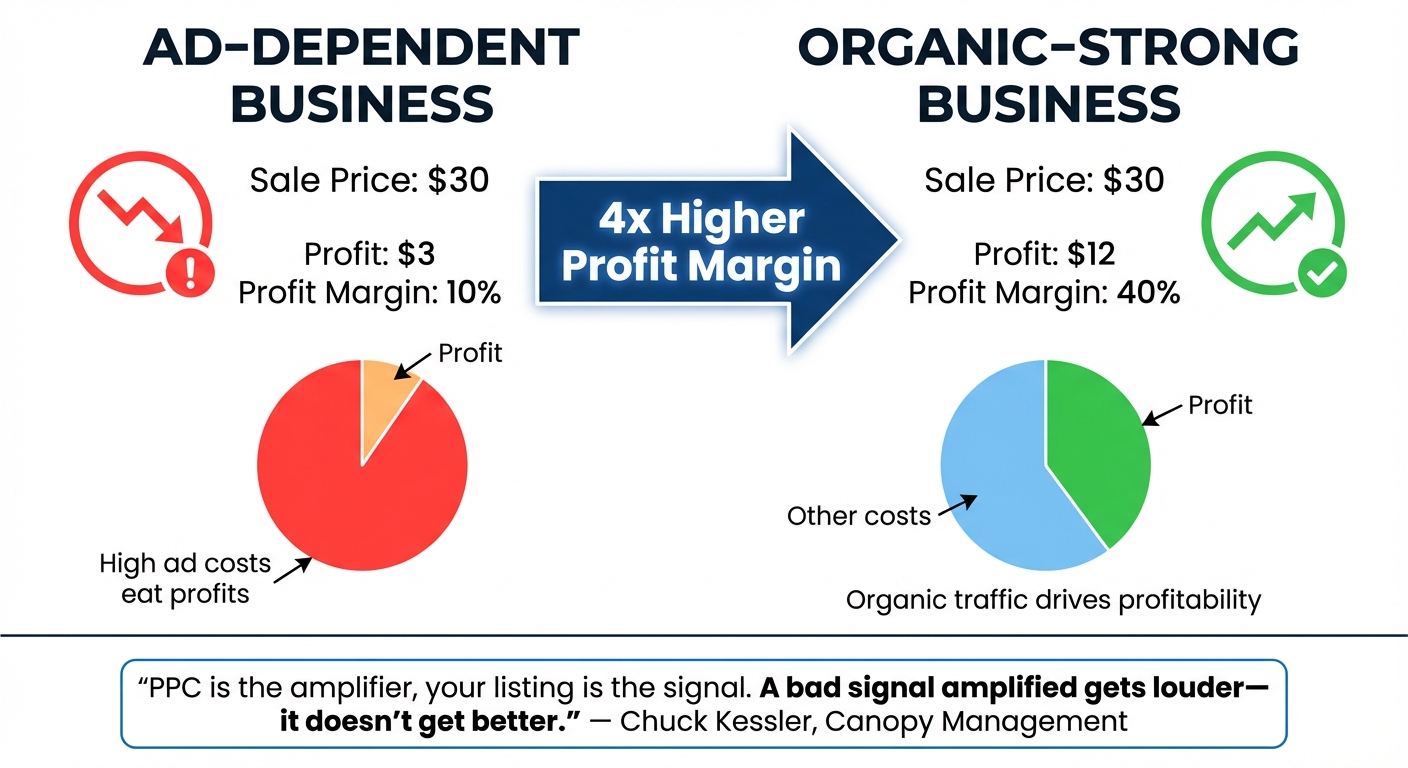
Ad-Dependent vs. Brand-Strong Amazon Business Models: Profit Margin Comparison
If your product isn’t ranking well organically, you’re stuck relying on paid traffic to drive sales. This approach forces you to pour more money into ads, which eats into your profits. For example, a product that relies entirely on paid traffic might only make $3 in profit on a $30 sale – a slim 10% margin – because of high ad costs. On the other hand, a product with strong organic visibility could bring in $12 profit on the same sale, with a much healthier 40% margin. This heavy reliance on ads creates a vicious cycle that undermines long-term profitability.
Why Paid Ads Don’t Boost Organic Rankings
Relying on paid ads alone won’t help your product climb Amazon’s organic rankings. That’s because Amazon’s algorithm prioritizes metrics like sales velocity and conversion rates – not ad spend. If your ads drive clicks but fail to convert into purchases, it signals to Amazon that your product isn’t resonating with shoppers. This can keep your organic ranking stagnant or even cause it to drop.
"PPC is the amplifier, your listing is the signal. A bad signal amplified gets louder – it doesn’t get better."
- Chuck Kessler, Content and SEO Manager, Canopy Management
While ads can give your product an initial boost, they only improve organic rankings if they generate the right performance signals. For that to happen, your product listing needs to be "retail ready." This means having high-quality images, engaging copy, and at least 15 reviews with a 4.0+ rating. Without these essentials, your ad traffic won’t convert well, leading to wasted ad spend without any organic growth.
Missing the Halo Effect from Ads
Another pitfall of poorly managed ads is the missed opportunity to create a "halo effect." This is when paid sales not only drive immediate revenue but also boost your organic visibility, leading to additional unpaid sales. When ads are mismanaged, this self-sustaining cycle never kicks in.
A great example of the halo effect in action comes from a consumer electronics brand led by Michael Maher. In March 2025, they used ads strategically to move their main product from outside the Top 100 to an impressive #46 in organic ranking. This shift resulted in 7.62% year-over-year growth and a 51% profit margin after fees. They achieved this by focusing their ad spend on the right keywords, which increased sales velocity and signaled relevance to Amazon’s algorithm.
On the flip side, many brands waste money targeting broad or irrelevant keywords. These clicks don’t convert into sales, which means they do nothing to improve organic rankings. Since Amazon’s algorithm relies on keyword-specific sales velocity, this kind of imprecision burns through your budget without delivering lasting results. Without a clear strategy, you’re spending money without building the organic visibility you need.
Solutions: How to Build a Brand That Lasts
Here are some practical strategies to balance paid advertising with organic growth and brand development. These approaches address the challenges of over-reliance on paid ads, weak brand identity, and poor organic visibility.
Lower Your TACoS for Long-Term Profitability
TACoS (Total Advertising Cost of Sale) is a key metric that compares your ad spend to your total revenue – covering both paid and organic sales. A healthy TACoS, typically around 10%, helps maintain profit margins while supporting growth.
A declining TACoS signals that your advertising efforts are contributing to long-term brand equity, even if your ACoS (Advertising Cost of Sale) remains steady or rises temporarily. This happens through the flywheel effect: ad-driven sales improve organic rankings, which in turn generate more organic sales over time.
To achieve this, consider a "Target for Rank" strategy. Focus your ad spend on high-impact keywords to boost your organic rankings. While this may cause a short-term rise in ACoS, the resulting increase in sales velocity should eventually reduce your overall TACoS.
Use automatic campaigns to discover high-converting keywords, then transition these to manual exact-match campaigns for better control and efficiency. Don’t forget to use negative keywords to block irrelevant, high-cost queries that don’t drive sales.
Prioritize your budget on proven bestsellers rather than low-margin items. For a quick TACoS improvement, allocate more spend toward branded campaigns, which often yield higher relevance and lower costs.
Lowering TACoS paves the way for sustained growth. Emplicit’s PPC management services can guide you through implementing these strategies while keeping an eye on the metrics that matter most for long-term profitability.
Build Brand Strength and Keep Customers Coming Back
Repeat customers are the backbone of profitability. They typically account for 65% of a company’s revenue and purchase 90% more frequently than new customers. Yet, many sellers treat purchases as one-off transactions.
To build loyalty, focus on creating emotional connections beyond product features. Use A+ Content and Brand Stores to tell your brand story, simplify the buying process, and encourage deeper engagement. Shoppers who visit a Brand Store buy 53.9% more often and spend 71.3% more per order.
Consistency is key. Maintain uniform visuals, tone, and service quality to build trust, as 80% of customers value their overall experience as much as the product itself.
Stay connected after the purchase. Use Sponsored Display "Purchaser Retargeting" with custom lookback windows – like 60–90 days for consumables – to remind customers to reorder. For everyday essentials, consider Subscribe & Save to encourage repeat purchases and build predictable demand. Enhance post-purchase engagement with setup guides, user tips, and personalized recommendations through Amazon’s Customer Engagement program to turn one-time buyers into loyal customers.
Social proof is powerful. Use Amazon Vine to generate early reviews and build credibility. Highlight these reviews prominently to reassure potential buyers and encourage repeat purchases.
Emplicit’s listing optimization and omnichannel marketing services can help you create a cohesive brand experience that keeps customers coming back.
Improve Your Organic Search Rankings
A strong brand and loyal customers naturally improve your organic search performance. Use Amazon Brand Analytics tools like the Search Query Performance and Top Search Terms dashboards to identify high-volume keywords and integrate them into your listings.
In July 2024, Guy Arad, Co-Founder of thefitguy, used this method and saw a 40% increase in quarterly sales after optimizing for the right search terms.
Conversion rate (CVR) plays a critical role in organic rankings. Optimized listings – with clear messaging, compelling visuals, and keyword-rich content – can significantly boost your CVR, making your ad spend more effective. Before ramping up ad budgets, ensure your listings are optimized for conversions.
Continuously test and refine listing elements like A+ Content, images, and titles using Amazon’s "Manage Your Experiments" tool to improve CVR and organic rankings.
Leverage the Market Basket Analysis dashboard in Brand Analytics to identify products frequently bought together. Create Virtual Bundles based on this data to increase average order size without additional ad spend. As Jason Panzer, President of HexClad, put it:
"It helped us determine which items we should try to cross-sell or upsell because we can identify typical purchase combinations." – Jason Panzer, President of HexClad
Expand beyond Amazon by linking your Amazon store to your website and social media platforms like Instagram and TikTok. Driving external traffic signals relevance to Amazon’s algorithm and can boost your organic visibility. Brands using Amazon display ads report an average 47% increase in non-Amazon sales.
Emplicit’s marketplace management services offer the expertise and tools to implement these strategies and improve your organic visibility.
Conclusion: Long-Term Success Requires More Than Profitable Ads
Profitable ads are important, but they’re not enough. Relying solely on paid ads for every sale means your brand isn’t growing – it’s just maintaining.
The ultimate goal is to lower your TACoS over time, signaling that your ad strategies are building organic visibility and lasting brand recognition. That’s when you stop renting customers and start owning your market position.
Success lies in balance. Paid ads drive initial sales velocity, organic rankings reduce long-term costs, and brand loyalty turns one-time buyers into repeat customers who are easier to convert.
The brands that thrive on Amazon aren’t necessarily those with the biggest ad budgets. They’re the ones that use ads strategically to build a brand that customers trust and return to, time and time again.
Don’t think of advertising as just an expense on your P&L. Treat it as an investment in your brand’s future. Because when the ads stop working, the strength of your brand is what will keep you afloat.
Conclusion: Long-Term Success Requires More Than Profitable Ads
Sure, profitable ads are important. But real success? That’s when your TACoS (Total Advertising Cost of Sales) starts to drop over time, showing stronger organic growth and a brand that resonates with customers. Lowering TACoS isn’t just about cutting costs – it’s about turning short-term ad wins into a machine for sustainable growth.
The brands that truly thrive don’t just chase new customers endlessly. They focus on building loyalty and standing out from the crowd. Ads should be used thoughtfully – as the spark that powers a long-term growth flywheel.
It’s all about finding the right balance. Paid ads might kick things off, but organic rankings help lower costs over time. Then, brand loyalty steps in, turning one-time buyers into repeat customers who not only cost less to win back but also spend more with every purchase.
As Jody Biggs, Director of Ads Monetization for Amazon Stores, puts it:
"Brand advertising is a performance multiplier. Once you quantify how brand advertising improves your performance across the entire customer journey, the question isn’t whether to invest… it’s how to optimize its impact."
Looking to move beyond short-term wins? Emplicit’s expertise in marketplace management, PPC strategies, and brand development can help you scale for long-term success. Let’s take your growth to the next level.
FAQs
How can I lower my TACoS while continuing to grow my brand?
To keep your TACoS low while still driving growth, it’s all about refining your ad strategy and boosting your organic reach. Start by zeroing in on high-margin, high-conversion keywords – this ensures your ad spend works harder for you. At the same time, put effort into creating SEO-optimized product listings and engaging brand content. This will naturally attract more organic traffic, cutting down your dependence on paid ads.
Don’t forget to regularly fine-tune your bids and refresh your ad creatives to keep your ACoS in check. The goal is to stretch every advertising dollar for maximum impact. Plus, focusing on building a loyal customer base and strengthening your brand identity will help you grow sustainably without letting your TACoS spiral out of control.
How can I build customer loyalty without relying on discounts?
Building customer loyalty isn’t just about throwing discounts around. It starts with delivering top-notch products and sharing a message that genuinely reflects your brand’s values. When customers see your brand as an extension of their own identity, they’re far more likely to stick around. Responding to reviews, addressing concerns, and making customers feel heard are crucial ways to show you value them beyond a single transaction.
Instead of relying on discounts, think about offering exclusive perks to reward loyalty. This could mean giving early access to new launches, providing tailored recommendations, or introducing a points system that unlocks special experiences rather than just money off. These approaches create a deeper emotional connection while keeping your profits intact.
To ensure long-term success, keep an eye on metrics like repeat-purchase rates and customer sentiment. By maintaining a consistent brand identity and nurturing a sense of community, you can build loyalty that lasts – even in a crowded marketplace.
Do Amazon ads impact my product’s organic rankings?
Yes, Amazon ads can play a role in boosting your product’s organic rankings. When your ads result in sales, they increase sales velocity, which signals to Amazon’s algorithm that your product is popular and in demand. Over time, this can help improve your product’s organic placement for relevant keywords.
That said, ads don’t directly replace organic rankings. Instead, they complement them by providing valuable performance data to Amazon’s algorithm. To avoid depending too much on ads, it’s essential to focus on optimizing your product listings, fine-tuning your keywords, and encouraging positive reviews. By combining ads to generate momentum with a strong organic strategy, you can achieve sustainable growth and better visibility on the platform.