
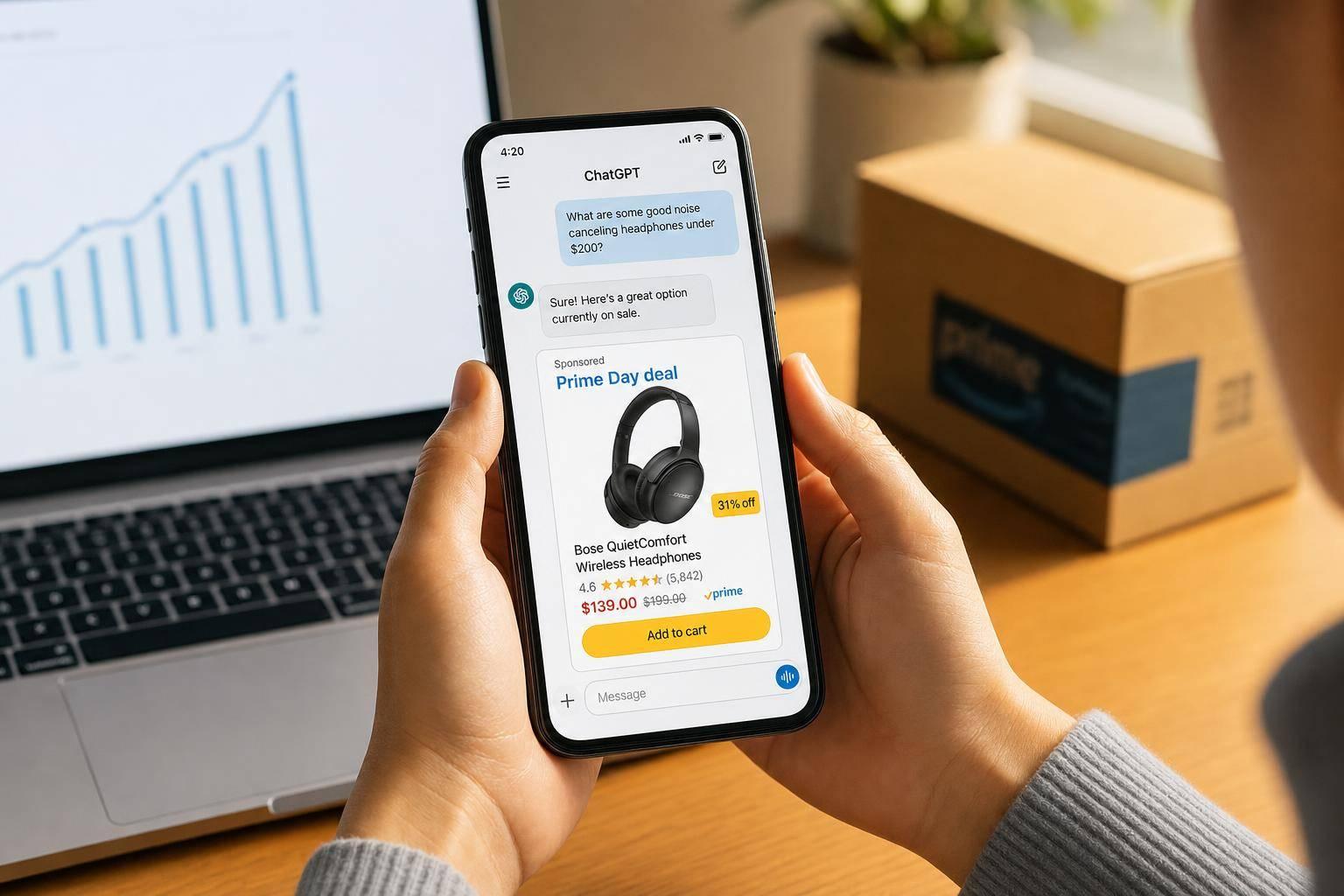
Amazon bought sponsored placements in ChatGPT during its four-day Prime Day 2026 event, testing a new advertising channel at the same time fresh data showed AI chatbot traffic produced unusually strong buying intent.
Adobe Analytics data released this week found that shoppers arriving at retail sites from AI chatbots during Prime Day 2026 were 40% more likely to complete a purchase than visitors coming from search, email, or social media. The source article said it was the first time in Prime Day’s history that AI-referred customers were the most likely to buy.
Amazon declined to comment on its ChatGPT ad purchase. But Marketplace Pulse founder Juozas Kaziukėnas posted screenshots of the ads on LinkedIn and described the move to Modern Retail as "really just a test." He also described Amazon’s approach as "symbolic."
A search for "best deal on Apple 11-inch iPad" in ChatGPT surfaced a sponsored Prime Day placement that linked users to Amazon.com rather than to a checkout flow inside the chat interface.
A traffic play, not an in-chat storefront
The source article said Amazon did not use OpenAI‘s product feed system as a direct commerce layer. Instead, it used ChatGPT as a traffic acquisition channel, sending users back to its own site, where Amazon keeps control of the transaction, customer relationship, and data.
That approach fits a broader pattern described in the source material. Amazon has blocked ChatGPT’s crawlers from reading its product listings, sued Perplexity after its AI browser shopped on customers’ behalf without authorization, and continues to block roughly 100 AI bots from accessing its site. According to J.P. Morgan data cited in the source article, agentic AI drives less than 1% of traffic across major online stores, and Amazon’s share is roughly 0.4%.
The same article said Amazon had also replaced its Rufus shopping chatbot with Alexa for Shopping and had pulled its product feed from US Google Shopping for over a month last year before returning.
sbb-itb-e2944f4
How ChatGPT‘s ad system works
OpenAI began testing ads in ChatGPT for US free and Go-tier users on February 9, 2026. Early advertisers included Williams Sonoma, Bed Bath & Beyond, and The Knot.
The ad system works differently from keyword-based retail ad platforms, according to the source article. When users ask product questions, OpenAI’s ad platform analyzes conversational context and matches sponsored placements to that discussion. The system does not use keyword auctions. Retailers submit structured product catalogs through SFTP in the same format used for Google Shopping, and OpenAI auto-generates ads from product names, images, and attributes.
The article said ads appear in clearly labeled tinted boxes below ChatGPT’s organic response and are governed by what OpenAI calls "answer independence", meaning ads cannot alter the AI’s organic replies.
Trust concerns and researcher criticism
The source article said this separation has not eliminated concerns about ads inside a conversational interface. It cited a January 2026 Ipsos survey reported by EMARKETER showing that 63% of US adults said ads in AI search results would make them trust the output less. A separate Partnercentric study found that 57% said AI chatbot ads would reduce their trust in the advertised brand itself.
Former OpenAI research scientist Zoë Hitzig resigned on the day the ads launched in February 2026, arguing that ChatGPT had accumulated an unprecedented archive of intimate personal data, making ad targeting in that environment fundamentally different from past ad formats.
A marquee retail advertiser joins a small market
The source article said Amazon’s appearance in ChatGPT ads marked a credibility milestone for OpenAI’s retail ad platform because Amazon is one of the biggest names in global retail.
OpenAI moved product feed management into a dedicated section of ChatGPT Ads Manager on June 2, 2026. The platform supports up to one million stock-keeping units per advertiser, requires a 100-product sample before opening full catalog access, and can support up to two million products total. It has also added a larger-image ad format with personalized call-to-action buttons including "shop now", "book now", and "sign up."
EMARKETER estimates AI chatbot advertising will generate less than $1 billion in revenue across the industry in 2026, or roughly 3% of total AI advertising spending. By comparison, the source article said J.P. Morgan expects Amazon’s own advertising business to generate approximately $83 billion in revenue this year and account for about one-third of Amazon’s operating income.
Why Prime Day made sense for the test
The source article said Amazon’s Prime Day use of ChatGPT was narrow and deliberate: event-level brand awareness aimed at high-intent chatbot users who could be directed back to Amazon.com.
Kaziukėnas said the more consequential question is whether Amazon expands from seasonal campaigns into product-level advertising inside ChatGPT. For now, the move amounted to a limited test during one of Amazon’s biggest shopping events, while data from Adobe suggested AI-referred visitors were arriving ready to buy rather than browse.
Amazon CEO Andy Jassy, cited in the source article, said the company’s experience with third-party AI agents had "not gotten great", pointing to issues including inaccurate pricing, incomplete product data, and the lack of personalized shopping history.
That tension sits at the center of Amazon’s ChatGPT ad debut: the company is willing to buy visibility inside an AI chatbot, but the click still has to return to Amazon.