

Understanding the difference between Amazon Gated Categories and Restricted Products is key to selling successfully on the platform. Gated categories require Amazon’s approval before listing items, while restricted products are either prohibited or require specific documentation to sell. Mistakes in these areas can lead to account suspension, unsellable inventory, or legal issues.
Key Takeaways:
- Gated Categories: Entire product categories (e.g., Jewelry, Automotive) requiring approval to list. Sellers must provide valid invoices, meet performance metrics, and often pay fees.
- Restricted Products: Specific items or brands (e.g., hoverboards, Nike) that need compliance with safety, legal, or regulatory standards. Some are entirely banned.
- Approval Process: Gated categories need invoices for 10+ units, while restricted products may require certifications like FDA or EPA approvals.
- Risks: Selling restricted products or listing in gated categories without approval can result in account penalties or suspension.
Pro Tip: Always check product and category requirements on Amazon Seller Central before sourcing inventory.
Here’s how to navigate these challenges and avoid costly mistakes.
What Are Amazon Gated Categories?
Definition of Gated Categories
On Amazon, certain product categories require explicit approval before sellers can list items. These are referred to as "gated categories." This system is in place to ensure products meet safety, authenticity, and legal standards, protecting both buyers and Amazon’s reputation.
"Amazon restricts categories which are particularly susceptible to counterfeiting and quality issues." – Webretailer.com
To sell in these categories, you’ll need a Professional selling plan (priced at $39.99/month), valid supplier invoices, and strong performance metrics. Specifically, Amazon looks for an Order Defect Rate below 1%, a Pre-Fulfillment Cancellation rate under 2.5%, and a Late Shipment Rate under 4%.
Now, let’s dive into the categories that are most commonly gated.
Common Gated Categories
Here are some of the most frequently restricted categories:
- Automotive & Powersports: Products like brake pads and helmets fall under this category due to strict safety requirements.
- Fine Jewelry & Watches: High-value items in this category are gated to mitigate counterfeiting risks. Sellers may need $50,000 in annual revenue or 12 months of selling experience to qualify.
- Grocery & Gourmet Food: Food safety, expiration dates, and FDA compliance are the primary concerns here.
- Medical Devices: Items in this category must meet FDA regulations, including registration numbers and 510(k) clearance.
- Dietary Supplements: Due to risks like mislabeling and unverified health claims, sellers must often provide a Certificate of Analysis from a third-party lab.
- Pesticides: Environmental safety concerns mean these products require EPA registration numbers.
- Fine Art: To ensure authenticity, sellers typically need at least three years of experience selling art.
Some categories are only partially gated. For example, while most Beauty products are open for listing, subcategories like "Topicals" require approval. Similarly, the Toys & Games category becomes gated seasonally (October through January) to ensure sellers can handle the increased holiday demand.
Once you’ve determined your category, the next step is to secure approval.
How to Get Approval for Gated Categories
Gaining approval for gated categories involves submitting precise documentation. Here’s what you’ll need:
- Invoices dated within the last 180 days showing a purchase of at least 10 units.
- Invoices from authorized wholesalers or manufacturers – retail receipts, packing slips, or pro-forma invoices won’t be accepted.
- Supplier details that exactly match your Seller Central account information. Amazon may contact your supplier to verify the invoices.
To apply:
- Log into Seller Central and go to the Inventory tab.
- Select Add a Product and search for your item.
- If "Listing limitations apply" appears, click it and choose Request Approval.
- Submit the required documentation.
"By requiring sellers to submit documentation before listing, Amazon reduces the likelihood of fraudulent, unsafe, or non-compliant products reaching customers." – AMZDOC LLC
Before investing in bulk inventory, test the listing first. Use the "Add a Product" tool to check for restrictions. This simple step can prevent costly mistakes, like purchasing unsellable stock. For categories like Fine Jewelry, be aware that ungating fees can be substantial, sometimes reaching thousands of dollars. Planning ahead is crucial.
sbb-itb-e2944f4
What Are Amazon Restricted Products?
Definition of Restricted Products
Restricted products on Amazon are specific items that require prior approval before they can be listed for sale. These restrictions are in place to meet safety, legal, and quality standards. Unlike prohibited items – such as illegal drugs or firearms, which are completely banned – restricted products can be sold if you provide the necessary documentation and obtain Amazon’s approval.
An easy way to think about it: gated categories block an entire group of products, while restricted products focus on individual items, even within open categories.
To sell restricted products, sellers must maintain an Order Defect Rate below 1%. Once you apply for approval, Amazon usually processes these requests within 3 to 10 business days.
Now, let’s dive into how these restrictions work at the ASIN and brand levels.
ASIN-Level and Brand Gating Restrictions
Amazon uses ASIN-level and brand gating to restrict specific products and brands. Unlike category gating, these restrictions are more precise, targeting individual listings or entire brands.
- ASIN-level restrictions apply to specific product listings. For example, a lithium-ion battery–powered tool might be restricted under hazardous materials (hazmat) rules, even if the broader Tools category is open. Sellers encountering these restrictions will often see warnings like "Listing limitations apply" or a yellow triangle in Seller Central.
"ASIN-level gates restrict individual listings even if the category is open."
– Dillon Carter, Co-Founder, COO at Aura
- Brand gating restricts all products under a specific brand, such as Nike, Apple, or Lego, to prevent counterfeit sales and ensure only authorized sellers can list those items. For instance, Amazon seized over 15 million counterfeit products in 2024 – more than double the 7 million seized in 2023 – and its AI systems now block over 99% of suspected counterfeit listings before they go live. Commonly gated brands include Nike, Lego, Apple, Samsung, Disney, Adidas, and luxury beauty brands like Clinique and Estée Lauder. Unauthorized sellers may also face a $1,500 non-refundable fee payable to the brand to gain approval.
Examples of Restricted Products
Here are some examples of restricted products and the reasons behind their restrictions:
- Alcohol: Requires age verification and compliance with regional laws.
- Laser pointers: Restricted due to safety concerns, particularly risks to eye health.
- Hoverboards: Often classified as "hazardous materials" because of battery safety issues.
- Counterfeit goods: Completely banned, with brand gating helping to eliminate fake listings.
- Pesticides: Require EPA registration numbers and specific seller training in the U.S..
- Medical devices: Must have FDA registration and 510(k) clearance documentation.
How to Get Ungated to Sell Anything on Amazon | COMPLETE GUIDE
Gated Categories vs. Restricted Products: Key Differences
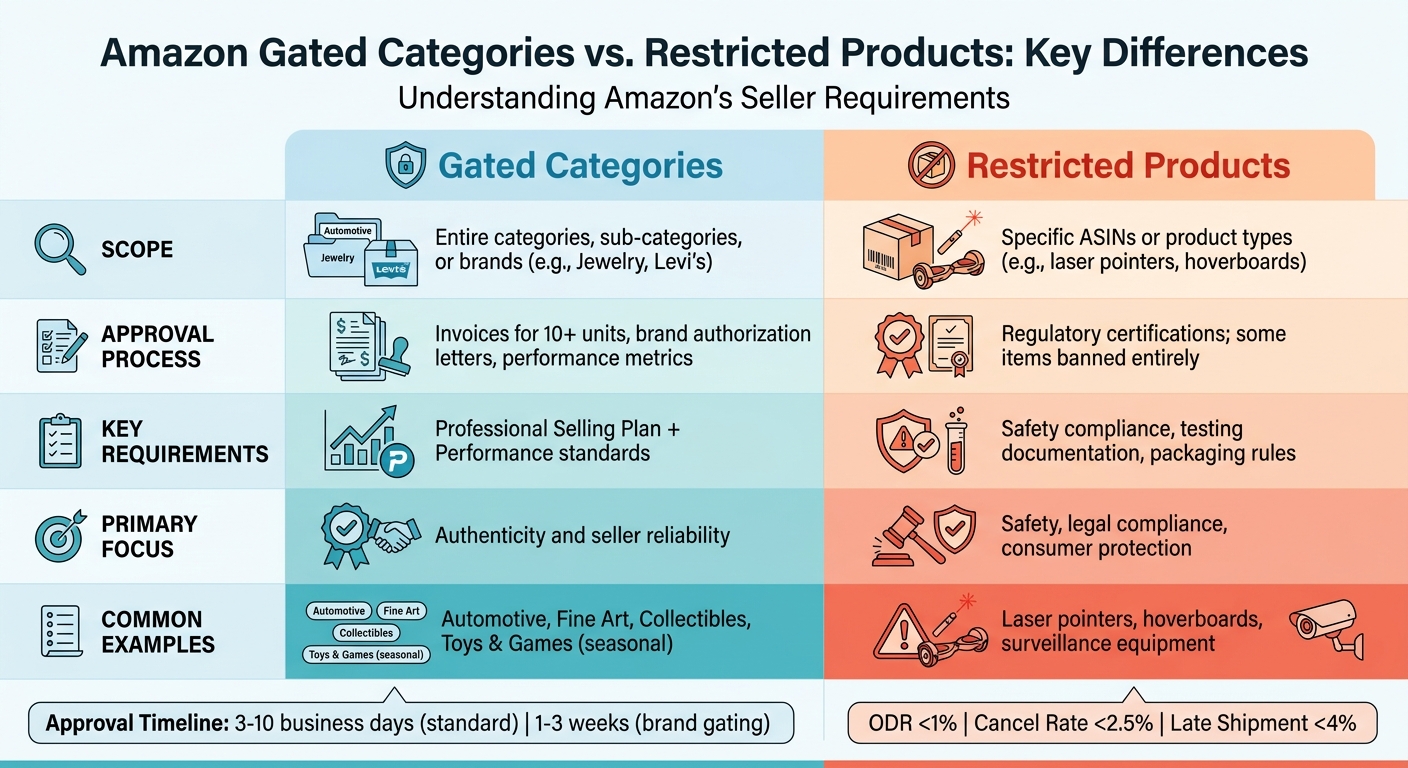
Amazon Gated Categories vs Restricted Products Comparison
Comparison Table: Gated Categories vs. Restricted Products
Here’s a breakdown to help you understand how gated categories and restricted products differ. Each comes with unique rules and requirements, so knowing these distinctions can save you from compliance headaches.
| Feature | Gated Categories | Restricted Products |
|---|---|---|
| Scope | Covers entire categories, sub-categories, or brands (e.g., Jewelry, Levi’s) | Focuses on specific ASINs or types of products (e.g., laser pointers, hoverboards) |
| Approval Process | Requires invoices for 10+ units, brand authorization letters, and meeting performance metrics | Needs regulatory certifications; some items are outright banned |
| Key Requirements | Requires a Professional Selling Plan and meeting performance standards | Must comply with safety laws, provide testing documentation, and meet packaging rules |
| Primary Focus | Ensures authenticity and seller reliability | Prioritizes safety, legal compliance, and consumer protection |
| Common Examples | Automotive, Fine Art, Collectibles, Toys & Games (seasonal) | Laser pointers, hoverboards, surveillance equipment |
If you’re aiming to sell in a gated category, prepare to submit wholesale invoices for at least 10 units purchased within the last 180 days. The approval process typically takes anywhere from 3 to 10 business days. For higher-end categories like Fine Jewelry, additional hurdles include a $5,000 entry fee and proof of $50,000 in annual revenue.
Where They Overlap and Common Mistakes
Although their rules are distinct, gated categories and restricted products can overlap, which often leads to confusion for sellers.
A common misconception is that an open category means all products within it are fair game. However, even in open categories, specific brands, ASINs, or sub-categories might still be gated. For instance, some segments in the Toys & Games category require separate approvals, especially during seasonal periods. This means sellers need to carefully check whether a product requires additional steps before listing.
"By selling products that require you to ungate, you are eliminating the competition of sellers who don’t want to bother with the hassle of unrestricting a certain product."
– Dillon Carter, Co-Founder and COO, Aura
Another frequent error is misunderstanding restrictions tied to product condition versus those tied to the category or brand. For example, categories like Baby Products, Beauty, and Grocery may allow new items but entirely prohibit the sale of used or refurbished ones. Additionally, Amazon may gate individual ASINs within an otherwise open brand to prevent issues like price gouging or unauthorized resale.
To avoid these pitfalls, always double-check both the category’s overall status and the specific ASIN’s requirements before sourcing inventory. Mastering these details can help you stay compliant and better manage your listings.
How to Handle Gated Categories and Restricted Products
How to Request Approval for Gated Categories
To check whether a product is gated, head to Seller Central and navigate to Catalog > Add Products. Enter the product’s ASIN or UPC, and if you see "Apply to sell" or "Listing limitations apply", the item is gated. Alternatively, you can use the Amazon Seller App to scan barcodes and confirm a product’s status.
If a product is gated, click "Request Approval" or "Show limitations" to see if the restriction applies to the brand, category, or ASIN. To proceed, you’ll need to submit wholesale invoices showing at least 10 units purchased within the last 90–180 days. Make sure the business name and address on the invoices match your Seller Central account details exactly. Keep in mind that retail receipts from stores like Walmart, Target, or Costco are not accepted.
Upload high-quality scans of your documents and submit your application. Standard reviews for category gating typically take 1 to 3 business days, but brand-gated reviews can take up to 1 to 3 weeks. You can monitor the status of your application in Seller Central under Catalog > View Selling Applications.
How to Avoid Restricted Product Violations
After gaining approval for gated categories, it’s crucial to ensure that all restricted products meet safety and regulatory standards. Restricted products require compliance with legal and safety regulations rather than just an approval process. Always verify a product’s status in Seller Central before sourcing. If you see "Not Available" or compliance warnings, the item may be prohibited or require certifications like a Certificate of Analysis (COA) or a Children’s Product Certificate (CPC).
Source your inventory only from authorized distributors or manufacturers who can provide proper documentation. Avoid using paid ungating services that offer fake invoices, as this can lead to permanent account suspension. Dillon Carter, Co-Founder and COO at Aura, emphasizes:
"Doctoring an invoice is the fastest way to get your Amazon account permanently suspended".
Stay updated on Amazon’s policies for your categories, as restrictions can change without notice. Regularly check the Account Health page and review performance notifications for any new restrictions on your listings. If you’re uncertain whether a product complies with current regulations, consult the category-specific requirements in Seller Central before listing it.
Staying Compliant Over Time
Getting approval is just the beginning; maintaining compliance is key to long-term success. Products can move from ungated to gated status at any time, so it’s essential to keep a library of compliant invoices for all your inventory. Glenn, a member of Amazon Staff, advises:
"Products can go from not requiring approval to requiring approval at any time. By ensuring that you have invoices that meet Amazon’s requirements you can protect the long term success of your business".
Keep your account health metrics in excellent shape. For most gated categories, Amazon requires an Order Defect Rate (ODR) below 1%, a Late Shipment Rate below 4%, and a Pre-fulfillment Cancel Rate below 2.5%. Sellers with strong performance over 90 days may even qualify for auto-approval in certain categories without needing to submit documents.
Conduct regular audits of your listings to ensure no products have been moved into restricted subcategories or gated at the ASIN level. If you’re a new seller, it’s wise to establish a 30-day sales history with ungated products before applying for gated categories. This "seasoning" period helps build the performance metrics Amazon evaluates. Finally, remember that maintaining a Professional Selling Plan, which costs $39.99 per month, is required to submit ungating applications.
Conclusion
Understanding the difference between gated categories and restricted products is crucial for protecting your account and ensuring long-term profitability. Each plays a specific role in maintaining the integrity of the marketplace, and recognizing this distinction is a key part of any compliance strategy.
Listing restricted items without proper authorization can lead to serious consequences, including permanent account suspension. As Daniel Hannig from SellerLogic cautions:
"Noncompliance with Amazon’s requirements can result in listing removals or account suspension".
On the other hand, meeting these requirements can provide advantages like higher profit margins and less competition. Many sellers shy away from gated categories due to the approval process, giving compliant sellers an edge.
Keeping your account health metrics in check is equally important. Metrics like an Order Defect Rate below 1%, a Pre-fulfillment Cancel Rate below 2.5%, and a Late Shipment Rate below 4% are essential – not just for gaining approvals but for maintaining long-term success. These benchmarks can also position you for faster approvals and open doors to new opportunities as Amazon’s policies change.
Additionally, products can move from ungated to gated status unexpectedly. To prepare for such shifts, maintain compliant invoices. Glenn_Amazon from the Amazon Seller Forum highlights this point:
"By ensuring that you have invoices that meet Amazon’s requirements you can protect the long term success of your business".
Whether you’re just starting out or looking to expand into regulated categories, a strong focus on compliance ensures your business can grow steadily and adapt to Amazon’s evolving marketplace.
FAQs
How do I know if a product is category-gated or ASIN-restricted?
To find out if a product is category-gated, see whether it falls under categories like luxury brands, supplements, or automotive parts. These categories often require seller approval for reasons like regulatory compliance or brand protection.
ASIN-restricted products, however, are tied to specific listings or brands that need approval, often due to safety standards or intellectual property rights. To stay compliant, use Amazon’s Seller Central to check products and regularly review their policies on restricted and gated categories.
What documents does Amazon accept for approval?
Amazon usually requires documents such as invoices, brand authorization letters, and regulatory compliance certificates for approval to sell in restricted categories. To prevent delays, make sure these documents align with Amazon’s exact guidelines.
What should I do if Amazon rejects my application?
If Amazon turns down your application for a gated category, don’t give up. Take the time to revise and resubmit your application with a more detailed and complete submission. Make sure you include all the required documents and clearly show how you meet Amazon’s guidelines. A well-prepared, accurate application can significantly improve your chances of getting approved.