

Amazon sellers often overcomplicate SEO.
They buy keyword tools too early, stuff listings with loosely related terms, and assume more keywords automatically means more sales. The video behind this article pushes back on that mindset. Its core argument is simple: you can build a solid Amazon listing SEO process using Amazon Brand Analytics alone, especially if your goal is relevance, not keyword volume theater.
That idea matters for small and mid-sized eCommerce teams. If you manage a lean catalog, limited ad budget, or an underperforming SKU, you do not need a bloated workflow. You need a disciplined one.
This article transforms the video into a clearer operating framework: how to use Amazon’s own search-term data, how to filter it intelligently, how to build titles and bullets around relevance, and where sellers commonly waste both ranking potential and PPC budget.
Why this approach matters in 2026
The most useful insight in the video is not "how to find keywords." It is how to think about listing SEO as a conversion problem, not just a visibility problem.
Many sellers chase impressions by forcing unrelated terms into titles, backend search fields, or ad campaigns. That can create three problems:
- Poor shopper relevance
- Lower conversion rates
- Wasted ad spend from broad, mismatched traffic
The speaker repeatedly emphasizes a principle worth keeping: if your product is wooden, do not optimize as if it were steel, glass, plastic, or marble just to borrow demand. That may increase appearances, but not qualified clicks.
For growth-stage brands, that distinction is critical. On Amazon, visibility without conversion quality is expensive noise.
sbb-itb-e2944f4
Key Takeaways
- Use Amazon Brand Analytics first before paying for third-party keyword tools.
- Filter keywords by product relevance, not just search frequency rank.
- Prioritize long-tail phrases that combine multiple buyer intents in one natural phrase.
- Build titles for both indexing and readability; don’t just stack terms.
- Keep bullet points short and scannable, because customers rarely read dense blocks of text.
- Avoid backend keyword stuffing; repeated or weakly relevant terms can hurt efficiency.
- Use competitor listings for pattern analysis, not for blind copying.
- Treat SEO and PPC as connected systems; irrelevant SEO can create irrelevant ad matching.
- Complete attribute fields carefully because catalog completeness supports discoverability.
- Start simple, measure performance, and refine instead of trying to "perfect" a listing in one pass.
The video’s method in one sentence
The process is: extract Amazon search terms from Brand Analytics, keep only relevant phrases, study successful competitors, then build a listing that reflects what buyers actually search for without overstuffing the content.
That sounds basic, but basic done well usually outperforms "advanced" done sloppily.
Step 1: Start with Amazon Brand Analytics, not guesswork
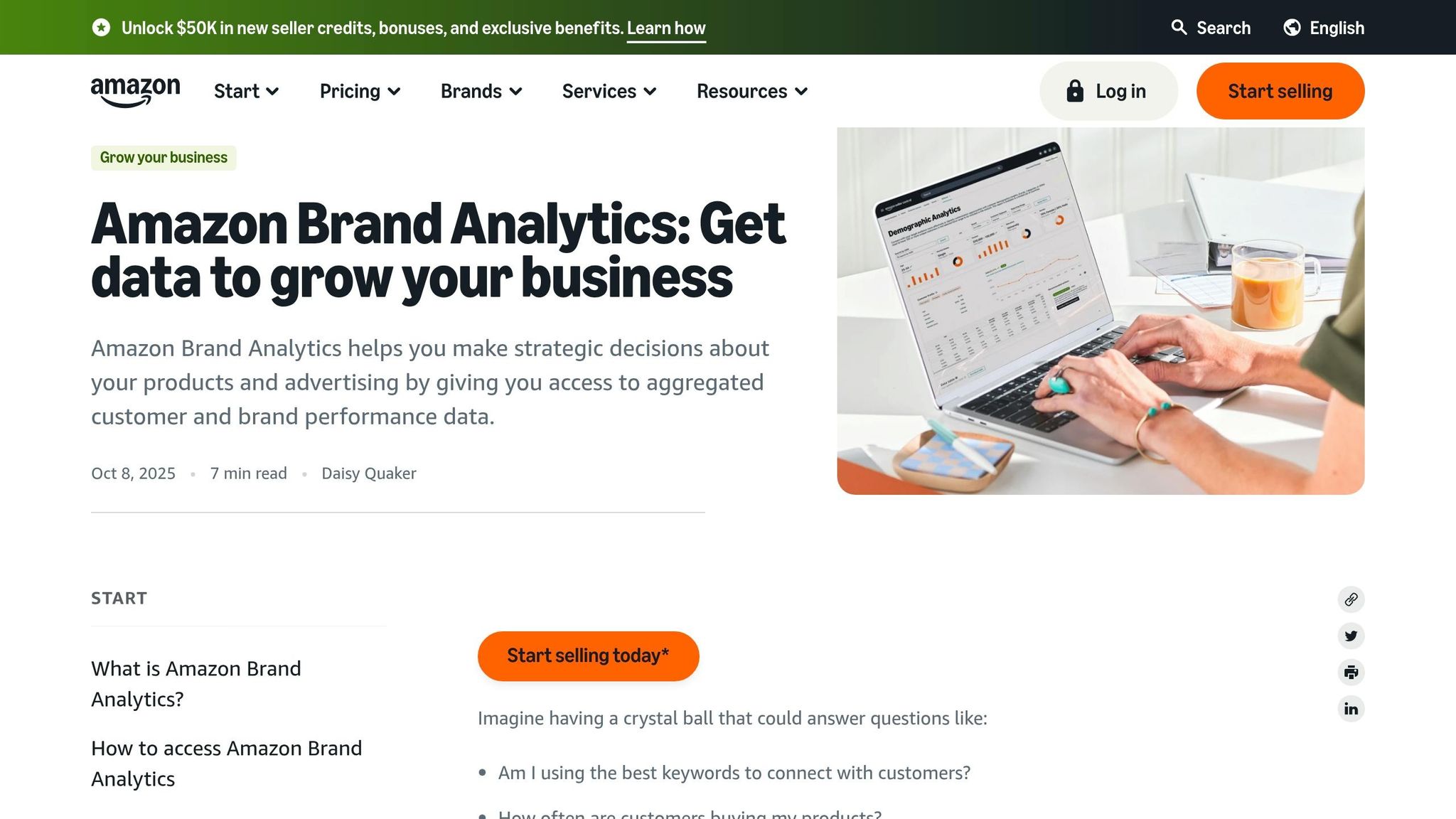
The workflow begins inside Amazon Brand Analytics, specifically the search terms report.
The goal is not to pull every possible keyword. The goal is to answer a sharper question:
What are customers already searching for around this product type?
In the video example, the product is a wooden chopping board. From there, the seller pulls search terms related to phrases like:
- chopping board
- cutting board
- wooden cutting board
- vegetable cutting board
- bamboo chopping board
The speaker uses the search frequency rank from Brand Analytics as a directional signal, since exact search volume is not directly provided in the report.
What this means strategically
For operators, Brand Analytics offers an important advantage: it reflects Amazon-native demand behavior. Third-party tools estimate demand through models. Brand Analytics starts closer to the source.
That does not make it perfect. It does make it practical.
If you already have Brand Analytics access, this should be your first-party keyword foundation.
Step 2: Build a raw keyword list, then clean it aggressively
One of the strongest parts of the workflow is the cleanup process.
After exporting search-term data into a spreadsheet, the seller strips the list down to two main fields:
- Search term
- Search frequency rank
Then comes the critical step: remove keywords that do not truly match the product.
For the chopping board example, irrelevant terms are removed, including terms related to:
- stainless steel
- glass
- marble
- plastic
- tray
- knife set
- holder
- round shape
- small size
- teak wood when the product is not teak
- brand names that are not the seller’s own
This is more than list hygiene. It is strategic restraint.
Why aggressive filtering improves performance
A common marketplace mistake is treating adjacent demand as useful demand. It often is not.
If your SKU is a large rectangular wooden board with a metal handle, then a search for "small glass chopping board" is not adjacent enough. Even if Amazon indexes the listing somewhere, that traffic is lower intent.
The video’s approach reflects a mature principle:
Keyword relevance is not a traffic issue. It is a conversion quality issue.
That matters even more if you run Sponsored Products. Weak relevance can distort your search term reports, waste bids, and make optimization harder later.
Step 3: Expand through buyer language variations
The video does something smart and very practical: it checks spelling variants and related naming conventions.
For example:
- chopping board
- choping board
- cutting board
This is useful because customers do not search with catalog precision. They search with habit, region, and imperfect spelling.
What sellers should take from this
You do not need to chase every typo obsessively. But you should:
- review common alternate phrasing
- identify synonym behavior
- confirm whether buyers prefer "cutting board" or "chopping board" in your market
- use natural variants across listing fields where relevant
This is especially helpful in categories where regional wording differs or where mobile search behavior leads to inconsistent phrasing.
Step 4: Use search frequency rank as a prioritization tool, not absolute truth
The speaker interprets lower search frequency rank as stronger search demand and higher rank values as weaker demand. That is directionally correct for prioritization.
But here is an important operational nuance not fully explored in the video:
Rank is useful, but conversion fit still wins
A term with stronger search demand is not always your best keyword if:
- the product doesn’t fully match the search intent
- top results are dominated by a different product type
- your price point is misaligned
- your images or reviews cannot compete
So, use search frequency rank to sort opportunity, but not to overrule merchandising reality.
For example, "cutting board" may be broader and larger than "wooden cutting board for kitchen", but the longer phrase may convert better if it aligns more tightly with the actual product.
Step 5: Analyze competitors for structure, not just keywords
After gathering search terms, the video shifts to competitor analysis.
The seller searches Amazon, identifies relevant competitors, and reviews:
- titles
- apparent order volume
- ASIN-level keyword presence in Brand Analytics
- CTR and conversion share indicators where available
This is the right move, but it should be framed carefully.
What to look for in competitor titles
Do not copy titles line by line. Instead, look for patterns such as:
- how early they place primary keywords
- whether they lead with material, use case, or size
- which modifier clusters appear repeatedly
- how they combine broad and long-tail phrases
- whether they include dimensions, handles, or surface benefits
The video notes a consistent title pattern across top listings: a primary keyword phrase first, then material/use-case modifiers, then functional descriptors.
That pattern matters because Amazon titles serve two audiences at once:
- the search algorithm
- the scanning shopper
Winning titles do not simply contain keywords. They organize information in the order buyers care about it.
Step 6: Build a title around high-intent phrase clusters
One of the clearest lessons in the video is the value of long-tail combinations.
The speaker explains that a phrase such as "wooden cutting board for kitchen" can help cover multiple search combinations at once. That is a useful way to think about title construction.
Why long-tail phrases are efficient
When you use a strong multi-word phrase naturally, you can support indexing for several smaller combinations, such as:
- wooden cutting board
- cutting board for kitchen
- wooden board for kitchen
- large cutting board
- chopping board for kitchen
The bigger point is this: semantic efficiency beats repetitive stuffing.
A better way to structure title logic
Instead of writing a title like this:
"Cutting Board Chopping Board Wooden Board Kitchen Board Large Board Vegetable Board"
Think in clusters:
- Core item type
Wooden Cutting Board - Primary use context
for Kitchen Use - Material or build qualifier
Bamboo / Mahogany / Solid Wood - Functional feature
with Metal Handle / Non-Slip / Thick Surface - Secondary use cases
for Vegetables, Fruit, Meat, Cheese - Dimension or size
if useful and space allows
That creates a title that is indexable, interpretable, and commercially legible.
Step 7: Don’t force every keyword into the title
The speaker creates a fairly long title and notes that Amazon policy guidance is evolving, with mention of shorter limits and the possibility of using highlights for additional information. The exact implementation can vary by category and timing, and the video does not specify category-specific enforcement details.
That uncertainty leads to the more durable lesson:
Your title should prioritize what matters most
Use title space for:
- the most important keyword cluster
- the most differentiating product facts
- the clearest purchase-decision details
Do not sacrifice readability to squeeze in every possible phrase.
A title is not only an indexing field. It is also ad copy, shelf signage, and conversion support.
Step 8: Keep bullets short, specific, and readable
This is one of the most practical sections in the video.
The speaker argues that sellers used to write oversized bullet points, but that shorter bullets work better. His advice: keep them concise, easy to read, and focused on what the customer needs to know quickly.
That is excellent guidance.
Why concise bullets outperform long bullets
On Amazon, bullets are not essays. They are decision accelerators.
Shoppers typically scan for answers to questions like:
- Is this the right size?
- Is it durable?
- What can I use it for?
- Does it have a handle?
- Is it easy to clean?
- Is it safe for knives?
- What makes it better than cheaper options?
If a bullet takes too long to decode, it fails its job.
A stronger bullet framework for sellers
Use each bullet for one job:
- Material and build quality
- Size and work surface
- Primary use cases
- Feature advantage
- Care, durability, or gifting/use context
The video also shows using ChatGPT to draft bullets and descriptions from the keyword set. That can be efficient, but there is an important caveat:
AI is a drafting tool, not a truth source.
Only include claims that are accurate for the product and permitted by Amazon policy.
If "antibacterial", "waterproof", or "knife-friendly" is not substantiated, do not add it just because competitors do.
Step 9: Treat backend search terms as a precision field, not a dumping ground
This is arguably the most valuable strategic warning in the video.
The speaker advises against filling backend search terms with every possible keyword. Instead, he recommends using a limited set of non-repetitive, highly relevant words that are not already overused in the visible listing.
That advice is sound.
Why backend keyword stuffing backfires
Sellers often assume the backend search terms field is free inventory for endless ranking attempts. In practice, bloated backend entries can create problems:
- diluted relevance
- redundant indexing
- wasted effort
- broader, less efficient ad matching
- less clarity in campaign analysis
The video’s stance is especially useful for ad-conscious sellers: too many marginal terms can send your listing and ads into weaker query environments.
Better backend search term principles
Use backend search terms for:
- relevant alternate phrasing
- omitted variants that don’t fit naturally in copy
- essential modifiers not already represented clearly
- compact, non-repetitive entries
Avoid:
- punctuation-heavy formatting
- duplicates
- unrelated materials or product types
- competitor brand names
- false claims
In short: backend terms should widen relevant reach, not manufacture fake relevance.
Step 10: Fill product attributes completely and accurately
The video also walks through editing product details beyond the title and bullets, including fields like:
- model name
- part number
- item type
- color
- dimensions
- recommended uses
- included items
- special features
This section may seem administrative, but it matters.
Why attribute completeness helps SEO and conversion
Amazon’s catalog system relies heavily on structured data. Complete and accurate attributes can support:
- faceted discoverability
- cleaner browse placement
- stronger shopper confidence
- fewer expectation mismatches
For example, including dimensions helps buyers self-qualify. Recommended uses help align the listing with practical intent. "Included items" reduces confusion.
For operations teams, this is low-cost optimization with real upside.
What the video gets especially right
Several ideas in the source material are more sophisticated than they first appear.
1. Relevance beats vanity reach
This is the central insight. More appearances do not matter if the wrong shoppers click.
2. Title strategy should reflect how customers search
The speaker repeatedly ties title wording back to actual buyer search terms, which is exactly the right orientation.
3. Short bullets respect shopper behavior
Many listings are still written like spec sheets. That hurts scanability.
4. SEO and PPC are connected
This is a strong practical point. Poor keyword discipline in listings can spill into poor traffic quality in ads.
Where sellers should apply caution
The video is useful, but there are several areas where experienced operators should add nuance.
Search demand estimates are approximate
The speaker infers rough search volume from rank positions. That may be directionally useful, but it is not exact. Do not budget or forecast from those assumptions alone.
Competitor claims should not be copied blindly
If another seller uses terms like "BPA-free", "waterproof", or "antimicrobial", that does not mean you should. Compliance matters, especially in kitchen and food-contact categories.
Character-limit guidance may vary
The video references changing title expectations and possible shorter limits. Since Amazon policies can differ by category and evolve over time, sellers should verify current rules inside Seller Central. The exact enforcement standard is not specified in the video beyond the general discussion.
SEO alone does not guarantee traction
The speaker makes an honest point: listing optimization helps visibility, but it does not promise sales. Product-market fit, pricing, reviews, images, and ad execution still matter.
That is not pessimism. It is operational reality.
A cleaner 2026 framework for Amazon listing SEO
If we condense the video into a professional workflow, it looks like this:
1. Pull demand signals from Brand Analytics
Start with search terms around the core product.
2. Export and simplify
Focus on search term and search frequency rank.
3. Remove irrelevant terms
Delete any phrase tied to wrong materials, sizes, features, shapes, or brands.
4. Add close variants
Include buyer-language alternates like synonyms and common spelling differences where relevant.
5. Study top competitors
Analyze title structure, feature emphasis, and query overlap.
6. Build a title in keyword clusters
Lead with the strongest relevant phrase, then layer in material, use case, feature, and size.
7. Write short bullet points
Keep them easy to scan and centered on product truth.
8. Use backend search terms sparingly
Prioritize omitted but relevant words. Avoid duplicates and stuffing.
9. Complete catalog attributes
Fill in structured fields carefully and accurately.
10. Validate with PPC and performance data
After launch or update, refine based on click-through rate, conversion rate, and search term quality.
What this means for eCommerce teams
For brands managing multiple SKUs or marketplaces, the biggest lesson is not "do SEO manually." It is this:
Good listing SEO is disciplined merchandising.
You are not trying to trick the algorithm. You are trying to:
- mirror customer language
- preserve product relevance
- improve conversion quality
- avoid unnecessary ad waste
- make the listing easier to understand
That is why this process is useful even if you later add tools like Helium 10, Data Dive, or other platforms. Third-party tools can accelerate research, but they do not replace judgment.
And judgment starts with one question:
Does this keyword accurately describe what the shopper will receive?
If the answer is weak, it does not belong in the listing.
Conclusion
The video’s biggest contribution is its simplicity. It strips Amazon SEO back to its essentials: understand how buyers search, select only what is relevant, write listing copy that reflects real intent, and avoid stuffing fields just because space exists.
For sellers and marketplace managers, that is a healthy reset.
In 2026, the most effective Amazon listing SEO is rarely the most complicated. It is usually the most disciplined: clean keyword selection, clear title architecture, concise bullets, complete attributes, and a strong respect for relevance.
If your current listings feel bloated, generic, or ad-inefficient, this framework is a good place to tighten the system.
Source: "Amazon SEO 2026 Step-by-Step: Complete Product Listing Optimization Guide (No Paid Tools)" – E-commerce Online Wala, YouTube, Jul 1, 2026 – https://www.youtube.com/watch?v=AOTlnastt94