

Organic traffic on Amazon offers lasting growth without ongoing ad spend. Unlike paid ads, organic sales improve profit margins and build long-term brand value. Success hinges on three main strategies: keyword optimization, better visuals, and external traffic sources.
For example:
- Keyword Optimization: A pet supplement brand used PPC data to identify high-converting keywords, improving organic visibility and sales.
- Visual Improvements: SteadyStraps revamped product images, boosting page views by 227.7% and sales by 12.5%.
- External Traffic: Driving Google and Facebook ads to Amazon listings increased keyword rankings and visibility.
These approaches help brands reduce advertising costs, improve rankings, and achieve compounding sales growth.
Marketplaces: Insider Strategies to Boost Organic Traffic and Ads Performance on Amazon with Farh…
sbb-itb-e2944f4
Case Study 1: Keyword Optimization for Niche Brand Growth
A niche pet supplement brand found a way to boost its organic traffic by using paid advertising data as a tool for keyword discovery. Instead of relying on guesswork, the brand analyzed its Sponsored Products campaigns to pinpoint high-converting keywords.
Keyword Research Methods
The process started by examining Sponsored Products search term reports to identify keywords that performed well in paid campaigns but had weak organic visibility. To refine their approach, they used Amazon’s Search Query Performance (SQP) dashboard in Brand Analytics. This tool helped them focus on terms with high purchase rates but low "Brand Share". The result? They uncovered keywords that were in demand but underutilized organically.
"Search Query Performance is a huge factor when deciding on which keywords to prioritize. Use it. It’s worth it." – Andres Londono, BellaVix
This strategy created a feedback loop between PPC and SEO. Keywords that excelled in paid campaigns were seamlessly added to the product listing’s title, bullet points, and back-end search terms, improving overall indexing and visibility.
How Keyword Placement Affected Sales
The brand strategically placed its main keyword in the title (e.g., "Glucosamine for Senior Dogs – Hip & Joint Support Supplement") to maximize the A9 algorithm’s impact and increase click-through rates. Bullet points were crafted with a focus on benefits, rather than just features. For example, instead of simply stating "Contains glucosamine", the updated description highlighted its role in promoting joint health .
This approach shows how blending paid advertising insights with strategic keyword placement can enhance organic growth, setting the stage for better visibility and increased sales. More strategies like this will be explored later.
Case Study 2: Image Optimization for Higher Click-Through Rates
Just like targeted keyword strategies, having the right images is essential for boosting organic visibility and driving conversions. SteadyStraps, a phone accessory brand, faced a big challenge with its organic traffic – its product images simply weren’t making an impact. Between April and June 2024, founder Larry Walters partnered with soona to overhaul the product listing for their "Solid Black Strap." Using soona’s AI-powered Listing Insights tool, they discovered their original images scored only 68 out of 100 due to issues like poor resolution and lack of variety.
To fix this, they made three key changes:
- Upgraded all images to over 1,600 pixels, enabling Amazon’s zoom feature.
- Added close-up shots to highlight details like texture and stitching.
- Incorporated lifestyle photos with hand models to provide a sense of scale.
These updates raised the listing score to 96. As a result, page views shot up by 227.7%, sessions increased by 103.9%, and units ordered grew by 12.5% in just two months.
"Our soona Listing Insight’s Score for our lead product was 68 and we improved our lead product’s listing with a soona score of 96."
- Larry Walters, Founder, SteadyStraps
This image overhaul laid the groundwork for even more mobile-specific enhancements.
Mobile-Optimized Image Tactics
When it comes to mobile shoppers, image optimization is a must. One effective strategy is ensuring the product takes up at least 85% of the image frame, keeping important details visible even on smaller screens. For instance, a kitchen scissors brand swapped out a plain, gray-on-white image for a 3D angled shot with bold lighting. This change led to a 47% increase in click-through rates and a 19% rise in conversion rates within just 30 days. Similarly, BellaVix tested two main images for a Boric Acid supplement using PickFu. The version that displayed the pills alongside the bottle resulted in a massive 307.14% jump in conversion rates.
By improving how products are presented visually, especially for mobile users, brands can significantly boost key performance metrics.
How Performance Metrics Affect Rankings
Amazon’s A10 algorithm heavily prioritizes conversion rates, which are estimated to make up 35–40% of its ranking formula. When better images lead to higher click-through and conversion rates, the algorithm rewards the listing with improved organic rankings. For example, a seller from the Titan Network mastermind group swapped generic lifestyle photos for problem-solution infographics. Using Amazon’s "Manage Your Experiments" tool over six weeks, they increased their session conversion rate from 18% to 29%, adding $47,000 in monthly organic revenue.
Stronger images don’t just boost clicks – they also drive sales, which prompts Amazon to improve a listing’s visibility. Moving up five search positions can increase revenue by 15–30% without spending more on ads. And because organic traffic typically converts 23% better than paid traffic, these improvements can snowball quickly.
"A 1% conversion rate improvement on a $2M SKU typically generates 8-12% net margin expansion, making CRO your highest-leverage profit activity after ranking improvements."
- Titan Network
Case Study 3: Using External Traffic Sources
This case study showcases how external traffic sources can fuel growth on Amazon. Between April and June 2024, Dave Bryant, founder of EcomCrew, conducted a strategic test using external ads to revitalize two underperforming Amazon listings. He allocated $4,996.28 to Google Performance Max and Facebook Retargeting campaigns, directing traffic to a Shopify bridge page. From there, 50.1% of visitors clicked "Buy on Amazon".
The bridge page played a key role, acting as a filter to weed out casual browsers before they reached Amazon. This approach helped safeguard the listings’ conversion rates from being diluted by window shoppers. Even with a high ACoS of 72.3%, the results were promising: over 90 days, the average organic keyword rankings improved from 13.21 to 10.96.
"A sale you send Amazon from an off-Amazon source results in more organic ranking juice."
- Dave Bryant, Founder, EcomCrew
This improvement signaled to Amazon’s algorithm that these products deserved higher organic visibility, prompting Amazon to promote them further. This success set the stage for exploring more tactical approaches.
Bringing External Traffic to Amazon
Building on this experiment, Bryant’s strategy began with careful keyword selection. Campaigns targeted 15–50 high-intent keywords derived from Amazon PPC data. To optimize spending, exact match campaigns were used alongside negative keywords (e.g., excluding "plastic" when promoting stainless steel bottles).
Timing was another critical factor. The first 30–60 days of a product’s launch – known as the "honeymoon period" – are when Amazon’s algorithm is most responsive to external traffic signals. Amazon expert Adam Heist explained, "Everything is on the line the first 30-60 days of a product’s life. Every launch campaign needs to have Google ads – you have to push the chips at launch".
When it comes to routing traffic, brands have two main options:
- Direct routing: Sends visitors straight to the Amazon product page.
- Bridge page routing: Uses an intermediary landing page with a "Buy on Amazon" button to filter out non-buyers and protect conversion rates, though it adds an extra step.
Both methods can benefit from Amazon Attribution links, which provide a 10% Brand Referral Bonus on sales driven from external sources. This bonus effectively reduces Amazon’s referral fees.
How External Traffic Affects A9 Rankings
External traffic packs a punch when it comes to Amazon’s A9 algorithm. Off-Amazon sales are believed to carry up to three times the ranking weight of standard organic sales. This tells Amazon that a product is so sought-after that shoppers are willing to search for it outside the platform.
The numbers back this up: off-Amazon search channels account for 41% of total sales and maintain a 58.6% cart-to-purchase conversion rate. Meanwhile, Google search channels achieve a 2.6% click-to-purchase conversion rate, which can increase to 3.1% for non-promoted products. By boosting sales velocity through external traffic, Amazon rewards listings with higher rankings for targeted keywords. This creates a "halo effect", where improved organic visibility drives additional sales without requiring extra ad spend.
"The goal of directing Google ad campaigns to your Amazon PPC listing is not a conversion or direct ROI, but rather to send external tag signals… so Amazon will notice and reward your product’s organic rank."
- Alexa Davis, Digital Marketing Manager, Scribe Media
This strategy works best for products rated 4.3 stars or higher. Lower-rated products often struggle to convert off-platform visitors, which can even harm their overall rankings. For brands ready to invest during the crucial launch phase, external traffic offers a strong opportunity to achieve sustainable organic growth.
Common Strategies Across All Case Studies
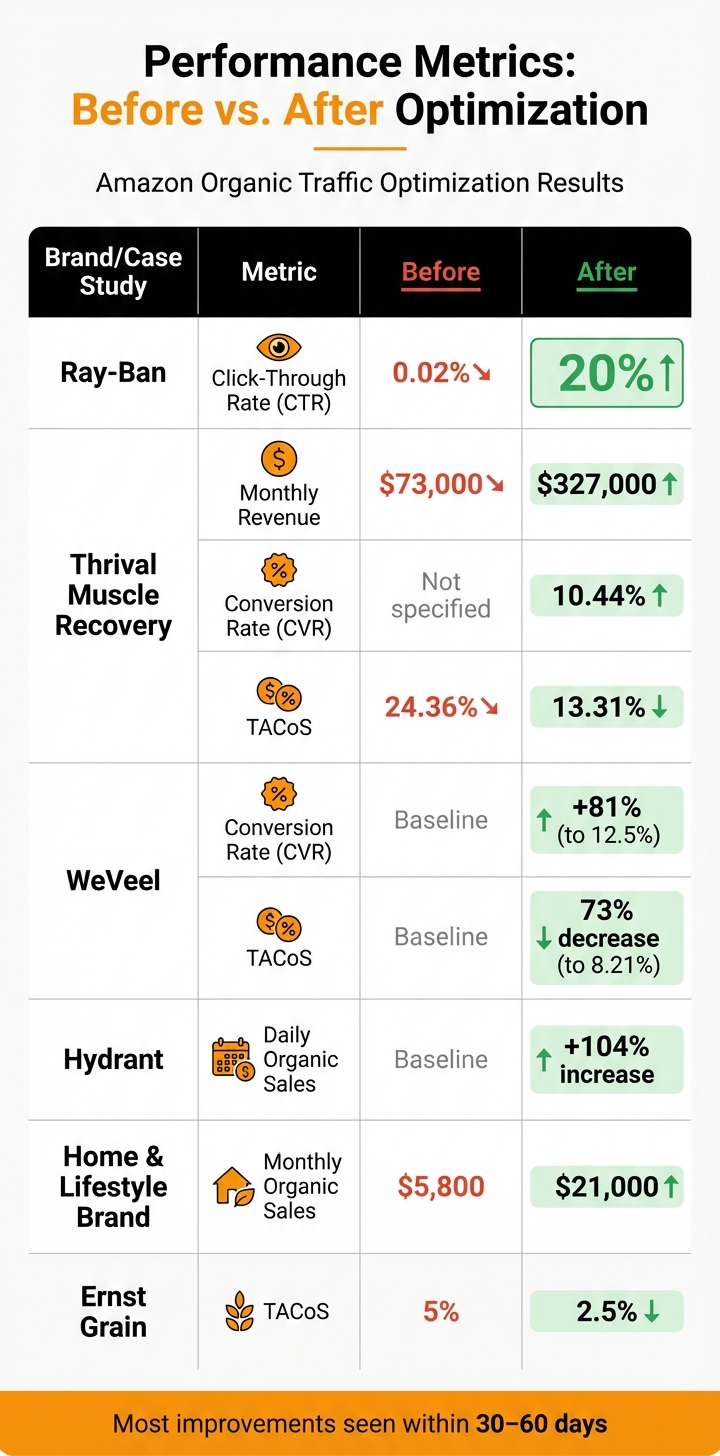
Amazon Organic Traffic Optimization Results: Before and After Performance Metrics
Looking at the case studies in detail, certain strategies consistently emerged as key drivers of success. Three main tactics stood out: targeted keyword optimization, upgraded visual content, and strategically aligned PPC campaigns.
Keyword optimization was the cornerstone. Brands conducted in-depth keyword research to identify high-traffic search terms, strategically embedding them into titles, bullet points, and backend search terms. Next came visual and content enhancements, where companies improved product images, added A+ content, and reformatted bullet points with bold text to make listings more engaging and easier to read. Finally, strategic PPC campaigns played a crucial role. Brands aggressively bid for top-of-search ad placements, signaling relevance to Amazon’s algorithm and generating the sales velocity needed to boost organic rankings.
A great example of synergy between paid and organic efforts comes from Nectar‘s collaboration with WeVeel. By aligning their advertising and copywriting teams around shared keyword goals, they achieved an 81% increase in conversion rates while slashing their Total Advertising Cost of Sales (TACoS) by 73%. This alignment created a snowball effect: ad-driven sales boosted organic rankings, reducing the need for paid traffic over time.
Performance Metrics Comparison
The results of these strategies are evident in the numbers. Here’s how some brands performed before and after optimization:
| Brand/Case Study | Metric | Before Optimization | After Optimization |
|---|---|---|---|
| Ray-Ban | Click-Through Rate (CTR) | 0.02% | 20% |
| Thrival Muscle Recovery | Monthly Revenue | $73,000 | $327,000 |
| Thrival Muscle Recovery | Conversion Rate (CVR) | Not specified | 10.44% |
| Thrival Muscle Recovery | TACoS | 24.36% | 13.31% |
| WeVeel | Conversion Rate (CVR) | Baseline | +81% (to 12.5%) |
| WeVeel | TACoS | Baseline | 73% decrease (to 8.21%) |
| Hydrant | Daily Organic Sales | Baseline | +104% increase |
| Home & Lifestyle Brand | Monthly Organic Sales | $5,800 | $21,000 |
| Ernst Grain | TACoS | 5% | 2.5% |
These results didn’t happen overnight. Most brands saw meaningful changes within 30 to 60 days, with the most dramatic improvements occurring when multiple strategies were implemented simultaneously.
Shared Tactics That Worked
In addition to the core strategies, several specific techniques repeatedly contributed to success:
- Listing consolidation: Merging product variations under a single parent ASIN helped brands concentrate reviews and sales velocity, strengthening their algorithmic position.
- Backend keyword optimization: Brands fully utilized the 250-character limit for backend search terms, ensuring no overlap with front-end copy. This often-overlooked step delivered measurable gains.
"Selecting the right keywords is the backbone of Amazon SEO; be strategic and careful on how to include the keywords in the listings." – Nitin Manchanda, founder of Botpresso
For instance, his team helped an Indian home products brand achieve a 23.9% month-over-month sales increase by tweaking titles and optimizing backend terms.
- Mobile-first formatting: Optimizing listings for mobile users was another game-changer. Ray-Ban’s CTR skyrocketed from 0.02% to 20% over eight months, largely due to mobile-friendly adjustments.
How Emplicit Achieves Similar Results
Emplicit applies the insights from these case studies to fuel organic growth across various channels. By focusing on strategies like keyword optimization, visual improvements, and effective PPC-to-organic integration, they’ve created a structured framework to deliver measurable growth on Amazon and other ecommerce platforms.
Emplicit’s Service Offerings
Emplicit provides a suite of ecommerce services grounded in these proven methods. Their listing optimization process uses reverse ASIN keyword research across multiple marketplaces. They prioritize placing primary keywords at the beginning of product titles while seamlessly weaving secondary keywords into bullet points and descriptions.
To broaden search reach, Emplicit optimizes backend search terms by incorporating variations, synonyms, and even common misspellings. Their PPC management focuses on blended TACOS (Total Advertising Cost of Sales), rather than just ACOS, ensuring ad spend contributes to long-term organic growth.
Beyond PPC and keyword optimization, Emplicit offers marketplace management for platforms like Amazon, TikTok Shops, Walmart, and Target. They also handle inventory and account health management to keep brands competitive and compliant. Through continuous strategic updates, they aim to sustain and improve organic performance over time.
Custom Strategies for Growth
Emplicit takes an iterative approach to growth, using quarterly content updates and ongoing keyword tracking to stay aligned with market trends. For instance, their strategy helped a home and lifestyle brand lower TACOS by 43% – from 27.6% to 11.4% – while increasing total monthly revenue by 141% in just seven months, ending October 2025.
Their custom approach creates what they call a PPC-to-organic flywheel. Paid campaigns signal relevance to Amazon’s A9 algorithm, which boosts organic rankings over time. One brand, for example, achieved a 3:1 organic-to-paid ratio, generating three organic orders for every paid order. Emplicit also highlights the importance of A+ content. While it doesn’t directly affect indexing, it enhances conversion rates, which can lead to higher organic rankings as part of a positive feedback loop.
Conclusion
The case studies highlight key strategies that drive sustained growth on Amazon. Success often hinges on strategic keyword placement, high-quality visuals, and integrated advertising efforts. Brands that prioritize their primary keywords in product titles, weave secondary terms into bullet points, and fine-tune backend search terms tend to achieve better results. For example, in July 2023, Momentum Commerce (now part of PMG) executed a large-scale content optimization strategy for a major clothing brand struggling with organic rankings. This approach led to a 35% increase in sales.
Investing in superior visuals also plays a critical role in boosting conversion rates. Additionally, external traffic signals can improve a product’s A9 ranking, ultimately enhancing organic visibility over time.
The findings emphasize the importance of ongoing SEO adjustments. Brands that regularly update their listings and ensure seamless collaboration across teams – spanning account management, advertising, and content – consistently outperform their competitors.
"The organic keyword ranking strategy requires excellent coordination and communication between the account management, advertising, and copywriting teams" – Nectar
Emplicit applies these insights to deliver measurable growth. Through continuous listing optimization, PPC management, and data-driven updates, they help sellers maintain a competitive edge. They also provide free tools, like the Product Listing Engagement Score and Inventory Restock Timing Estimator, to empower sellers with actionable insights.
FAQs
How can I find keywords to improve my organic rank?
Start with 10–20 broad seed keywords that align with your product, its features, and the benefits it offers. To expand this list, tools like Amazon’s autocomplete can help uncover long-tail keywords that reflect high intent. Focus on keywords that are most relevant for your titles, bullet points, and backend search terms.
As you refine your strategy, keep an eye on search volume and competition levels to ensure you’re targeting the right terms. Dive deeper by analyzing customer behavior and how your keywords perform after clicks. This will help you fine-tune your approach, improving both relevance and conversions – two key factors that directly influence your organic rankings.
Which product images improve clicks and conversions the most?
Lifestyle, iconographic, and comparison images are often the top performers on Amazon. These types of visuals help create an emotional connection with potential buyers, build trust, and clearly showcase the product’s features or benefits. This combination can lead to higher click-through rates and improved conversions.
Should I send external traffic to Amazon directly or via a bridge page?
When figuring out whether to send external traffic straight to Amazon or route it through a bridge page, it really comes down to your specific goals.
Sending traffic directly to Amazon can help improve your product’s organic rankings. Why? Because it signals to Amazon’s algorithm that your product is popular, which can lead to better visibility.
On the other hand, a bridge page gives you more control. You can fine-tune your messaging, collect leads, and even segment your audience for targeted follow-ups.
The best approach? Consider mixing both strategies. Use each one where it makes the most sense for your marketing objectives.