

If you sell on Amazon, sales tax collection for your transactions is handled automatically, thanks to marketplace facilitator laws. These laws, implemented across all U.S. states with sales taxes as of January 1, 2023, require platforms like Amazon to calculate, collect, and remit sales tax for marketplace sales. Here’s what you need to know:
- Amazon’s Responsibility: Amazon calculates, collects, and remits sales tax for transactions in states with marketplace facilitator laws.
- Seller’s Role: Sellers must assign correct Product Tax Codes to ensure accurate tax rates. For non-Amazon sales or states where FBA inventory creates nexus, sellers handle tax compliance independently.
- Marketplace Facilitator Laws: These laws simplify tax collection by shifting responsibility to platforms like Amazon, ensuring compliance and helping states recover billions in lost tax revenue.
- State Variations: Tax thresholds and rules differ by state. Sellers must monitor their nexus footprint and register for tax permits where required.
- Tax Reporting: Use Amazon’s Seller Central reports to track tax collection and ensure compliance, especially for multi-channel sales.
While Amazon simplifies tax collection for marketplace sales, sellers still need to manage registration, filing, and compliance for other sales channels. Stay informed about state-specific rules and maintain accurate records to avoid penalties.
Only 4 States Force you to Collect Taxes as an Amazon Seller in 2024

sbb-itb-e2944f4
What Are Marketplace Facilitator Laws?
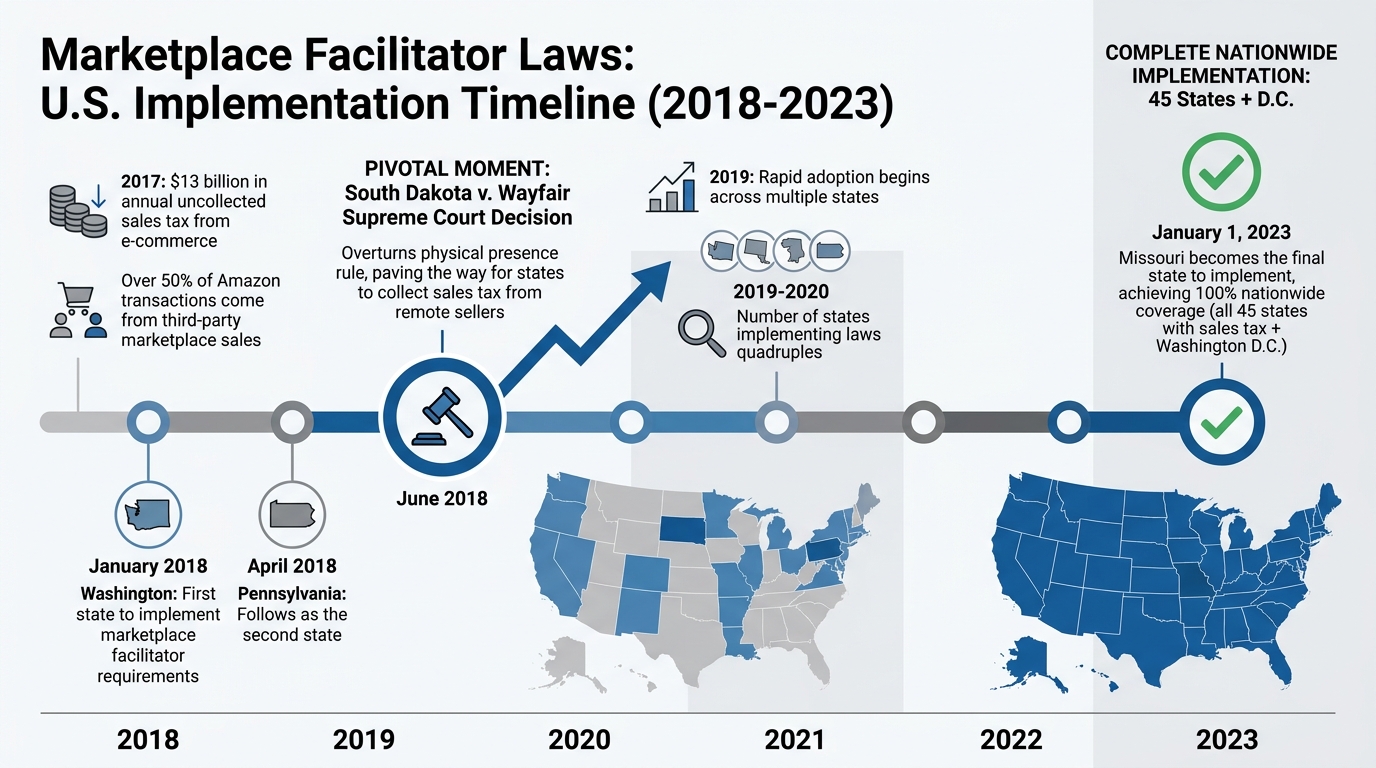
Timeline of U.S. Marketplace Facilitator Laws Implementation 2018-2023
Marketplace facilitator laws are state-level regulations that shift the responsibility for sales tax collection and remittance from individual sellers to the platform hosting their sales. Instead of requiring each third-party seller to handle these taxes, platforms like Amazon take care of the entire process.
A platform qualifies as a marketplace facilitator if it handles tasks like listing products, processing payments, and providing services such as fulfillment and customer support. Under these laws, platforms like Amazon calculate the correct sales tax based on the buyer’s location, collect it at checkout, and remit it to the appropriate state tax authority.
These laws were born out of the 2018 South Dakota v. Wayfair decision, which overturned the long-standing requirement that businesses must have a physical presence in a state to be obligated to collect sales tax. This ruling allowed states to enforce tax collection based on economic activity – commonly defined as $100,000 in sales or 200 transactions – regardless of physical location.
Washington led the charge by implementing marketplace facilitator requirements in January 2018, followed by Pennsylvania in April of the same year. The adoption of these laws gained momentum quickly, with the number of states implementing them quadrupling between 2019 and 2020. The final state, Missouri, joined the fold on January 1, 2023, achieving nationwide implementation.
Core Components of Marketplace Facilitator Laws
These laws outline specific responsibilities for platforms like Amazon when managing sales tax. The platform must:
- Calculate the correct local tax rates based on the buyer’s address.
- Collect the tax at the time of checkout.
- Remit the collected funds to the appropriate state and local tax authorities according to a set filing schedule.
To protect sellers, most of these laws include a liability shield. This provision ensures that sellers are not penalized for tax calculation errors made by the platform, provided they supplied accurate Product Tax Codes. This is crucial because sellers no longer control the tax calculation process once the platform takes over.
The scope of these laws typically includes sales of tangible goods, digital products like e-books and software, and certain taxable services. However, the sales thresholds that trigger a platform’s obligations vary by state. For instance, California’s threshold is $500,000 in total sales, while Florida sets it at $100,000.
Why These Laws Were Created
Before marketplace facilitator laws, states struggled with a massive gap in sales tax compliance. By consolidating the responsibility to a handful of large platforms rather than millions of small sellers, enforcement became far more efficient.
The financial stakes were high. In 2017, U.S. states were estimated to lose $13 billion annually in uncollected sales tax from e-commerce. With more than half of Amazon’s transactions coming from third-party marketplace sales, states needed a dependable way to capture this revenue.
These laws also addressed fairness in the marketplace. Previously, remote sellers enjoyed a price advantage over brick-and-mortar stores, which were always required to collect sales tax. By requiring platforms to handle this process, the laws not only leveled the playing field but also reduced the administrative burden on small businesses that would otherwise need to register and file tax returns in multiple states.
This evolution in tax regulation sets the stage for Amazon’s detailed tax collection and remittance processes, which will be discussed next.
How Amazon Collects and Remits Taxes
Amazon simplifies tax collection by automating the process once a customer completes a purchase. The system determines if the transaction is taxable based on the destination state’s regulations, calculates the appropriate tax rate according to the buyer’s location, and collects the tax during checkout. If marketplace facilitator laws apply, Amazon designates the transaction as "MarketplaceFacilitator" in your settlement reports and handles the entire remittance process to the state. You can verify this by checking the "Tax Collection Model" field in your Channel Order lines.
For example, on a $100 sale with $15 in tax, you receive only the $100. Amazon collects and remits the $15 directly to the tax authority. In this system, the tax amount never enters your cash flow. Settlement statements for MTC transactions typically show a net-zero balance for tax-related funds since Amazon collects the tax from the buyer and remits it without involving your account.
"Amazon’s introduction of a Marketplace Facilitator program almost takes the responsibility of remitting sales tax out of your hands as an Amazon seller, but there are a few considerations to keep in mind." – Cyndi Thomason, eComEngine
As a seller, you are not responsible for remitting taxes that Amazon has already calculated, collected, and paid to the state.
Amazon’s Marketplace Tax Collection (MTC) Process
Amazon’s tax collection process is highly automated. When a sale occurs, the system pinpoints the buyer’s location to determine the correct tax jurisdiction. It then checks whether marketplace facilitator laws apply and if the transaction meets state-specific thresholds, like California’s $500,000 or Florida’s $100,000 in annual sales.
The decision to apply MTC or TCS (Tax Collection Services) is not up to the seller. Instead, Amazon determines this based on the tax collection rules of the state or jurisdiction where the transaction took place. This process is consistent across transactions, although fulfillment methods introduce additional nexus considerations.
Tax Collection for FBA vs. FBM Orders
Amazon’s tax collection process remains consistent regardless of whether the order is fulfilled through Fulfillment by Amazon (FBA) or Fulfillment by Merchant (FBM), as long as marketplace facilitator laws are in effect. However, the nexus implications differ significantly between these two fulfillment models.
For FBA, Amazon stores your inventory in fulfillment centers across multiple states, which can create "physical nexus" or "inventory nexus." This means you may establish tax obligations in states where you do not directly operate. Among 8,416 businesses evaluated, 6,076 relied solely on FBA, while 1,944 used a mix of FBA and FBM. FBA sellers must monitor these additional nexus obligations, especially for non-Amazon sales channels.
FBM sellers, on the other hand, maintain more control over their nexus footprint. They only establish physical nexus in states where they have their own warehouses, offices, or staff. This makes compliance simpler for sellers who operate exclusively through Amazon. However, those selling across multiple platforms must carefully track which sales Amazon handles and which require independent tax collection and remittance.
"Inventory location, state thresholds, registration history, old sales channels, and entity structure can all change the answer." – The FBA Guys
With approximately 86% of Amazon sellers using FBA, most face the complexities of managing nexus obligations across Amazon’s distributed fulfillment network. Even though Amazon manages tax collection for marketplace sales, it’s essential to keep detailed records distinguishing Amazon transactions from other channels to ensure compliance across all revenue streams.
State-Specific Tax Collection Rules
Amazon is responsible for collecting and remitting sales tax in 45 states and Washington, D.C.. However, the five states without a statewide sales tax – Delaware, Montana, New Hampshire, Oregon, and Alaska – don’t require Amazon to collect state-level taxes. That said, Alaska is an exception in some ways, as over 100 local jurisdictions there have their own marketplace collection requirements.
With marketplace facilitator laws now in place across most states, Amazon automatically takes care of the majority of tax collection. However, sellers still need to stay informed about local tax rules. Each state has its own thresholds, rules, and enforcement dates, so understanding these details is essential to ensure compliance and address any additional responsibilities.
Table: States with Marketplace Facilitator Laws
| State | Enforcement Date | Amazon MTC Active | Notes |
|---|---|---|---|
| Alabama | Jan 1, 2019 | Yes | Threshold: $250,000; uses Simplified Sellers Use Tax (SSUT) |
| Alaska | Jan 1, 2020 | Yes (Local) | No statewide tax; collection varies by local jurisdiction |
| California | Oct 1, 2019 | Yes | Threshold: $500,000; registration not required if 100% marketplace sales |
| Florida | July 1, 2021 | Yes | Threshold: $100,000 |
| Illinois | Jan 1, 2020 | Yes | Removing 200-transaction threshold effective Jan 1, 2026 |
| New Jersey | Nov 1, 2018 | Yes | Sellers may request "non-reporting" status when selling solely via marketplaces |
| New York | June 1, 2019 | Yes | Threshold: $500,000 and 100 transactions |
| Texas | Oct 1, 2019 | Yes | Threshold: $500,000; major FBA fulfillment center state |
| Washington | Jan 1, 2018 | Yes | Threshold: $100,000; requires separate B&O tax filing |
Some states have unique conditions that sellers should note. For example, in Maryland, publicly traded communications companies can request a waiver if they have an agreement with Amazon to collect their taxes. In Mississippi, marketplace sellers with over $1 billion in national revenue can choose to collect and remit their own sales tax rather than relying on Amazon. Additionally, states like Nevada, New Jersey, and North Carolina allow sellers to take on tax collection responsibilities through written agreements with the marketplace.
Staying on top of these state-specific rules is critical for managing tax obligations across various jurisdictions.
Managing State-Level Tax Differences
While Amazon’s automated tax collection simplifies much of the process, sellers must still account for state-specific variations. This is especially true in home-rule states like Colorado and Louisiana, where local tax obligations may require additional attention.
"Amazon handled one slice of the retail tax workflow. It did not decide whether you should be registered in a state for another reason… Those are still seller problems."
– The FBA Guys
To stay compliant, review your Amazon Tax Reports monthly to ensure state-specific tax collections align with your inventory locations. If you have inventory stored in a state due to FBA, this physical presence (known as physical nexus) might require registration. Additionally, don’t forget to track and reconcile sales made outside of Amazon separately.
What Sellers Must Do After Amazon Collects Taxes
Even though Amazon takes care of collecting and remitting sales tax, sellers still have some important responsibilities to stay compliant. You’ll need to handle state tax registration, file necessary returns, and manage tax-exempt sales while keeping detailed records.
"Amazon usually handles the sales-tax collection piece on Amazon marketplace sales… but your state obligations still split into three separate jobs: sales-tax collection on the marketplace order, registration and filing duties tied to your own facts, and entity or income-franchise obligations." – The FBA Guys
State Registration and Filing Obligations
Sellers must register for sales tax permits in states where they have a nexus and ensure they file returns on time, even if those returns show $0 in tax collected. Skipping this step can lead to penalties and increase your chances of being audited.
Handling Tax-Exempt Sales
Tax-exempt sales come with their own set of requirements. If a business or nonprofit buys from you without paying sales tax, you’re responsible for collecting valid exemption certificates to prove their tax-exempt status. Amazon offers the Amazon Tax Exemption Program (ATEP), where eligible buyers can upload their exemption certificates directly. However, it’s up to you to ensure these certificates are accurate, up-to-date, and relevant to the state where the sale occurred. Without proper documentation, states might hold you accountable for unpaid taxes during an audit. Keep these records for four to seven years.
Keeping Accurate Records
Strong record-keeping is key to staying compliant. Use Amazon’s Seller Central Tax Document Library to access your tax reports, and download the Combined Sales Tax Report every month for a complete overview of transactions. This report helps you monitor three key areas:
- Sales tax collection: Managed by Amazon for marketplace orders.
- Registration and filing duties: Your responsibility in states where you have a nexus.
- Entity or income-franchise obligations: State-specific business taxes, like Washington’s B&O tax.
For the 2025 tax year (filed in 2026), the IRS will issue Form 1099-K if your gross sales exceed $20,000 and you’ve completed 200 transactions.
If you’re selling on multiple platforms, such as Shopify or Walmart, keep separate records for each channel. To simplify things, use tools like Excel pivot tables to organize your Amazon sales data by "Ship To State", making it easier to reconcile transactions when filing returns.
How to Access and Use Amazon Tax Reports
Amazon’s Seller Central organizes tax-related data into two primary sections. The Tax Document Library focuses on sales tax-specific reports, while the Reports Repository (located under the Payments section) offers broader financial reports that can cover custom date ranges. These detailed financial reports are only available to Professional sellers. Together, these tools are essential for accurate tax filing and complement Amazon’s tax collection processes.
Steps to Access Tax Reports in Seller Central
To retrieve your tax reports, log in to Seller Central and head to the Tax Document Library under the Reports menu. Here, you’ll find three key types of reports:
- Sales Tax Calculation Report: Breaks down the sales tax you’re responsible for reporting.
- Marketplace Tax Collection Report: Details the taxes Amazon has collected and remitted on your behalf.
- Combined Sales Tax Report: Offers a consolidated view of both figures.
For more detailed transaction data, go to Reports > Payments > Date Range Reports. You can generate either a PDF Summary for a high-level overview or a CSV Transaction Report for detailed insights into orders, fees, and tax data. These reports can cover periods of up to 365 days and include historical data as far back as 2012. Keep in mind that reports may take up to three hours to generate.
"Think of Date Range reports as your financial magnifying glass… these reports let you zoom in on any time period you choose to see exactly what’s happening with your orders, fees, and transactions." – Roberto_Amazon, Amazon Staff
Using Tax Reports for Filing and Audits
Amazon’s automated tax systems simplify tax filing, but these reports are critical for ensuring accuracy and preparing for audits. Once you’ve downloaded your reports, pay close attention to the Tax Collection Model column in the Transaction Report. If the column shows "MarketplaceFacilitator", Amazon has already handled the tax remittance for that order. If it displays "Standard", you’ll need to report and remit the tax yourself.
To streamline state-by-state filing, try using Excel to create a pivot table. Set "Ship To State" as rows and "Total Tax" as values to generate a clear breakdown of taxes owed by jurisdiction.
For audit purposes, keep the Marketplace Facilitator Tax Collection Report handy. This document demonstrates to state authorities that Amazon has already remitted the taxes for certain orders, helping to avoid double taxation. Additionally, in early 2026, Amazon added new columns to Transaction Reports – Transaction Status (indicating whether funds are deferred or released) and Transaction Release Date – to provide better tracking of reserve funds.
Recent Changes in Amazon’s Tax Policies (2023–2026)
Since January 2023, Amazon has fully automated tax collection across the United States. With Missouri joining on January 1, 2023, all U.S. states with sales tax requirements, including Washington, D.C., are now covered by this system.
In addition to this, several states have simplified their tax rules. By July 1, 2025, at least 15 states removed the 200-transaction threshold for economic nexus, shifting instead to a revenue-based standard – typically $100,000 in gross sales. Illinois adopted this change on January 1, 2026, while Utah and Alaska implemented it in mid-2025.
Early in 2026, Amazon made retroactive updates to its 2025 Date Range Summary and Transaction reports to improve accuracy. Around the same time, the IRS reinstated the 1099-K reporting threshold to $20,000 and 200+ transactions. If you’re preparing taxes for 2025, be sure to download the updated reports to align your records with Amazon’s corrected data.
How Policy Changes Affect Sellers
These tax policy updates bring both simplifications and new responsibilities for sellers. While Amazon’s expanded tax collection streamlines many transactions on the platform, sellers still need to manage obligations outside of Amazon. For instance, FBA inventory stored in certain states can create a sales tax nexus, which may affect sales made through your website or other channels. In states like Texas and Washington, marketplace-facilitated sales are excluded from economic nexus calculations for independent sales channels. However, most other states include these sales when determining thresholds.
Some states also require sellers to register and file tax returns, even if Amazon handles the tax collection. For example:
- New Jersey requires registration but allows sellers to request "non-reporting" status via Form C‑6205‑ST if all sales occur through marketplaces.
- Washington mandates that sellers pay Business & Occupation (B&O) tax separately, regardless of Amazon’s involvement in sales tax collection.
Tax authorities are now using AI and advanced tools to cross-check Amazon’s data against sellers’ self-filed returns, making it easier to identify discrepancies for multi-channel sellers. Amazon’s automated system navigates over 14,000 unique tax jurisdictions to calculate taxes accurately. As of 2025, the average combined state and local sales tax rate is approximately 7.5%.
Staying Prepared for Future Policy Updates
To stay compliant with these evolving requirements, sellers should take proactive steps. Start by downloading your Marketplace Tax Collection report from Seller Central each month to confirm that Amazon is applying the correct tax codes to your products. Use the Inventory Event Detail report (located under Reports > Tax Document Library) to track where Amazon stores your FBA inventory. This will help you identify states where you might have a physical nexus for non-Amazon sales. Keeping separate records for marketplace and direct sales can prevent double taxation or missed nexus thresholds.
It’s also wise to allocate 25–30% of your Amazon profits into a separate account to cover quarterly estimated tax payments. Remember that the 15.3% self-employment tax – which funds Social Security and Medicare – applies to net profits in addition to regular income tax. Reassess your tax strategy when adding new sales channels, hiring employees, or changing your business structure.
"A marketplace collecting tax does NOT automatically eliminate all your sales tax responsibilities." – NexusMonitor
Lastly, ensure that accurate Product Tax Codes (PTCs) are assigned to your products. Most marketplace facilitator laws protect you if Amazon calculates taxes incorrectly, but only if you’ve assigned the right PTCs. Regularly verify these codes in Seller Central to maintain this protection.
Conclusion
Amazon’s role as a marketplace facilitator has made sales tax collection easier for many sellers, but it doesn’t mean you’re off the hook for all tax responsibilities. While Amazon calculates and remits sales tax in all 45 states with a sales tax, plus Washington, D.C., you still need to monitor your nexus footprint, keep detailed records, and file the necessary tax returns – even if those returns show no tax owed.
Even though Amazon handles sales tax for platform transactions, you’re still responsible for direct sales tax obligations, and using FBA (Fulfillment by Amazon) can create nexus across multiple sales channels. As NexusMonitor explains:
"Marketplace tax collection does NOT eliminate all your sales tax responsibilities."
To stay compliant, assign the correct Product Tax Codes, download monthly tax reports, and track your inventory using the Inventory Event Detail report. This level of record-keeping is critical since state agencies are increasingly cross-checking Amazon’s data with your tax filings during audits. These steps highlight the importance of staying diligent with your sales tax obligations.
Beyond sales tax, don’t overlook your income tax responsibilities. Self-employed sellers must account for self-employment tax (15.3%) in addition to regular income tax. For the 2025 tax year, the IRS requires a 1099-K form for sellers with over $20,000 in gross sales and more than 200 transactions. To avoid penalties, set aside 25–30% of your profits for quarterly estimated tax payments.
FAQs
Do I still need a sales tax permit if Amazon collects the tax?
Yes, even if Amazon collects and remits sales tax for you, you’re still required to have a sales tax permit. This doesn’t eliminate your responsibility to register and comply with each state’s specific sales tax regulations. Make sure you understand and follow the tax registration and reporting requirements for all the states where you operate.
When does FBA inventory create sales tax nexus for my non-Amazon sales?
When your FBA inventory establishes a physical or economic presence in a state, it creates a sales tax nexus. This connection can lead to tax responsibilities, such as registering for a sales tax permit and filing returns. However, the specific requirements vary based on each state’s laws and thresholds.
How do I prove Amazon remitted sales tax if I’m audited?
To demonstrate that Amazon remitted sales tax during an audit, it’s crucial to maintain proper documentation. This includes sales tax collection reports, remittance records, and official statements or receipts from Amazon. These records provide proof that Amazon collected and submitted the taxes on your behalf, serving as essential evidence of compliance.