

Amazon SEO used to be relatively straightforward: find the highest-volume keywords, place them in the title and bullets, support them with PPC, and work your way up the rankings. That approach still matters. But it is no longer enough.
Amazon’s search experience is changing in a way that matters for every brand trying to protect margins and scale organic sales. More sponsored placements are crowding search results. AI-assisted shopping experiences are expanding. And buyers are moving from short keyword searches toward question-based discovery.
The practical takeaway is simple: Amazon SEO is becoming less about stuffing terms and more about proving relevance to buyer intent.
This article breaks down that shift, explains how it fits with the traditional four-phase SEO model, and shows what sellers should do now to prepare for AI-driven search on Amazon.
Why Amazon SEO Feels Harder Than It Used To
If your organic growth has slowed, that does not necessarily mean your product has become less competitive. The search results themselves are more crowded than before.
Amazon has expanded sponsored placements across the page, pushing organic listings further down. That has two consequences:
- Organic visibility is harder to win
- Paid traffic becomes more expensive to sustain
In that environment, SEO becomes more valuable, not less. Strong SEO improves organic ranking and can also improve ad performance because Amazon is more likely to see the product as relevant for the search. That is an important nuance many sellers miss: PPC can support SEO, but better SEO can also lift PPC efficiency.
sbb-itb-e2944f4
The Four Core Phases of Amazon SEO Still Matter
The speaker frames Amazon SEO through a four-phase model. That structure remains useful because AI is changing how sellers optimize, not eliminating the fundamentals.
1. Search Term Optimization
This is the foundation: identify primary keywords, category terms, and competitor language, then place the most important terms in visible listing fields like the title and bullets.
Most sellers do some version of this already. The difference between average and advanced execution is prioritization. Not every keyword deserves equal visibility.
2. Incremental Indexing
Indexing is different from ranking.
A product may be considered related to a keyword and therefore indexed, without ranking strongly enough to generate meaningful traffic. This phase focuses on expanding the product’s keyword footprint over time, often through backend search terms and selective copy adjustments.
3. Strike Zone Optimization
This phase targets keywords where the product already has momentum, typically terms ranking on page two or three. These are often the easiest opportunities to turn into page-one traffic.
The logic is compelling: moving from page two to page one can create a disproportionate jump in impressions and sales.
4. Search Query Report Analysis
Amazon’s internal reporting helps sellers understand which search terms are actually driving visibility, clicks, and conversion. This phase connects listing optimization to real buyer behavior instead of relying only on third-party assumptions.
These four phases still form the operational base of Amazon SEO. But the video argues that a new layer is emerging on top of them.
The Emerging "Phase Five": Optimizing for AI and Buyer Questions
The most important idea in the video is that Amazon search is moving toward prompt-based, intent-aware discovery.
In the recording, the AI assistant is referred to as Rufus, with an update noting that Amazon’s shopping AI is evolving into a broader Alexa-for-shopping experience. The name is less important than the direction: shoppers are increasingly being guided by AI answers, recommendations, comparisons, and follow-up questions.
That changes what SEO should accomplish.
Historically, a seller could win by loading titles and bullets with exact-match keywords. Today, Amazon is increasingly surfacing products based on whether the listing helps answer the shopper’s underlying question.
That means a product detail page is no longer just a sales page. It is also becoming a knowledge source for Amazon’s AI layer.
What Buyer-Intent SEO Looks Like in Practice
The video uses a supplement listing to show how this works. The key observation is that Amazon’s AI-generated prompts tend to be phrased as questions:
- How often should this be taken?
- What are the benefits of this ingredient?
- Which formulation is best absorbed?
- Can it interact with medication?
These questions reveal something important: shoppers are not always searching for a brand or SKU. They are searching for a solution, an outcome, or reassurance.
That creates a strategic shift in listing copy.
Old model: differentiate first
Traditional conversion copy often leads with what makes the product special:
- Our formula is stronger
- Our delivery system is better
- Our brand is more premium
New model: explain the product first, then differentiate
For AI-era SEO, listings may perform better when they first clarify:
- what the product is
- what it does
- who it is for
- how it works
- what concerns buyers commonly have
Only after that should the copy emphasize what makes the specific product different.
This is not a small editorial preference. It reflects a deeper change in how Amazon may parse relevance.
Keyword Stuffing Is Losing Ground
The speaker highlights repeated use of the same term across titles and bullets as an outdated tactic. Amazon has become stricter and smarter about this behavior.
For example, repeating the same keyword too many times in a title can trigger Amazon to rewrite the title. More broadly, stuffing offers diminishing returns because the algorithm increasingly recognizes semantic relevance and context.
That does not mean keywords are unimportant. It means the winning approach is now:
- prioritize high-relevance head terms
- avoid redundancy
- build context around the term
- answer adjacent intent questions
In other words, relevance is becoming more conversational and less mechanical.
Why A+ Content May Matter More Than Before
One of the strongest insights in the video is the rising importance of crawlable A+ content.
Historically, many sellers treated A+ as mostly a conversion asset: a visual upgrade that helps tell the brand story but contributes less directly to SEO. The video suggests that assumption is becoming outdated.
Why?
Because AI systems need text to interpret. If your A+ modules contain actual crawlable text that explains product benefits, use cases, and common questions, that content may support how Amazon understands the product in relation to buyer prompts.
What counts as crawlable text?
The distinction is straightforward:
- Crawlable text: text a user can highlight/select on the page
- Non-crawlable text: words embedded inside images or video
This matters because text inside an image may look persuasive to a shopper but may not be useful for indexing or AI retrieval.
A practical implication
If your A+ content is heavily visual but light on selectable text, you may be missing a growing SEO opportunity.
That does not mean turning A+ into a wall of text. It means using its text fields strategically to answer the kinds of questions buyers ask before they purchase.
How to Use Buyer Questions Without Making Bullets Awkward
One of the better tactical clarifications from the video is this: you do not need to write bullet points as literal questions and answers.
That would often read poorly and weaken conversion.
Instead:
- Use A+ FAQ-style sections to directly address high-value questions
- Use bullet points to answer those same questions in descriptive language
For example, instead of writing:
- "How does this support cellular energy?"
You might write:
- "Supports cellular energy production by helping the body convert nutrients into usable energy."
This approach is cleaner for shoppers while still giving Amazon language it can associate with likely prompts.
How to Identify the Right Intent Questions
The video does not recommend relying blindly on emerging "AI indexing" tools. In fact, it warns that many tools claiming to track AI visibility may be unreliable or based on fabricated outputs rather than direct Amazon data.
That skepticism is healthy.
A more grounded approach is to work from the signals Amazon already exposes:
Start with top target keywords
Identify your core commercial search terms. These are the high-relevance phrases most central to the product category.
Then look at the related question prompts
When Amazon surfaces prompt-like questions near search results or product pages, treat those as strategic clues. They can reveal:
- concerns blocking conversion
- educational gaps in the category
- adjacent use cases
- comparison criteria
- high-intent informational angles
Translate those prompts into listing content
Use those questions to shape:
- bullet point framing
- A+ modules
- FAQ content
- classic Q&A section responses
- brand story text where relevant
This creates a listing that is not only keyword aligned, but intent aligned.
Organic SEO and Prompt-Based Advertising Are Converging
Another important point from the video is that Amazon is not only using prompts for discovery. It is also bringing prompts into advertising.
That means brands may soon need to compete in two parallel environments:
- Organic AI relevance
- Sponsored prompt visibility
This mirrors what happened when sponsored placements expanded across standard search results. The lesson for operators is familiar: if Amazon opens a new surface, competition will quickly follow.
The advantage goes to brands that optimize before the feature becomes crowded.
What Still Drives Ranking in Amazon SEO
For all the discussion about AI, the video is clear that the core ranking drivers have not disappeared.
The fundamentals still include:
- organic sales
- click-through rate
- conversion rate
- PPC sales
- average sales history over time
That is worth emphasizing because some sellers overreact to new platform features and abandon basics. AI optimization is not a replacement for fundamentals. It is an added layer.
A product that answers buyer questions beautifully but gets poor CTR or weak conversion will not sustain visibility. Likewise, a product with strong sales but weak intent coverage may lose out as Amazon leans further into AI-assisted discovery.
The winning strategy is additive: solid fundamentals plus intent-aware content.
How to Handle Large Keyword Lists Without Ruining the Listing
A common seller mistake is trying to cram every possible keyword into front-end copy.
The video recommends a more structured approach:
Put top-priority terms in visible copy
Use titles, bullet points, and product descriptions for your highest-relevance keywords. These are the phrases with the strongest combination of search volume and purchase intent.
Use backend search terms for broader coverage
Long-tail, secondary, and already-indexed terms can often be moved into backend fields. This helps preserve listing readability while maintaining discoverability.
Recycle keyword placement over time
As terms become indexed, some can be removed from bullets and retained in backend search terms, making room for new targets. That process aligns with the idea of incremental indexing.
For ecommerce teams managing dozens or hundreds of ASINs, this is especially important. Front-end copy should not become a dumping ground for every term in the master keyword list.
The Strike Zone: Your Fastest SEO Wins
If a keyword ranks on page two or three, the product has already shown some relevance. That makes it a strong candidate for focused optimization.
To push those terms onto page one, the video suggests combining:
- explicit inclusion of the keyword in listing copy where appropriate
- backend support
- PPC sales velocity on that keyword
- improved CTR
- stronger conversion for traffic arriving through that term
This is a useful reminder for performance-minded sellers: not all SEO opportunities are equal. A term ranking at #180 is usually less attractive than a term sitting at #28 with strong commercial intent.
The best SEO work often comes from prioritized leverage, not total keyword coverage.
Which Data Sources Matter Most
The video mentions three types of tools or data sources for monitoring performance:
Amazon Search Query Performance Report
This is the most direct internal source for search-term performance and should anchor analysis whenever possible.
Helium 10
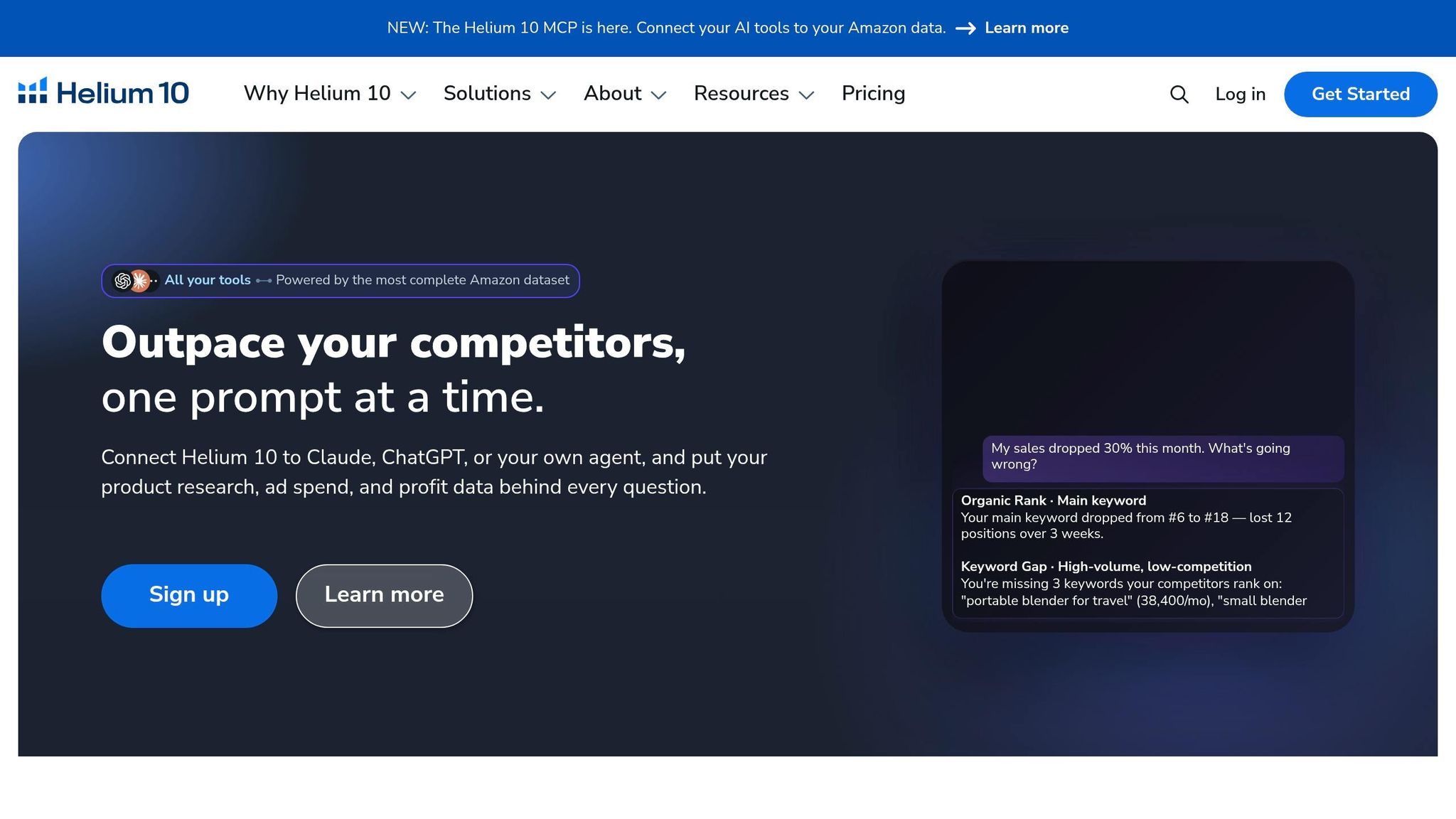
Useful for ranking visibility, indexing checks, and keyword tracking across both organic and sponsored contexts.
Data Dive
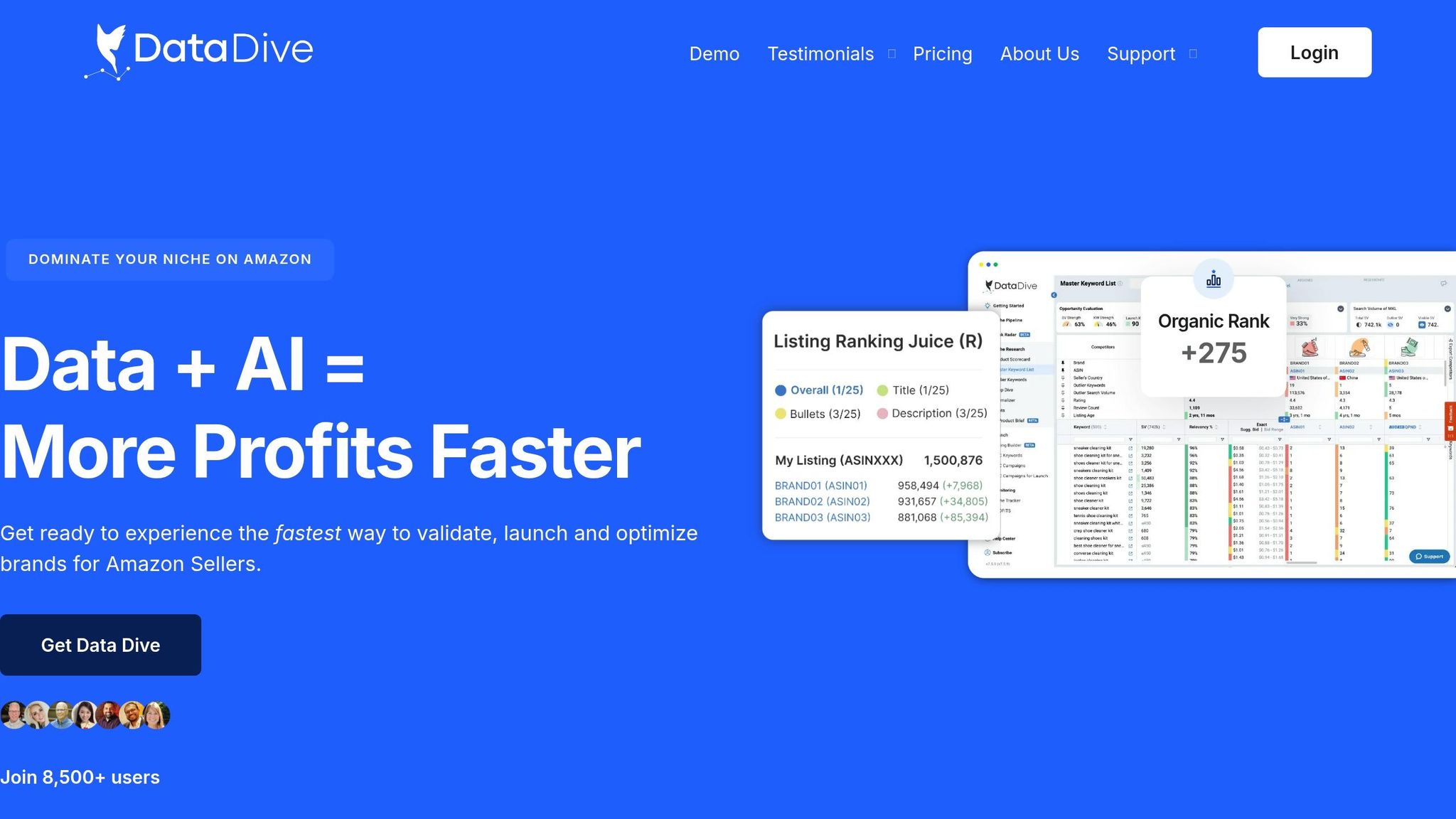
Positioned more as a competitive benchmarking and organic research tool than a PPC-focused solution.
The larger lesson is not about brand preference. It is about triangulation. Amazon sellers should avoid making decisions based on a single data source, especially in areas where platform transparency is limited.
Key Takeaways
- Amazon SEO is evolving from pure keyword matching to buyer-intent matching.
- The traditional four phases of SEO still matter, but sellers should add a fifth layer focused on prompts, questions, and AI retrieval.
- Use top keywords in titles and bullets, but stop treating repetition as a strategy.
- Answer buyer questions in descriptive bullet points rather than turning bullets into clunky Q&A blocks.
- Use A+ content and FAQ sections strategically, especially with crawlable text that explains benefits, use cases, and objections.
- Mine Amazon’s own prompt suggestions to uncover high-value buyer questions tied to your main keywords.
- Support page-two and page-three keywords first; these "strike zone" terms often offer the fastest path to page-one gains.
- Keep backend search terms organized so secondary and long-tail keywords do not overload the front-end listing.
- Be cautious with AI-visibility tools that claim precise Amazon prompt data; the video indicates many are unreliable.
- Treat AI optimization as future-proofing, not a magic switch. Sales, CTR, conversion, and relevance still drive ranking.
A Practical Framework for Sellers to Use Right Now
If you manage Amazon listings today, the smartest response is not to overhaul everything at once. It is to layer intent optimization into your existing SEO workflow.
A simple implementation model looks like this:
Step 1: Audit your top 5 to 10 commercial keywords
Confirm which terms truly deserve front-end visibility.
Step 2: Look for related buyer questions
Use Amazon’s own search and product-page prompts as signals for what buyers want to know.
Step 3: Rewrite bullets for clarity and relevance
Make bullets more descriptive, more readable, and more aligned with how a shopper evaluates the category.
Step 4: Expand crawlable A+ text
Add useful explanations, FAQs, and benefit context in text fields Amazon can parse.
Step 5: Update classic Q&A and FAQ sections
Address common objections and informational questions directly.
Step 6: Push strike-zone keywords with PPC and conversion work
Use paid traffic strategically where the product already has ranking momentum.
Step 7: Recheck indexing and ranking regularly
Use Amazon’s internal reports and trusted keyword tools to measure whether visibility is expanding.
Final Thoughts
The most useful message in the video is not that Amazon AI has already transformed search overnight. It has not. The shift appears gradual.
That is exactly why this matters now.
Platform changes are easiest to exploit before competitors fully adapt. Sellers who keep treating Amazon SEO as a pure keyword-placement exercise may still maintain some visibility, but they risk losing ground as search becomes more personalized, conversational, and intent-driven.
The brands most likely to win the next phase of Amazon SEO will be the ones that do both well: they will satisfy the algorithm’s traditional ranking requirements while also answering the customer’s real question before it is asked.
Source: "Amazon SEO has CHANGED: Stop Keyword Stuffing (New 2026 AI Ranking Rules)" – My Amazon Guy, YouTube, Jun 8, 2026 – https://www.youtube.com/watch?v=P7ybXcVoZT4