

Amazon SEO platforms are tools designed to help sellers optimize their product listings, improve rankings, and increase sales on Amazon. These platforms provide advanced features not available in Amazon Seller Central, such as keyword research, listing optimization, competitor analysis, and performance tracking. With Amazon’s A10 algorithm prioritizing factors like sales velocity and external traffic, using these tools is essential to stand out in a marketplace with over 9.7 million sellers and 350 million products.
Key Features of Amazon SEO Platforms:
- Keyword Research: Discover high-performing keywords through reverse ASIN lookups, keyword volume analysis, and trend tracking.
- Listing Optimization: Use AI-driven tools to create effective product titles, bullet points, and descriptions while ensuring compliance with Amazon’s policies.
- Competitor Insights: Analyze competitor keywords, sales velocity, and pricing strategies to refine your own approach.
- Performance Tracking: Monitor sales velocity, conversion rates, and keyword rankings to evaluate and adjust strategies.
- Automation: Save time by automating routine tasks like inventory tracking, PPC management, and backend search term updates.
Why It Matters:
Amazon’s competitive landscape requires sellers to optimize for visibility and conversions. Tools like Helium 10, SellerApp, and Jungle Scout offer integrated solutions to streamline operations, improve rankings, and boost profitability. Sellers leveraging these platforms can automate up to 70% of tasks and achieve better results by combining PPC and organic SEO strategies.
This guide breaks down the essential tools and strategies to help you succeed on Amazon, from keyword research to performance analytics.
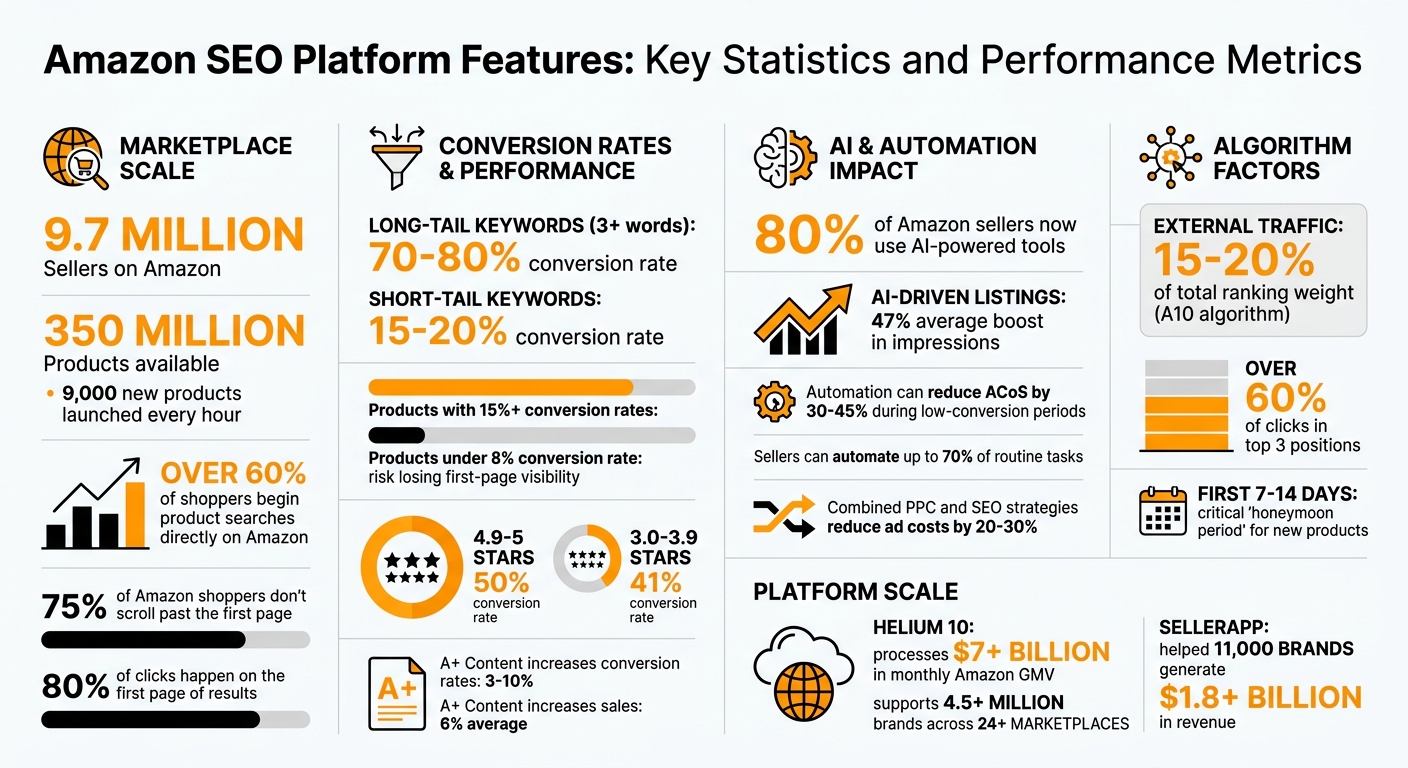
Amazon SEO Platform Features: Key Statistics and Performance Metrics
Keyword Research Features
Reverse ASIN Lookup
Reverse ASIN lookup is a method where you input a competitor’s Amazon Standard Identification Number (ASIN) into a tool to uncover the specific keywords that product ranks for. This strategy helps identify "golden keywords" – terms that are highly relevant but face less competition. It allows you to discover high-performing keywords that competitors might be leveraging but are often overlooked. By analyzing the titles of top-ranking products for a specific seed keyword, you can spot recurring keyword patterns to refine your SEO approach. Since more than 60% of shoppers begin their product searches directly on Amazon rather than general search engines, these insights are essential for identifying opportunities and improving your product listings.
Next, let’s look at how keyword volume data can guide demand trends and conversion strategies.
Keyword Volume and Trend Analysis
Keyword volume reflects customer demand and is crucial for increasing product visibility. While high-volume keywords improve visibility, long-tail keywords – those with three or more words – tend to convert at a much higher rate (70–80%) compared to short-tail keywords, which convert at only 15–20%. Trend analysis adds another layer by helping you identify seasonal demand shifts, spot gaps in the market, and assess the long-term potential of a product niche – key factors under Amazon’s A10 algorithm. A balanced strategy that combines short-tail keywords for broad exposure with long-tail keywords for targeting high-intent buyers can improve organic rankings. Additionally, tracking sales velocity for specific terms reveals which keywords drive faster sales – a critical ranking factor on Amazon. Regularly reviewing keyword performance, keeping an eye on seasonal patterns, and using real-time data through APIs makes your keyword research more adaptable and effective.
Once demand trends are clear, backend search term optimization can further refine your strategy.
Backend Search Term Optimization
Backend optimization complements front-end keyword strategies by using hidden keywords to boost discoverability. These backend search terms, entered in the "Generic keyword" field in Seller Central, are invisible to shoppers but indexed by Amazon’s search algorithm. This space is ideal for adding synonyms, abbreviations, alternate product names, and common spelling variations. Avoid repeating keywords already included in your product title, bullet points, or description. To maximize efficiency, format backend terms in lowercase, single-spaced text without punctuation, and exclude stop words like "a", "an", "of", "the", and "by". Arrange keywords in the natural order shoppers might use – for example, "white sneakers" instead of "sneakers white". Including Latent Semantic Indexing (LSI) keywords can further clarify keyword relationships and improve indexing.
For brands enrolled in Amazon Brand Registry, advanced tools like the Search Query Performance and Top Search Terms dashboards provide valuable insights to fine-tune backend search terms based on data-driven priorities.
sbb-itb-e2944f4
Listing Optimization Features
AI-Driven Listing Builders
AI-powered tools can now craft product titles, bullet points, and descriptions specifically tailored to Amazon’s A9 algorithm, all in a matter of seconds. These systems go beyond basic keyword placement by analyzing top competitors and employing keyword deduplication to include the maximum number of unique, indexable terms. They even dive into customer reviews to uncover key motivators and frequent complaints, ensuring your listing resonates with shoppers.
Another standout feature is compliance monitoring. These platforms automatically scan for trademarked terms, restricted claims, and policy violations, helping to prevent listing suppression. This proactive approach can lead to an average 47% boost in impressions. For the best results, place your most important keyword at the start of the title and structure bullet points with an "ALL CAPS HOOK" followed by a short, descriptive phrase.
Now that your listing is built, the next step is verifying its visibility with index checkers.
Index Checker and Keyword Placement Tools
Index checkers confirm whether Amazon has indexed your listing for specific keywords, ensuring that your product appears in relevant search results. Without this verification, you could waste time optimizing for terms that won’t help your product rank. As SellerApp puts it:
"The Index Checker verifies which keywords Amazon has actually indexed for your listings, preventing wasted optimization effort on terms that were never going to rank." – SellerApp
These tools also provide real-time insights into your listing’s health, identifying missing backend data or weak keywords that might limit your product’s visibility. To make the most of Amazon’s 249-byte backend keyword limit, include only terms that aren’t already visible in your listing.
Once your keywords are indexed, listing analyzers can help you identify and address performance gaps.
Listing Analyzer for Performance Gaps
Listing analyzers leverage Search Query Performance (SQP) data to identify where potential customers drop off during their shopping journey. They can help you pinpoint whether the issue lies in visibility, engagement, or conversion. For example, if impressions are high but clicks are low, you might need to refine your main image or title. If clicks are strong but conversions lag, consider adjusting your pricing, reviews, or A+ content.
These tools also compare your listing’s performance against top competitors, revealing areas where you might be falling short. They can detect missing elements – such as A+ content, suppressed images, or vague details – that could trigger Amazon’s auto-suppression. Including A+ Content, for instance, has been shown to increase conversion rates by 3% to 10%.
"Amazon ranks product listings based on sales volume, not search volume. This means that even if a keyword has high search volume, it won’t necessarily help your product rank if it doesn’t convert into sales." – Keren Dinkin, Copywriter, Sellerise
Automated audits are another key feature, flagging sudden drops in rankings or conversion rates so you can act quickly to minimize sales disruptions.
At Emplicit, we use these advanced AI tools to fine-tune every detail of your Amazon listings, ensuring your products achieve maximum visibility and conversion potential.
Competitor and Market Intelligence
Competitor Keyword Strategy Insights
Using reverse ASIN lookup is an effective way to uncover competitor keywords, helping you figure out which search terms drive their traffic and sales. For instance, Helium 10 processes more than $7 billion in monthly Amazon GMV and supports over 4.5 million brands across 24+ marketplaces.
Specialized tools like ZonGuru’s "Keyword Spotlight" go even deeper by revealing hidden backend keywords – those strategically placed to attract traffic without appearing in the visible listing. Some advanced platforms take this a step further, grouping competitor keywords into themes using AI to provide actionable insights.
"Keywords (and someone’s larger keyword strategy) are the key to getting your product seen and to boost its relevance." – Helium 10
Competitor reviews are another goldmine of information. They highlight recurring customer complaints or favorite features that can be incorporated into your own SEO strategy to capture relevant traffic. Tools like "Sales Spy" allow you to monitor competitor sales velocity and pricing changes in real time, enabling quick adjustments to your conversion strategy. These insights not only refine your SEO approach but also improve your overall performance tracking.
With competitor insights in hand, market tracking tools help you see where your brand fits in the larger picture.
Market Tracker and Niche Analysis
Once you’ve nailed down competitor keywords, market trackers help measure your standing relative to the competition. These tools provide near real-time data on share of voice and market dominance, showing whether you’re gaining or losing visibility compared to direct competitors. For example, Helium 10’s Market Tracker 360 offers up to two years of historical data, making it easier to identify long-term trends versus short-term seasonal spikes. As Max Vogel, Growth Lead at 10XCREW, puts it:
"Market Tracker 360 has helped me determine how big a market is and identify opportunities for expansion… I can see all relevant market information at once – no combining data, no spreadsheets."
These tools also help identify “rising winners” and “fading listings,” allowing you to shift focus toward high-growth products before the market becomes oversaturated. Automated tracking makes it easier to spot emerging products in your niche, giving you a head start.
Keeping an eye on share of voice for high-volume keywords ensures your brand stays visible, even as competitors ramp up their efforts. Considering that about 75% of Amazon shoppers don’t scroll past the first page of search results, maintaining strong first-page visibility is critical.
Trend Forecasting and Digital Shelf Reports
Digital shelf reports offer a clear picture of how your brand stacks up against competitors. They visualize your share of the market compared to the top five competitors, breaking it down by revenue, units sold, and pricing trends. Jungle Scout’s Competitive Intelligence tool, for example, lets you analyze up to 200 ASINs to gain insights tailored to specific market segments.
Tracking review velocity can help you spot rising products early. By focusing on competitors with rapidly growing review counts, you can identify new trends and analyze their keywords to capture similar traffic. Monitoring Amazon badges, like “Climate Pledge Friendly,” can also reveal untapped opportunities and areas for improving your listings. Many platforms now use AI-powered sentiment analysis to sift through thousands of reviews, helping you identify customer preferences and market gaps for better optimization.
Balancing organic and sponsored performance is another key strategy. By tracking both, you can fine-tune your PPC spend while improving organic rankings at the same time. SellerApp’s managed services have already helped 11,000 brands generate over $1.8 billion in revenue through data-driven strategies. Techniques like dayparting – adjusting bids based on hourly trends – can cut ACoS by 30% to 45% during low-conversion periods. This ongoing cycle of competitor insights and performance optimization drives consistent growth.
"Without access to this level of data, we are driving in the dark." – Brainlabs, Digital Marketing Agency
At Emplicit, we use these cutting-edge tools to help brands stay ahead of market trends and maintain their competitive edge on Amazon.
Analytics and Performance Tracking
Sales Velocity and Conversion Analytics
Sales velocity – how fast and how much you sell – plays a big role in Amazon’s ranking system. Products with conversion rates above 15% often land in the top 10, while those under 8% risk losing first-page visibility. This makes it crucial to track metrics like Click-Through Rate (CTR) and Conversion Rate (CVR) to ensure your listings are turning views into sales.
Modern tools combine ad spend, pricing, and inventory data to give a clearer picture of SKU profitability, avoiding an overemphasis on ACoS (Advertising Cost of Sales). Mike Danford, Marketplace Strategist at Adverio, warns against "Optimization Myopia", where focusing too much on ACoS can lead to missed issues like shrinking margins, inefficient inventory, or loss of market share. Advanced platforms also offer ASIN-level analysis to pinpoint issues like returns, fees, or high costs of goods sold (COGS). AI-powered anomaly detection flags unusual patterns – like sudden drops in conversions or unexpected ad spend spikes – so you can act before problems grow.
"Most plateaued Amazon brands aren’t under-spending; they’re trapped in Optimization Myopia, obsessing over ACoS while margin, inventory efficiency, and market share quietly erode." – Mike Danford, Marketplace Strategist, Adverio
For new products, the first 7 to 14 days are critical. During this "honeymoon period", Amazon temporarily boosts rankings, making it essential to monitor sales velocity closely.
Keyword Rank Tracker
Tracking keyword rankings is a natural extension of monitoring sales performance. For example, in March 2026, a kitchen gadget seller using SellerSprite identified "compact vegetable chopper" as a high-potential keyword. By optimizing their title and running targeted PPC campaigns during the honeymoon period, they climbed to the #2 organic position within just 10 days and held that spot long-term.
Focus on "striking distance" keywords – those ranked between 4 and 15 – to push them into the top three, where over 60% of clicks happen. Automated alerts can notify you of rank drops greater than three positions, helping you quickly address potential issues like negative reviews, price shifts, or stockouts. With 80% of Amazon clicks happening on the first page, maintaining strong visibility is non-negotiable.
"Knowing whether a product moved from position 15 to position 5 after an optimization update is crucial for validating strategy." – Ash Metry, Founder & CEO, Keywords.am
Amazon’s A10 algorithm now factors in external traffic, which contributes 15-20% of total ranking weight. Rank trackers can measure how off-platform campaigns – like social media or email marketing – affect organic rankings. High-frequency tracking tools, offering hourly updates, are especially useful during major sales events like Prime Day.
AI Data Visualization and Reporting
Interpreting data is just as important as collecting it, and visual reporting tools make this easier. AI dashboards can answer natural language queries and sync with Amazon Marketing Stream for intraday adjustments.
These tools also track how traffic flows to your listings, revealing which products drive "Frequently Bought Together" sales or how customers move from competitor listings to yours. They measure the impact of A+ Content, which can increase sales by 6% on average, and monitor review velocity – products with 4.9 to 5 stars convert at 50%, compared to 41% for products rated between 3.0 and 3.9 stars.
"The real competitive edge comes from interpreting the right data, not just collecting more of it." – Mike Danford, Marketplace Strategist, Adverio
At Emplicit, we use AI-powered analytics to help brands uncover profitability gaps, refine ad spend, and maintain a competitive edge across Amazon and other platforms. The goal is to connect data from every part of your operation – PPC campaigns, inventory management, and more – so decisions focus on improving profitability rather than chasing vanity metrics. These real-time insights ensure every piece of your Amazon strategy works together to boost your bottom line.
Integration and Automation for Scalable Management
PPC and Organic SEO Synergy
Blending PPC and SEO strategies on Amazon creates a dynamic system where both efforts amplify each other’s results. For instance, PPC campaigns provide real-time data on high-converting keywords. Modern tools can automatically integrate this data into your product listings – titles, bullet points, and backend search terms – helping boost your organic rankings.
This integration triggers a ripple effect. PPC sales increase your product’s sales velocity, a key factor for Amazon’s A10 algorithm. As your organic rankings improve for high-intent keywords, you can cut back on ad spending for those terms, lowering your overall Advertising Cost of Sales (ACoS). By combining PPC and SEO strategies, sellers can see ad costs drop by as much as 20–30%.
"Amazon SEO and PPC strategy work best when both sides are tightly integrated. When paid and organic efforts support each other, sellers don’t just get more traffic; they lower ad costs." – Bridgeway Digital
The most effective platforms identify "strike zone" keywords – those ranking between positions 20 and 50 – and use PPC campaigns to push them into top organic spots. A balanced strategy often dedicates about 10% of total sales to PPC and 3% to SEO, with a suggested focus on optimizing two keywords for SEO for every one targeted in PPC. This approach also ensures campaigns adapt in real time, aligning with inventory levels to avoid overspending or missed opportunities.
Inventory and Account Health Monitoring
Running out of stock can have long-lasting effects on your Best Seller Rank and organic visibility. Predictive tools use data like sales velocity, seasonality, and demand trends to alert you to potential stockouts before they occur.
Advanced platforms sync ad budgets with inventory levels. When stock is high, campaigns ramp up; when inventory runs low, ad spend is scaled back to protect your BSR and avoid wasting money on products you can’t fulfill. These tools also keep an eye on account health, quickly flagging issues like suppressed listings, Buy Box losses, ranking drops, or unauthorized sellers – often within hours rather than days.
"SellerApp became a decision-making layer across our business. It didn’t just help us optimize ad performance, it gave us the clarity to manage growth, allocate budgets with precision." – Eytan Weiner, Founder, Quantum Networks
Automation can also reduce ACoS by 30–45% during periods of low conversions through techniques like dayparting, which adjusts bids based on when conversions are most likely. Custom alerts for revenue, inventory, and competitive metrics allow sellers to address problems like Buy Box losses before they escalate.
Beyond immediate fixes, automation supports scalability by enabling tailored strategies for growth.
Custom Strategy Builders for Scaling
As your product catalog expands, manually updating listings and campaigns becomes unmanageable. AI-driven tools like Helium 10’s Listing Builder and CopyMonkey simplify this process by generating keyword-optimized listings in seconds, eliminating the need for additional copywriters.
"I use CopyMonkey to quickly generate keyword-optimized listings without hiring additional copywriters." – Nick Milani, Amazon FBA Seller and Coach
Advanced platforms also offer continuous optimization with adjustable risk profiles – conservative, moderate, or aggressive – ensuring that listings evolve based on performance data. For sellers looking to expand internationally, AI tools can adapt content for up to seven global marketplaces (US, UK, DE, FR, IT, ES, JP), ensuring compliance and local relevance. Tools like Ecominsights.io even allow you to ask complex questions in plain English, eliminating the need for manual spreadsheet analysis and speeding up decision-making.
At Emplicit, we focus on creating customized strategies that align every part of your Amazon operation. From PPC campaigns and inventory management to account health monitoring, every component is designed to work together seamlessly. The goal? To automate repetitive tasks while keeping the strategic oversight needed to grow your profitability and market share efficiently.
Conclusion
Key Takeaways for Business Growth
Amazon SEO has evolved far beyond simple keyword matching. Today, it’s all about understanding buyer intent, with AI playing a significant role. For example, Amazon’s COSMO algorithm now drives product discovery, while over 300 million shoppers interacted with Rufus by 2026. This means your listings need to act as structured knowledge hubs, not just collections of keywords. The tools discussed in this guide – like reverse ASIN lookups and real-time conversion analytics – help you optimize for organic sales, external traffic, and customer satisfaction.
With 80% of Amazon sellers now using AI-powered tools and 9,000 new products launching every hour, manual optimization simply can’t keep up. Having the right tools isn’t just a time-saver – it’s crucial for maintaining your rankings. Running out of stock, for instance, can lead to weeks of lost visibility, forcing you to rely on costly ads to recover.
"The gap isn’t access to tools. It is choosing the right ones… picking the wrong technology stack costs more than just monthly subscription fees; it costs months of wasted ranking momentum." – Ash Metry, CEO, Keywords.am
Rather than focusing solely on volume, prioritize conversion rates. High conversion rates are essential for securing top positions and page-one visibility. A good platform should help you target high-intent keywords and automate tasks like backend search term optimization, inventory forecasting, and aligning PPC with organic strategies. These are the building blocks for refining your Amazon SEO approach.
Next Steps for Implementing Amazon SEO Strategies
To improve your Amazon SEO, start by evaluating your current tool stack. Many sellers invest in all-in-one platforms but only use a fraction of their features. Often, specialized tools provide better returns at a lower cost. Align your spending with your business size: sellers managing fewer than 10 ASINs can operate effectively on $100–$200 per month, while those managing 50+ ASINs should budget $800–$1,500+ monthly for enterprise-level tools.
Begin with Amazon’s free native tools, such as Brand Analytics and the Listing Quality Dashboard, to establish a solid foundation before exploring premium options. Afterward, integrate tools like reverse ASIN research, AI-driven listing builders, and hourly rank trackers to measure the immediate effects of your updates. Use the TFSD framework – Title, Features, Search Terms, Description – to ensure every field in your listing contributes to better rankings.
At Emplicit, we combine PPC management, listing optimization, inventory forecasting, and account health monitoring into cohesive strategies. Automation handles repetitive tasks, while strategic oversight ensures sustainable growth. Whether you’re scaling from 10 to 50 ASINs or managing multiple marketplaces, the goal remains the same: maximize profitability while staying agile as Amazon’s algorithms continue to change.
Full Amazon SEO Masterclass using Data Dive – Advanced Step-by-Step Guide
FAQs
Which Amazon SEO platform features matter most for my product?
When choosing an Amazon SEO platform, the most important features will depend on your specific goals. However, some tools stand out as essential for improving visibility, optimizing product listings, and tracking performance.
Here are the top features to look for:
- Keyword Research Tools: These help you identify the search terms customers are using, ensuring your listings target the right audience.
- AI-Powered Listing Optimization: Automates and refines your product descriptions, titles, and backend keywords to improve rankings and attract more buyers.
- Analytics Dashboards: Monitor key metrics like sales, customer reviews, and ad performance in one place to make data-driven decisions.
- Competitor Analysis Tools: Gain insights into what your competitors are doing, uncovering gaps and opportunities to improve your product’s rankings and sales.
By focusing on these features, you’ll have the tools needed to stay competitive and grow your presence on Amazon.
How do I choose keywords that rank and convert?
To pick keywords that perform well and drive sales on Amazon, prioritize search volume, relevance, and buyer intent. Start by using tools like Amazon’s search bar or the Product Opportunity Explorer to identify terms with high search volume that align with your product. Focus on long-tail keywords and phrases that reflect specific features or use cases buyers might search for. Additionally, studying your competitors’ keywords can reveal untapped opportunities that strike a balance between ranking potential and boosting conversions.
How can I measure if my SEO changes improved sales?
To see if your Amazon SEO tweaks are paying off, keep an eye on key performance indicators (KPIs) such as sales rank, product impressions, click-through rate (CTR), and conversion rate. Watch how organic search traffic and sales trends evolve over time. By regularly checking these metrics in your analytics dashboard, you can figure out if your efforts are making your product more visible and driving more sales.