

If I want the short answer: Amazon wins on purchase intent, Walmart helps protect margin on value SKUs, and TikTok Shop can grow share fastest for low-priced items that sell well on video.
I’d look at these three channels in a simple way:
- Amazon is best when people already know what they want and are searching for it.
- Walmart Marketplace is a strong fit when price matters a lot and I need lower channel costs.
- TikTok Shop works best when a product is easy to show, easy to explain, and easy to buy on impulse.
A few numbers make the tradeoffs clear:
- Amazon product page conversion often sits around 9.5% to 10.5%, with strong listings reaching 12% to 18%
- Amazon take rates for $18 to $35 items hit 42% to 47% after the January 2026 fee changes
- Walmart WFS offers next-day delivery reach to 88% of the U.S. population
- TikTok Shop U.S. GMV reached $32 billion in H1 2026, up 61% year over year
- TikTok Shop AOV reached $47 in Q2 2026
If I were judging platform fit, I’d focus on five things:
- customer reach
- ad cost
- conversion behavior
- catalog fit
- speed of share gains
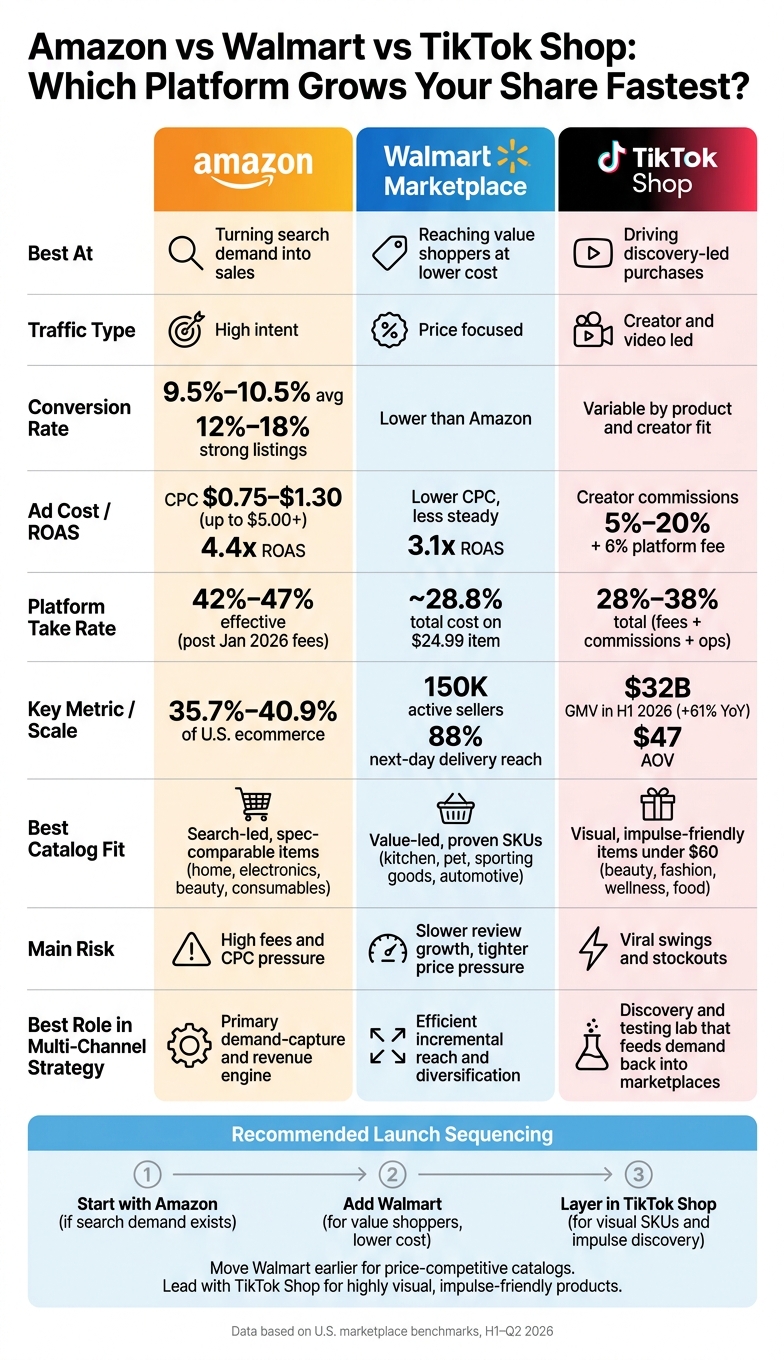
Amazon vs Walmart vs TikTok Shop: Platform Comparison for Ecommerce Sellers (2026)
Amazon FBA vs. TikTok Shop: The Answer Might Surprise You
sbb-itb-e2944f4
Quick Comparison
| Criteria | Amazon | Walmart Marketplace | TikTok Shop |
|---|---|---|---|
| Best at | Turning search demand into sales | Reaching value shoppers at lower cost | Driving discovery-led purchases |
| Traffic type | High intent | Price focused | Creator and video led |
| Ad cost | Highest of the three | Lower, but less steady | Mix of fees, commissions, and ads |
| Conversion pattern | Strongest and most steady | Lower than Amazon | Varies by product and creator fit |
| Best catalog fit | Search-led, spec-comparable items | Value-led, proven SKUs | Visual items, often under $60 |
| Main risk | Fees and CPC pressure | Slower review growth and tighter price pressure | Viral swings and stockouts |
| Best role | Main marketplace engine | Low-cost second marketplace | Discovery and impulse-buy channel |
My takeaway: if I already have search demand, I’d start with Amazon. If my price point is tight and value matters, I’d add Walmart sooner. If my product sells in a short video, I’d test TikTok Shop early.
Below, I’d break down where each platform wins, where costs stack up, and how I’d match each one to the right part of a catalog.
Amazon: High-intent reach and strong conversion at higher ad costs
Amazon accounts for about 35.7% to 40.9% of U.S. ecommerce sales, which makes it the biggest ecommerce channel in the United States. That matters for one simple reason: people come to Amazon ready to purchase. They aren’t just browsing for ideas. They’re often comparing options, checking reviews, and looking for the best fit right now.
That buying mindset makes Amazon one of the clearest places to see which SKUs have room to grow before you push harder into other channels.
Reach, ad costs, and buyer conversion
Amazon product detail page conversion rates usually land around 9.5% to 10.5% on average. Well-built listings often hit 12% to 18%. That’s much higher than discovery-first channels because Amazon shoppers tend to show up with a clear goal.
Put plainly, Amazon is better at converting demand that already exists than generating demand from scratch. That’s a big part of why brands can gain share faster there.
Sponsored Products CPCs often fall between $0.75 and $1.30, though they can climb to $2.00 to $5.00+ in beauty, supplements, and electronics. Those higher costs can still pay off when the basics are in place:
- Strong listings
- Solid reviews
- Sharp pricing
- Prime-ready fulfillment
If one of those pieces is off, performance can slip in a hurry.
A common play is to put budget behind the highest-intent keywords and the SKUs that already convert best. As organic rank improves, paid ads usually carry less of the load.
Catalog fit and common share growth patterns
Amazon tends to work best in categories with strong search demand. Home & kitchen, consumer electronics, consumables, personal care, beauty, and grocery are steady performers.
Some category numbers make that pretty clear. Beauty & Personal Care grew about 19% year over year, while Computers & Tablets grew 32% in one category analysis. These categories often have heavy search volume, repeat purchases, and enough room to stand out through better content and stronger reviews.
How Emplicit supports Amazon growth
For brands that want to turn demand into market share faster, execution matters just as much as ad spend. Emplicit supports Amazon growth through PPC, listing optimization, inventory planning, account health management, and marketplace management, with a focus on the levers that improve conversion and organic rank.
Walmart Marketplace: Lower-cost traffic and value-focused customer reach
Walmart Marketplace is still much smaller than Amazon. It has about 150,000 active sellers, while Amazon has 1.2 million+. For new brands, that leaves more open space.
That gap matters most if you already know your products sell on Amazon but you’re feeling margin pressure. In Q2 2026, 11% of mid-size sellers said Walmart was their fastest-growing revenue channel. So this isn’t just a backup plan anymore. For more brands, it’s becoming a main sales channel.
Reach, pricing pressure, and conversion behavior
Walmart shoppers tend to care a lot about price, especially in everyday staple categories. That means pricing has to be tight. Conversion rates on Walmart are usually lower, so it’s smart to pressure-test your unit economics using a conservative conversion floor before you commit inventory. If the math still works, Walmart can add extra market share without squeezing margin too hard.
Ads tell a similar story. Walmart Connect posts an average ROAS of 3.1x, compared with 4.4x for Amazon Sponsored Products. Part of that comes down to platform maturity. In many categories, Walmart’s auction is still less developed, which can lead to uneven CPC spikes and make scale harder to control.
Where Walmart often wins is cost. Amazon’s January 2026 fee changes added inbound placement fees of $0.27–$1.32 per unit, which pushed effective take rates for some sellers to 42%–47%. Walmart WFS charges a $0 inbound surcharge, and its referral fees come in lower than Amazon’s by an average of 2.3 percentage points across key categories. If you sell value-led products, that gap can matter a lot.
| Metric | Amazon FBA (July 2026) | Walmart WFS (July 2026) |
|---|---|---|
| Avg. Referral Fee | ~15% (tiered) | 15% cap on most categories |
| Inbound Placement Fee | $0.27–$1.32 per unit | $0 |
| Total Platform Cost (1-lb, $24.99) | ~$7.52 (~30%) | ~$7.20 (~28.8%) |
| Avg. ROAS | 4.4x | 3.1x |
| Next-Day Delivery Reach | High (mature) | 88% of U.S. population |
Still, lower fees alone won’t move the needle. The product mix has to line up with Walmart’s price-first demand.
Catalog fit and expansion from Amazon into Walmart
Walmart usually works best in categories like kitchen, pet, sporting goods, regional food, farm supply, and automotive accessories, where competition is lighter and shoppers are already looking for good value. A smaller, sharper SKU set tends to do better here. Walmart rewards products that are priced well and stay in stock. That’s why many brands begin with their top 20 proven SKUs, then add more only after margins hold.
There are a few nuts-and-bolts issues to plan for. WFS needs inventory that is separate from FBA, so you’ll need a domestic 3PL that can split purchase orders across both networks. And content setup isn’t something you can skip. Listings without Walmart Rich Media content – Walmart’s version of Amazon A+ content – can get hit with ranking penalties. Review growth also tends to move more slowly, which is why Walmart’s Spark Reviewer program can help during launch.
Laura Bettencourt, VP of Marketplace Operations at Pattern, puts it plainly:
"The brands that get into trouble are the ones that treat Walmart like a mirror of their Amazon catalog. Walmart shoppers search differently, the images that convert are different… It’s a real second channel, not a toggle." – Laura Bettencourt, VP of Marketplace Operations, Pattern
How Emplicit supports Walmart expansion
Walmart expansion works best when launch timing, content, inventory, and ads are handled together instead of piece by piece. Emplicit supports Walmart expansion through launch planning, content, inventory, and Walmart Connect ads. That includes bid management needed to deal with a less mature auction setup. For brands entering Walmart for the first time, Walmart-specific support can cut down on trial and error during launch and help improve share capture from day one.
TikTok Shop: Fast awareness and impulse-driven sales for the right catalog
TikTok Shop wins share through discovery, not search. Creators and live video spark demand inside the app and turn impulse into purchases. Amazon and Walmart usually capture demand that already exists. TikTok Shop helps create that demand in the first place. For products that are easy to understand at a glance and simple to buy, that can mean faster share gains than search-led channels.
TikTok Shop U.S. GMV reached $32 billion in H1 2026, a 61% year-over-year increase. Average Order Value climbed to $47 in Q2 2026, up from $31 in 2024.
Reach, creator costs, and conversion path
TikTok Shop’s reach comes from creators, not keywords. Brands often seed products to creators with 50,000 to 500,000 followers. Commissions usually fall between 5% and 20%, with 12% to 15% common in competitive categories. The platform fee is 6%, and some new sellers can get a 2% promotional rate through September 2026. Once you add creator commissions, ads, and day-to-day operations, total take rate usually lands around 28% to 38%.
The buying path looks very different from Amazon. On Amazon, shoppers search, compare options, read reviews, and then decide. On TikTok Shop, a short-form video or live stream often sparks the purchase. It’s fast, impulse-driven, and often unplanned. Brands that use Fulfilled by TikTok (FBT) get a 12% to 18% lift in conversion rates from the delivery promise badge alone, with average delivery windows of 2.8 days.
Catalog fit and social commerce growth patterns
TikTok Shop works best for products that are easy to show, simple to explain, and priced below about $60. The strongest categories include:
- Beauty
- Fashion
- Wellness
- Food and beverage
- Home goods
For viral SKUs, TikTok Shop can win the purchase before the shopper ever makes it to Amazon.
"Two years ago, a TikTok viral moment was a gift for your Amazon listing. Now it’s a retention problem. If you’re not capturing that buyer on TikTok Shop the moment they want to buy, you may not see them on Amazon at all." – Kiri Masters, Founder of Bobsled Marketing
For brands getting started on TikTok Shop, sequencing matters. A common path is to connect Shopify first, seed 20 to 40 creators, and then layer in paid amplification plus Fulfilled by TikTok enrollment. It also helps to hold a separate inventory buffer for viral spikes. One sudden surge can trigger stockouts across every channel at the same time.
How Emplicit supports TikTok Shop growth
Once TikTok proves demand, execution determines whether that demand turns into repeatable share. TikTok Shop has a lot of moving pieces: creator coordination, content compliance, Fulfilled by TikTok logistics, and paid amplification. Handling all of that well without a dedicated team is hard.
Emplicit supports TikTok Shop setup, content coordination, and marketplace operations, including navigation of the Managed Creator Partner program for regulated categories like supplements and skincare. For brands that want TikTok Shop tied to their broader ecommerce growth, not treated like a side test, that support can help turn early traction into repeatable share gains.
Cross-platform patterns and conclusion: Which channel adds share fastest
The pattern across these case studies is pretty clear. Amazon captures demand that already exists. Walmart helps cut acquisition cost for value-focused shoppers. And TikTok Shop can add share the fastest when a product works well in short-form video.
Here’s the channel-by-channel guide based on those case patterns:
| Criteria | Amazon | Walmart Marketplace | TikTok Shop |
|---|---|---|---|
| Immediate Conversion | Highest on Amazon | Strongest on Walmart for value SKUs | Variable on TikTok Shop |
| Traffic Cost | Highest on Amazon | Lower on Walmart | Creator-led cost structure on TikTok Shop |
| Awareness Speed | Slowest on Amazon | Moderate on Walmart | Fastest on TikTok Shop |
| Catalog Fit | Search-led, spec-comparable SKUs | Price-competitive SKUs | Visual, impulse-friendly SKUs |
| Multi-Channel Role | Primary demand-capture and revenue engine | Efficient incremental reach and diversification channel | Discovery and testing lab that feeds demand back into marketplaces |
Recommended sequencing for small and mid-sized brands
The best order depends on how people in your category find products and decide to buy.
- Start with Amazon if search demand is already there. Then add Walmart to reach value shoppers at a lower cost. After that, layer in TikTok Shop for visually strong SKUs to test new creative angles and stretch demand further.
- Move Walmart up earlier if your catalog is price-competitive or close to commodity products.
- Lead with TikTok Shop for products that look good on camera and spark impulse buys. Then build out Amazon and Walmart to pick up the search demand that follows.
Methodology and key takeaways
This comparison uses U.S. marketplace benchmarks and case patterns. CPC, ROAS, conversion, and TikTok Shop metrics are directional, not universal. They can shift a lot based on category, competition, and execution.
Put simply, Amazon leads on conversion and scale, Walmart adds efficient incremental reach, and TikTok Shop can add share fastest when the creative fit is there.
FAQs
How should I choose my first channel?
Choose your first channel based on your goals, resources, audience, and product category.
Amazon is often a strong place to start if you want scale. TikTok Shop can work well for fast brand discovery, especially with younger shoppers. And Walmart is a smart pick if your buyers care a lot about price and you want to tap into its online-plus-store reach.
It also helps to look at your team’s bandwidth. Amazon usually takes more day-to-day work. TikTok Shop tends to be simpler to run.
Emplicit can help brands weigh these options and grow across channels.
What products usually fit TikTok Shop best?
TikTok Shop tends to work best for products that look good on camera, are easy to show in action, and tie into trends people already care about. Beauty products and gadgets are common standouts because short videos, tutorials, and live demos can show the product fast and make the value clear.
These products usually sell through discovery, emotion, and buzz. In other words, people often buy because the item catches their attention in the feed, not because they went looking for it first.
When does Walmart make more sense than Amazon?
Walmart often makes more sense when your goal is lower costs, less competition, and access to budget-conscious shoppers. With about 150,000 sellers versus Amazon’s millions, brands may get better product visibility.
It can also be a better fit if you want to skip monthly subscription fees, pay lower referral fees, and use Walmart’s store network for fast delivery and in-store pickup.