
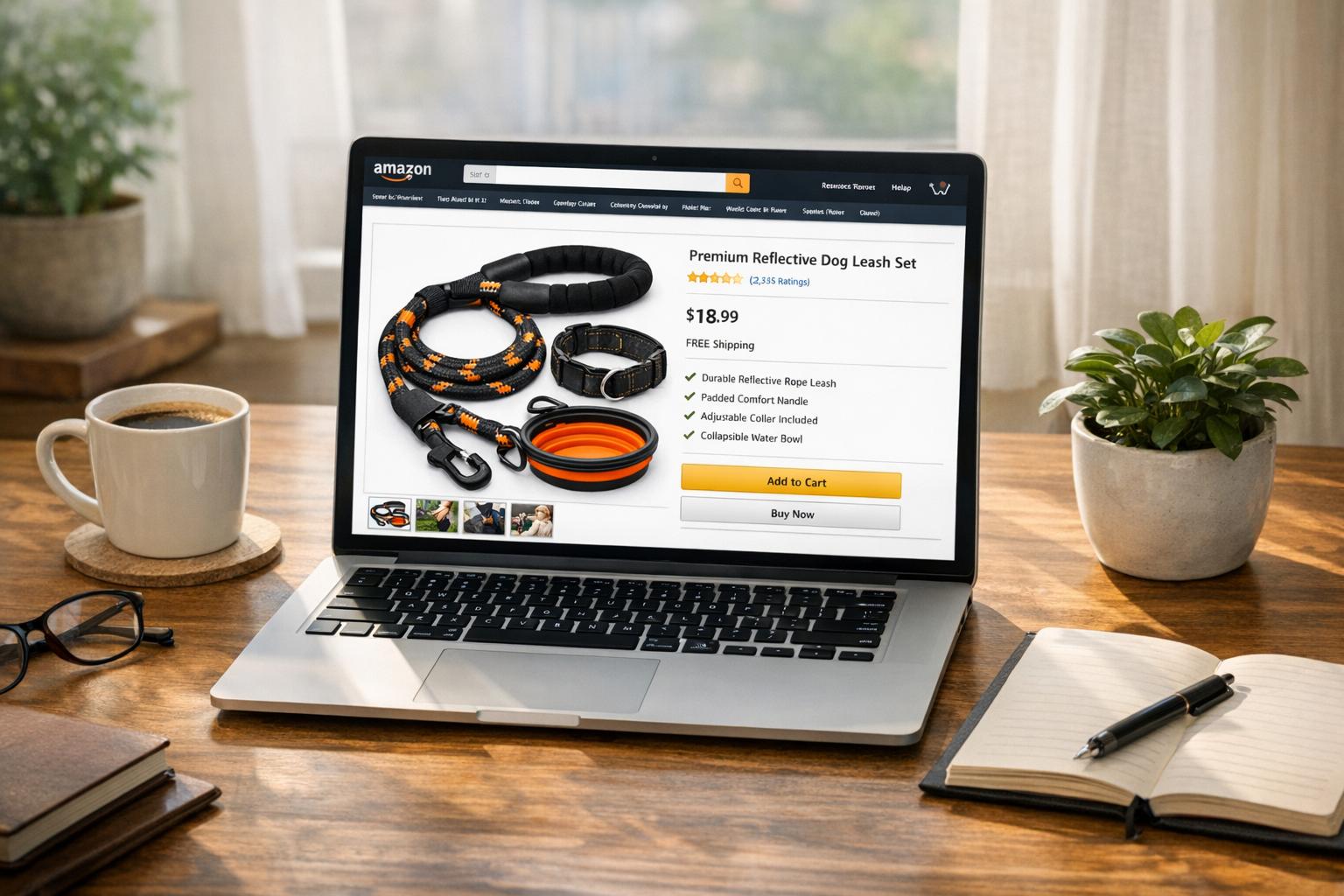
Want to know why some pet products dominate Amazon while others get lost in the shuffle? After reviewing 200 pet product listings, we found the top 10% excel by focusing on four key areas: availability, search visibility, conversion, and customer engagement. These listings average 573 reviews (vs. 31 for others) and use enhanced content on 35% of their pages (vs. 6%). Here’s how they stand out:
- Product Titles: Clear, keyword-rich titles optimized for Amazon’s algorithm.
- Descriptions: Focus on benefits, not just features, with concise bullet points.
- Visuals: High-quality images, lifestyle photos, and videos to engage shoppers.
- Reviews: Proactively managed to build trust and improve rankings.
The difference isn’t luck or big budgets – it’s strategy. If you’re selling pet products, these tactics can transform your listings and boost sales.
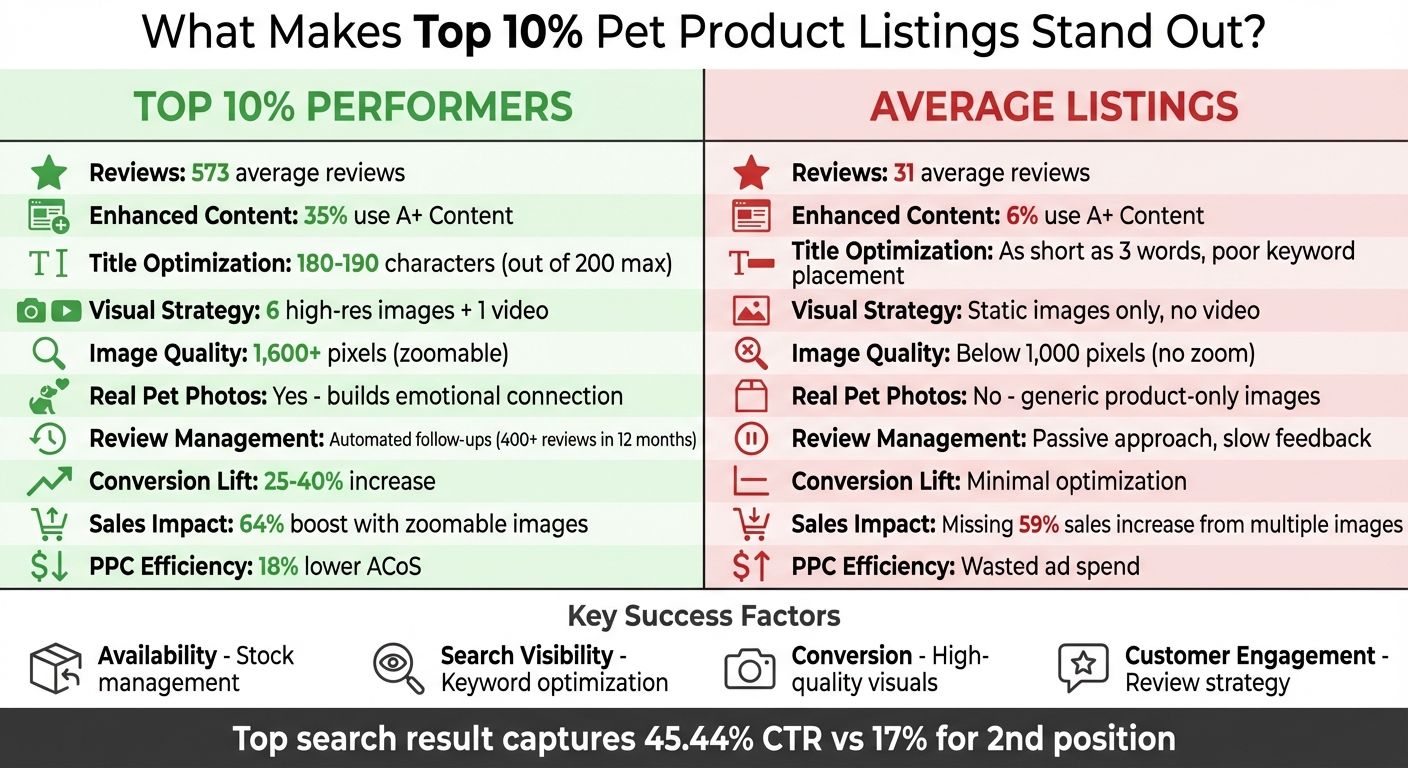
Top 10% vs Average Pet Product Listings on Amazon: Key Performance Differences
Amazon Listing Optimization Tutorial Guide: Automatic Pet Feeder, Rank KWs SEO with Data Dive Tools
1. Emplicit‘s Marketplace Management Approach

Emplicit’s marketplace management strategy addresses performance gaps by adopting data-driven tactics that align with the practices of top-performing listings. This approach fine-tunes every customer interaction, from the search results page to the final purchase, ensuring a seamless and effective shopping experience. Below, we break down key elements of this strategy, focusing on product titles, descriptions, and visual presentation.
Product Titles
A well-crafted product title is essential for visibility and relevance. The best titles start with core keywords and include the brand name upfront. For example, a title like "Grain-Free Dog Treats for Large Breeds" fits within Amazon’s 200-character limit and aligns with the A9 algorithm’s requirements. These titles avoid keyword stuffing but smartly incorporate high-intent phrases such as "fat-free pet food" or "high-fiber" to appeal to specific customer needs.
Descriptions and Benefits
Descriptions are structured to highlight benefits clearly and concisely. Bullet points start with a key product feature, followed by the specific advantage it offers to customers. This approach resonates particularly well with pet owners, 65% of whom prioritize ingredient quality when making purchasing decisions.
"I like to look for food and treats made from whole food ingredients. Just like when I shop for my family, I look at the ingredient list to make sure I know what is in the product".
Detailed descriptions also include strategically placed text modules to ensure that important information is indexed by Amazon’s algorithm, enhancing discoverability.
Visual Presentation
Visuals play a crucial role in engaging shoppers and complementing optimized text. Emplicit’s "7-slot" framework ensures a comprehensive visual strategy, including:
- A high-resolution hero image on a white background
- Lifestyle imagery showing real-life product use
- Infographics to highlight features
- A dimensions chart for clarity
- A package contents image
- A 12–30 second vertical video for dynamic engagement
Images should meet Amazon’s standards, with a resolution of at least 1,000 pixels – ideally 1,600 pixels – on the longest side, filling 85% of the frame. Including real pet photos has been shown to significantly boost shopper engagement. For products designed for multiple species, split testing visuals – such as dog-focused versus cat-focused imagery – can help identify which approach drives higher click-through rates.
2. Top 10% Pet Product Listings
Emplicit’s data-driven insights reveal that the top 10% of pet product listings excel by implementing strategies that grab attention, build trust, and drive conversions. These listings masterfully craft their titles, descriptions, visuals, and review strategies to stand out in a crowded marketplace.
Product Titles
The best-performing titles make the most of Amazon’s 200-character limit, using 180–190 characters to include essential details like the Brand Name, Keywords, Quantity/Size, and Features and Benefits – all without resorting to keyword stuffing. For example, the title for Jungle Creations’ "Washable Pee Pads for Dogs" uses 186 characters to seamlessly integrate the brand, primary keywords, dimensions (30" x 36"), and specific use cases like "for puppy playpen, whelping box, crate".
"The product title is so important because its keywords tell Amazon’s A9 algorithm exactly what your product is, and whether or not the item is what your buyers are looking for."
- Brian Connolly, Ecommerce Expert, Jungle Scout
These titles comply with Amazon’s upcoming January 21, 2025 requirements, which ban special characters like "!" or "These titles comply with Amazon’s upcoming January 21, 2025 requirements, which ban special characters like "!" or "$" and limit word repetition to twice per title [4]. They also target niche search terms such as "for senior dogs" or "hunting vest", aiming to capture long-tail queries with higher conversion potential [4][11]. Beyond titles, these listings enhance engagement with optimized descriptions and visuals.quot; and limit word repetition to twice per title. They also target niche search terms such as "for senior dogs" or "hunting vest", aiming to capture long-tail queries with higher conversion potential. Beyond titles, these listings enhance engagement with optimized descriptions and visuals.
Descriptions and Benefits
Top listings maximize the use of Amazon’s five bullet points and 2,000-character description space to clearly communicate benefits. Each bullet starts with the main benefit, followed by specifics on how it meets a customer need. This approach resonates with pet owners, 65% of whom prioritize ingredient quality when deciding what to buy.
Additionally, A+ Content with crawlable text ensures that key benefits are indexed by Amazon’s search algorithm. Instead of merely repeating the product title, these descriptions focus on benefits, helping the listing stand out. Paired with detailed descriptions, high-quality visuals further strengthen the listing’s appeal.
Visual Presentation
The top 10% of listings take full advantage of Amazon’s visual slots, typically including six high-resolution photos and one video. Images are at least 1,600 pixels on the longest side, enabling hover-to-zoom functionality and showcasing product quality. A well-thought-out mix of visuals might include:
- A main image with a white background.
- Lifestyle photos featuring real pets interacting with the product.
- Infographics highlighting key features.
- Close-ups of textures or stitching.
- A dimensions chart for clarity.
Using real pet imagery instead of generic logos or shadows helps forge an emotional connection with buyers. For instance, Jungle Creations’ washable pee pad listing includes colorful infographics that explain product benefits and sizing, a strategy that has earned over 400 positive reviews in under a year. To further optimize, sellers use the 100-character ALT text field to include relevant keywords, common misspellings, and even translations.
Review Management
High-quality reviews are a hallmark of top listings. These sellers use automated follow-ups to gather detailed feedback, helping Jungle Creations, for example, secure 400+ reviews in just 12 months. Reviews with rich descriptions and multimedia not only build trust but also boost rankings. With the top search result boasting a 45.44% click-through rate compared to just 17% for the second position, maintaining strong review metrics is essential for visibility and achieving a higher Best Seller Rank. These efforts ultimately lead to better conversion rates and a stronger competitive edge.
sbb-itb-e2944f4
3. Average Pet Product Listings
While top-performing pet product listings on Amazon are optimized to attract attention and drive sales, the average listings tend to fall short. These underwhelming listings often miss key opportunities, which directly affects their visibility, click-through rates, and conversions.
Product Titles
One of the most glaring issues with average listings is their poorly constructed product titles. Many are far too short – sometimes as brief as three words – leaving both Amazon’s algorithm and potential shoppers without enough context to understand the product. These titles often lack crucial details like benefits, target audiences, or specific use cases.
Another common mistake is the haphazard placement of keywords. Instead of arranging keywords in a logical and impactful way, average listings often throw them together randomly, reducing their effectiveness in search results. Worse still, some sellers resort to keyword stuffing, repeating variations like "reflective", "reflectors", and "reflects" in a single title. This not only fails to improve search rankings but also makes the titles look unprofessional and spammy to shoppers.
It’s no surprise that some of these listings score as low as 8 out of 100 on Amazon’s Listing Quality Score due to poor title optimization. As AMZ Assistance puts it:
"Amazon will allow up to 250 characters, so my philosophy is that you should use as much of that real estate as possible!"
Unfortunately, the lack of attention to detail in titles is a pattern that extends to other critical areas like descriptions and benefits.
Descriptions and Benefits
Average listings often focus too much on technical features – like materials, dimensions, or specifications – without connecting these features to how they improve the lives of pets or their owners. For instance, sellers frequently repeat the same information from the title in the bullet points, offering no additional value. The language used is often vague and generic, making it hard for shoppers to see what makes the product special.
Despite 65% of pet owners prioritizing ingredient quality when choosing products, this information is often buried or omitted entirely in average listings. Sellers also tend to skip important details like sizing charts, material craftsmanship, or trust-building elements such as guarantees. Instead of tailoring products to specific audiences, many listings take a one-size-fits-all approach, creating a single SKU for products meant for both dogs and cats. This strategy fails to address the unique needs of each audience.
The lack of thoughtful presentation doesn’t stop there – it also extends to the visuals.
Visual Presentation
Visuals play a huge role in creating trust and engagement, but average listings often fall short in this area. Instead of featuring real pets interacting with the product, these listings typically rely on generic product-only images. This approach misses the chance to create an emotional connection with shoppers.
Additionally, most average listings only include static images, skipping video demonstrations that could show the product in action. For pet owners, seeing how a product works with actual animals is often a make-or-break factor. Another common issue is the failure to show products in relation to different pet breeds or sizes, leaving shoppers to wonder, "Will this fit my dog?".
Some sellers also embed critical product information directly into images. While this might seem helpful at first glance, Amazon’s algorithm can’t read text within images, which means these listings miss out on valuable SEO opportunities. On top of that, many sellers neglect the use of ALT text, failing to add high-volume keywords or even Spanish translations to improve discoverability.
Pricing Strategies
Pricing is another area where average listings falter. Many sellers fail to optimize their pricing, missing simple but effective tactics like psychological pricing (e.g., $19.99 instead of $20.00). They also rarely experiment with different price points or offer promotions and bundles to stand out. In a competitive marketplace where 53% of pet owners shop for pet products weekly, these missed opportunities can be costly.
Review Management
Reviews are one of the most powerful tools for building trust and boosting visibility, but average listings often take a passive approach to review management. Unlike top performers, which actively encourage detailed, multimedia-rich reviews, these listings lack automated follow-up systems to generate feedback. As a result, reviews trickle in slowly and are often less descriptive, with few photos or videos to provide social proof.
This lack of strong reviews further compounds visibility issues. When the top search result captures a 45.44% click-through rate compared to just 17% for the second position, weak review metrics make it nearly impossible for average listings to compete effectively.
Pros and Cons
When deciding how much to invest in optimizing your listings, it’s crucial to weigh the benefits against the challenges. Here’s a breakdown of three common strategies:
| Strategy | Pros | Cons / Challenges |
|---|---|---|
| Top 10% (Full Optimization) | Boosts conversion rates by 25–40%, improves organic search rankings, increases ROAS by 20–30%, and delivers a 64% sales uplift with zoomable images. Listings with four or more images see a 59% sales increase. | Requires significant upfront costs for professional photography and video production, as well as time-intensive keyword research and A+ content creation. |
| Average (Minimalist) | Low initial investment, quick product launch, and minimal technical expertise needed. | Results in poor search visibility, low conversion rates, wasted PPC spend, and struggles to compete in crowded categories. |
| Balanced (Incremental) | Allows sustainable growth by focusing on high-impact areas like optimized titles and main images, while avoiding resource strain. | Slower initial growth compared to fully optimized competitors, risk of losing market share in competitive niches, and requires careful prioritization of tasks. |
These strategies highlight the trade-offs sellers face. Fully optimized listings tend to perform significantly better. As Fahim Sheikh, CEO of Trellis, explains:
"Most sellers see a 25–40% lift in conversion rate after a full optimization."
For sellers with tighter budgets, focusing on a few key elements can still make a difference. Start with a keyword-rich title, a high-resolution main image (at least 1,600 pixels), and bullet points that clearly outline benefits. These "above-the-fold" details are often the deciding factors for whether a shopper stays engaged or moves on.
Additional investments can drive even greater results. For instance, zoomable images (used in at least 25% of your listing photos) can increase sales by 64%, while a sizing infographic can improve conversion rates by nearly 20%. Plus, optimized listings often lead to an 18% drop in PPC ACoS, reducing advertising costs.
The key is to focus on changes that will have the biggest impact in your product category. As your sales grow, you can gradually expand your efforts, creating a strong foundation for long-term success.
Conclusion
The best-performing listings stand out by leveraging real pet images, creating separate SKUs for dogs and cats, incorporating crawlable A+ Content, and using optimized 100-character ALT text paired with detailed infographics and lifestyle photos. These elements not only enhance visibility but also resonate with pet owners, driving engagement and conversions.
Take PETKIT as an example: they captured 28% of the self-cleaning litter box market in the first half of 2024. By addressing automation needs and customer pain points, they achieved an impressive 45% year-over-year growth and a 93% boost in revenue. Similarly, HawaiiPharm saw explosive growth – over 700% in the supplement category – by strategically carving out a niche.
To start improving your listings, focus on the basics, especially if you’re working with a limited budget. Prioritize a keyword-rich title (up to 200 characters), a high-resolution main image (at least 1,600 pixels), and clear, benefit-driven bullet points. These "above-the-fold" elements are crucial for driving conversions.
As your sales grow, take your listings to the next level. Add zoomable images to at least 25% of your photos, which can increase sales by 64%. Enroll consumable products in Subscribe & Save to capture a 13% greater wallet share. Finally, experiment with images featuring different pet breeds to appeal to a broader audience. These small but strategic upgrades can make a big difference in your success.
FAQs
What do the top 10% of pet product listings on Amazon do differently to boost visibility and sales?
Top-performing pet product listings on Amazon succeed by blending optimized content, smart pricing, and active customer engagement. Their product titles are short, packed with relevant keywords, and include essential details like the brand name, size, material, or standout benefits – while staying within Amazon’s character limits. Bullet points are designed to showcase the key features in a way that’s easy to read and quickly digestible. High-quality images are a must. Main photos often feature real pets to grab attention, while additional images include descriptive ALT text to boost search visibility.
These listings also use tools like dynamic pricing to remain competitive and often participate in programs like Subscribe & Save to encourage repeat purchases. Genuine reviews and timely responses to customer questions help build trust and improve rankings. Additionally, top sellers keep an eye on trends within the rapidly growing pet category. They adjust inventory, create bundles, and tailor seasonal messaging to meet customer needs, ensuring they stay ahead of the curve.
What are the best ways to improve the visuals on my pet product listings to increase engagement?
To make your pet product listings stand out, prioritize high-quality, relatable visuals. Showcase clear, well-lit photos of pets using your products – like a dog joyfully playing with a toy or a cat lounging on a cozy bed. These kinds of images create an emotional connection that draws in shoppers. For the main image, stick to platform rules: use a white background, center the product, and ensure it fills at least 85% of the frame. Make sure the resolution is sharp, with at least 1,000 pixels on the longest side.
Don’t forget to include keyword-rich ALT text for every image. Incorporate popular pet-related terms and even common misspellings to enhance search visibility. For American shoppers, always use U.S. measurements (inches, pounds, etc.) to keep things user-friendly. Experiment with different image styles, such as lifestyle shots or various angles, to find what clicks with your audience. These small tweaks can elevate your listings, making them more polished and engaging.
Why should product descriptions focus on benefits instead of just features?
When you emphasize benefits, you help shoppers understand how a product can make their lives better or address specific challenges. This creates a deeper emotional connection, making your listing more engaging and relatable. The result? A higher chance of capturing attention and boosting conversions.
In contrast, just listing features might provide information, but it often misses the mark in connecting with buyers personally. Focusing on benefits allows you to showcase the real value behind those features in a way that speaks directly to your audience.
Related Blog Posts
- Why 73% of Pet Brands Fail on Amazon Before Year Two (And How to Be the Exception)
- The Humanization of Pet Care Is Changing Amazon. Is Your Brand Keeping Up?
- Most Pet Brands Optimize for Amazon Keywords. The Best Ones Optimize for This Instead.
- Why the Fastest-Growing Pet Brands on Amazon Are Spending Less on Ads, Not More