
TikTok Shop uses a strict point-based system to enforce seller compliance. Violations can lead to penalties like temporary bans, reduced traffic, or permanent suspension. Points reset every 90 days unless you hit 48 points, which results in permanent deactivation. Sellers in the U.S. face additional rules, such as adhering to federal regulations for cosmetics, electronics, and jewelry. Common violations include misleading product listings, exaggerated claims, and promoting prohibited items. To stay compliant:
- Monitor Account Health: Keep your points low and review your Account Health Rating (AHR) regularly.
- Avoid Misleading Listings: Ensure accurate product descriptions, clear images, and no exaggerated claims.
- Stay on TikTok’s Platform: Avoid redirecting users to external sites or including external links in your listings.
- Follow Content Rules: Ensure promotional videos and livestreams align with TikTok’s guidelines.
- Understand Prohibited Products: Avoid selling banned items like counterfeit goods, tobacco, or unapproved health products.
TikTok also offers tools like the Video Pre-Check Tool to help sellers avoid issues before publishing content. Regular audits, updated documentation, and compliance with both TikTok policies and U.S. regulations are key to maintaining a healthy account.
Common Policy Violations on TikTok Shops
Sellers on TikTok Shops often run into trouble with certain violations, sometimes without even realizing it. Being aware of these pitfalls can help protect your account from penalties.
Product Listing Mistakes
One of the most frequent issues is sharing misleading information. This includes showing different prices between the listing and checkout, using fake brand names, claiming unverified awards, or making exaggerated promises like "No. 1", "the best", or "the only" without proper proof. Some sellers even promote unrealistic claims, such as "acne removal in 3 days".
Another common problem is deceptive listing practices. For example, sellers might list products in unusual units (like selling tissues by the "sheet" instead of the "pack") or bundle unrelated items (like a t-shirt and necklace) into one listing to manipulate pricing. Image quality is another area of concern – blurry photos, incomplete product angles, or primary images without solid color backgrounds can all lead to violations. TikTok requires that the primary image take up at least 60% of the frame and that descriptions include at least 30 words.
Sellers are also prohibited from redirecting traffic outside TikTok. This means you cannot include phone numbers, social media handles, QR codes, or external website links in your listings. TikTok emphasizes:
"TikTok Shop cannot guarantee the safety and security of transactions or activities that take place outside of TikTok Shop. Content will be removed if it includes links, references, or other calls to action that encourage users to leave the TikTok Shop".
By following these rules, you can avoid unnecessary penalties and keep your account in good standing.
Content Policy Violations
TikTok also closely monitors the quality and accuracy of promotional content. Misleading videos are a common issue – your videos and descriptions must align with the actual product being sold. Sellers often get flagged for importing videos from other platforms without making creative edits, using static images during livestreams, or featuring watermarked media from competitors.
Health claims are another major violation area. For example, you cannot show "before and after" photos for weight loss products or claim that any product cures serious medical conditions. Additionally, using off-platform engagement tactics can result in penalties. This includes running manual auctions instead of TikTok’s Countdown Bidding Feature or hosting giveaways without using the LIVE Giveaway Tool. TikTok requires all promotional activities to remain within its official features and for transactions to stay on the platform.
Violations in these areas add points to your account’s penalty system, making compliance essential to avoid restrictions.
Prohibited Products and Copyright Issues
TikTok Shop enforces strict rules about what can and cannot be sold. Banned items include adult products, alcohol, tobacco, vapes, live animals, weight management products with misleading claims, illegal drugs, firearms, weapons, and gambling services. If you’re selling items like lithium batteries, aerosols, or flammable liquids, you must declare them properly during the listing process to avoid shipment issues.
Intellectual property violations are treated very seriously. Selling counterfeit goods, knockoffs, or using unauthorized trademarks, copyrighted material, patents, or celebrity likenesses can result in immediate penalties. If you want to include a brand name in your listing, you must have written permission or legal authorization. Even joke listings, like "invisible phones" or "air for sale", are against TikTok’s policies and can lead to account violations.
Staying informed about these rules is critical to keeping your business compliant and safeguarding your account.
sbb-itb-e2944f4
How TikTok Enforces Policy Violations
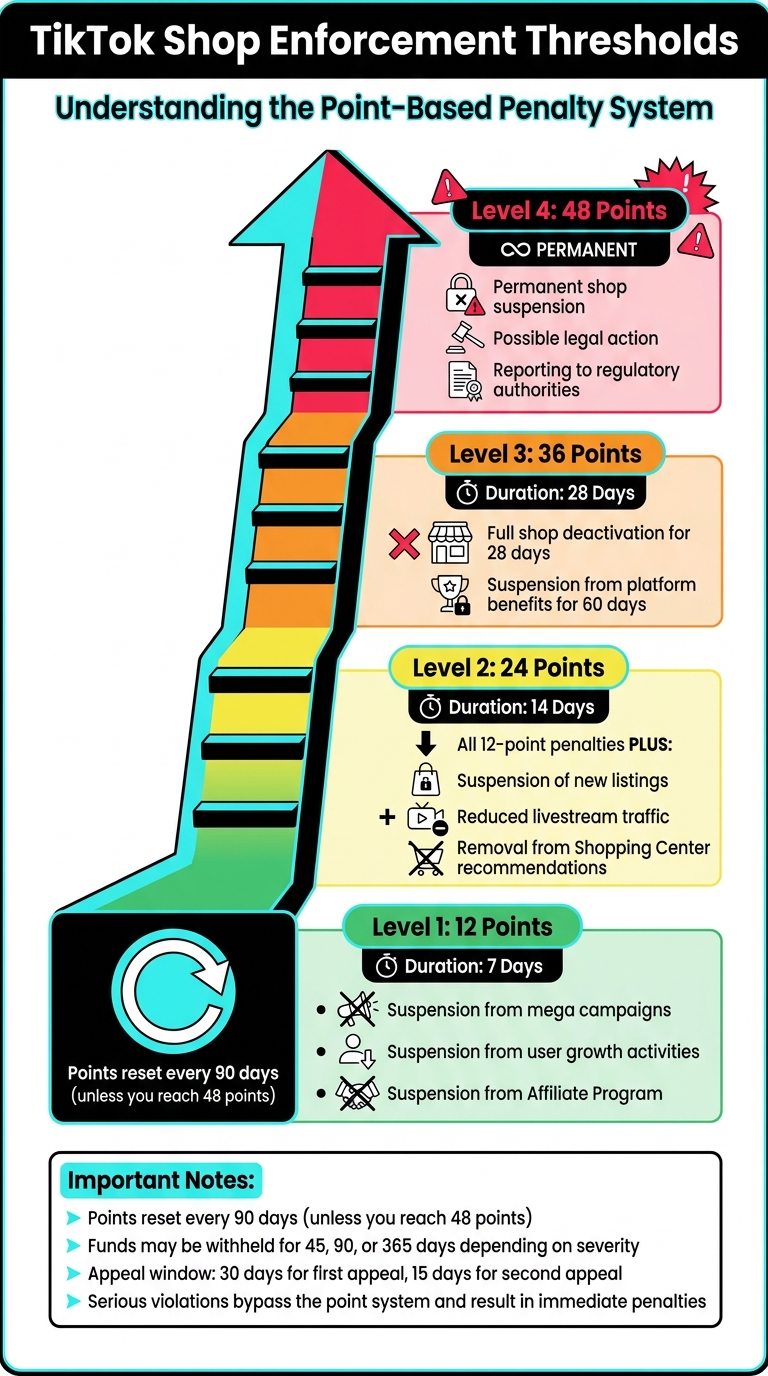
TikTok Shop Point-Based Penalty System and Enforcement Actions
TikTok uses a point-based system to handle policy violations, assigning points based on the severity and impact of each infraction. These points reset every 90 days unless the account accumulates 48 points, which results in permanent suspension. The platform also tracks an Account Health Rating (AHR) and issues milestone warnings when an account is within 5 points of the next enforcement level. This approach aligns with TikTok’s efforts to maintain a secure and fair environment.
Types of Penalties and Suspensions
TikTok’s enforcement measures escalate as accounts accumulate 12, 24, 36, and 48 points, with penalties becoming increasingly severe at each stage.
| Enforcement Threshold | Penalty Duration | Specific Enforcement Actions |
|---|---|---|
| 12 Points | 7 Days | Suspension from mega campaigns, user growth activities, and the Affiliate Program |
| 24 Points | 14 Days | Includes all 12-point penalties PLUS suspension of new listings, reduced livestream traffic, and removal from Shopping Center recommendations |
| 36 Points | 28 Days | Full shop deactivation for 28 days; suspension from platform benefits for 60 days |
| 48 Points | Permanent | Permanent shop suspension; possible legal action or reporting to regulatory authorities |
In addition, TikTok may withhold funds for periods of 45, 90, or 365 days depending on the severity of the violation. Sellers have the opportunity to file an appeal within 30 days of a violation, and if the first appeal is denied, a second appeal can be submitted within 15 days. Completing TikTok’s Policy or Milestone Quizzes can also help reduce enforcement durations or regain points.
Serious Violations and Their Consequences
Certain violations bypass the standard point system and result in immediate and severe penalties. Fraudulent, deceptive, or illegal activities can lead to instant account deactivation, regardless of the current point total. Examples include using fake engagement tactics such as artificially inflating orders, views, likes, or follows. Violations involving illegal or reproduced content may result in up to 48 points being assigned.
TikTok also monitors "Connected Accounts" – shops linked by shared phone numbers, emails, or bank account details. If one shop is banned, all connected accounts may face suspension simultaneously. In the most severe cases, particularly those involving deceptive or illegal practices, TikTok retains the right to permanently withhold funds.
Additional Requirements for US Sellers
For sellers in the U.S., adhering to TikTok’s policies is only part of the equation; compliance with federal and state regulations is equally important.
- Cosmetics: Products must be for external use only, have temporary effects, and cannot claim to treat or prevent diseases. Any cosmetic making medicinal claims faces immediate removal.
- Electronics: Items with standalone lithium batteries exceeding 25Ah or 300Wh are strictly prohibited.
- Jewelry: Sellers must follow Federal Trade Commission (FTC) guidelines, including compliance stamps for gold or silver. Diamonds must meet the Kimberley Process Certification Scheme requirements.
- Plants and Seeds: Sellers need to verify compliance with the Lacey Act and USDA designations for "noxious" plants before listing.
- Native American-made Products: Items labeled as such require verification by a member of a recognized U.S. Native American Tribe or a certified artisan.
Lastly, sellers using TikTok’s Countdown Bidding Feature must maintain a Shop Performance Score (SPS) of 2.5 or higher to retain access to the tool.
How to Avoid Policy Violations
Staying compliant with TikTok Shop policies requires consistent attention, as the platform frequently updates its standards and prohibited items list. Sellers are fully responsible for keeping up with these changes. TikTok Shop University emphasizes:
"This TikTok Shop Prohibited Products Policy is updated regularly. It’s the responsibility of sellers to frequently refer to this page to ensure compliance with our most up-to-date policy".
Review Your Listings and Content Monthly
Make it a habit to audit your catalog every month to catch potential compliance issues before they lead to penalties. TikTok’s enforcement is no joke – just in the latter half of 2024, over 450,000 seller accounts were deactivated, and around 37 million product listings were blocked due to violations.
During these reviews, check that your product titles, descriptions, and images are accurate, fair, and verifiable. Use TikTok’s platform documentation to ensure your listings meet the latest specifications. For any claims related to health or product performance, back them up with proper documentation from authorized professionals.
Keep a close eye on your performance metrics. Aim to maintain a Late Dispatch Rate below 4%, an On-Time Delivery Rate above 80%, and a Valid Tracking Rate over 95%. If your Account Health Rating dips below 200, act quickly – appeal incorrect violations or complete Policy Quizzes to recover points. Starting in January 2025, ensure all products with hazardous materials have completed mandatory Hazmat classification fields.
For additional support, TikTok offers an automated tool to help you review your content before publishing.
Use TikTok’s Video Pre-Check Tool
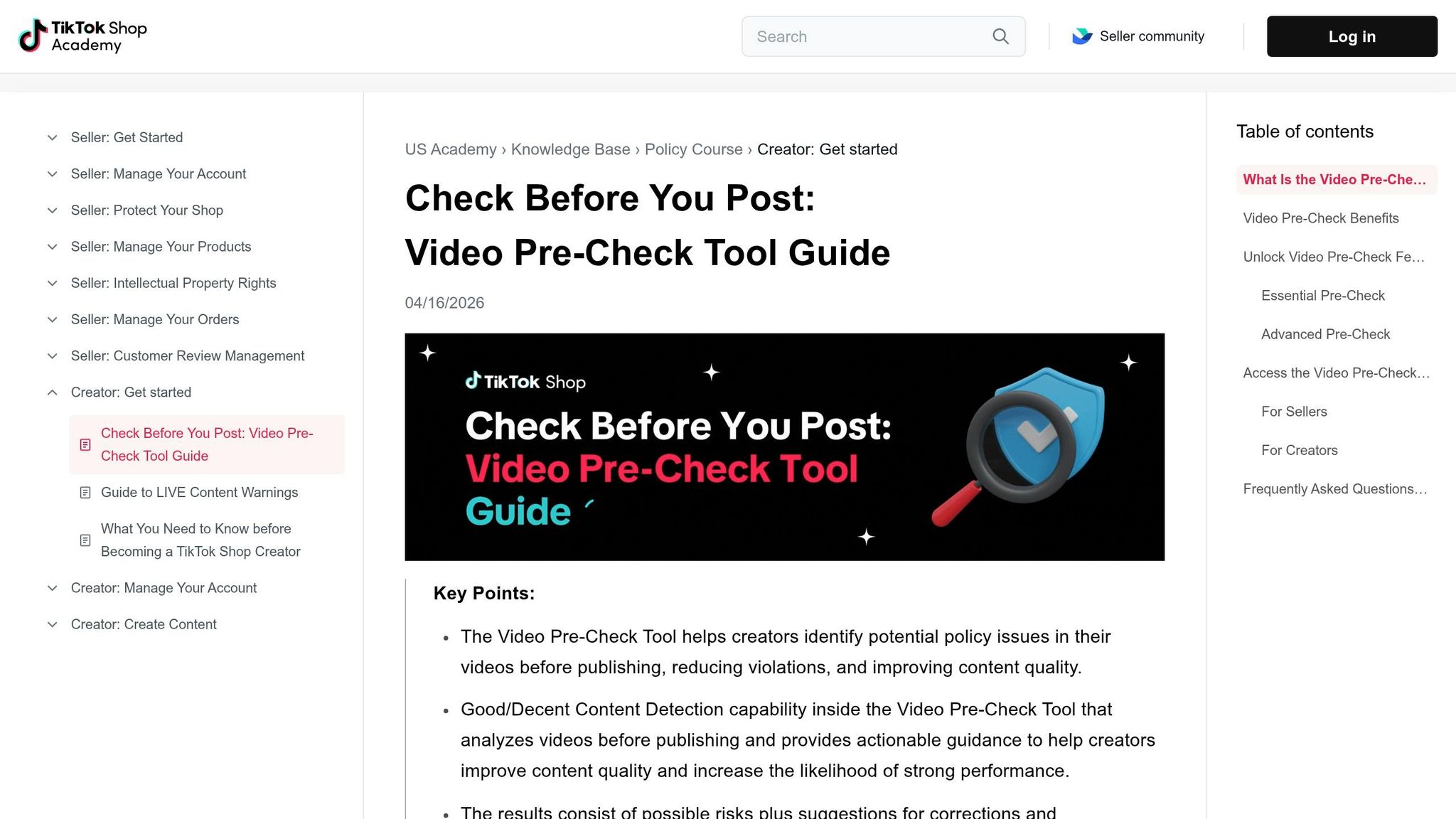
Pair your manual reviews with TikTok’s Video Pre-Check Tool for automated scans of your shoppable videos. This tool, available in the TikTok Shop Seller Center, checks visuals, audio, links, and hashtags for potential policy violations before you publish. Results are typically available within 10 minutes.
Here’s how it works: all sellers can use at least two pre-checks daily, while Platinum badge holders can access up to 10. To use the tool, go to the "LIVE & Video" tab in your Seller Center, select "Create Content", and then "Quality Check". Note that you can only link one product per video during the pre-check.
If any issues are flagged, click "View Details", make the necessary edits, and rescan your video to confirm compliance. Platinum badge sellers can also enable the "auto-post" feature once the tool confirms zero violations.
Keep Required Documentation Updated
Ensure all safety certificates, brand authorizations, and lab reports are up to date. For toys, verify that your Children’s Product Certificates (CPC) are current. Additionally, avoid including external contact information or links in your listings, as this could lead to violations.
If you’re using AI-generated content, label it clearly to avoid misleading your customers. And when running giveaways or offering purchase-based incentives, stick to official TikTok Shop promotional tools to maintain transparency.
Managing Compliance with Emplicit
Navigating TikTok Shop’s shifting policies can feel overwhelming, but Emplicit simplifies the process with systematic monitoring and proactive management. By tapping into Emplicit’s comprehensive ecommerce services, sellers can stay aligned with TikTok Shop policies while making their operations more efficient.
Account Health Monitoring
Emplicit keeps a close eye on your Account Health Rating (AHR), which TikTok measures on a 0–1,000 scale. Specific thresholds trigger restrictions: an AHR of 150 leads to a 7-day freeze on new campaigns and listings, 100 restricts Affiliate access and reduces livestream traffic for 14 days, 50 results in a 28-day shop deactivation, and hitting zero means permanent deactivation.
The team also manages your Shop Performance Score (SPS), which ranges from 0 to 5 and evaluates six key metrics: Negative Review Rate, Non-Buyer Fault Return Rate, Seller Fault Cancellation Rate, On-Time Delivery Rate, IM Dissatisfaction Rate, and After-Sales Handling Time. Maintaining an SPS of 3.5 or higher unlocks perks like Affiliate Marketing and 5-day accelerated settlements. An SPS of 4.0 or more qualifies you for 1-day express settlements and prestigious Gold or Silver Star Seller badges. Emplicit also tracks TikTok’s "Top Opportunity" tags to identify which metrics need the most focus. Beyond metrics, maintaining high-quality listings is critical for long-term success.
Listing Quality and Inventory Control
Emplicit ensures your product listings meet TikTok’s strict formatting and documentation requirements. This includes verifying that your products steer clear of prohibited categories and maintaining proper documentation for restricted categories like Beauty, Electronics, and Children’s Products through TikTok’s Qualification Center.
Proper inventory management is another focus. By keeping stock levels accurate, Emplicit helps you avoid inflated inventory numbers, which can lead to higher Seller Fault Cancellation Rates. This is especially important considering TikTok deactivated over 450,000 seller accounts and blocked 37 million product listings in the latter half of 2024. For sellers dealing with hazardous materials, Emplicit handles the mandatory attributes – such as classification, battery type, and transportation details – required as of January 5, 2025.
Tailored Compliance Solutions
Emplicit’s Growth and Enterprise plans offer compliance strategies customized to your product categories and business size. The team oversees appeal windows – 30 days for the first appeal and 15 days for follow-ups – and uses Policy Quizzes, available three times a month, to help recover AHR points or shorten enforcement periods. These strategies are designed to prevent violations and speed up recovery.
For sellers working with creators, Emplicit monitors affiliate content to ensure compliance. As AuditSocials once pointed out:
"The biggest compliance mistake TikTok Shop sellers make is assuming that creator-generated content is the creator’s compliance problem. It is not. If a creator makes an unsubstantiated health claim about your product, your seller account takes the hit".
With dedicated support from USA-based account managers available on Enterprise plans, Emplicit provides the oversight needed to catch potential violations before they affect your account. These tailored solutions align seamlessly with TikTok Shop policies, helping your business remain compliant and thrive.
Conclusion
Navigating TikTok Shop’s compliance environment is no small feat. Sellers must juggle multiple responsibilities, including managing product listings, creator content, advertising standards, and livestreams. A single piece of content can activate FTC rules, advertising policies, product safety regulations, and trade requirements all at once. Recent enforcement actions, such as widespread deactivations and listing blocks, highlight the high stakes involved. To succeed, sellers need clear, proactive strategies at every step of their operations.
The risks extend beyond operational hurdles. Legal liabilities can lead to severe consequences, such as frozen commissions, shop suspensions, or even permanent deactivation. For instance, commission freezes can last up to 90 days, while shop suspensions may range from 7 to 28 days, depending on the Account Health Rating. In extreme cases, permanent deactivation can result in funds being withheld for up to 365 days. To avoid these outcomes, maintaining a Compliance Score above 50 and a Shop Performance Score of 2.5 or higher is crucial. These metrics are key to retaining access to essential features like the Affiliate Marketplace and advanced promotional tools.
Taking a proactive approach to compliance can protect both your revenue and reputation. Steps like pre-approving creator content, securing proper documentation for restricted products, and conducting monthly catalog audits can help identify and address potential issues early. Additionally, using TikTok’s Video Pre-Check Tool and monitoring your Account Health Rating daily can help you respond swiftly to violations, often within the critical 12- to 72-hour enforcement window.
Sellers must also be vigilant about claims made by affiliates and creators. If an affiliate makes an unsupported health claim about your product, the consequences fall squarely on your seller account – not theirs.
Considering TikTok Shop is projected to generate over $30 billion in global sales by 2026, and with regulatory scrutiny increasing – such as the FTC’s first individual creator fines exceeding $100,000 in 2025 – preventive compliance measures are more important than ever. By streamlining your compliance efforts and leveraging tools like TikTok’s Video Pre-Check Tool, you can safeguard both your business and reputation. Partnering with experts like Emplicit can also help you stay ahead of policy changes and keep your TikTok Shop thriving.
FAQs
How do I figure out what caused a violation?
To figure out why a violation occurred on TikTok Shops, start by checking your account notifications or the violation alerts. These will usually provide details about what went wrong. Common reasons include not following TikTok’s content policies, like promoting banned products or engaging in restricted activities. Take a close look at the specific policy mentioned in the alert. If you believe the violation was flagged in error, you can file an appeal and include any supporting evidence. Staying updated on TikTok’s policies can help you avoid similar problems in the future.
What can I do to remove points faster?
To reduce points more quickly, start by checking TikTok’s policy guidelines to understand the violations. If needed, correct or remove any content that goes against the rules. It’s also a good idea to avoid repeating similar mistakes. If you think a violation was assigned unfairly, you have up to 30 days to file an appeal. Resolving issues promptly and sticking to the platform’s rules can help you lower points faster.
What claims are safest to make in videos and listings?
The safest claims are those that are truthful, verifiable, and align completely with TikTok’s content policies. Steer clear of exaggerated or unproven statements about how a product performs or its benefits. This not only keeps your content compliant but also helps build trust with your audience.