

Behavioral segmentation helps businesses group customers based on actions like purchase habits, browsing behavior, and engagement. This approach drives higher Customer Lifetime Value (CLV) by targeting the right customers with personalized strategies. Why does this matter? Retaining customers is 5 to 25 times cheaper than acquiring new ones, and even a 5% increase in retention can boost profits by up to 95%.
Here’s a quick breakdown:
- What it is: Grouping customers based on actions (e.g., purchase frequency, cart abandonment).
- Why it works: Behavioral data predicts future actions better than demographics.
- How CLV improves: Personalization encourages repeat purchases, increases order values, and reduces churn.
Key strategies include using metrics like Recency, Frequency, and Monetary value (RFM) to identify high-value customers, targeting cart abandoners with discounts, and rewarding loyal customers with exclusive perks. Tools like CRMs and AI-powered analytics make this process efficient and precise.
In short, focusing on what customers do – not just who they are – can significantly grow your business.
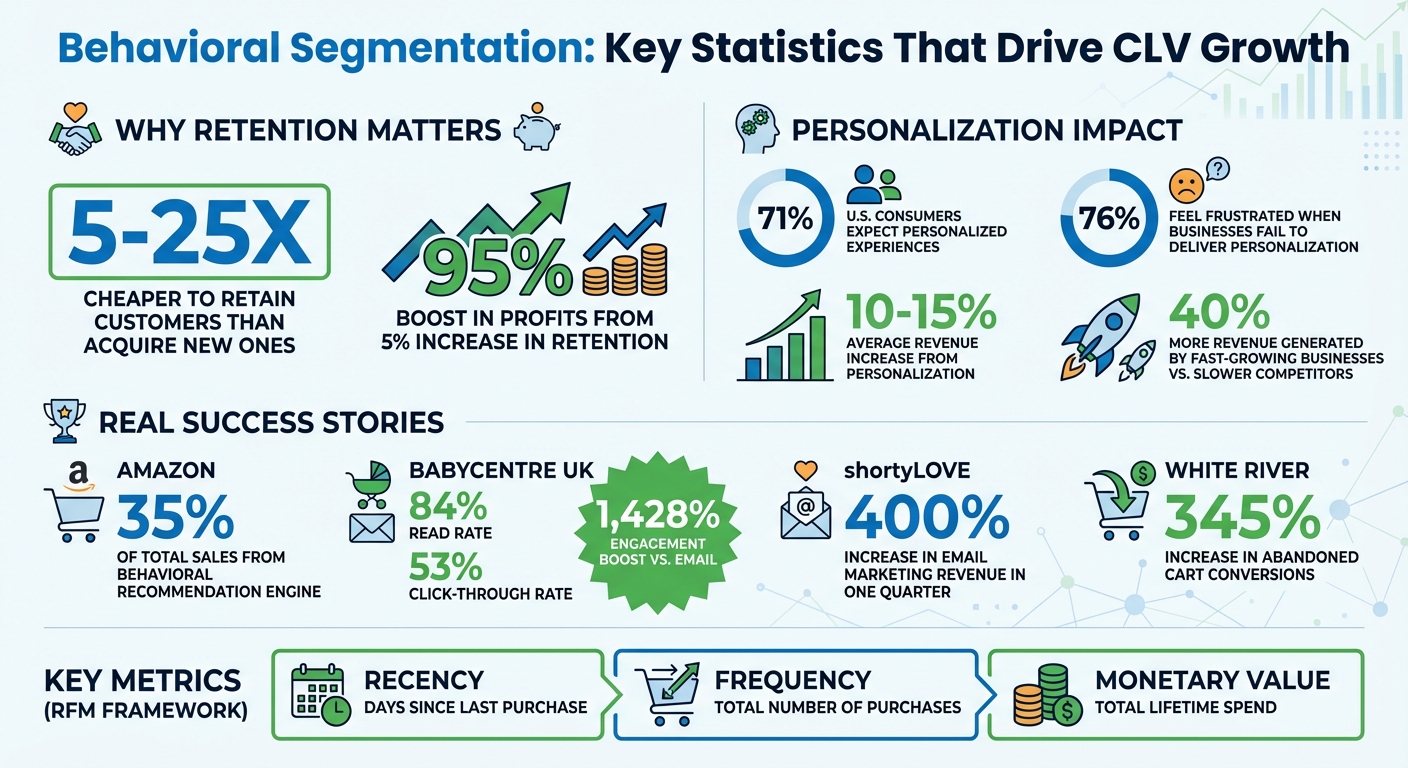
Behavioral Segmentation Impact on Customer Lifetime Value: Key Statistics and ROI
Core Concepts of Behavioral Segmentation
Principles and Key Metrics
Behavioral segmentation focuses on categorizing customers based on their real-time actions – like purchases, clicks, and overall engagement. Metrics such as RFM (Recency, Frequency, Monetary value) play a central role here. Recency tracks how recently a customer made a purchase, Frequency looks at how often they buy, and Monetary value measures how much they spend per transaction. These metrics work together to spotlight high-value customers while flagging those who might be at risk of dropping off.
Other important metrics include session frequency, dwell time, average order value, and feature usage. These data points go beyond traditional demographics to reveal deeper insights into customer behavior and intent. With these foundational metrics in mind, let’s dive into the main types of behavioral segments businesses can use to fine-tune their strategies.
Types of Behavioral Segments
Ecommerce businesses often rely on several behavioral segmentation categories to better understand and target their customers:
- Purchase behavior: Groups customers based on how often they buy, their average order value, and their product preferences.
- Customer journey stage: Identifies where a customer is in the funnel – whether they’re in the awareness, consideration, purchase, retention, or advocacy phase.
- Benefits sought: Segments customers by what they value most, such as price, quality, or convenience.
- Loyalty activity: Categorizes customers by their participation in loyalty programs, referrals, or repeat purchase habits.
- Occasion-based: Targets customers who shop during specific events, like holidays, life milestones, or seasonal needs.
- Usage behavior: Tracks actions like session frequency and time spent on a website, helping distinguish between highly engaged visitors and casual browsers.
For example, BabyCentre UK used a behavioral-targeted messenger bot to achieve an 84% read rate and a 53% click-through rate – a staggering engagement boost of 1,428% compared to their standard email funnel. Similarly, Guinness leveraged occasion-based segmentation during the Six Nations Rugby Cup, reaching 21 million people with its "Guinness Clear" campaign.
These segmentation strategies directly support more accurate Customer Lifetime Value (CLV) modeling, enabling businesses to target customers with precision.
Behavioral Segmentation and CLV Modeling
Behavioral data plays a critical role in refining Customer Lifetime Value (CLV) predictions. Since past actions often predict future behavior, integrating metrics like RFM scores with usage patterns helps businesses identify high-value customers early and estimate their long-term revenue potential with greater accuracy.
AI-powered tools take this a step further through probabilistic forecasting, allowing companies to predict both high CLV customers and potential churn risks. For instance, Amazon’s recommendation engine – built on behavioral purchase data – accounts for 35% of the company’s total sales.
Precision is key when applying these models. Instead of broadly targeting all recent buyers, businesses can focus on customers who, for example, spent over $100 in the last 30 days. This level of targeting ensures marketing resources are directed toward the most valuable segments. For customers with high purchase frequency but lower transaction values (often called "frequentists"), stretch coupons can encourage bigger orders. On the other hand, for customers with high transaction values but less frequent purchases ("splurgers"), chain reaction coupons can prompt more regular spending.
Full Python Tutorial: Customer Lifetime Value & RFM Analysis using Machine Learning
Building Data Foundations for Behavioral Segmentation
To make behavioral segmentation work effectively, you need a solid data foundation. This foundation plays a crucial role in shaping Customer Lifetime Value (CLV) outcomes.
Data Sources for Ecommerce Brands
The first step in creating accurate behavioral segments is collecting data from the right sources. Ecommerce platforms like Shopify and BigCommerce track transaction histories and order details, while U.S. marketplaces such as Amazon, Walmart, and TikTok Shops offer purchase reports that can be synced with direct-to-consumer channels. Tools like Google Analytics provide insights into website activity, including session times, pages visited, and cart abandonment trends. Meanwhile, email and SMS platforms reveal campaign engagement and click behavior, and loyalty programs monitor points balances, VIP tiers, and referral activities.
Centralized systems like CRMs and ERPs combine communication histories and calculate CLV using the formula: Average transaction size × Number of transactions × Retention period. Adding customer feedback – through NPS, CSAT scores, or product reviews – helps identify both loyal advocates and customers at risk of leaving.
By tapping into these diverse sources, businesses can collect the critical data points necessary for effective segmentation.
Key Behavioral Data Points
Behavioral data can be grouped into three main categories:
- Transactional Data: Purchase frequency, order value, and recency.
- Engagement Data: Product views, time spent on pages, and cart additions.
- Lifecycle Markers: Identifiers like new visitors, first-time buyers, and loyal advocates.
Why does this matter? Because personalization is no longer optional. A staggering 71% of U.S. consumers expect tailored experiences, and 76% feel frustrated when businesses fail to deliver. Companies that prioritize personalization see impressive results – on average, a 10-15% increase in revenue. Fast-growing businesses even generate 40% more revenue from personalization compared to their slower competitors.
Data Preparation and Integration
Once the data is collected, the next step is refining it. Start by cleaning and standardizing raw data from all sources. Then, unify multi-channel data to create a single, cohesive customer view. For U.S.-based brands, ensure that all data aligns with USD and local time zones.
A critical part of this process is connecting customer identities across channels. For example, link an email subscriber’s activity with their browsing history and marketplace purchases. In 2024, White River, a hardwood molding retailer, used this strategy to analyze their customer lifecycle. By comparing orders placed within 24 hours versus 30 days, their Director of Marketing, Richard Enriquez, fine-tuned automated SMS and email flows. The result? A 345% increase in abandoned cart conversions.
"With Segments the guessing is replaced with science." – Richard Enriquez, Director of Marketing & eCommerce, White River
To stay ahead, use real-time processing tools for dynamic segmentation that updates as customers move through different lifecycle stages. And don’t forget to prioritize first-party data – it offers better accuracy and ensures compliance with regulations like GDPR and CCPA.
With a well-prepared and integrated data foundation, businesses can now focus on how targeted behavioral segments can unlock CLV growth.
sbb-itb-e2944f4
Behavioral Segments That Increase CLV
Once your data foundation is solid, focusing on targeted behavioral segments can significantly enhance customer lifetime value (CLV).
High-Value Segments to Target
To maximize CLV, it’s essential to prioritize customer groups with the most potential. Not all customers contribute equally, so tailoring your approach to specific segments is key.
VIP/Loyal Customers, for instance, are frequent buyers who trust your brand. These customers thrive on exclusivity – think early product access, tiered rewards, or special offers. Meanwhile, First-Time Buyers need nurturing. Sending thank-you messages with next-order discounts or personalized recommendations can turn them into repeat customers.
At-Risk/Dissatisfied Customers – those showing signs of churn or leaving negative feedback – require immediate attention. Targeted campaigns, feedback requests, or offers to address their concerns can help re-engage them. Similarly, Cart and Browse Abandoners, who show high purchase intent, respond well to incentives like free shipping or time-sensitive discounts.
Then there are Deal Seekers, shoppers driven by discounts. They’re likely to convert through back-in-stock alerts or seasonal promotions. Lastly, Engaged Shoppers, who explore your site extensively or browse multiple categories, respond well to emails offering deeper product insights.
Identifying these segments is just the beginning. Success lies in crafting tailored strategies for each group to maximize their value.
Strategies for Each Segment
For VIP customers, tiered loyalty programs work wonders. Offer perks like faster shipping or birthday gifts as they spend more. On the other hand, Frequentists – those who shop often but spend less – can be encouraged to increase their order value with coupons that activate only when they exceed their usual spend. Splurgers, who spend big but shop infrequently, respond well to incentives like "chain reaction" coupons, which reward them for making another purchase within a set timeframe.
To turn first-time buyers into loyal customers, automate follow-ups with care tips and upsell opportunities. For at-risk customers who haven’t purchased in 60–90 days, "We Miss You" campaigns with steep discounts can reignite their interest.
A great example of segmentation in action comes from the handbag brand shortyLOVE. They divided their audience into 12 lifecycle groups based on purchase behavior. Loyal customers received design-focused content, while new sign-ups got sales-driven messaging. The result? A 400% increase in email marketing revenue in just one quarter.
"With Segments the guessing is replaced with science."
– Richard Enriquez, Director of Marketing & eCommerce, White River
These strategies directly impact CLV by improving purchase frequency, boosting average order value, and enhancing customer retention – key drivers of long-term revenue.
Marketplace-Specific Opportunities
Marketplaces like Amazon and Walmart offer unique data that can refine segmentation efforts and further increase CLV. For example, analyzing Subscribe & Save patterns on Amazon can reveal repeat purchase cycles. This insight allows brands to create flexible subscription plans where customers can pause or skip deliveries as needed. Similarly, identifying products purchased monthly versus quarterly helps tailor subscription offerings.
On Walmart, tracking how customers engage with different platforms – like mobile apps versus desktop – enables more effective, platform-specific messaging. A notable example is Magnolia Bakery, which used Shopify tagging to identify customers who bought pies for Thanksgiving. The following holiday season, they targeted the same group with personalized offers, driving repeat sales.
With mobile commerce projected to account for over 10% of all U.S. retail sales by 2025, optimizing your marketplace strategy for mobile users is more critical than ever.
Emplicit’s ecommerce services help brands seamlessly integrate these data-driven segmentation strategies, ensuring your marketplace presence drives maximum customer lifetime value. Next, we’ll dive into how to implement these strategies and measure their impact on CLV.
Implementing and Measuring Behavioral Segmentation
Implementation Playbooks
Start by defining clear criteria for each behavioral segment using a straightforward formula: (Behavior) + (Threshold) + (Where Clause). For example, you might define "Engaged Shoppers" as users with "Time on site > 10:00" (Behavior/Threshold) "within the last month" (Where Clause). This kind of precision ensures your segments are actionable and measurable.
Another effective tool is RFM analysis, which scores customers based on Recency (days since their last purchase), Frequency (total number of purchases), and Monetary Value (total lifetime spend). Many businesses divide their customer database into quintiles, assigning scores from 1 to 5 for each category. A customer with an RFM score of 555 represents your most valuable audience (recent, frequent, and high spenders), while a score of 111 indicates the opposite. This method allows you to identify groups like "Frequentists" (high frequency, low spend) and "Splurgers" (high spend, low frequency), tailoring your strategies to address their unique behaviors.
Automated engagement flows are another powerful way to turn segmentation into revenue. Set up real-time triggers for specific actions, such as sending browse abandonment emails to visitors who leave without purchasing or "back in stock" alerts to bargain hunters. For example, personalized, real-time triggers can help recover abandoned carts and drive conversions.
Tiered loyalty programs can also benefit from behavioral segmentation. For instance, NON, a non-alcoholic beverage brand, rewards loyal customers with exclusive pre-sale invitations for new products, emphasizing their importance as "valued members of the NON family." At the same time, neutral customers receive feedback requests and personalized discounts to encourage further engagement.
Once segmentation is in place, the next step is tracking key metrics to measure its impact on customer lifetime value (CLV).
Tracking CLV Metrics
To gauge the effectiveness of behavioral segmentation, focus on tracking metrics that directly influence CLV. The standard formula – Average transaction size × Number of transactions × Retention period – provides a baseline. Key metrics to monitor include:
- Average Order Value (AOV): Higher AOV boosts total lifetime revenue, especially for segments like Frequentists.
- Purchase Frequency: More frequent transactions open up cross-selling opportunities and amplify CLV over time.
- Customer Retention Rate (CRR): Longer retention periods significantly increase CLV.
- Churn Rate: A rising churn rate signals a need to revisit retention strategies.
As Austin Caldwell, Senior Product Marketing Manager at NetSuite, puts it:
"You can’t improve what you don’t measure. Once you start measuring CLV and breaking down the various components, you can employ specific strategies… with a goal of continuously reducing costs and increasing revenue."
Tracking RFM segment migration is another effective way to measure lifecycle marketing success. For example, monitor how customers transition from "Potential Regular" to "Champion." As Mike Arsenault, Founder & CEO of Rejoiner, explains:
"There is no better predictor of future purchase behavior and future customer lifetime value than historical purchase behavior."
To streamline this process, use automated ERP/CRM dashboards that track metrics in real time. Implement Change Data Capture (CDC) to ensure your personalized marketing content updates automatically as customer behaviors shift. This real-time tracking prevents outdated analysis and allows you to trigger marketing workflows whenever a customer’s segment status changes.
With metrics in place, regularly review and refine your segmentation to reflect changing customer behaviors.
Maintenance and Governance
Behavioral segmentation isn’t a "set it and forget it" strategy – it requires ongoing maintenance to remain effective. Since customer behaviors are constantly evolving, regular reviews are essential to keeping your segments accurate. Monthly evaluations of segment definitions based on recent activity can help fine-tune your approach.
Consistency across channels is also crucial. Use a centralized system to ensure all departments and platforms are aligned.
Different types of segments demand different maintenance strategies. For instance:
- Real-Time Segments: These, like cart abandoners, rely on automated triggers and need minimal manual adjustments.
- Broad Segments: Groups like VIPs or lapsed customers benefit from scheduled reviews to ensure thresholds (e.g., AOV > $100) stay relevant.
- Predictive Segments: These use machine learning to adapt automatically to market trends, identifying customers at risk of churning.
Privacy compliance is another critical aspect. Adhere to regulations like GDPR and CCPA by maintaining transparency and providing customers with easy options to manage their data preferences.
Adam Davis, Senior Marketing Manager at Magnolia Bakery, shares their approach:
"In these multiple revenue streams, it’s hard for us on paper, just at a glance, to understand the difference between a local customer and a nationwide customer. So we’ve set up a lot of tagging… so that next Thanksgiving, we don’t have to go back and understand, oh, well, what was that customer? Shopify is already doing the work for us."
Regularly A/B test strategies for each segment to identify what drives the highest conversion and retention rates. You can also layer behavioral data with demographic or geographic insights to create more refined sub-segments. Keep an eye out for early churn signals, such as declining purchase frequency or shorter site visits, and trigger automated re-engagement campaigns as needed.
Emplicit’s e-commerce services provide tools to help brands implement these tracking systems effectively, ensuring your behavioral segmentation strategy remains impactful as your business grows.
Conclusion and Key Takeaways
Behavioral segmentation is reshaping how brands approach Customer Lifetime Value (CLV) by focusing on what customers do rather than who they are. Stephan Serrano from Barilliance highlights that this method is often more predictive than relying on demographic data. The numbers back this up – 35% of Amazon’s total sales come from product recommendations driven by behavioral data. Similarly, BabyCentre UK achieved an 84% read rate and 53% click-through rate by tailoring messages based on user behavior.
By zeroing in on actions like purchase frequency, average order value (AOV), time spent online, and engagement, brands can uncover actionable insights to boost CLV. These behaviors point to opportunities like reducing churn with timely re-engagement, driving repeat purchases through personalized reminders, and optimizing marketing spend on the most valuable customer segments. For example, when Olay used AI-driven insights from its Skin Advisor tool, it identified a demand that led to the launch of Retinol 24 – now one of their top-selling products.
Getting started is simpler than it seems. Focus on high-value groups like cart abandoners or VIP customers. Use a basic formula – (Behavior) + (Threshold) + (Timeframe) – to define these segments (e.g., customers spending more than $50 within 30 days). Once this foundation is set, you can move toward more advanced AI-powered models to refine your strategy.
These efforts become even more effective with the right ecommerce tools. Emplicit’s comprehensive ecommerce services support brands in implementing these strategies across platforms like Amazon, Walmart, TikTok Shops, Target, and their own websites. Whether it’s PPC optimization, listing management, inventory tracking, or account health monitoring, Emplicit provides the infrastructure to unify customer data, create precise segments, and deliver personalized campaigns. Combining behavioral segmentation with technical expertise turns customer data into lasting growth.
As customer behaviors shift over time, it’s crucial to regularly update your strategy and ensure compliance with privacy regulations to keep your efforts effective.
FAQs
What makes behavioral segmentation different from demographic segmentation?
Behavioral segmentation groups customers based on their actions – like how they shop, use products, or interact with a brand. On the other hand, demographic segmentation organizes customers by static traits such as age, gender, income, or location.
Using behavioral data allows businesses to craft tailored strategies that align with customer needs. This approach not only enhances the customer experience but also boosts customer lifetime value (CLV) and drives business growth.
What are the best tools for implementing behavioral segmentation in ecommerce?
To make behavioral segmentation work for your business, you’ll need the right tools to collect, analyze, and act on customer data. Here’s a breakdown of some key options:
- Web analytics tools (like Google Analytics) track browsing habits, conversions, and click patterns, helping you identify important trends in customer behavior.
- A CRM or customer data platform brings together purchase history, email interactions, and loyalty stats, making it easier to group customers based on their value, buying frequency, or risk of leaving.
- Email and SMS marketing platforms (such as Klaviyo) let you design and automate personalized campaigns tailored to specific customer groups.
- Personalization software (like Barilliance) collects real-time data and enables dynamic segmentation, so you can offer customized product recommendations or pricing.
When these tools work together, ecommerce brands can centralize customer data, analyze behaviors, and deliver targeted messages. The result? Stronger connections with your audience and a boost in Customer Lifetime Value (CLV).
How can businesses evaluate the success of their behavioral segmentation strategies?
To evaluate the effectiveness of behavioral segmentation, businesses should focus on essential ecommerce metrics such as customer lifetime value (CLV), average transaction value (ATV), repeat purchase rate, and churn or retention rates. By comparing these metrics before and after implementing segmentation strategies, businesses can assess whether their messages are connecting with the right audiences and driving improved outcomes.
Dashboards can make it easier to track performance indicators like conversion rates, cart abandonment recovery, and revenue generated per email or SMS for each customer segment. Experimenting with offers, timing, or messaging within segments and conducting cohort analysis can uncover valuable trends. For instance, a 12% increase in ATV among frequent buyers or a 5-point boost in repeat purchases from recent cart abandoners are clear signs of a successful segmentation strategy.
Emplicit helps brands stay ahead by integrating analytics across platforms like Amazon, TikTok Shop, Walmart, Target, and custom storefronts. Their tools deliver real-time reporting on metrics like CLV, retention, and segment-specific ROI, enabling businesses to fine-tune their strategies for continuous improvement.