

If you’re selling on Amazon in 2026, staying ahead of competitors is no longer optional – it’s critical. Competitor benchmarking tools can help you analyze pricing, keywords, sales trends, and market share to refine your strategy. Here’s a quick breakdown of seven top tools to consider:
- Helium 10: Advanced analytics for sales estimates, keyword research, and inventory tracking. Plans start at $99/month.
- Jungle Scout: Offers 20% more accurate data than competitors, with pricing from $49/month.
- AMZScout: Beginner-friendly with a focus on niche discovery and historical sales data. Starts at $29.99/month.
- SellerApp: Affordable keyword and pricing insights with plans starting at $19/month.
- DataHawk: Tailored for enterprises with complex analytics and custom pricing.
- Keepa: Tracks historical price and rank data, starting at $15/month.
- Emplicit: Managed service for sellers who prefer expert guidance over self-management.
Each tool serves different needs, from beginners to enterprise-level sellers. Whether you want to track keywords, optimize pricing, or monitor competitor stock levels, these tools can provide the data you need to succeed. For a quick comparison, see the table below.
Quick Comparison
| Tool | Starting Price | Best For | Key Feature |
|---|---|---|---|
| Helium 10 | $99/month | Advanced sellers | Precise sales estimates and keyword tools |
| Jungle Scout | $49/month | Product research | Competitive insights and market share |
| AMZScout | $29.99/month | Beginners | Niche discovery and Chrome extension |
| SellerApp | $19/month | Budget-conscious sellers | Real-time competitor tracking |
| DataHawk | Custom pricing | Enterprise-level sellers | Multi-platform analytics |
| Keepa | $15/month | Price tracking | Historical price and rank data |
| Emplicit | Custom pricing | Managed services | Expert-led account management |
Choose a tool based on your business size, goals, and budget. Combining tools can also provide a more comprehensive approach to competitor analysis.
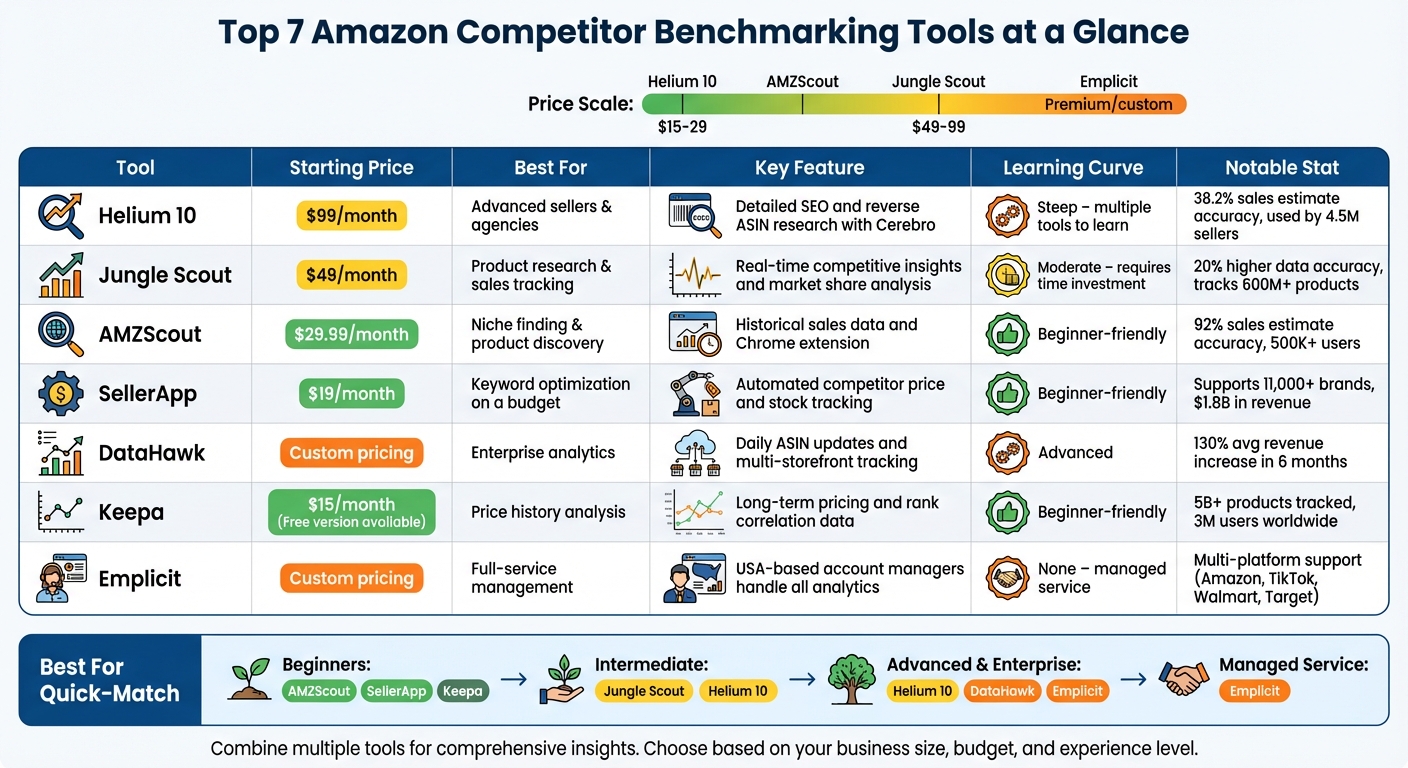
Amazon Competitor Benchmarking Tools Comparison: Pricing, Features & Best Use Cases
Amazon FBA Competitor Analysis Using Helium10 Reverse Asin And Xray
sbb-itb-e2944f4
1. Helium 10
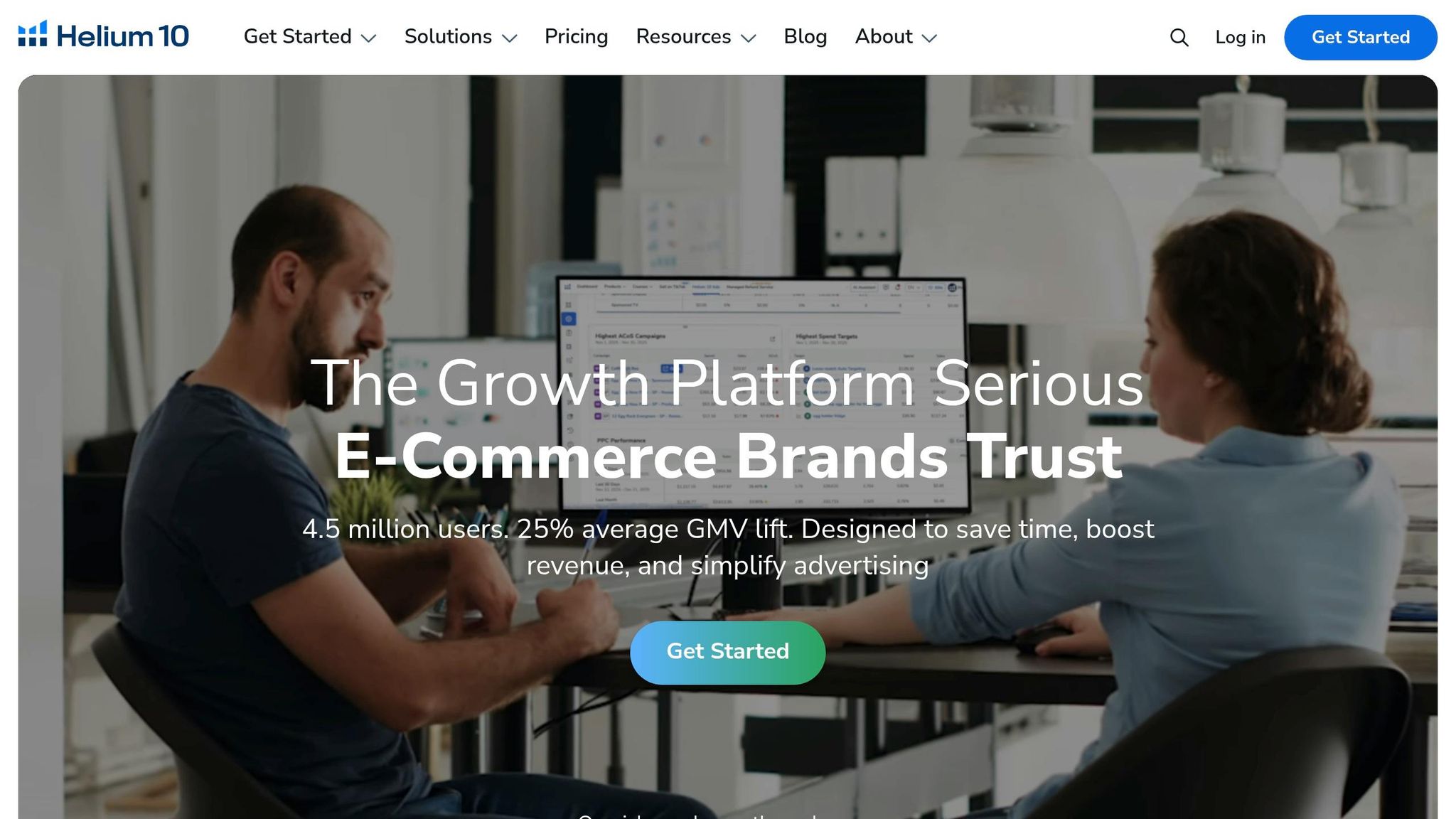
Helium 10 is trusted by 4.5 million sellers for its ability to deliver sales estimates with remarkable precision – within 22 units on average. About 38.2% of its sales estimates are spot-on, giving sellers the confidence to base decisions on data rather than guesswork.
Competitor Data Insights
Helium 10 offers a suite of tools to analyze competitors and market trends. With Cerebro, you can uncover competitor keywords by simply entering an ASIN. Market Tracker 360 keeps tabs on market share, while Trendster highlights historical price changes. Xray delivers insights on monthly sales, revenue, Best Seller Rank (BSR), and FBA fees, and the Chrome Extension tracks competitor inventory levels. Together, these tools help sellers craft scalable pricing strategies.
Pricing and Affordability
Helium 10 provides flexible pricing plans tailored to sellers at different stages of growth:
- Platinum: $99/month for sellers earning under $100K annually.
- Diamond: $279/month for businesses generating $100K–$10M annually, with added inventory and PPC tools.
- Enterprise: $1,499/month for sellers with over $10M in sales, featuring dedicated support.
Ease of Use for Amazon Sellers
Helium 10 simplifies the process for Amazon sellers with its one-click Chrome Extension, offering instant data access. For new sellers, resources like FBA training, Ads Academy, and monthly Q&A sessions make understanding the platform’s tools much easier. The Listing Analyzer evaluates your listing quality on a 1–10 scale, comparing it to competitors to help you optimize.
"Without access to this level of data, we are driving in the dark." – Brainlabs
Additional Features for Business Growth
Helium 10 goes beyond the basics with features designed to maximize growth. Its AI-powered listing builders make creating optimized product pages a breeze, while Adtomic automates PPC management. The platform even offers refund recovery services, which have been shown to increase GMV by an average of 25%. Helium 10 supports multiple Amazon marketplaces and has expanded its analytics to include Walmart and TikTok Shop, broadening its appeal.
2. Jungle Scout
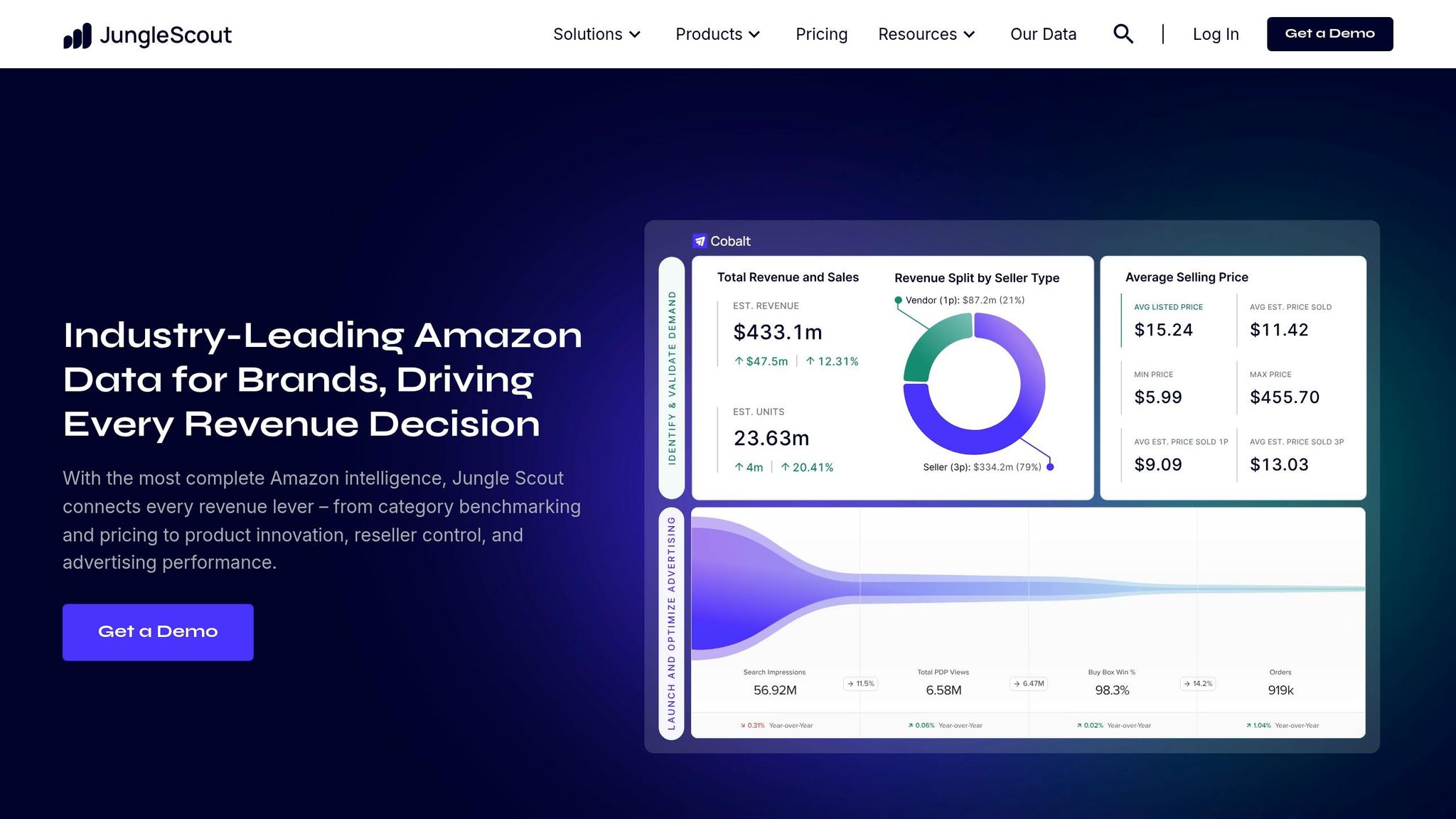
Jungle Scout stands out as a top-tier Amazon benchmarking tool, offering a competitive edge with its impressive accuracy and extensive product tracking. The platform boasts 20% higher data accuracy than its closest competitor and monitors over 600 million products across 24 categories. For brands leveraging its enterprise-level Cobalt tool, the results speak for themselves – on average, these users experienced a 28% increase in Amazon revenue year-over-year. It’s a trusted choice for sellers aiming to grow their business.
Competitor Data Insights
Jungle Scout’s Competitive Intelligence tool is designed to help sellers understand their market position. It provides detailed comparisons of unit sales and revenue against competitors, offering 12 months of historical data for specific ASINs. This data includes metrics like revenue, unit sales, average price, star ratings, and review counts.
The platform also features Share of Voice metrics, which reveal how visible your brand is for targeted keywords compared to competitors. Additionally, its AI-driven review analysis pinpoints what customers love – or dislike – about competing products. For sellers looking to analyze their niche in depth, Jungle Scout allows mapping of up to 200 competitors using visual layouts that highlight keyword overlap. These tools are available with flexible pricing options to suit businesses of all sizes.
Pricing and Affordability
Jungle Scout offers plans tailored to different stages of business growth:
- Starter Plan: At $49/month or $348 annually, this plan is ideal for basic product research.
- Growth Accelerator Plan: For $79/month or $588 annually, this plan includes review automation and access to the supplier database.
- Brand Owner + Competitive Intelligence Plan: Priced at $399/month or $3,588 annually, this option provides advanced market share tools, 10 user licenses, and more.
These pricing tiers ensure that sellers can find a plan aligned with their needs.
Ease of Use for Amazon Sellers
Jungle Scout’s user-friendly design consistently earns praise. Christian F., a Project Leader, shares:
"Jungle Scout can track Amazon sales and performance, so you can see what’s working and what’s not in a very intuitive way".
Beyond its interface, the platform offers 24/7 customer support and comprehensive training through Jungle Scout Academy. Shamal A., a CEO, highlights its versatility:
"They cover almost everything required to do business on Amazon. If you have a Jungle Scout, then you do not need 10 different tools to solve the problem…".
This all-in-one approach helps sellers make smarter, data-driven decisions for competitive benchmarking.
Additional Features for Business Growth
Jungle Scout includes several tools designed to support business growth:
- Supplier Database: Connect with verified manufacturers.
- Inventory Manager: Predict and manage stock levels to avoid stockouts and reduce storage fees.
- Opportunity Finder: Identify niches with high demand and minimal competition.
- Brand Control: Monitor for unauthorized resellers to protect profit margins.
- Automated Review Requests: Boost your product’s social proof.
These features make Jungle Scout a comprehensive solution for sellers looking to optimize their Amazon strategies and grow their businesses effectively.
3. AMZScout
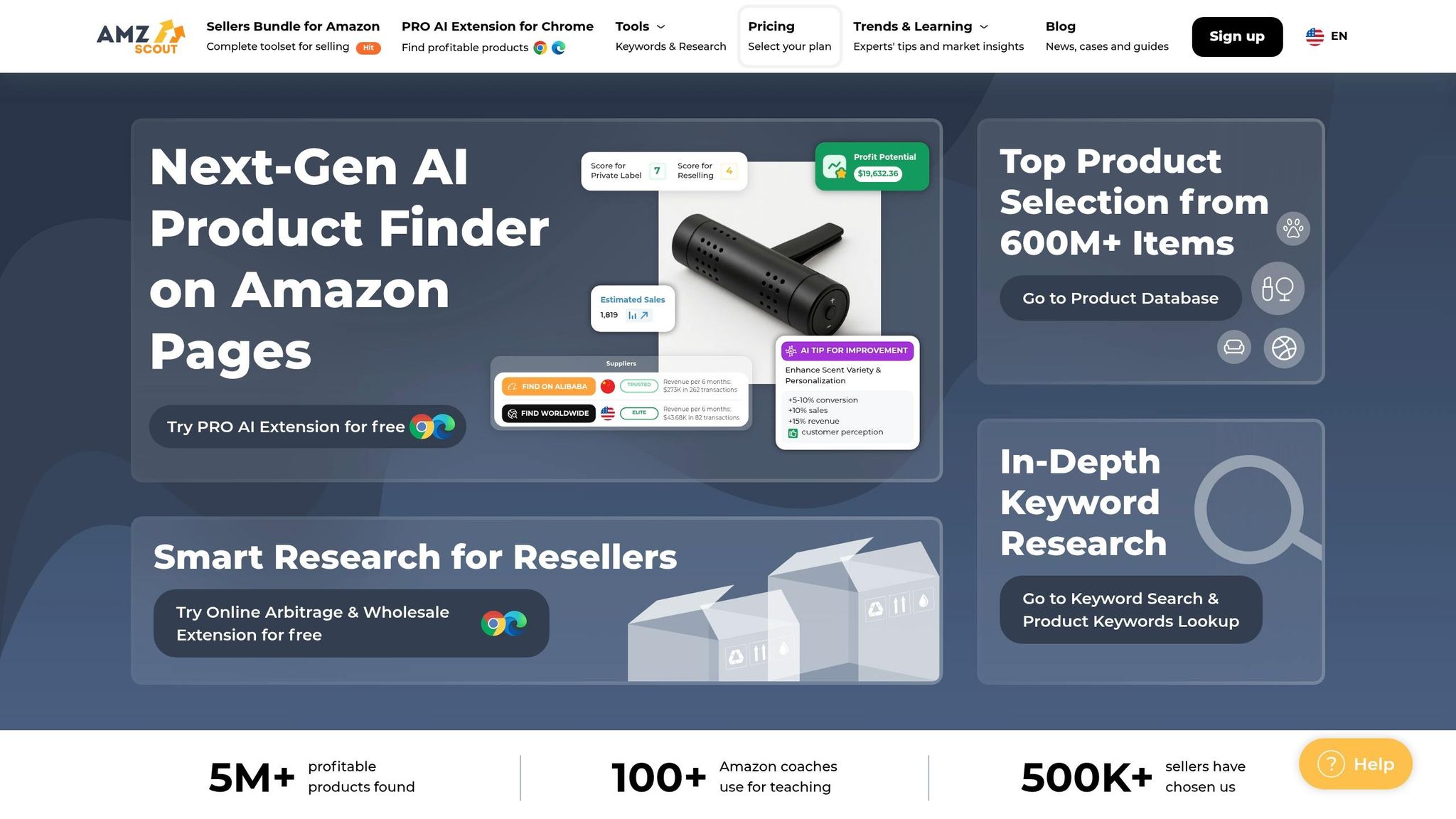
Used by over 500,000 sellers, AMZScout gives access to an extensive database of 600 million SKUs across nine marketplaces, helping sellers pinpoint profitable opportunities. The platform boasts a sales estimate accuracy rate of 92% and scored 8.5 out of 10 for ease of use in a 2024 usability study.
Competitor Data Insights
AMZScout excels in delivering competitor intelligence. It provides data on monthly sales volume and revenue projections for any ASIN, while also tracking real-time stock levels and price changes for competitors. This helps sellers spot out-of-stock opportunities to capture market share.
The Keyword Intelligence tool performs reverse ASIN lookups, revealing competitor keywords, search volumes, and PPC cost estimates. Meanwhile, the Review Analyzer extracts insights from customer reviews, identifying product pain points and offering a deeper understanding of buyer behavior. The platform’s Opportunity Score combines various success metrics to highlight overlooked niches. For example, a brand owner generating $7 million annually used review insights to refine their listings, leading to a 12% price increase and a higher Buy Box win rate. These tools provide sellers with actionable insights to fine-tune their strategies.
Pricing and Affordability
AMZScout’s pricing starts at $29.99 per month, with plans going up to $59.99, and includes a 7-day trial. This positions it competitively alongside other tools like Jungle Scout and SmartScout, which also start at $29 per month, and Analyzer.Tools, with plans ranging from $39.99 to $79.99 monthly.
Ease of Use for Amazon Sellers
AMZScout is known for its easy-to-navigate interface and detailed video tutorials, making it a great choice for new sellers. Private Label Seller Rachel C. shared her experience:
"AMZScout’s profit calculator showed me a 32% margin on paper. Three months after launch, my actual margin was 11%. The calculator didn’t account for my real return rate… AMZScout found me the opportunity".
The Chrome extension streamlines data access, displaying key metrics like Best Sellers Rank, fees, and seller details directly on Amazon product pages. Titan Network highlights AMZScout’s speed and integrated workflow, noting its AI-driven approach helps sellers achieve ROI faster. In one notable case, a seller leveraged the product database to grow monthly revenue from $3,000 to $25,000 within six months by targeting undervalued niches.
Additional Features for Business Growth
Beyond accurate data, AMZScout includes tools designed to boost business growth. The AI Listing Builder enhances product descriptions and titles, potentially increasing visibility by up to 30%. The Product and Niche Finder identifies high-demand, low-competition products, while historical sales data helps sellers predict demand trends. Sellers can apply advanced filters – like limiting results to products with fewer than 160 reviews, a BSR under 5,000, and prices above $25 – to uncover products with strong demand but minimal competition. Additionally, the reverse ASIN lookup feature helps sellers pinpoint profitable competitor keywords for their PPC campaigns.
4. SellerApp
SellerApp supports more than 11,000 brands, contributing to over $1.8 billion in revenue through its optimization tools and services. With the ability to analyze more than 300 million data points daily, the platform provides sellers with actionable insights on product opportunities and competitive positioning. These insights power features ranging from keyword discovery to pricing strategies.
Competitor Data Insights
SellerApp offers a suite of tools designed to give sellers an edge over competitors. Its Reverse ASIN Discovery tool identifies competitor keywords, while Share of Shelf Tracking, ASIN Performance Monitoring, and Competitor Operational Tracking provide real-time data on rankings, pricing, sales estimates, revenue trends, and PPC activity. The Buy Box Intelligence feature uncovers competitors’ pricing tactics and fulfillment methods, helping users identify high-intent keywords and spot new product launches before they gain traction.
Pricing and Affordability
SellerApp provides a 7-day free trial, complete with personalized onboarding. Subscription plans are tiered to fit different needs, with Essential, Pro, and Business options available, along with tailored solutions for agencies and larger enterprises. Pete Smith, a 7-figure Amazon seller, shared his experience:
"The SellerApp’s Analytics Tools are easy to use, affordable and powerful. It is robust and has helped our research team save time and redundancy which is common when using an excel spreadsheet."
The platform’s database includes over 35 million products with real-time sales estimates and offers access to more than 135 million customer search term queries.
Ease of Use for Amazon Sellers
Beyond its advanced data tools, SellerApp focuses on delivering a user-friendly experience. The Chrome Extension provides instant competitive analysis directly on Amazon, displaying daily order estimates and FBA fees on the product page. The Listing Quality Index (LQI) evaluates your product pages against category leaders in areas like titles, images, and A+ content. Real-time business alerts notify sellers of critical changes, such as Buy Box losses, ranking drops, or unauthorized activity. Eytan Weiner, Founder of Quantum Networks, highlighted its impact:
"As we scaled into eight figures, we needed more than a dashboard. SellerApp became a decision-making layer across our business. It didn’t just help us optimize ad performance, it gave us the clarity to manage growth, allocate budgets with precision, and move faster across our entire e-commerce operation."
Additional Features for Business Growth
SellerApp’s AI-powered advertising tools automate PPC bids and dayparting, reducing ACoS by 30% to 50%. Its inventory and profit dashboards monitor stock levels and expenses, leading to measurable revenue and margin improvements. The platform also predicts stockouts by analyzing sales velocity and seasonal trends, automatically adjusting ad spend to protect your Best Seller Rank. For example, Simple Mixes increased its Amazon sales by 6.5X while cutting ACoS by 57%, and Reelskin saw a 941% boost in advertising revenue using SellerApp’s full-funnel ad strategy.
5. DataHawk
DataHawk stands out in Amazon competitor benchmarking, providing advanced analytics tailored for high-revenue sellers. Designed for brands and agencies managing extensive Amazon catalogs – typically those with annual revenues of $500,000 or more – it’s trusted by over 1,200 leading companies. The platform offers a centralized dashboard that spans Amazon, Walmart, and Shopify. Unlike standard analytics tools, it tracks and analyzes key metrics, detecting changes in competitor pricing, listings, and rankings automatically.
Competitor Data Insights
DataHawk delivers detailed market share evolution reports, showing how competitors’ positions shift within your niche over time. Its reverse ASIN lookup and Best Seller Rank tracking tools monitor daily changes in listings and performance metrics across platforms. The Sales Estimator covers over 3 million ASINs, offering historical trend data to help businesses assess competitor performance. Additionally, real-time Search Engine Results Page (SERP) data reveals which ASINs rank for specific keywords.
Alex Kelly, Head of Media Operations at Cullen+Rose, highlighted its impact:
"DataHawk is foundational to us understanding what’s going on in the business. It’s helping us see things that we wouldn’t see before."
These capabilities are tailored for large-scale enterprises, reflected in its premium pricing structure.
Pricing and Affordability
DataHawk’s pricing model is built around its enterprise-level features. It uses a custom pricing structure, with no public tiers or self-service options. Costs include a platform fee based on sales volume and a credits fee tied to the number of keywords, products, and categories tracked. An annual commitment is required, with moderate usage typically costing in the mid-four figures, while larger enterprises incur higher fees. While this pricing may deter smaller sellers, the platform boasts an average revenue increase of 130% within six months and a 31% boost in Return on Ad Spend during the first year.
Thomas Gragnic, Digital Services Manager at T’nB, shared his experience:
"DataHawk had all the data and features we needed, with analytic and reporting capabilities we couldn’t find elsewhere."
The platform has earned ratings of 4.5/5 on Trustpilot and 4.3/5 on G2. Users praise its comprehensive data and support, though some mention its complexity requires dedicated resources for setup.
Additional Features for Business Growth
DataHawk goes beyond competitor tracking, offering tools that drive business growth. Its AI-powered insights help optimize product pages and boost revenue. The Financial Reporting module calculates true profitability per SKU by factoring in Amazon fees, FBA costs, advertising expenses, cost of goods sold (COGS), and shipping. The Listing Quality Scoring feature evaluates product pages against SEO standards, providing scores for titles, bullet points, images, and A+ content. Automated anomaly alerts notify teams of hijackers, ranking drops, or unexpected competitor price changes, saving an average of 25 hours per month on data management.
Ryan Iverson, CEO of Bright Ventures, emphasized its value:
"DataHawk is more than just a marketplace analytics tool; it’s a key partner in helping us build our business platform."
6. Keepa
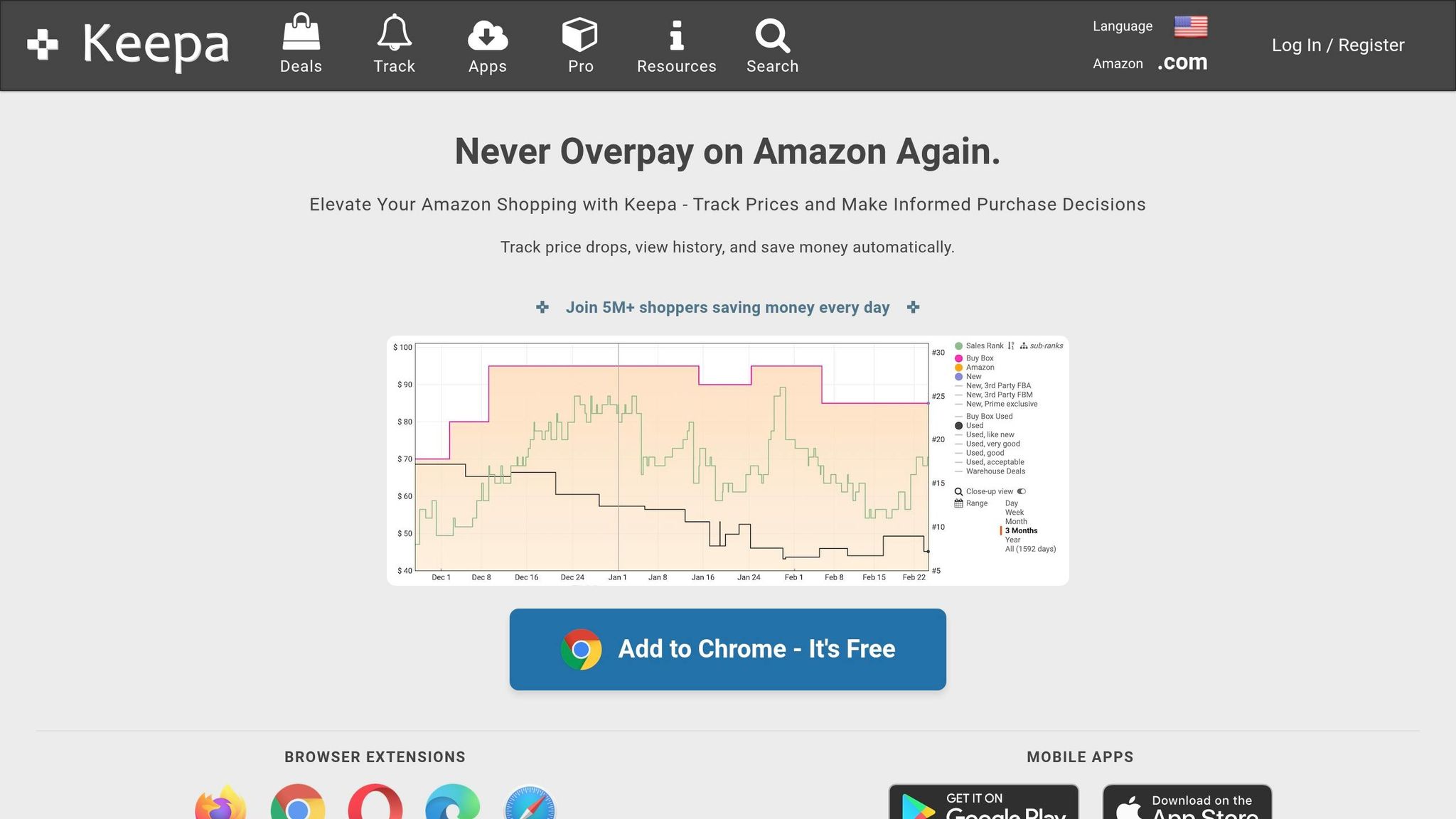
In the fast-paced Amazon marketplace, having access to historical data can make all the difference when it comes to refining your strategy. Keepa focuses on tracking historical price trends and sales rank data across Amazon’s global platforms. With a database that spans over 5 billion products and serves 3 million users worldwide, this tool is ideal for sellers who value long-term data over real-time updates. Its browser extension integrates seamlessly with Amazon product pages, displaying detailed graphs that track up to 18 metrics, including price changes, Buy Box ownership history, and shifts in Best Seller Rank.
Competitor Data Insights
One of Keepa’s key strengths is its ability to provide deep insights into competitor pricing and sales trends. For instance, sales rank data shows that a product’s rank can swing by 35% in a single month, highlighting seasonal demand fluctuations. By examining Buy Box price patterns, sellers can determine if competitors’ prices align with what customers are accustomed to paying. The Product Finder feature allows users to perform highly specific searches, such as identifying items with a certain percentage of price drops or those marked as "out of stock" by Amazon – capabilities that Amazon’s own search lacks.
Dillon Carter, Co-Founder of Aura, praised Keepa’s alert system:
"Keepa’s alerts are instant. While other trackers might check prices once daily, Keepa detects when products drop in price within minutes."
For larger-scale research, the bulk analysis feature can process up to 10,000 ASINs at once using CSV files. This provides sellers with 30-, 90-, and 365-day averages for prices and seller counts, enabling comprehensive competitive analysis.
Pricing and Affordability
Keepa offers a free version that covers basic price history tracking, but professional sellers often opt for the premium subscription. At around $15 per month or $149 annually, the premium plan unlocks full access to Sales Rank data, Buy Box tracking, and API capabilities for automated data processing. Many users rely heavily on Keepa’s Sales Rank and Buy Box data, with 90% of decisions reportedly informed by these metrics. However, Keepa’s Trustpilot rating is just 2/5 from 24 reviews, with 71% of users citing poor customer support and dissatisfaction with the no-refund policy.
Ease of Use for Amazon Sellers
Although Keepa’s interface may take some time to master, seasoned sellers appreciate the convenience of its Chrome extension, which overlays detailed graphs directly onto Amazon pages, eliminating the need to switch between platforms. The tool is compatible with browsers like Chrome, Firefox, Edge, Safari, and Opera, and even includes a mobile barcode scanner for retail arbitrage.
Additional Features for Business Growth
Keepa goes beyond competitor analysis by offering international price comparisons across more than 10 Amazon domains, such as .com, .co.uk, .de, and .fr. This feature highlights regional pricing differences and potential arbitrage opportunities. Sellers can also set up alerts for price increases to track items gaining value or monitor rare and collectible inventory. Spencer Padway, CEO of Search Nurture, summed up the tool’s value:
"Without Amazon analytics, you could lose a lot of money on creating uninformed product pricing. In the long run, a tool like Keepa will help you make money and stay competitive."
Keepa’s API further enhances its functionality by enabling bulk operations and automated inventory management, which supports dynamic pricing strategies. This combination of features makes it a powerful tool for sellers looking to refine their competitive edge. Up next, discover another tool that builds on these insights for even more comprehensive benchmarking on Amazon.
7. Emplicit
Emplicit takes ecommerce management to the next level by translating raw data into actionable strategies. It offers full-service solutions tailored for platforms like Amazon, TikTok Shops, Walmart, and Target, helping businesses turn market insights into growth opportunities.
Tailored Strategies for Growth
By analyzing market trends and data, Emplicit develops customized ecommerce strategies. With expert account managers handling tasks like listing optimization, PPC campaigns, and pricing, brands no longer need to juggle multiple analytics tools. This hands-on approach is perfect for businesses that prefer expert guidance over managing complex data independently.
Simplifying Amazon Selling
For Amazon sellers feeling overwhelmed by standalone analytics tools, Emplicit provides a managed service that takes the hassle out of PPC optimization, listing improvements, and inventory management. With USA-based account managers handling the details, sellers can focus on scaling their business instead of navigating complicated software.
Expanding Beyond Amazon
Emplicit doesn’t stop at Amazon. It offers services like omnichannel marketing, brand management, and content creation to help businesses grow across multiple platforms. With flexible service tiers – from basic marketplace management for smaller businesses to robust enterprise-level support – Emplicit allows brands to pick a plan that aligns with their goals and budget.
Tool Comparison Table
Amazon’s competitive landscape is constantly shifting, making it crucial to choose the right benchmarking tool. Here’s a quick breakdown of various tools to help you decide which one aligns best with your goals:
| Tool | Starting Price | Ideal For | Key Strength | Learning Curve |
|---|---|---|---|---|
| Helium 10 | $99/month | Advanced sellers & agencies | Detailed SEO and reverse ASIN research with Cerebro | Steep – multiple tools to learn |
| Jungle Scout | $49/month | Product research & sales tracking | Real-time competitive insights and market share analysis | Moderate – requires time investment |
| AMZScout | $29.99/month | Niche finding & product discovery | Historical sales data and handy Chrome extension | Beginner-friendly |
| SellerApp | $19/month | Keyword optimization on a budget | Automated competitor price and stock tracking | Beginner-friendly |
| DataHawk | Custom pricing | Enterprise analytics | Daily ASIN updates and multi-storefront tracking | Advanced |
| Keepa | Free/Subscription | Price history analysis | Long-term pricing and rank correlation data | Beginner-friendly |
| Emplicit | Custom pricing | Full-service management | USA-based account managers handle all analytics and strategy | None – managed service |
Each tool serves a specific purpose, catering to users ranging from beginners to seasoned sellers. For those just starting, SellerApp and AMZScout offer budget-friendly, easy-to-use options. If you’re scaling up and need deeper insights, Helium 10 and Jungle Scout are excellent choices for advanced analytics and competitive intelligence.
What sets Emplicit apart is its fully managed service. Instead of requiring users to learn software, their expert account managers handle everything – from benchmarking to optimization – across platforms like Amazon, TikTok Shops, Walmart, and Target.
For the best results, consider combining data from multiple tools to improve accuracy. New sellers can stick to affordable, beginner-friendly tools, while growing brands may benefit from investing in more advanced solutions for comprehensive insights.
This table provides a clear starting point to match your strategic needs with the right tool before diving deeper into the details.
Conclusion
Selecting the right Amazon competitor benchmarking tool hinges on your business goals and level of experience. If you’re just starting out, tools like SellerApp and AMZScout are budget-friendly and easy to navigate, offering essential features like keyword tracking and pricing analysis without overwhelming complexity. On the other hand, seasoned sellers or agencies may find advanced solutions such as Helium 10 or DataHawk more fitting, as these platforms provide in-depth analytics and reverse ASIN research to identify untapped opportunities.
As highlighted by industry experts:
"In the world of Amazon selling, data is your most powerful asset, and competitive analysis is where data becomes direction." – Bridgeway Digital
These tools take the guesswork out of decision-making by delivering actionable insights. Automated competitor tracking can save over an hour daily, and with 68% of serious sellers monitoring competitors every 1 to 24 hours, staying vigilant is key to navigating market changes.
To maximize your strategy, consider combining insights from multiple tools rather than relying on just one. For instance, pairing a keyword research tool with a pricing optimizer can provide a well-rounded competitive edge. If you’d rather not manage this process yourself, Emplicit offers a managed solution. Their U.S.-based account managers oversee analytics and optimization across platforms like Amazon, TikTok Shops, Walmart, and Target, freeing you up to focus on scaling your business.
FAQs
Which tool fits my Amazon business size and budget?
The best tool for you will depend on your business’s size, specific needs, and budget.
- Smaller sellers might find tools like Keepa or CamelCamelCamel ideal for tracking prices without breaking the bank.
- Mid-sized sellers could benefit from platforms such as Helium 10 or Jungle Scout, which provide more detailed competitor analysis.
- Larger businesses with substantial budgets can explore advanced options like Helium 10’s MT 360 or Jungle Scout’s Market Tracker for comprehensive data insights and real-time monitoring.
Each of these tools is tailored to fit different levels of operations, so choose what aligns best with your goals.
What competitor metrics should I track first on Amazon?
When analyzing competitors on Amazon, focus on these critical metrics:
- Best Sellers Rank (BSR): This shows how well a product is performing within its category. A lower BSR indicates higher sales, giving you a clear picture of top-performing items.
- Reviews: Pay attention to the number and quality of reviews. They reveal customer satisfaction, common complaints, and areas where you can differentiate your product.
- Pricing Trends: Tracking pricing over time helps you understand how competitors position their products, enabling you to adjust your pricing strategy accordingly.
- Advertising Presence: Observe how often competitors appear in sponsored ads. This can indicate their investment in advertising and help you gauge their marketing efforts.
These metrics are essential for understanding market dynamics, customer preferences, and competitive positioning, allowing you to fine-tune your approach for better results.
Should I use one tool or combine multiple tools?
When deciding between using a single tool or combining multiple tools for Amazon competitor benchmarking, it really boils down to your objectives and how much detail you’re after. Combining tools can give you a more comprehensive picture, capturing aspects like pricing, market trends, and product performance. On the other hand, if you’re just starting out or have focused priorities, a specialized tool might suffice. That said, leveraging multiple tools often provides deeper insights, which can be valuable for making strategic decisions.