

Cross-channel journey mapping helps businesses understand how customers interact across various platforms and touchpoints. It’s essential for creating a smooth experience, as customers often engage with multiple channels before purchasing. The article outlines seven practical steps to improve journey mapping:
- Set Clear Goals and Personas: Define specific objectives and focus on high-impact journey segments. Avoid one-size-fits-all personas; instead, tailor maps for distinct customer behaviors.
- Inventory Touchpoints: List and categorize all customer interactions, including brand-owned, partner-managed, and uncontrolled touchpoints like social media or reviews.
- Use Data Over Assumptions: Rely on actual customer data, not guesses, to build accurate maps. Resolve identities and centralize data for a unified view.
- Understand Intent and Emotions: Map customer goals and emotions at each stage to identify friction points and opportunities for improvement.
- Standardize Metrics: Align KPIs across channels to avoid inconsistent reporting and inflated attribution.
- Test and Optimize: Regularly test customer flows, focusing on real-world scenarios and transitions between systems.
- Turn Insights Into Action: Assign ownership for each friction point, create workflows, and collaborate across teams to implement changes.
These steps help businesses improve customer experiences, reduce friction, and increase loyalty. Start small, measure results, and expand efforts to achieve better outcomes.
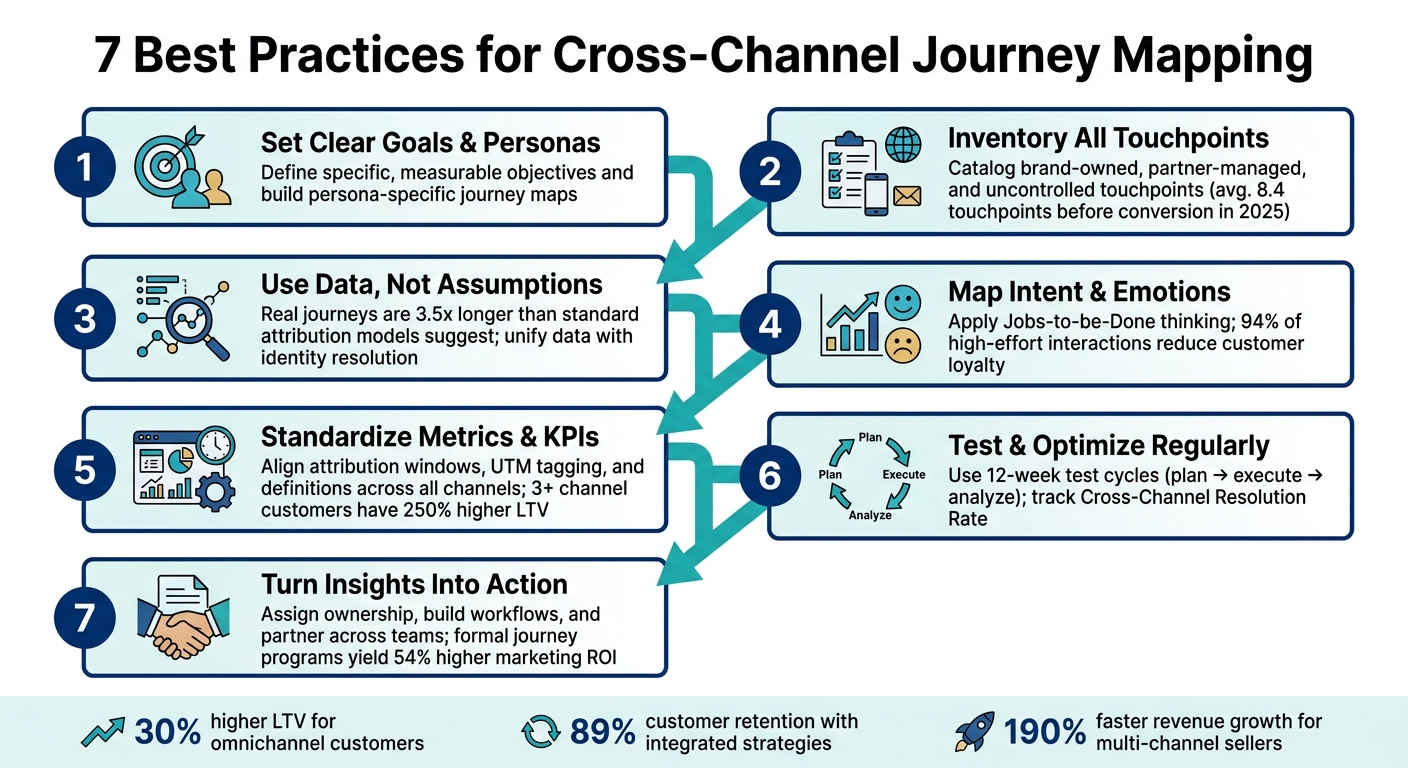
7 Best Practices for Cross-Channel Journey Mapping
Journey Mapping: What Goes Wrong and How to Get It Right | Oliver West (VML)

1. Start With Clear Goals, Scope, and Personas
Before diving into mapping, it’s essential to define the exact problem you’re trying to solve. Vague goals like "improve the customer experience" won’t cut it. Instead, aim for something specific and measurable, such as "reduce cart abandonment by 15% in Q3" or "increase trial-to-paid conversion by 20% over the next two quarters." These concrete objectives turn a mapping exercise into a practical business tool.
"A map without a goal is a visualization exercise, not a business tool." – Marketful
Once you’ve nailed down your goals, it’s equally important to set the scope. Trying to map every customer interaction across all channels at once will leave you with an overwhelming and ineffective diagram. Focus on one high-impact journey segment – like first-time purchases, account renewals, or post-purchase onboarding – and map it thoroughly before expanding. Brands that focus on targeted journey segments can see revenue grow by 10% to 15%, while also cutting their service costs by 15% to 20%. That’s a win-win for staying focused.
When it comes to personas, avoid lumping all customers into a single map based on a "typical shopper." This approach leads to maps that fail to represent anyone accurately. Instead, build maps around specific personas. Consider their triggers, barriers, behaviors, and current state – like loyalty tier, recent purchases, or open support tickets. For example, "Researched Rebecca" and "Last-Minute Liam" each have distinct shopping behaviors that require separate maps. By tailoring maps to their unique journeys, you’ll uncover actionable insights.
Investing time in setting clear goals, defining scope, and creating detailed personas ensures that your mapping efforts deliver meaningful results. Many enterprises struggle to use journey maps effectively because they fail to tie them to specific decisions, metrics, or budget owners. Assigning a dedicated owner with the authority and resources to act on the findings is what transforms a map into a powerful tool rather than just wall art.
2. Build a Full Inventory of Cross-Channel Touchpoints
Once you’ve nailed down your goals and customer personas, it’s time to list every point where customers interact with your brand. This list is often much longer than you’d think. Consider this: the average number of consumer touchpoints before a conversion has jumped from 5.2 in 2020 to 8.4 in 2025. For B2B buyers, the complexity is even greater – they engage with over 60 touchpoints before closing a deal. If you’re only monitoring the obvious ones like your website, email campaigns, or paid ads, you’re missing out on critical insights.
It’s important to differentiate between channels (like email) and touchpoints (such as an order confirmation email). Without this distinction, your journey maps risk being incomplete, leaving out potential friction points.
"Touchpoints are the building blocks of any useful journey map. Miss a touchpoint and you miss part of the experience you’re trying to understand." – Joe Allen, Smaply
To organize your touchpoints effectively, break them down into categories based on ownership:
| Category | Examples | Control Level |
|---|---|---|
| Brand-Owned | Website, email, paid ads, in-product onboarding | High |
| Partner-Managed | G2/Capterra reviews, affiliate content, analyst reports | Medium |
| Uncontrolled | Reddit threads, Slack communities, word-of-mouth | Low |
Once your inventory is categorized, the next step is to assess the impact of each touchpoint.
Uncontrolled touchpoints, like Reddit discussions or word-of-mouth, often carry unexpected weight in influencing decisions. As Igor Flyunt, CEO of ObserviX, highlighted:
"We tracked every paid click, every email open, every demo booking. Then a closed-won deal told us they found us through a Reddit thread we never saw."
These "dark" touchpoints – peer recommendations, private groups, and third-party reviews – are powerful but frequently overlooked by attribution models. It’s worth noting that 67% of customers trust third-party reviews more than brand advertisements.
To refine the customer journey and create a seamless cross-channel experience, follow these steps:
- Score each touchpoint on a 1–5 scale for its impact and friction.
- Focus on those with high scores in both areas.
- Assign ownership and define the next action you want the customer to take at each touchpoint.
- Update your inventory quarterly to account for new channels and evolving customer behaviors.
3. Use Data, Not Assumptions, to Connect Journeys
Most customer journey maps are based on assumptions rather than actual data. However, real customer journeys are often 3.5 times longer than what standard attribution models suggest. Furthermore, 72% of customer interactions take place outside direct sales conversations. If your maps rely solely on assumptions, you’re likely leaving out large portions of the customer experience. This is why grounding your journey maps in data is so important.
The first step? Identity resolution. This involves connecting various identifiers – like anonymous browser cookies, email addresses, product user IDs, and CRM records – into a single, unified customer profile. Start with deterministic matching, which uses exact identifiers (such as email addresses or phone numbers). Avoid jumping straight to probabilistic matching, as it can mistakenly combine distinct profiles, leading to inaccurate insights.
"Customer journey analytics replaces the idealized framework with actual data about how people move from first touch to paying customer to long-term advocate." – OSCOM Analytics
Once you’ve resolved identities, centralize this data in a unified data warehouse. Tools like BigQuery or Snowflake can help integrate data from marketing platforms, product analytics, CRM systems, and support tools. From there, you can create a unified timeline for each customer. This timeline should include details like timestamps, customer IDs, event types, and other key properties. Such a structure makes it easier to identify real behavioral patterns across multiple channels.
But here’s a challenge: platform-reported numbers often don’t align with reality. For example, a single customer journey involving a Meta ad, a Google search, and a Shopify purchase might result in all three platforms claiming 100% credit for the sale. This can inflate reported revenue by 1.3x to 1.8x. To avoid misleading conclusions, always reconcile platform-reported data with your actual order records to determine which channels are genuinely driving conversions.
By relying on precise data to piece together your customer journey, you can make better decisions and ensure smoother coordination across channels.
The table below highlights how default attribution models vary across major platforms:
| Platform | Default Model | Known Bias |
|---|---|---|
| Shopify | Last non-direct click | Under-attributes paid media |
| Meta | 7-day click / 1-day view | Over-reports 20–60% via view-through/modeled conversions |
| Google Ads | Data-driven | Moderate over-reporting from cross-device modeling |
| GA4 | Data-driven | Under-reports due to consent loss and ad blockers |
4. Map Customer Intent, Emotions, and Key Moments
Once you’ve gathered data-driven insights, the next step is to dig deeper into the intent and emotions behind customer actions. Data may show you what customers are doing, but understanding why they’re doing it is what transforms a journey map into a genuinely useful tool.
A helpful way to approach this is by adopting the Jobs-to-be-Done framework. Instead of asking, “Who is this customer?”, shift the focus to, “What is this customer trying to achieve right now?” Customers have specific questions at each stage of their journey. For instance, during the awareness phase, they’re wondering, “Is this relevant to me?” By the time they’re at checkout, the question becomes, “Is this safe and worth it?”. Explicitly mapping these questions ensures your team stays focused on what truly drives customer behavior.
Behavioral signals can also reveal a lot about intent and emotion. Actions like repeated searches, multiple visits to pricing pages, or rage clicks (when users rapidly click an unresponsive element) are clear indicators of frustration, urgency, or friction. These real-time signals often provide more reliable insights than post-purchase surveys, which can be clouded by hindsight bias.
"The map is not the territory. The map on the wall represents the Happy Path… the territory is the Actual Path – the messy, chaotic, emotional reality of how human beings actually shop." – thelightbulb.ai
This quote highlights the importance of accounting for the complexities and emotions that influence customer behavior. The journey is rarely as clean and linear as it might look on a diagram.
It’s also critical to consider moments that occur outside of your direct control. Platforms like third-party review sites, Reddit, and word-of-mouth can significantly shape customer intent before they even land on your website. While these influences might not be measurable, your journey map should acknowledge their role in shaping decisions.
Here’s a breakdown of the key moments where intent often shifts and the common issues customers encounter:
| Critical Moment | Customer Mindset | Most Common Friction |
|---|---|---|
| First Impression | "Is this relevant to me?" | Slow load times, ad mismatch |
| Trust Building | "Can I trust this brand?" | Missing reviews, no social proof |
| Checkout Decision | "Is this worth the final cost?" | Unexpected fees, forced account creation |
| First Product Use | "Did I make the right choice?" | Poor instructions, damaged goods |
| Support Interaction | "Do they care about my issue?" | Repeating information across channels |
Addressing these critical moments can translate insights into actionable improvements. Focus on the points that carry the most emotional weight for customers. For example, 94% of customers who experience high-effort interactions report being less loyal to the brand. Ignoring these pain points isn’t just inconvenient for customers – it’s a direct threat to loyalty and long-term business success.
sbb-itb-e2944f4
5. Standardize Metrics and KPIs Across Channels
When it comes to data-driven insights, consistency in measuring performance across channels is absolutely essential. Metrics are only as useful as their definitions, and without standardization, each platform ends up telling its own version of the story. This lack of alignment makes it nearly impossible to compare results in a meaningful way.
One common issue is overlapping attribution, which often inflates revenue figures. The solution? Start by creating a single source of truth – whether it’s your CRM or ecommerce platform – and use it to unify metric definitions. This involves syncing up time zones, currency formats, attribution windows, and even the criteria for what counts as a "conversion." Don’t forget to implement consistent UTM tagging to ensure every team follows the same campaign tracking rules.
Once you’ve aligned these definitions, focus on the metrics that truly highlight performance gaps across channels. Here’s a breakdown of key categories and their insights:
| Metric Category | Key KPIs | What It Reveals |
|---|---|---|
| Financial | Deduplicated Revenue, Channel Contribution Margin | Actual profitability by channel |
| Marketing | Blended ROAS, Blended CAC, Multi-Touch Attribution | Efficiency of cross-channel spending |
| Customer | Cross-Channel LTV, Return Rate, Repeat Purchase Rate | Long-term value and areas where the customer journey faces friction |
| Operational | Inventory Accuracy, Oversell Rate, Order Processing Time | Backend inefficiencies that disrupt the customer experience |
One particularly eye-opening metric? Customers who shop across three or more channels tend to have a 250% higher lifetime value compared to those who stick to just one channel. If your current reporting doesn’t highlight this segment, you’re probably missing opportunities to invest in the channels that attract your most valuable customers. Standardizing lifetime value (LTV) tracking across platforms can quickly uncover hidden gaps in your customer journey map.
6. Test and Optimize Cross-Channel Flows Regularly
To keep your customer flows running smoothly across all channels, regular testing is a must. Once you’ve established standardized metrics, testing helps confirm whether the assumptions in your journey map hold true. Start with high-impact flows like new customer onboarding or credential resets – these touch a lot of customers and can significantly affect revenue.
Don’t limit your testing to the "happy path" where everything goes perfectly. Real customers face interruptions: they switch devices mid-session, encounter timeouts, or return after stepping away. Test for these real-world disruptions. For instance, simulate scenarios like device changes or session timeouts. As Cyara puts it:
"A CX journey that technically works but forces customers to repeat themselves or navigate inconsistent prompts still represents a failure in experience terms."
Pay particular attention to transitions between systems. These handoff points – like data moving between your CRM, chatbots, or email platforms – are where issues often arise. One key metric to track here is the Cross-Channel Resolution Rate. This measures the percentage of customers who complete a task without needing to restart in another channel. If this rate is low, it’s a sign that context isn’t transferring effectively.
To truly understand whether your optimizations are working, use holdout groups. These are small segments of customers who don’t experience any changes to their journey. Comparing their behavior to that of the optimized group helps you see if your changes are driving results – or if those outcomes would’ve happened anyway.
Adopt a 12-week cycle for testing: dedicate four weeks each to planning, execution, and analysis. This structure helps you quickly identify underperforming flows and make adjustments. Over time, this cycle creates a feedback loop where each round of testing refines your journey map, and the updated map guides the next round of tests.
7. Turn Journey Maps Into Actionable Processes and Partnerships
Once you’ve gathered insights through testing and analysis, the next step is turning those insights into something actionable.
A journey map sitting idle in a shared drive won’t lead to results. The real impact happens when you transform those insights into clear ownership, structured workflows, and effective partnerships.
One of the most common reasons journey maps fail? No one takes responsibility. As Marketful explains, "A journey map without an opportunities layer is analysis without output. Assign each opportunity an owner and a priority before the workshop ends.". This means every friction point needs a dedicated owner, clear priorities, and scheduled reviews. Without these, even the most detailed map won’t achieve anything.
To make the most of your journey map, bring together insights from marketing, support, product teams, IT, and operations. Collaboration between frontline staff and decision-makers is key to closing the gap between assumptions and the actual customer experience. Companies with formal journey management programs report 54% higher marketing ROI, 3.5x more referral revenue, and an 18x faster sales cycle compared to those without.
Operational Practices That Drive Results
On the operational side, two key practices stand out: system state management and conflict resolution rules.
- System state management ensures your systems retain important customer context – like open support tickets, loyalty status, or cart contents – so customers don’t have to repeat themselves.
- Conflict resolution rules help prevent awkward or poorly timed communications, such as sending a promotional email to someone dealing with a service issue. For example, you can set global frequency caps or implement a 48-hour pause on marketing emails after a purchase to avoid overwhelming your audience.
For brands juggling multiple ecommerce channels, internal teams often struggle to act on journey map insights. Multi-channel sellers, however, grow revenue 190% faster than those sticking to a single channel. This is where full-service providers like Emplicit come in. They can help translate your journey map into real-world execution across platforms like Amazon, TikTok Shop, Walmart, and Target, each of which has its own unique requirements and customer expectations.
Keep the Map Alive
A journey map isn’t a one-and-done project – it’s a living document. Forrester predicts that by 2026, static journey mapping will decline by two-thirds as organizations move toward live, data-driven management. To stay ahead, conduct quarterly friction audits, feed insights into your product roadmap, and schedule accountability check-ins within a month of any mapping session. This kind of ongoing attention separates teams that simply create maps from those that use them to drive real improvement.
Conclusion
Cross-channel journey mapping is all about continuously understanding how customers interact with your brand and eliminating the friction that can hurt revenue. The seven practices outlined here are designed to simplify your efforts and deliver measurable results. Research shows that omnichannel customers can have up to 30% higher lifetime value, and brands with well-integrated strategies can retain as much as 89% of their customers.
The key practices – like setting clear goals, cataloging touchpoints, standardizing metrics, and implementing actionable processes – help align assumptions with what customers actually experience. As Marina Conquest from Virto Commerce aptly says:
"True omnichannel CX isn’t a UX layer; it’s an architectural decision."
This architectural perspective is what separates brands that achieve real results from those that create journey maps that never see practical use. By focusing on data unification, emotional mapping, consistent KPIs, and shared ownership across teams, businesses can create smoother, more cohesive customer experiences.
However, executing these strategies effectively across platforms requires operational precision. While many brands know the steps to take, they often struggle to implement them across multiple channels. This is where Emplicit steps in, offering comprehensive ecommerce services that turn insights into action – whether it’s managing PPC campaigns, optimizing listings, or handling inventory and account health on platforms like Amazon, TikTok Shop, Walmart, and Target.
The brands that succeed don’t just show up everywhere – they connect everything seamlessly. Start small by tackling one high-friction journey, demonstrate the ROI, and then expand from there.
FAQs
What journey should I map first?
Begin by identifying the customer journey that will have the biggest impact on your business. Prioritize areas where you can resolve customer challenges and boost growth. Once you’ve fine-tuned this key area, you can branch out to other channels.
Emplicit can assist in this process through services such as marketplace management, tailored strategies, and data-driven listing optimization. These tools are designed to help brands grow efficiently across platforms like Amazon, Walmart, and even their own websites.
How do I connect customer activity across channels?
To bring together customer activity from different channels, prioritize identity resolution to merge scattered data into one cohesive timeline. Implement a standardized identifier strategy, such as email-based matching or using a persistent User ID through tools like Google Tag Manager.
Consider using a Customer Data Platform (CDP) or a centralized data warehouse to consolidate information from various platforms. Additionally, maintain consistent UTM tagging across all campaigns to prevent data silos and ensure smooth tracking of customer interactions.
Which KPIs matter most for cross-channel journeys?
When analyzing customer journeys, it’s critical to track KPIs that shed light on how customers move between channels and their overall long-term value. Some key metrics to monitor include:
- Average number of channel switches per journey: This helps you understand how often customers move between different platforms or touchpoints.
- Channel abandonment rates: High abandonment rates might indicate frustration or inefficiencies in specific channels.
- Customer lifetime value (CLV): A broader metric that reflects the total revenue a customer brings over their relationship with your business.
Additionally, keep an eye on transition success rates between touchpoints. This metric can reveal friction points where customers struggle or drop off. Pair these insights with other broader indicators like customer satisfaction scores (CSAT) and first-contact resolution rates. Together, these metrics ensure you’re creating smoother transitions while maintaining a positive overall customer experience.