

Your top-selling product on Amazon might seem like a success, but it could be quietly damaging your brand and long-term business growth. Here’s why relying too much on one product or Amazon’s marketplace can hurt your business:
- Loss of Control Over Customer Relationships: Amazon owns the customer connection, not you. Buyers remember Amazon, not your brand.
- Revenue Risks: A single product leaves you vulnerable to algorithm changes, price wars, or Amazon launching competing products.
- Brand Damage: Amazon’s private-label products and counterfeiters can erode your reputation and margins.
- High Costs: Amazon fees take up to 45% of your revenue, and price competition can slash profits further.
To protect your brand, diversify your product line, expand to other sales channels, and build direct customer relationships. Avoid putting all your eggs in Amazon’s basket.
The Hidden Costs of Amazon Dependency: Key Statistics for eCommerce Sellers
The Amazon Brand Strategy No One Talks About
Problem 1: Depending Too Much on One Product
Relying heavily on a single best-seller leaves your business exposed to sudden disruptions. A single algorithm tweak, a competitor’s strategy, or a platform’s decision could wipe out your revenue overnight. Unfortunately, many brands have already faced significant losses due to this kind of vulnerability.
Unstable Revenue from a Single Product
Competition directly from platforms can quickly destabilize businesses built around one product. For example, in 2022, Douglas Mrdeza’s company, Top Shelf Brands, filed for bankruptcy after Amazon began selling similar products at lower prices. Despite achieving $25 million in annual revenue from beauty products on Amazon, the company had to shut down four warehouses and lay off 40 employees.
In another case, Nicholas Parks of SnobFoods experienced a devastating blow in October 2023. After years of successful sales, his hot sauce business crumbled when Amazon undercut his pricing, leaving him with unsold inventory and tied-up capital. He explained:
"It doesn’t even matter if I’ve sold it for 10 or 15 years. Once Amazon starts selling it, I’m just closed out of the market for that product".
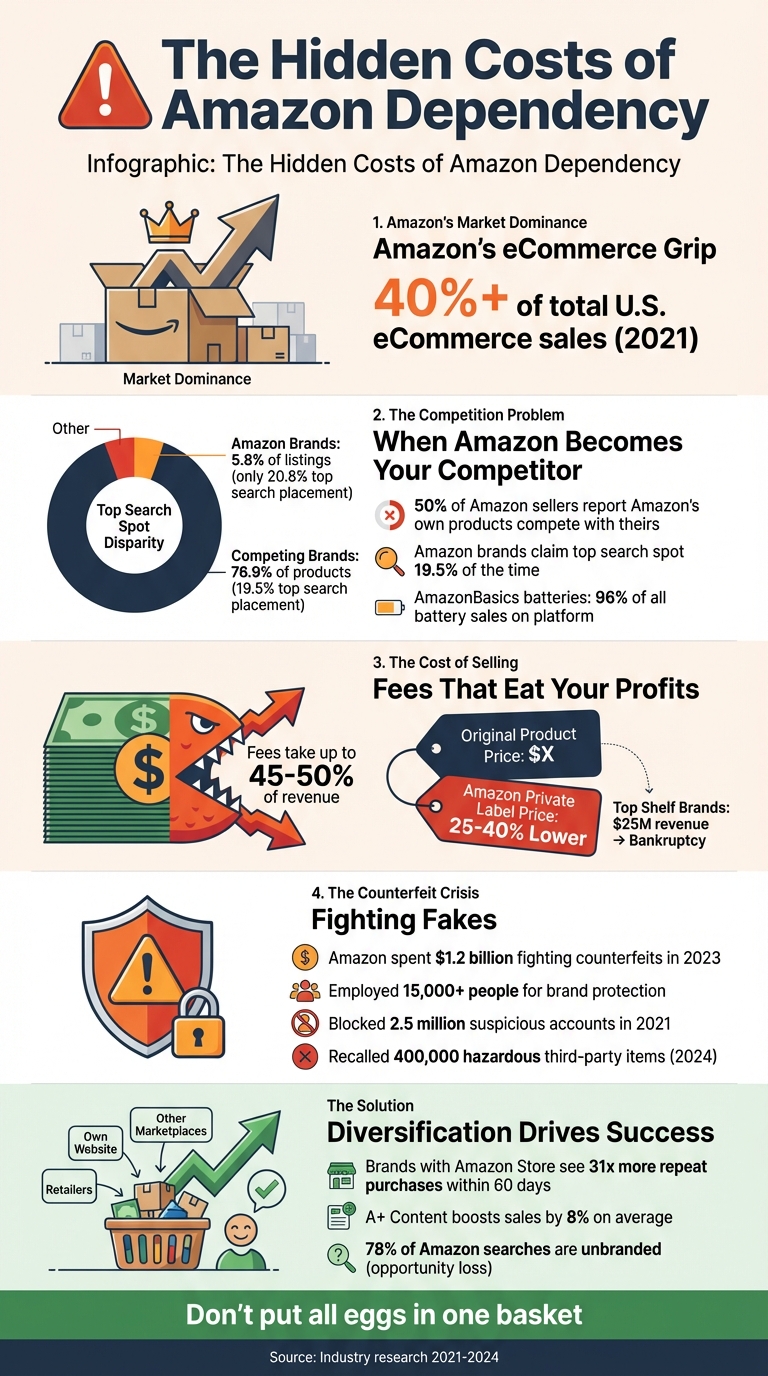
The numbers paint a troubling picture: around 50% of Amazon sellers report that Amazon’s own products directly compete with theirs. When Amazon enters a market, its brands claim the top search spot 19.5% of the time, even though they account for just 5.8% of total listings. These shifts can trigger revenue shocks that ripple through inventory and cash flow.
Supply Chain and Inventory Problems
When your single product loses its market position, excess inventory becomes a costly burden. Storage fees pile up for unsold products, especially if Amazon introduces a competing version. To avoid these fees, you might pay for inventory removal, but that only adds to your financial strain.
Then there’s the “trickle problem.” Unauthorized sellers often list your product at prices below your Minimum Advertised Price (MAP), triggering Amazon’s algorithms to match those lower prices across the platform. This can erode your profit margins, cost you the Buy Box, and force you to spend money buying back discounted stock from rogue sellers just to stabilize pricing. It’s a vicious cycle of losing money while trying to regain control – all because your business hinges on one product caught in a price war you didn’t create.
Problem 2: How Amazon’s Marketplace Hurts Your Brand
Relying too heavily on Amazon’s marketplace doesn’t just bring risks of revenue instability – it also directly threatens your brand’s identity. The platform uses its vast data resources to create competing products, while counterfeiters exploit its open system to sell knockoffs. These combined forces can gradually erode the brand equity you’ve worked so hard to build.
Amazon Creates Competing Versions of Your Product
Amazon keeps a close eye on every detail of how your product performs. From tracking search terms and click-through rates to analyzing how long a customer hovers over your listing, Amazon’s "data engine" identifies products worth mimicking. Once identified, the platform often launches its own private-label versions to compete directly with your offerings.
Take the case of Peak Design. In early 2021, founder Peter Dering discovered that Amazon had released an AmazonBasics sling bag strikingly similar to his company’s $90 version. Amazon’s copycat bag was priced at just $30. In response, Peak Design created a viral video pointing out the inferior materials and lack of warranty in Amazon’s product. The backlash was swift – fans bombarded the AmazonBasics listing with negative reviews, and Amazon eventually pulled the product.
The numbers paint a clear picture of Amazon’s advantage. A study found that Amazon’s private-label brands appeared at the top of search results 19.5% of the time, despite making up only 5.8% of the products in the sample. Meanwhile, competing brands, which accounted for 76.9% of the products, captured the top spot at a nearly identical rate of 20.8%. Amazon can also manipulate search rankings to favor its own products, pushing competing listings to obscurity. For instance, AmazonBasics batteries now dominate 96% of all battery sales on the platform.
Stacy Mitchell, Co-Executive Director of the Institute for Local Self-Reliance, summed up the situation:
"Amazon has developed a lot of these private labels by gathering data, essentially spying on the companies that have to rely on its website in order to reach consumers".
But it’s not just Amazon’s private-label products that threaten your brand. Counterfeiters also use the platform to wreak havoc.
Counterfeit Products Damage Your Reputation
Counterfeiters take advantage of Amazon’s marketplace by hijacking product listings to sell poor-quality imitations. They can steal your Amazon Standard Identification Number (ASIN) or Buy Box, allowing them to sell knockoffs directly on your product page. When customers unknowingly purchase these fake items, they often leave negative reviews on your listing – reviews that damage your reputation even though you didn’t sell the product. Counterfeiters also manipulate reviews to harm legitimate sellers, either flooding listings with fake negative feedback or using excessive 5-star reviews to trigger Amazon’s fraud detection algorithms, which can lead to your listing being suspended.
In some cases, counterfeiters even hijack abandoned AmazonBasics listings. For example, in 2019, investigators found third-party sellers repurposing an old HDMI cable listing to sell unrelated items, like wooden digital alarm clocks. By taking over these listings, counterfeiters inherited thousands of positive reviews from the original product, making their knockoffs appear credible to unsuspecting buyers.
The scale of this issue is staggering. In 2023 alone, Amazon spent over $1.2 billion and employed more than 15,000 people to fight counterfeits, fraud, and abuse. In 2021, the company blocked over 2.5 million suspicious accounts to prevent counterfeit listings. Despite these efforts, counterfeiters continue to harm brands by selling low-quality imitations at lower prices. This not only eats into your profit margins but also erodes customer trust.
Problem 3: Price Wars and Legal Liability
Selling on Amazon’s marketplace isn’t just about competing for customers – it’s about surviving relentless pricing pressure and navigating legal risks that can erode profits. These two challenges often work hand-in-hand, creating a harsh environment where even successful sellers can find themselves struggling to stay afloat.
Forced Price Cuts That Slash Profit Margins
Amazon’s fees already take a hefty bite out of third-party sellers’ earnings, sometimes eating up to 50% of revenue through warehousing, shipping, and advertising costs. But the challenges don’t stop there. Amazon monitors prices across the web, and if it finds your products listed at a lower price elsewhere, it can suppress or even remove your listing. This creates a no-win situation where sellers are forced to lower their prices on Amazon to stay visible, even if it means sacrificing profits.
Take the story of Douglas Mrdeza, the founder of Top Shelf Brands. Between 2014 and 2022, he built a thriving beauty business on Amazon, reaching $25 million in annual revenue with a team of 40 employees. But by 2018, Amazon started selling its own versions of his top products, undercutting his prices and leveraging its shipping network to avoid the fees that Mrdeza had to pay. By 2022, the mounting pressure forced Top Shelf Brands to file for bankruptcy. When Amazon introduces private-label products priced 25%–40% lower than yours, it commoditizes your brand, reducing it to just another option in a brutal price war.
And the trouble doesn’t end with pricing – it’s compounded by legal risks.
Product Liability and Compliance Challenges
Legal exposure is another significant burden for sellers. In July 2024, the Consumer Product Safety Commission (CPSC) ruled that Amazon is legally responsible for recalls of third-party products sold through its "Fulfilled by Amazon" program. This decision specifically addressed 400,000 hazardous items, including defective carbon monoxide detectors and hair dryers that lacked necessary safety features. The CPSC emphasized:
"Amazon cannot sidestep its obligations under the CPSA simply because some portion of its extensive services involves logistics".
This ruling means that if your product has a safety issue – even one you didn’t know about – you’re required to notify customers, issue refunds, and handle recalls. Amazon’s control over fulfillment doesn’t protect you from these liabilities; in fact, it increases your exposure. A single recall can wipe out years of profits and permanently damage your brand’s reputation.
sbb-itb-e2944f4
How to Protect Your Brand from Amazon Dependency
To reduce risks while still benefiting from Amazon’s reach, it’s crucial to diversify your revenue streams. Brands that thrive over the long haul focus on broadening their product offerings, expanding to multiple sales channels, and building direct relationships with customers. A great starting point? Expand your product line to avoid over-reliance on a single source of income.
Expand Your Product Line
Adding variety to your product catalog can shield your business from sudden market changes. Amazon’s Brand Analytics reports are invaluable here – they reveal what customers frequently purchase together, helping you spot bundling opportunities or gaps in your offerings. For example, if customers buying your yoga mats often search for resistance bands or foam rollers, those products could be natural additions to your lineup.
You can also take advantage of tools like Virtual Bundles and enhanced content to increase average order values and strengthen your brand identity. Did you know that brands with an Amazon Store see up to 31 times more repeat purchases within 60 days? Plus, A+ Content has been shown to boost sales by an average of 8%.
To protect your unique products, consider securing design patents. Peter Dering, CEO of Peak Design, advises investing in design patents for each product – a cost of roughly $1,000 per patent – to prevent knockoffs. Expanding your product line is just one part of the equation; reaching customers across multiple platforms is equally critical.
Sell on Multiple Platforms
Amazon might dominate online sales – accounting for over 40% of total U.S. eCommerce revenue in 2021 – but it also comes with risks like account suspensions, algorithm changes, and pricing pressures. To safeguard your business, keep your Amazon presence intact while branching out to other platforms.
Consider marketplaces like Walmart Marketplace, where competition is lower, or launch a direct-to-consumer (D2C) website. A D2C site gives you control over customer data, strengthens relationships, and allows for more effective remarketing campaigns.
"Selling on Amazon is no longer the sure thing that it used to be. Even major brands like Birkenstock and Nike have taken their products off the market." – Angie Tran, Content Marketing Manager, AdRoll
To simplify operations, multichannel software can be a game-changer. These tools centralize your catalog, synchronize inventory in real time, and help prevent overselling.
How Emplicit Helps Protect and Grow Your Brand
Emplicit offers solutions to safeguard your brand while driving growth across channels. Their PPC optimization acts as an "Advertising Defense", using branded keyword bidding to block competitors from stealing your traffic and undermining your visibility. For added protection, their listing services leverage Amazon’s tools like Brand Registry, Transparency, and Project Zero to combat counterfeit products and listing hijacking.
Beyond advertising and listing protection, Emplicit helps manage inventory, forecast demand, and monitor account health across platforms like Amazon, Walmart, TikTok Shops, and your own eCommerce site. With their support, you can focus on building a sustainable, resilient brand.
Case Studies: Brands That Escaped the Single-Product Trap
Case Study 1: Fitness Brand Expands Product Line
In September 2022, Peak Design faced a challenge when a knockoff version of its Everyday Sling Bag hit the market. The counterfeit was priced at just $30, compared to the original’s $90. This prompted the brand to take action: they rallied their loyal customer base to share authentic reviews and invested in design patents, which cost around $1,000 each, to protect their products. This experience highlighted the importance of safeguarding their designs.
Peter Dering, the CEO of Peak Design, shared his perspective:
"I really recommend [design patents] for anyone who’s bringing a product that they don’t want to be knocked off".
This strategy proved essential in protecting the brand from competitors who often undercut original products by 25% to 40%. While expanding their product line helped reduce reliance on a single item, building diverse sales channels emerged as another key way to strengthen their position.
Case Study 2: Beauty Brand Builds Multi-Channel Presence
Glossier took a completely different route by avoiding reliance on Amazon altogether. The brand’s foundation was laid through the success of its blog, Into the Gloss, launched in 2010. By the time Glossier debuted in 2014, the blog had grown to over 10 million page views per month, giving the company a massive, engaged audience without needing Amazon’s discovery algorithms.
This community-focused approach paid off in a big way. Glossier went on to generate over $100 million in annual revenue and reached a valuation of more than $1 billion – all while retaining full control over customer data and the overall brand experience. This strategy stands in stark contrast to the Amazon marketplace, where 78% of searches are unbranded, and 65% of shoppers feel comfortable buying from unknown sellers. By prioritizing direct relationships with customers, Glossier demonstrated how owning those connections can build lasting brand equity.
Conclusion: Build a Stronger Brand Beyond Amazon
Key Takeaways for eCommerce Sellers
Having a top-selling product on Amazon might boost your revenue right now, but putting all your eggs in one basket – especially one marketplace – poses serious risks. In 2021, Amazon accounted for over 40% of total U.S. eCommerce sales. While that dominance is impressive, it also means that relying on Amazon alone leaves your business vulnerable to sudden changes.
Smart brands understand that Amazon should be part of a broader strategy. Protecting your intellectual property with design patents, diversifying your product lineup to avoid overdependence on one item, and establishing a strong Direct-to-Consumer (DTC) presence are all essential steps for long-term success. As Lisa Federico from Zentail aptly puts it:
"At some point, every brand that’s wholly reliant on Amazon will either fail or plateau".
The message is clear: if you’re leaning too heavily on Amazon, it’s time to rethink your approach.
Next Steps: Strengthen Your eCommerce Strategy
Start by evaluating your current product mix and sales channels. If Amazon is responsible for the majority of your revenue – or if one product dominates your sales – you’re exposing your business to unnecessary risk. To mitigate this, explore additional marketplaces and partner with a reliable 3PL provider to ensure fast, nationwide delivery.
Building your own eCommerce site is another crucial move. Owning your platform gives you access to valuable customer data, allowing you to create personalized email campaigns, segment your audience effectively, and foster long-term customer loyalty. These steps can help shield your business from the impact of algorithm changes or marketplace suspensions.
For a more comprehensive approach, consider working with a full-service partner like Emplicit. Their marketplace management solutions can help you diversify sales channels, protect your brand from counterfeits, and scale across platforms like TikTok Shops, Walmart, and Target. By broadening your reach and securing direct relationships with customers, you’ll lay the groundwork for sustainable growth and a resilient brand.
FAQs
How can I build stronger customer relationships while selling on Amazon?
To build stronger relationships with your customers on Amazon, a great first step is enrolling in the Amazon Brand Registry. This program gives you more control over your trademarks and offers tools like the Brand Dashboard. It also allows you to create A+ content and design a custom storefront that showcases your brand’s unique identity. Plus, you can keep an eye out for unauthorized sellers, enforce pricing guidelines, and connect directly with customers through Amazon’s messaging system, giving you more influence over their post-purchase experience.
Beyond Amazon, consider using off-platform strategies to foster loyalty. For example, branded packaging, QR codes, or thank-you notes can encourage buyers to join your email list, follow you on social media, or visit your website for exclusive offers. Expanding your sales channels – like selling through your own site – reduces your dependence on Amazon, helps you maintain control over pricing, and strengthens your brand’s long-term value, all while still tapping into Amazon’s enormous customer base.
How can I protect my brand from competition with Amazon’s private-label products?
To protect your brand from competition with Amazon’s private-label products, the first step is to enroll in the Amazon Brand Registry. This program secures your trademarks and gives you access to tools like Transparency and Project Zero, which help combat counterfeiting and unauthorized use of your product information. Pair this with strong intellectual property protections, such as patents and trademarks for your unique designs and packaging, to make it harder for Amazon’s private labels to replicate your products.
Set your brand apart by highlighting what makes your products special. Use A+ Content to showcase premium features, superior quality, or eco-friendly attributes. Enhanced visuals and a compelling brand story can also help you stand out. Stay vigilant by regularly monitoring the marketplace for counterfeit or imitation listings, and act swiftly to file takedown requests when necessary.
To further safeguard your brand, reduce dependence on Amazon by diversifying your sales channels. Create a direct-to-consumer website, leverage social media platforms for commerce, and collaborate with other retailers. This approach not only protects your brand’s reputation but also ensures you remain profitable in a highly competitive environment.
How can I expand my sales channels beyond Amazon to protect my business?
To lessen reliance on Amazon, a good starting point is to build a direct-to-consumer (DTC) website using platforms like Shopify. This approach gives you full control over the customer experience, allows you to keep all profits, and helps you gather invaluable customer data. Once your DTC site is up and running, think about branching out to other marketplaces like eBay or Walmart, which can easily sync with your existing inventory. You might also consider niche or international platforms to tap into new audiences.
When it comes to marketing, diversify your efforts by running paid ads on platforms like Meta or TikTok to drive traffic directly to your DTC site. Collaborating with influencers or launching affiliate programs can also help you grow your reach while avoiding Amazon’s fees. Another option is to establish wholesale partnerships with physical retail stores or distributors, which can provide consistent revenue streams less impacted by changes in online marketplaces.
To keep everything running smoothly, use unified analytics to track performance across all channels. Focus on key metrics like sales, profit margins, and customer acquisition costs to fine-tune your strategy for each platform. By spreading your efforts across multiple sales and marketing channels, you’ll create a more balanced and resilient business that doesn’t depend too heavily on Amazon.