

Customers expect fast responses – period. In fact, 88% now demand quicker replies than they did a year ago. For ecommerce brands, delays can lead to lost sales and frustrated shoppers. Tools powered by AI and automation are stepping in to bridge this gap, cutting response times by up to 40% and handling up to 70% of repetitive queries like "Where is my order?"
Here are the top tools to help you respond faster, boost efficiency, and keep customers happy:
- Emplicit: Combines ecommerce services like PPC management and inventory control with rapid response tools. Ideal for multi-marketplace sellers.
- Zendesk: AI-driven platform with tools like triggers, macros, and intelligent triage. Handles 80%+ of queries without human input.
- Intercom: Features Fin AI for routine questions and a unified inbox for managing multiple channels.
- Gorgias: Tailored for ecommerce, integrates with Shopify to automate tasks like refunds and order tracking.
- eDesk: Simplifies multi-channel support with integrations across 300+ platforms and AI tools for routine inquiries.
- Tidio: Offers live chat, chatbots, and AI for handling up to 67% of customer questions.
- Nurix: Focuses on voice support, providing AI-powered phone agents capable of resolving 90% of issues.
Quick Comparison:
| Tool | Best For | AI Resolution Rate | Starting Price |
|---|---|---|---|
| Emplicit | Multi-channel ecommerce brands | Custom strategies | Custom pricing |
| Zendesk | Large enterprises | 80%+ | $55/agent/month |
| Intercom | SaaS and product-led companies | 40–60% | $29/seat/month |
| Gorgias | Shopify-centric brands | 30–45% | $10/month |
| eDesk | Multi-channel sellers | 70% | $39/agent/month |
| Tidio | Small businesses and startups | 67–89% | $24/month |
| Nurix | High-volume phone support | 90% | Custom pricing |
These tools help ecommerce businesses meet customer expectations, improve efficiency, and drive loyalty. Choose the one that aligns with your business size, sales channels, and support needs.
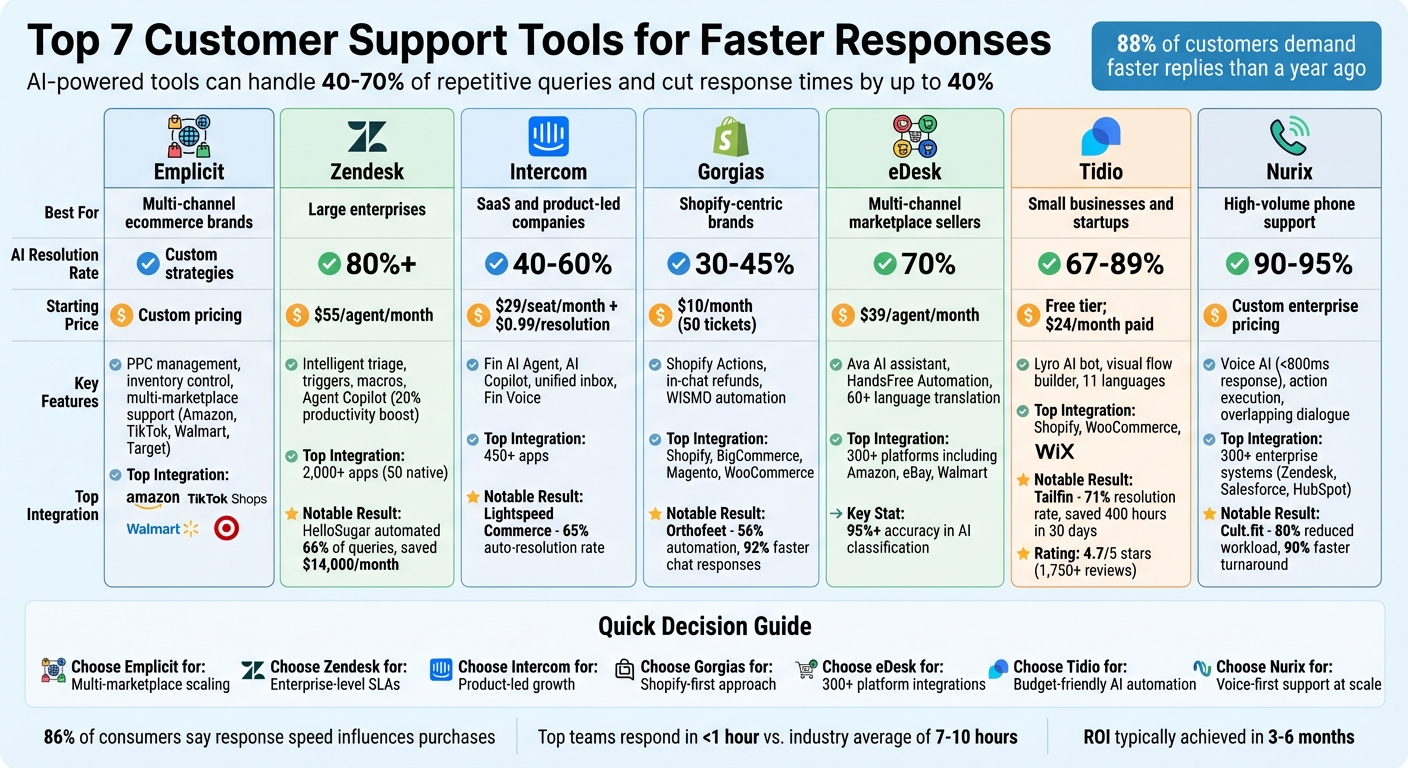
Customer Support Tools Comparison: Features, Pricing, and AI Resolution Rates
1. Emplicit
Emplicit brings together rapid response management and a wide range of ecommerce services, catering to platforms like Amazon, TikTok Shops, Walmart, and Target.
Integration with Ecommerce Platforms
Emplicit simplifies ecommerce operations by combining essential services – like PPC management, listing optimization, and inventory control – into one seamless system. By centralizing tasks such as customer inquiries and order processing, it eliminates the need to juggle multiple tools, saving time and reducing delays.
With dedicated account managers, businesses benefit from quick responses that enhance product visibility and improve conversion rates across platforms like Amazon, TikTok Shops, and Walmart.
This all-in-one approach is paired with pricing options that accommodate businesses of different sizes.
Pricing and Scalability
Emplicit offers three service tiers to meet various business needs:
- Basic: Designed for small businesses, this tier supports one marketplace with essential services.
- Growth: Ideal for growing businesses, it supports up to three marketplaces, offering advanced inventory management and tailored strategies.
- Enterprise: Built for large-scale operations, this tier provides comprehensive omnichannel support with USA-based account managers.
sbb-itb-e2944f4
2. Zendesk
Zendesk uses AI-powered tools to handle customer inquiries, delivering quicker responses while reducing the workload on support teams. With its autonomous AI agents, over 80% of interactions are resolved without human involvement, allowing teams to tackle more complex customer needs [10, 11].
Automation Capabilities
Zendesk provides three main types of automation:
- Triggers: These activate immediately, such as sending automatic receipt confirmations.
- Time-based automations: Useful for follow-ups or reminders.
- Macros: Designed to handle repetitive, common queries efficiently.
The Agent Copilot feature enhances productivity by offering real-time suggestions, summarizing interactions, and recommending next steps. This tool has been shown to increase productivity by 20%.
AI-Driven Resolution Rates
Zendesk’s AI is built on a foundation of over 18 billion real customer service interactions, ensuring it performs effectively right from the start. For example:
- In 2026, the salon chain HelloSugar automated 66% of customer queries using Zendesk AI agents, saving $14,000 monthly and doubling its number of locations.
- Cosmetics brand Lush reported saving around 5 minutes per ticket and 360 agent hours per month after adopting Zendesk’s AI tools.
The platform also includes intelligent triage, which identifies customer intent, sentiment, and language. This allows tickets to be routed to the most suitable agents without manual effort. Additionally, AI-powered quality assurance reviews every interaction, reducing review time by 80%.
Pricing and Scalability
Zendesk offers four pricing tiers:
- Support Team plan: $19 per agent per month (billed annually), includes features like macros, automations, and triggers.
- Suite Team plan: $55 per agent per month, adds AI agents and generative replies.
- Suite Professional plan: $115 per agent per month, includes SLAs and skills-based routing.
- Suite Enterprise plan: $169 per agent per month, offers custom agent roles and advanced business rules.
For AI agent resolutions, Zendesk uses outcome-based pricing, starting at $1.00 per resolution.
Zendesk’s streamlined design and AI-driven capabilities make it a standout choice for businesses aiming to optimize their customer support systems. It sets a high bar for efficiency and innovation among the tools featured here.
3. Intercom
Intercom blends AI automation with a unified inbox to manage customer inquiries efficiently. Its Fin AI Agent leverages proprietary language models to understand context and intent, providing quick, natural responses complete with source links.
Automation Capabilities
Intercom’s AI-powered tools simplify support processes in several ways. The Fin AI Agent handles routine questions, while the AI Copilot supports agents by offering conversation history and suggested replies. Additionally, businesses can create custom no-code workflows for both proactive and reactive support.
The platform consolidates conversations from Messenger, email, WhatsApp, SMS, Facebook, and Instagram into a single inbox. For phone support, Fin Voice extends this automation by managing voice inquiries with a natural conversational flow.
"With Intercom everything is centralized in one dashboard, which saves us a huge amount of time and helps us respond to customers faster." – Verified User via G2
AI-Driven Resolution Rates
Intercom’s AI tools deliver impressive results. The Fin AI Agent resolves up to 50% of common queries instantly. Internally, Intercom reports an 81% automation rate when using its own tools. A notable example comes from January 2026, when Lightspeed Commerce implemented Fin across 99% of its support interactions. The AI agent independently resolved 65% of those inquiries, significantly reducing the workload for human agents.
Pricing and Scalability
Intercom offers three pricing tiers: Essential at $39, Advanced at $99, and Expert at $139 per seat/month. The Fin AI Agent adds $0.99 per successful resolution to any plan. For businesses experiencing high traffic, "pre-committed resolution buckets" can be purchased in advance at discounted rates to help manage costs.
4. Gorgias
Gorgias focuses on fast, AI-driven support tailored specifically for ecommerce brands. It integrates seamlessly with major platforms like Shopify, BigCommerce, Magento, and WooCommerce, allowing businesses to access real-time order history, tracking information, and customer value directly within the platform. This eliminates the need for manual lookups and speeds up response times significantly.
Automation Capabilities
Gorgias leverages automation to simplify and speed up customer interactions. Automated rules can trigger responses based on message intent, sentiment, or specific details like order status and tracking numbers. Pre-built macros populate with customer data automatically, and self-service options empower customers to handle common issues – such as "Where is my order?" (WISMO) inquiries or return requests – without needing agent assistance.
The platform’s AI Agent is trained using a brand’s Help Center, macros, and Shopify data, enabling it to deliver personalized, 24/7 responses. For example, Orthofeet automated 56% of its tickets within two months, cutting live chat first response times by 92%. Similarly, Dr. Bronner’s automated 45% of inquiries in the same timeframe, saving $100,000 annually and increasing customer satisfaction by 11%. These automation tools are tightly integrated with ecommerce systems to ensure smooth operations.
Integration with Ecommerce Platforms
Gorgias enhances agent efficiency by enabling direct actions within ecommerce platforms. For instance, Shopify Actions allow agents to edit orders, process refunds, and cancel shipments directly from the helpdesk, eliminating the need to switch between tabs. The platform also consolidates communication channels – including email, live chat, SMS, and social media (Instagram and Facebook) – into a single inbox, ensuring no message goes unnoticed.
Caitlyn Minimalist, a jewelry brand, used Gorgias’s AI-assisted chat features to provide personalized product recommendations. This approach led to an 11.3% increase in average order value and a 50% boost in sales through chat interactions. By combining automation with streamlined integrations, Gorgias delivers tools that scale with business needs.
Pricing and Scalability
Gorgias uses a ticket-based pricing model, where a "ticket" is any message that receives a response from an agent, automated rule, or the AI Agent. The pricing tiers include:
- Starter: $10/month for 50 tickets
- Basic: $60/month for 300 tickets
- Pro: $360/month for 2,000 tickets
- Advanced: $900/month for 5,000 tickets
All plans, except Starter, support up to 500 agent seats, making it cost-effective for larger teams. The AI Agent is available as an add-on, priced at $0.90 per resolved conversation for annual plans. This flexible pricing structure ensures businesses can scale their support operations without incurring excessive costs.
5. eDesk
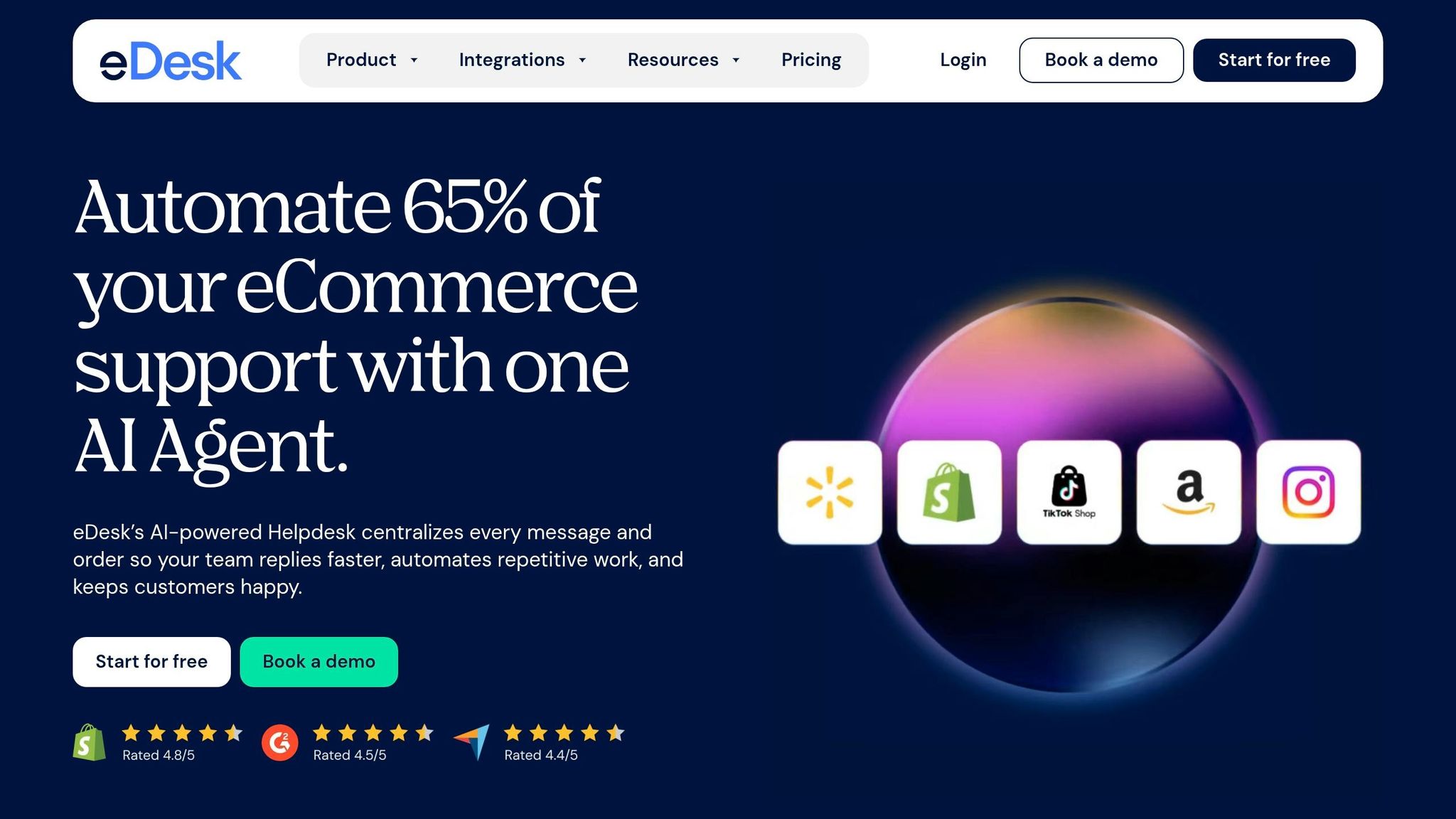
eDesk is designed specifically for ecommerce sellers juggling multiple sales channels. With integrations across more than 300 platforms – like Amazon, eBay, Walmart, TikTok Shop, Shopify, BigCommerce, and WooCommerce – agents can access order details directly within the platform. This eliminates the hassle of switching between tabs, streamlining the support process.
Automation Capabilities
eDesk’s automation tools are tailored for ecommerce support, making customer service faster and more efficient. Its AI-powered assistant, Ava, can handle up to 70% of customer inquiries automatically, covering common issues like order status updates and return requests. For more complex questions, the AI Smart Reply feature drafts responses using real-time order data, enabling agents to resolve tickets with just one click. This approach boosts resolution rates by up to 73%.
Another standout feature, HandsFree Automation, sends pre-written responses to common queries like "Where is my order?" (WISMO) – a type of inquiry that often makes up 30% to 50% of ecommerce support volume. Additionally, eDesk’s AI classification system categorizes incoming messages into over 20 intent categories with over 95% accuracy. This helps prioritize tickets and route them to the right agents efficiently.
These tools, combined with its seamless integrations, ensure eDesk delivers smooth and effective support workflows.
Integration with Ecommerce Platforms
eDesk goes beyond basic integrations by including marketplace-specific SLA management. Features like built-in countdown timers for Amazon’s 24-hour response rule remove the need for manual tracking. Its unified inbox consolidates emails, live chats, social media interactions, and marketplace messages into one place. Plus, with AI-powered auto-translation covering over 60 languages, teams can easily support international customers without language barriers.
Pricing and Scalability
eDesk offers flexible pricing, starting at $39 per month, with options for per-agent and ticket-based models. This predictable structure is particularly useful during high-demand periods, such as Black Friday. AI features are available across all plans, and the platform scales effortlessly to handle multi-brand and multi-region operations, even for businesses processing millions of orders. For teams looking to explore its capabilities, eDesk provides a 14-day free trial, allowing them to test the platform using live support data.
6. Tidio
Tidio continues to enhance response times with a combination of live chat, chatbots, and email automation. Its standout feature is Lyro, a conversational AI agent that uses natural language processing to manage customer inquiries. Unlike traditional chatbots that stick to rigid scripts, Lyro can understand context and deliver tailored responses across both web chat and email ticketing.
Automation Capabilities
Tidio is built for speed when it comes to automation. It can handle up to 67% of common customer questions and repetitive tasks, freeing up support teams to tackle more complex issues. With its intelligent chat triage system, incoming messages are automatically categorized and routed to the appropriate team or bot. The no-code "Flows" feature allows users to set up custom workflows for ecommerce-specific tasks like recovering abandoned carts or collecting leads – all without requiring programming skills.
The platform extends automation across multiple channels, including Instagram, Facebook Messenger, and email, consolidating all communications into a single dashboard. Additionally, its AI supports 11 languages, a major advantage since over 75% of shoppers prefer to interact in their native language.
Integration with Ecommerce Platforms
Tidio integrates seamlessly with platforms like Shopify, WooCommerce, and Wix, enabling the AI to access product data for more informed responses. For example, the Shopify integration allows support agents to view customer carts, check shipping details, and even process refunds – all directly within the chat interface, eliminating the need to juggle multiple systems. Lyro can also suggest products based on visitor behavior and pull answers from help articles to resolve issues 24/7. Plus, setting up live chat takes less than 30 minutes.
These integrations make Tidio a flexible option for businesses of all sizes.
Pricing and Scalability
Tidio offers a free plan for basic needs, with paid plans starting at $24.17/month for the Starter tier. The Growth plan begins at $49.17/month, scaling based on conversation volume (from 250 to 2,000 conversations). For larger needs, the Plus plan costs $749/month, while the Premium plan is priced at $2,999/month and includes fully managed services. Instead of charging per user, Tidio uses conversation-based pricing, which works well for smaller teams but may lead to variable costs for high-traffic stores. A 7-day free trial is available to explore premium features.
With a 4.7/5 star rating on G2 from over 1,750 reviews, Tidio is often praised for its user-friendly design and powerful AI tools.
7. Nurix
Nurix takes phone support to another level with its voice-first AI solution, delivering responses in under 800 milliseconds that feel just like talking to a real person. This is a game-changer for businesses managing heavy call volumes, where even minor delays can make or break the customer experience. It aligns perfectly with the broader trend of using AI to streamline support across different channels.
Automation Capabilities
Nurix AI agents don’t just answer questions – they take action. Whether it’s processing returns, updating customer accounts, or scheduling callbacks, these agents handle tasks seamlessly. They’re also designed to keep conversations running smoothly, even when customers interrupt or switch topics mid-sentence. The platform’s ability to manage overlapping dialogue ensures a natural flow, no matter how chaotic the conversation gets. On top of that, Nurix’s NuPlay platform and NuPulse dashboard enable businesses to customize voice agents and monitor interactions in real time.
AI-Driven Resolution Rates
Nurix boasts a resolution rate of over 90%. For example, in February 2026, Cult.fit slashed its support workload by 80% and reduced turnaround times by 90%. Similarly, Aditya Birla Capital reported a 10% increase in conversions – all without adding extra staff.
"The solution isn’t hiring more agents – it’s deploying AI that handles the volume while your team focuses on the conversations that actually need a human touch." – Sakshi Batavia, Nurix
Integration with Ecommerce Platforms
Nurix integrates with more than 300 enterprise systems, including top CRM, ERP, and contact center platforms like Zendesk, Salesforce, and HubSpot. This deep integration allows the AI to access customer data across systems and execute complex workflows independently. It’s also SOC 2 and GDPR compliant, ensuring it meets stringent security standards. These integrations make the platform a strong choice for businesses looking for scalable, enterprise-ready solutions.
Pricing and Scalability
Nurix uses a custom pricing model tailored to each business’s needs. It’s designed for mid-to-large enterprises handling 1,000 or more daily calls, with costs that adjust based on call volume and integration requirements.
Tool Comparison Table
Choosing the right tool depends on factors like your business size, sales channels, and support needs. Here’s a breakdown of how these platforms compare based on features that help deliver quicker customer responses.
| Tool | Automation Features | AI Resolution Rate | Platform Integrations | Starting Price | Best For |
|---|---|---|---|---|---|
| Emplicit | Marketplace management, PPC and listing optimization, inventory tools | Custom strategies for ecommerce growth | Amazon, TikTok Shops, Walmart, Target, custom ecommerce sites | Custom pricing | Multi-channel ecommerce brands scaling across marketplaces |
| Zendesk | Intelligent triage, AI ticket routing, suggested replies | 80%+ automation rate | 2,000+ apps (50 native integrations) | $55/agent/month | Large enterprises needing robust SLAs |
| Intercom | Fin AI agent, AI Inbox summarization, AI Copilot drafting | 40–60% automatic resolution | 450+ apps | $29/seat/month + $0.99/resolution | SaaS and product-led companies |
| Gorgias | Shopify-trained AI, WISMO automation, in-chat refunds | 30–45% ticket deflection | 15 native (Shopify-focused) | $10/month (50 tickets) | Shopify-centric brands |
| eDesk | Accurate ticket classification, FAQ auto-resolution | Hands-free routine query handling | 300+ native ecommerce integrations | $39/agent/month | Multi-channel marketplace sellers |
| Tidio | Lyro AI bot, visual flow builder, abandoned cart recovery | 67–89% AI resolution | 5 native integrations | Free tier; $24/month paid | Small businesses and startups |
| Nurix | Voice AI, action execution, overlapping dialogue management | 95% issue resolution rate | 300+ enterprise systems | Custom enterprise pricing | High-volume phone support operations |
The table outlines critical differences, but here are some quick takeaways for easier decision-making:
- Emplicit is ideal for ecommerce brands managing multiple sales channels, offering tools like PPC optimization and inventory management.
- Gorgias provides affordable, usage-based pricing starting at $10/month, while Zendesk starts at $55/agent/month. Intercom charges per seat, plus $0.99 per resolution.
- For integrations, eDesk stands out with over 300 native ecommerce connections, while Gorgias allows agents to process in-chat refunds directly through Shopify. Nurix caters to enterprise-level voice systems with seamless CRM and ERP integration.
AI-powered automation is another area where these tools shine. For example:
- In early 2026, Orthofeet automated 56% of support tickets in just two months using Gorgias, improving chat response times by 92%.
- Tailfin leveraged Tidio’s Lyro AI to achieve a 71% resolution rate, saving 400 hours of manual work within 30 days.
These examples highlight the tangible benefits of choosing the right tool for your specific needs.
Conclusion
The right customer support tool can completely change how quickly your ecommerce business addresses customer inquiries – and that speed has a direct impact on your revenue. Studies show that 86% of consumers say responsiveness and accuracy heavily influence their purchasing decisions. Every minute you shave off your response time can lead to more conversions and fewer abandoned carts.
Modern tools streamline communication across multiple channels and often use AI to handle 40% to 70% of repetitive questions like "Where is my order?". This frees up your team to focus on more complex issues. In fact, 75% of CRM leaders report that AI has significantly reduced their response times. The result? Greater efficiency and smarter technology investments.
But it doesn’t stop at choosing the right tool – you also need to monitor your performance. Keep an eye on metrics like First Response Time and customer satisfaction, reviewing them weekly. When deciding on a platform, make sure it aligns with your business’s size and needs. Whether you’re a small startup, a Shopify brand, a multi-channel seller, or a large enterprise needing advanced customization, there’s a tool for you. Many businesses see a return on investment within three to six months, with top-performing teams responding in under an hour compared to the industry average of seven to ten hours.
"Speed now separates the brands that grow from the brands that churn"
Fast and accurate support isn’t just a nice-to-have; it’s a key factor in driving conversions and earning long-term customer loyalty. Use these insights to find the tool that speeds up your responses and helps your business thrive.
FAQs
Which support channels should I automate first?
Automate support channels that deal with routine questions and are most commonly used by your customers – think email, live chat, and social media messaging. By streamlining these areas, you can cut down response times and boost customer satisfaction. Plus, it lets your team concentrate on handling more complex problems. This approach is especially useful for eCommerce brands juggling multiple platforms like Amazon, Shopify, and social media.
How do I measure whether response times are improving?
Keep an eye on metrics like response time or first response time (FRT). FRT measures how long it takes to provide a meaningful reply after a customer reaches out. These metrics give you valuable insight into your support team’s performance.
To stay on top of this, use tools with built-in analytics. They allow you to monitor trends, compare performance across different time periods, and pinpoint areas that need attention. Real-time and AI-powered support systems can also deliver continuous data, making it easier to spot patterns and ensure response times improve over time.
What should I look for in integrations with my ecommerce platforms?
Integrations that allow smooth data exchange and automation can make a big difference in how your business operates. Look for features like real-time visibility into inventory, order processing, and customer data management. Another essential aspect is the ability to automate data transfers with back-end systems like ERP or CRM tools.
These integrations simplify workflows, cut down on manual tasks, and reduce the chances of errors. By connecting your systems effectively, you can speed up customer response times and enhance overall service quality.