
Amazon has revamped its ranking system for pet food products, introducing a new AI model called COSMO that focuses on buyer intent and semantic meaning over traditional keyword matching. Additionally, the updated A10 algorithm now prioritizes external traffic sources like TikTok and Meta Ads, while penalizing sellers who rely solely on Amazon PPC. These changes, coupled with stricter rules such as 200-character title limits and penalties for return rates above 12%, are reshaping how pet food brands perform on the platform.
Key takeaways:
- COSMO AI ranks listings based on buyer intent and context, not just keywords.
- External traffic (e.g., TikTok, Meta Ads) is now critical for rankings.
- Return rates >12% trigger listing suppression.
- 200-character title limits favor concise, benefit-driven titles.
- Review sentiment matters more than sheer review volume.
Pet food brands face higher risks due to the consumable nature of their products and customers’ focus on quality. Sellers must monitor metrics like click-through rates, conversion rates, and return rates to avoid ranking drops. Adapting listings to align with these updates – such as refining titles, improving images, and addressing customer concerns – can help maintain visibility. Tools like Amazon’s Seller Dashboard, Brand Analytics, and external traffic campaigns can provide a competitive edge.
Failing to act quickly could lead to declining sales and lost market share.
Master Amazon’s A10 Algorithm in 2025: Secret SEO & PPC Strategies
How Amazon’s New Ranking System Affects Pet Food
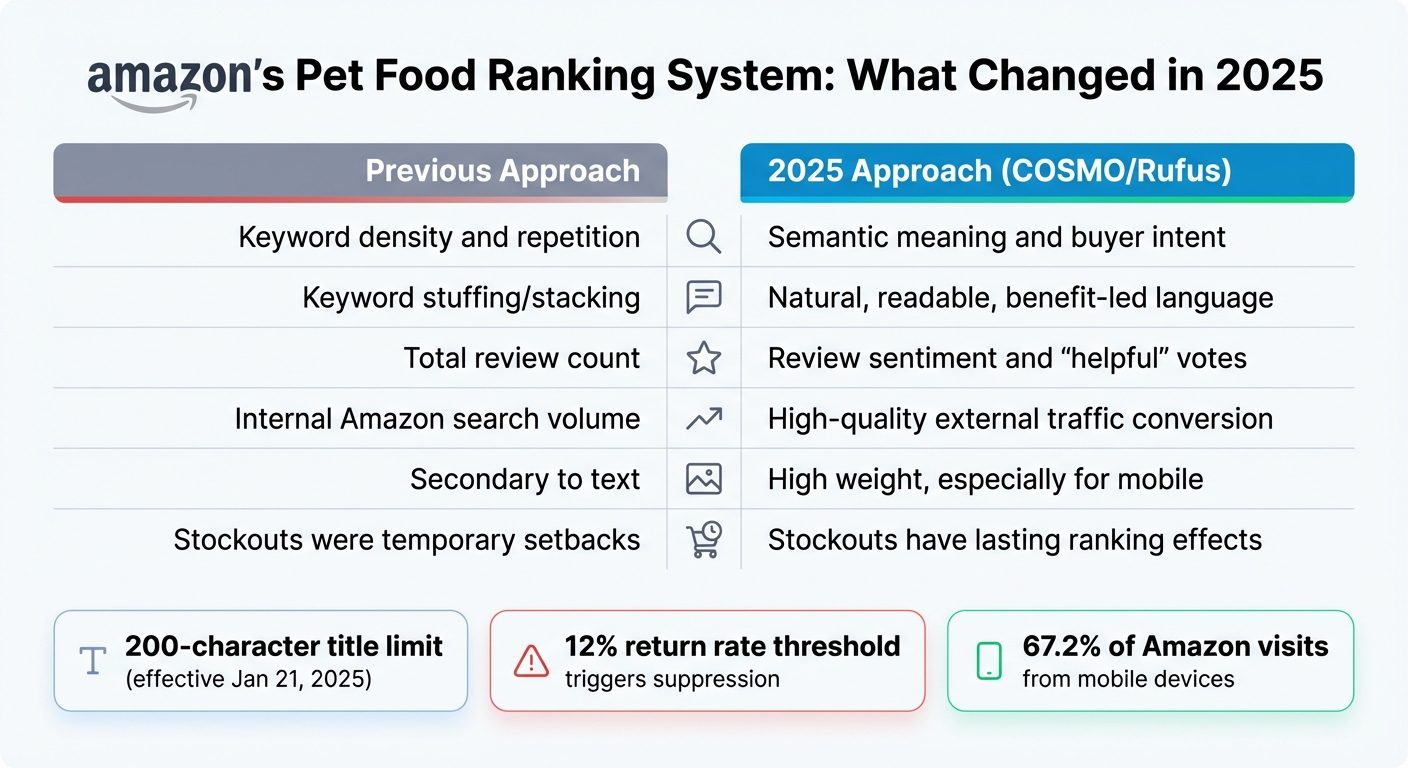
Amazon Algorithm Changes 2025: Old vs New Ranking System for Pet Food
Amazon has shifted gears with its ranking system, replacing the old keyword-matching approach with COSMO, an AI designed to focus on semantic search and buyer intent. Instead of simply counting how often keywords appear, COSMO evaluates whether your listing aligns with what buyers are actually looking for. This change marks a significant departure from traditional methods, bringing some notable updates.
In addition, Amazon has rolled out Rufus, an AI shopping assistant prominently displayed on both desktop and mobile. Rufus responds to conversational search queries like "best food for dogs with sensitive stomachs", moving away from rigid keyword matching.
What Changed in the Algorithm for Pet Food
Amazon has implemented 200-character title limits, effective January 21, 2025. This new rule eliminates redundant keywords and special characters from titles. For instance, titles like "Premium Dog Food – Dry, Organic, Large Breed, Grain-Free, High Protein" are now penalized. Instead, the algorithm favors concise, benefit-driven titles such as "Supports healthy joints and shiny coats in 30 days".
Return rates above 12% now trigger automatic suppression of listings. To help sellers monitor performance, Amazon added Return Rate and Star Rating metrics to the seller dashboard on January 4, 2025. This makes it easier to track listing quality while penalizing underperformers.
Another shift is the increased focus on review sentiment over sheer volume. A listing with 500 reviews but low "helpful" votes will rank lower than one with 150 reviews that actively engage customers. Visual content also plays a bigger role now, especially since 67.2% of Amazon visits come from mobile devices. Your main product image needs to clearly convey the product’s primary benefit, even at thumbnail size.
| Feature | Previous Approach | 2025 Approach (COSMO/Rufus) |
|---|---|---|
| Primary Focus | Keyword density and repetition | Semantic meaning and buyer intent |
| Title Strategy | Keyword stuffing/stacking | Natural, readable, benefit-led language |
| Review Metric | Total review count | Review sentiment and "helpful" votes |
| Traffic Source | Internal Amazon search volume | High-quality external traffic conversion |
| Visuals | Secondary to text | High weight, especially for mobile |
| Inventory | Stockouts were temporary setbacks | Stockouts have lasting ranking effects |
These changes introduce new challenges for sellers, particularly in the pet food category.
Why Pet Food Sellers Face Higher Risks
The updated algorithm puts pet food sellers under greater scrutiny. With a stronger focus on buyer intent and listing quality, the pet food market’s inherent challenges are magnified. For example, 65% of pet owners prioritize ingredient quality above all else. These buyers are meticulous – they analyze labels, read reviews carefully, and are more likely to return products that don’t meet their expectations. A single quality issue can lead to higher return rates, triggering penalties under the new system.
Pet food’s consumable nature adds to the pressure. Customers expect consistent quality with every purchase, and 53% of pet owners shop at least once a week. Stockouts don’t just mean lost sales – they can hurt your ranking permanently, as Amazon’s AI now factors seller reliability into its evaluations. A competitor with steady inventory can easily surpass your listing, even if your product has better reviews.
As Atlisco puts it:
"Amazon now ranks listings more like a human shopper would." – Atlisco
In this category, safety and trust are paramount. Listings that provide detailed ingredient information, certifications, and rich content addressing buyer concerns are rewarded by the algorithm. Sellers who rely solely on keyword-heavy listings without offering meaningful, engaging content risk falling behind as COSMO and Rufus continue reshaping the marketplace to prioritize genuine buyer intent.
How to Spot Ranking Drops Before They Hurt Sales
Spotting ranking drops early is crucial to avoiding revenue loss. With over 70% of Amazon shoppers never venturing beyond the first page, even a small slip in rankings can have a big impact on sales. Keeping an eye on key performance metrics can help you stay ahead.
Which Metrics to Track in Your Seller Dashboard
One of the most important indicators of a ranking issue is your Click-Through Rate (CTR). The 2025 A10 algorithm prioritizes CTR as a key signal – if fewer shoppers are clicking on your listing in search results, Amazon may see it as less relevant. Make it a habit to check your CTR weekly in the Search Query Performance dashboard.
Another critical metric is your Conversion Rate. Listings with conversion rates above 19% tend to perform best in 2025. If you notice a drop in your Unit Session Percentage, it’s time to dig into customer feedback and pricing to identify potential issues. Conversion metrics can give you a clearer picture of where adjustments might be needed.
Your return rate also demands close attention. A return rate nearing 12% could lead to penalties or even listing suppression. Use the Voice of the Customer dashboard to monitor this metric daily and address any spikes immediately.
Then there’s your Best Sellers Rank (BSR), which provides real-time insight into how your product stacks up against the competition. If your BSR starts climbing (for instance, moving from #10 to #50), it’s a sign that your sales velocity is dropping. Tools like Keepa or Camelcamelcamel can help you track BSR trends daily, and pairing this data with Search Query Performance insights can help you identify where customers are dropping off in their journey.
How to Check ASIN Performance and Sales Data
To get a deeper understanding of your product’s performance, focus on ASIN-specific data. Start each day by reviewing your Business Reports. Look at sessions and impressions for your top SKUs over a rolling 30-day period. If traffic is dipping without an obvious reason, it could signal a ranking drop, giving you a chance to act before it worsens. The Search Catalog Performance dashboard is another valuable tool, helping you track your ASIN’s entire funnel – from search appearances to cart additions.
For even more detailed insights, turn to Brand Analytics. The Search Query Performance tool can reveal which keywords are losing share of voice, indicating that competitors are gaining ground. Pay special attention to "strike zone" keywords (those ranked between positions 10–25). Targeted PPC campaigns or limited-time promotions can help push these keywords into the top 10. Monitoring these critical keywords daily can alert you to potential sales issues early on.
Lastly, keep an eye on sales velocity, which measures the number of units sold daily. A consistent drop in daily sales often foreshadows a decline in organic search rankings. The 2025 algorithm places a stronger emphasis on customer retention and repeat purchases, especially for consumable products like pet food. If you notice a pattern of one-time buyers with no Subscribe & Save enrollments, it’s a warning sign that needs further investigation.
sbb-itb-e2944f4
How to Update Your Pet Food Listings for the New Rules
If you’ve spotted ranking issues, it’s time to bring your listings up to speed with Amazon’s 2025 requirements. Making these updates now can help you avoid penalties that could harm your sales.
Fixing Titles, Images, and Compliance Issues
Starting January 21, 2025, Amazon will enforce a strict 200-character limit for product titles. Titles exceeding this limit or repeating keywords more than twice will be flagged. For example, a title like "Organic Dog Food Grain Free Dog Food Natural Dog Food" will no longer work – it could actually hurt your rankings.
Amazon’s new COSMO algorithm changes how titles should be crafted. Instead of stuffing them with keywords, focus on clarity and intent. COSMO prioritizes listings that address the "why" behind a shopper’s search. For instance, a title like "Grain-Free Organic Dog Food for Sensitive Stomachs" is far more effective than a keyword-heavy alternative.
Images are also gaining importance in 2025. High-quality, zoomable images (at least 1600 pixels on the longest side) can increase sales by 64%. For pet food, showcase close-up shots of the kibble’s size, texture, and color to give buyers a clear idea of what they’re purchasing. Including a short video (30–90 seconds) that demonstrates the product in use or provides storage tips can also make a big difference.
Don’t forget about ALT text for images, which now supports up to 100 characters of indexing keywords. Use this space to include high-traffic search terms and even Spanish translations to reach a broader audience.
By refining these elements, you’ll position your listings for better visibility and stronger performance.
Reducing Returns Through Better Quality Control
A return rate above 12% puts your listing at risk of suppression or losing search visibility. To avoid this, manage customer expectations before they make a purchase. If your pet food has unique qualities – like a specific texture, kibble size, or ingredient profile – highlight these details early in your listing. Use your first three images and bullet points to address potential concerns. For example, if the kibble is larger than usual, include a comparison image with a coin or ruler. If the formula is tailored for active breeds, make that clear so buyers with senior or less active pets don’t mistakenly purchase it.
Regularly check your Voice of the Customer dashboard for recurring complaints. Are customers mentioning damaged packaging, inconsistent quality, or misleading descriptions? These patterns point to issues that need immediate attention. Keep in mind that 65% of pet owners prioritize ingredient quality when selecting pet food. Any mismatch between what you promise and what you deliver will likely show up in your return rate.
With strong quality control measures in place, you can reduce returns and focus on improving your keyword strategy for better relevance.
Choosing Keywords That Match Buyer Search Intent
The 2025 COSMO update shifts the focus from keyword repetition to understanding buyer intent. The algorithm now evaluates context, synonyms, and the problems shoppers aim to solve. Instead of overusing "dog food", incorporate related terms like "organic dog treats", "natural pet snacks", or "high-protein kibble for active breeds".
Tools like the Product Opportunity Explorer and Brand Analytics (specifically the Search Query Performance dashboard) can help you identify high-intent search terms. Focus on longer, specific phrases like "grain-free cat food for sensitive stomachs" or "high-protein kibble for active breeds" to align with COSMO’s intent-driven approach.
Place your most important keywords in the product title, keeping it concise and readable. Use bullet points to expand on the benefits of your product, following a "Problem → Benefit → Feature" structure. For example: "Does your dog have a sensitive stomach? Our grain-free formula uses limited ingredients to reduce digestive upset and support healthy digestion." This not only answers buyer questions but also naturally incorporates keywords.
In your backend search terms (up to 250 bytes), include synonyms, abbreviations, and alternative spellings. Add terms that don’t fit naturally into your front-facing copy, like common misspellings or Spanish translations. If you sell products for both dogs and cats, consider creating separate SKUs to target specific keywords like "calming treats for dogs" versus "calming treats for cats", without altering your physical packaging.
| Keyword Type | Placement | Character/Byte Limit | Purpose |
|---|---|---|---|
| Primary Keywords | Product Title | 200 characters (60 recommended) | Immediate relevance and click-through rate (CTR) |
| Secondary Keywords | Bullet Points | ~500–1,000 characters | Explaining benefits and features |
| Backend Terms | Generic Keywords | 250 bytes | Indexing synonyms and misspellings |
| ALT Text | Image Metadata | 100 characters | Indexing for image search and accessibility |
How Emplicit Helps Pet Food Brands Adapt to Algorithm Changes
Navigating Amazon’s constant updates can be tricky, especially for pet food brands trying to stay competitive. Emplicit steps in with expert solutions tailored to meet these challenges. Their Growth and Enterprise plans are designed to address the specific hurdles pet food sellers face under Amazon’s evolving ranking systems.
Emplicit’s Services for Pet Food Sellers
Emplicit fine-tunes product listings to align with the COSMO algorithm’s emphasis on buyer intent. Instead of relying on outdated keyword strategies, they craft titles and bullet points that directly address the "why" behind customer searches – exactly the focus of the new algorithm.
For PPC campaigns, Emplicit takes a multi-layered approach. They combine Amazon Prime Video ads, Amazon DSP, and ongoing sponsored ads to engage shoppers at every stage of their journey. Additionally, they leverage Amazon Marketing Cloud (AMC) to create advanced audience segments, distinguishing between loyal customers and those new to the brand. This level of precision is crucial in such a competitive market.
Emplicit also ensures strict compliance monitoring to avoid listing penalties. For instance, high return rates can lead to suppression, so they keep a close eye on this metric, along with fulfillment readiness, inventory fitness, and bundling compliance. This is especially critical after Amazon limited bundle creation to brand owners. Considering that 70% of Amazon shoppers never look beyond the first page, maintaining visibility and compliance is essential.
Emplicit Plan Comparison for Pet Food Brands
To make it easier for pet food sellers to choose the right level of support, Emplicit offers three distinct plans. Here’s how they compare:
| Plan | Best For | Key Features | Marketplace Limit |
|---|---|---|---|
| Basic | Small pet food brands just starting out | Marketplace management, basic PPC optimization, listing optimization | 1 marketplace |
| Growth | Brands looking to scale | All Basic features, inventory management, account health monitoring | 3 marketplaces |
| Enterprise | Established brands with complex needs | All Growth features, omnichannel marketing, full-service team, USA-based account managers | Unlimited |
For brands grappling with the COSMO algorithm’s intent-focused rankings or the A10 algorithm’s emphasis on external traffic, the Growth and Enterprise plans offer the tools and expertise needed to stay ahead in the game.
Conclusion
Amazon’s transition to the A10 and COSMO algorithms has reshaped the competitive landscape for pet food brands. The strategies of the past – like keyword stuffing and relying solely on internal PPC campaigns – are no longer effective. As of July 2025, the algorithm now emphasizes buyer intent, external traffic, and content quality over simplistic keyword matching. Brands that fail to adapt are already seeing the consequences, and many may not even realize the full impact until their sales begin to decline.
These changes come with real risks. The pet food category, a major market with immense potential, is particularly vulnerable. Even a slight drop in rankings can lead to noticeable decreases in visibility and revenue. If you’re not leveraging external traffic sources like TikTok or Meta, you’re skipping a critical ranking signal.
Now is the time to act. Review your A+ content, ensure your titles are optimized for natural readability, and use Amazon Attribution to track external traffic. Regularly monitor your return rates and make sure your listings address the deeper "why" behind customer searches – not just the surface-level "what".
To make these adjustments easier, Emplicit provides tailored solutions. Their Growth and Enterprise plans are designed to help pet food brands navigate these algorithm changes. Whether it’s intent-driven listing optimization, managing multi-channel PPC campaigns, or ensuring compliance, Emplicit’s team handles the technical details so you can focus on scaling your business.
Don’t wait – acting now ensures your brand stays ahead of the competition. Delay, and you risk falling behind.
FAQs
How has Amazon’s COSMO AI changed the way pet food products are ranked?
Amazon’s COSMO AI has changed the game for pet food rankings, moving away from keyword-packed content to a buyer intent-driven strategy. Now, the algorithm favors listings that use genuine, customer-friendly language, feature high-quality images, and include A+ content that resonates emotionally with shoppers.
Outdated methods like keyword stuffing or overly flashy titles are now penalized. To remain competitive, brands must focus on creating product pages that are engaging, visually appealing, and authentic.
Why is external traffic more important for Amazon rankings now?
Amazon’s updated A10 algorithm has made external traffic a major factor in determining product rankings. What does this mean for sellers? It’s no longer enough to rely solely on internal ads or organic browsing within Amazon. Instead, driving visitors from outside sources – like Google searches, social media platforms, or influencer shoutouts – has become crucial. These external signals demonstrate to Amazon that customers are actively seeking out your product, not just stumbling upon it.
When a product consistently attracts high-quality traffic from outside Amazon, it sends a strong message: this item is relevant and likely to sell. As a result, listings that convert external clicks into purchases often enjoy higher organic rankings. This strategy can be particularly effective in competitive categories, such as pet food, where standing out is key.
This shift also highlights Amazon’s growing focus on organic engagement and multi-channel sales efforts. Instead of relying heavily on internal sales velocity or paid ads, the platform now rewards sellers who build a robust presence across multiple channels. For those looking to maintain or improve their rankings, investing in external visibility is no longer optional – it’s essential.
How can pet food brands adjust to Amazon’s latest algorithm updates to stay competitive?
To keep up with Amazon’s updated ranking algorithm, pet food brands need to fine-tune their listings to match buyer intent and create a seamless shopping experience. The new algorithm puts a spotlight on semantic relevance, emotional appeal, and visual quality, while also rewarding external traffic and steady sales performance.
Here’s how brands can adjust:
- Use natural, intent-focused language: Write product descriptions that feel conversational and address customer needs. Include relevant synonyms to broaden appeal, but steer clear of repetitive keyword stuffing.
- Upgrade visual content: Add crisp, high-resolution images and detailed A+ content to highlight product benefits, such as promoting better pet health or catering to specific dietary needs.
- Leverage external traffic sources: Drive shoppers to your Amazon listings through social media, email campaigns, or your brand’s website. External clicks now play a role in boosting rankings.
- Keep inventory in check: Ensure stock levels are consistently healthy, use FBA or fast shipping options, and monitor your Buy Box performance to avoid disruptions or penalties.
By prioritizing these tactics, pet food brands can adapt to the algorithm changes, maintain strong visibility, and achieve steady sales on Amazon.