

Click-through rate (CTR) is overrated. Many pet brands on Amazon fixate on CTR, believing it’s a key to growth. But here’s the truth: CTR measures interest, not profitability. A high CTR doesn’t guarantee sales or revenue – it’s a vanity metric that can mislead your strategy.
Instead, focus on metrics that drive results:
- Conversion Rate (CVR): Tracks how many clicks turn into purchases. A strong CVR means your listing converts interest into sales.
- Advertising Cost of Sales (ACOS): Shows how much you spend on ads for every dollar earned. A low ACOS signals profitable ad spend.
- Customer Lifetime Value (CLV): Measures total revenue from a customer over time. High CLV allows for smarter ad investments.
CTR might look good on paper, but it doesn’t pay the bills. Shift your focus to metrics that matter – sales, profitability, and long-term growth.
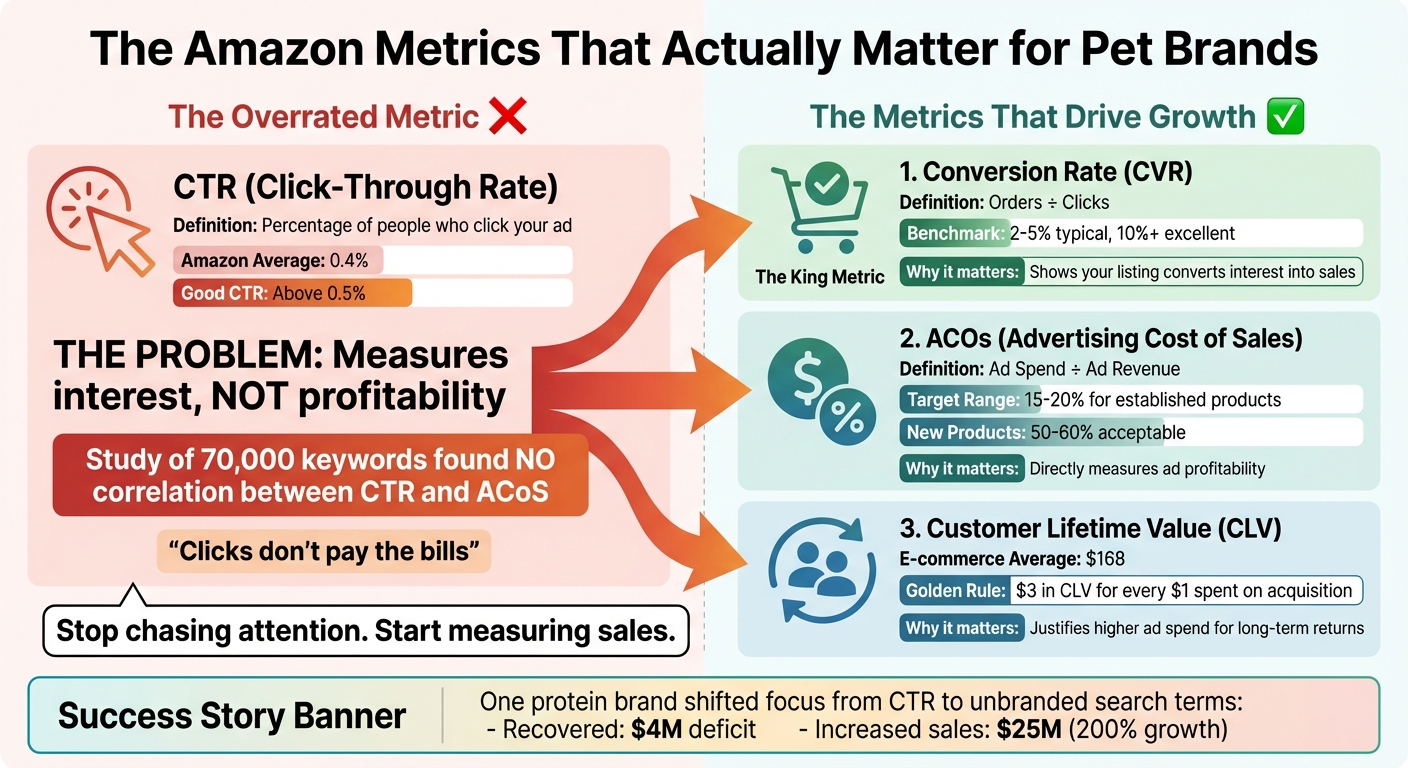
CTR vs Profitable Amazon Metrics for Pet Brands Comparison
Amazon Brand Metrics – Detailed Metrics Explained
The Overrated Metric: Click-Through Rate (CTR)
Many pet brands obsess over CTR, often at the expense of focusing on what truly drives growth.
What Click-Through Rate (CTR) Measures
CTR, or click-through rate, is the percentage of people who click on your ad after seeing it. For example, if your dog food ad gets 10,000 impressions and 50 clicks, your CTR is 0.5%.
On Amazon, the average CTR across all ad types hovers around 0.4%. A CTR above 0.5% is generally seen as good, while anything below 0.3% can be a cause for concern. Sponsored Products usually land between 0.4%–0.6%, whereas Sponsored Display ads tend to perform lower, ranging from 0.2%–0.4%.
Why Pet Brands Focus on CTR
For many pet brands, CTR is like a performance report for their advertising. A high CTR tells Amazon’s A9 algorithm that your product aligns well with shopper searches, which can lead to better organic rankings over time. It can also improve your Quality Score, potentially reducing cost-per-click and securing more favorable ad placements.
"A high CTR tells Amazon, ‘When people search for this keyword, my product is a highly relevant solution.’" – Headline Amazon Agency
CTR also serves as an early diagnostic tool. A low CTR might highlight problems with your main image, pricing, or keyword targeting – issues you can address before shoppers even visit your product page. Considering that 35% of Amazon shoppers click on the first search result, and up to 64% of clicks go to the top three results, it’s clear why brands often prioritize this metric.
Why CTR Doesn’t Lead to Growth
Here’s the catch: clicks don’t pay the bills. A study analyzing 70,000 randomly selected Amazon keywords found almost no connection between CTR and Advertising Cost of Sales (ACoS). In other words, a high CTR doesn’t necessarily mean your ads are profitable.
"CTR is not correlated with ACoS, and therefore is not relevant to your decision. ACoS is all you need! So stop worrying about your low CTR keywords!" – Helium 10 Team
The problem lies in what CTR actually measures. It only tracks initial interest, not what happens after the click. A high CTR can mask deeper issues like poor conversion rates or wasted ad spend. For example, if you’re running ads for a specialized supplement but targeting a broad term like "dog treats", you might attract clicks from curious shoppers who never buy. Worse, if your product gets lots of clicks but few sales, Amazon’s algorithm might interpret this as a lack of relevance, which could hurt your organic rankings.
"A click doesn’t indicate quality. A high CTR does not translate into high conversion rates." – The Statsig Team
While CTR can give you a snapshot of initial interest, real growth comes from what happens after the click. It’s the post-click performance that truly matters.
The Metrics That Drive Real Results
Click-through rate (CTR) might grab attention, but it doesn’t always tell the full story. To truly measure success, pet brands need to shift their focus to metrics that directly impact profitability. These metrics reveal whether your ad spend is actually working for you.
Conversion Rate (CVR)
Conversion rate measures how many purchases result from clicks (orders ÷ clicks). For instance, if 100 people click on your ad for organic dog treats and 5 make a purchase, your CVR is 5%.
"Conversion rate is the ‘king metric’ because this helps understand your search term relevance… and improving your organic relevance." – Erika Sharma, eComEngine
Amazon PPC campaigns typically achieve CVRs between 2% and 5%, though the best campaigns can hit 10% or more. Why does this matter? A strong CVR indicates your product listing effectively convinces shoppers to buy. Plus, higher CVRs can improve your Quality Score, leading to lower cost-per-click and better ad placements.
Advertising Cost of Sales (ACOS) and Return on Ad Spend (ROAS)
ACOS measures how much you spend on ads for every dollar of revenue generated. It’s calculated by dividing ad spend by ad revenue. For example, if you spend $20 on ads and generate $100 in sales, your ACOS is 20%. Most pet brands aim for an ACOS of 15-20% to maintain healthy profit margins.
ROAS flips the script, showing how much revenue you earn per dollar spent. A ROAS of 3.0 means you’re earning $3 for every $1 spent – a common benchmark for successful campaigns.
"ACoS on Amazon really only measures profit. But if this isn’t your only advertising goal, you should focus on other metrics." – Stephanie Jensen, AMZ Advisers
Here’s the takeaway: While new product launches might justify a higher ACOS of 50-60% to gain visibility, established products should target 20-30% for consistent profitability. Unlike CTR, which has little connection to profitability, ACOS directly shows whether your ads are making money or losing it.
For a broader view, consider customer lifetime value to understand the long-term impact of your ad spend.
Customer Lifetime Value (CLV)
CLV calculates the total revenue a customer brings in over their relationship with your brand. Repeat purchases significantly boost this number.
"At Amazon, every customer counts for today and tomorrow. That’s the real value of CLV." – Michael Erickson Facchin, CEO, Ad Badger
On average, e-commerce brands see a CLV of about $168, with customers sticking around for 2-3 years. A good rule of thumb: for every $1 spent on customer acquisition, aim to generate $3 in lifetime value. For instance, if a cat litter subscription customer spends $150 over two years, you could spend up to $50 to acquire them – even if the first sale barely breaks even.
Brands with higher CLV can afford to bid more aggressively on competitive keywords, knowing they’ll see returns in the long run. Use Amazon’s Customer Loyalty Analytics Dashboard to monitor repeat purchase rates and identify your most valuable customer segments.
sbb-itb-e2944f4
How to Shift Your Focus to Better Metrics
To improve profitability, it’s essential to move beyond vanity metrics and focus on numbers that genuinely impact your bottom line. Start by reviewing your current metrics and adjusting your strategy accordingly.
Review Your Current Metrics
Head over to Seller Central Business Reports and take a close look at your Unit Session Percentage – Amazon’s version of conversion rate. A healthy range here is usually between 7% and 15%. If you’re spending more than 80% of your ad budget on branded search terms, you might be missing out on new customers who aren’t already familiar with your product. Use the Search Query Performance dashboard to identify which search terms actually lead to purchases, not just clicks.
Another key metric to monitor is your Total Advertising Cost of Sale (TACoS), which compares your ad spend to your total revenue (both organic and paid). A decreasing TACoS is a strong indicator that your ads are driving organic growth. Ben Donovan, Co-founder of Brand Builder University, puts it this way:
"A decreasing TACoS is a clear sign that organic sales are growing and overall profitability is improving – even if ACOS isn’t changing."
For new products, aim for a TACoS around 20%, with the goal of lowering it to about 10% over time. Mature products, on the other hand, should target a TACoS in the 10–15% range. Once you’ve set these benchmarks, shift your attention to improving the quality of your listings to convert clicks into sales.
Optimize for Sales, Not Just Clicks
If your product is getting plenty of impressions and clicks but has a low conversion rate, don’t just pour more money into ads. Instead, focus on optimizing your product detail page. Amazon’s "Manage Your Experiments" tool allows you to A/B test elements like main images, titles, and A+ Content over a 4–10 week period. Even small updates can make a difference – basic improvements can boost sales by 8%, while Premium A+ Content can increase conversions by up to 20%.
Redirect your ad budget from high-click-through-rate (CTR) keywords that don’t convert toward unbranded search terms with stronger buyer intent. While these keywords may have a higher cost-per-click, they’re more likely to result in sales. Research shows that 65% of industries saw better conversion rates by targeting high-intent audiences rather than chasing cheaper clicks. For pet brands, using Market Basket Analysis to identify products often purchased together – like dog food and bowls – can help you create Virtual Bundles that boost Average Order Value.
Use Data to Guide Budget Decisions
To ensure your ad spend stays profitable, calculate your Break-Even ACOS by factoring in your profit margin after accounting for costs of goods sold and Amazon fees. For subscription-based products like cat litter or dog food, promoting "Subscribe & Save" options can significantly increase Customer Lifetime Value. It’s often more cost-effective to grow the value of existing customers than to acquire new ones.
Leverage the Customer Loyalty Analytics dashboard (available with the $39.99/month Professional Selling Plan) to segment your audience into categories like "Top Tier", "Promising", "At Risk", and "Hibernating" customers. A good rule of thumb is to maintain a 3:1 ratio between Lifetime Value and Customer Acquisition Cost.
"If the keyword has at least one sale, use ACoS only (not CTR) to make decisions on whether to keep the keyword or raise/lower your bid." – Helium 10 Team
Conclusion
While CTR might look impressive on the surface, it’s often just a vanity metric that can steer pet brands away from real growth. A study analyzing 70,000 Amazon keywords found no connection between high CTR and a favorable ACoS.
The brands that truly succeed focus on metrics like Conversion Rate, ACoS, and Customer Lifetime Value. These numbers provide a clearer picture of product relevance, ad profitability, and long-term customer impact. Shifting your attention to these metrics has been shown to drive tangible results.
For example, one protein brand moved its focus from branded to unbranded search terms. The result? They recovered a $4M deficit and boosted annual sales by $25M – a staggering 200% increase.
Ad budgets are finite. Spending money on high CTR keywords that don’t convert is a waste. It’s time to stop chasing attention and start measuring what truly matters: sales.
FAQs
Why is click-through rate (CTR) not a reliable metric for pet brands on Amazon?
Click-through rate (CTR) is often labeled a vanity metric because it only tells part of the story. Sure, it measures how many people click on your ad or listing, but it doesn’t reveal whether those clicks translate into actual sales or meaningful growth. You could boost CTR with a flashy image or an irresistible title, but that doesn’t guarantee the clicks are coming from shoppers ready to buy.
For pet brands, purchasing decisions hinge on more than just attention-grabbing tactics. Factors like competitive pricing, trustworthy reviews, clear ingredient information, and overall brand credibility play a huge role. The problem with CTR is that it doesn’t account for these critical elements. Plus, Amazon only tracks impressions for paid campaigns, which can inflate CTR with unqualified traffic – think of curious clicks from people who have no intention of making a purchase. This can lead to overvaluing CTR while overlooking more meaningful metrics like conversion rate, sales, or profitability, which provide a clearer picture of how your business is really performing.
How can pet brands use conversion rates to boost sales on Amazon?
Conversion rate (CVR) is the percentage of shoppers who visit your product page and end up making a purchase. For pet brands, CVR holds particular weight since Amazon shoppers often come with a strong intent to buy. On average, Amazon’s platform-wide CVR hovers around 9.8%, which is significantly higher than the 1.3% seen on general e-commerce sites. Keeping an eye on CVR through Amazon’s Business Reports can help you spot underperforming listings and fix them before they start draining your ad budget.
To boost CVR and increase sales, focus on optimizing key elements of your listings. Use clear, descriptive titles, high-quality images, and persuasive bullet points that address what pet owners are looking for – like grain-free options or vet-approved products. Competitive pricing and genuine customer reviews are also crucial in turning browsers into buyers. CVR data can guide your inventory decisions, too. For example, products with a CVR of 10% or higher are safer bets for restocking, while lower-performing items might need tweaks such as improved content or promotional offers. By consistently refining your listings and focusing ad spend on products with strong conversion rates, pet brands can drive steady growth and profitability on Amazon.
Why is Customer Lifetime Value (CLV) important for optimizing Amazon ad spend?
Customer Lifetime Value (CLV) represents the total revenue a customer is likely to bring to your brand throughout their relationship with you. For pet brands on Amazon, this metric is crucial for shifting focus from short-term ad metrics like ACoS to long-term profitability. By understanding CLV, you can target ad spend toward customers who are more likely to make repeat purchases, ultimately increasing your returns over time.
CLV also plays a big role in determining how much you can reasonably spend to acquire new customers while staying profitable. When you know your average CLV, you can confidently set bids, avoid overspending on low-margin sales, and focus on campaigns that attract high-value customers. This strategy not only enhances your ROAS but also lays the groundwork for sustainable growth.
Related Blog Posts
- Why 73% of Pet Brands Fail on Amazon Before Year Two (And How to Be the Exception)
- The Real Reason Your Amazon Pet Product Has 4.8 Stars and Still Isn’t Selling
- Most Pet Brands Optimize for Amazon Keywords. The Best Ones Optimize for This Instead.
- Why the Fastest-Growing Pet Brands on Amazon Are Spending Less on Ads, Not More