

Amazon‘s pet supplies category is booming, growing 25.3% year-over-year, yet premium brands face tough challenges from cheaper imports and Amazon‘s private-label products. These competitors undercut prices by 25%-40%, dominate visibility through Amazon‘s algorithm, and even imitate premium designs, eroding brand value and trust. Counterfeits, pricing pressure, and loss of visibility make it harder for high-quality brands to compete.
Key Takeaways:
- Challenges: Cheap imports dominate over half the market, often bypassing U.S. taxes and regulations, while private-label products benefit from Amazon’s algorithm.
- Impact: Premium brands face pricing wars, counterfeits, and damaged customer trust, leading to reduced margins and brand erosion.
- Solutions:
- Highlight ingredient quality, advanced tech, and niche health benefits.
- Use Amazon Brand Registry for protection and optimize listings with A+ Content.
- Invest in targeted advertising to maintain visibility.
- Build loyalty with subscription programs and tailored promotions.
- Track performance using Amazon’s analytics tools to refine strategies.
Focusing on quality and differentiation allows premium brands to thrive despite the competition. Pet owners are willing to pay for trusted, high-quality products, creating opportunities for brands to grow by standing out in this competitive market.
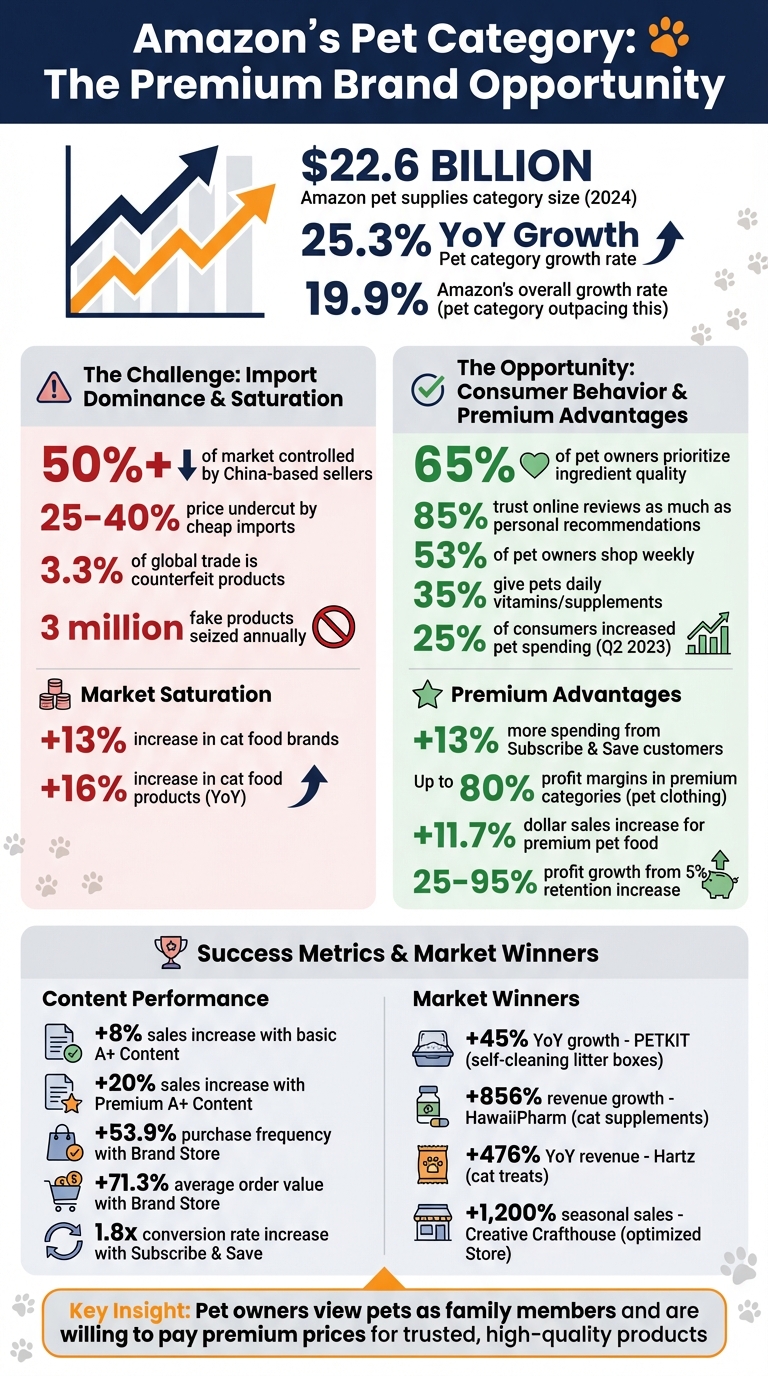
Premium Pet Brands vs Cheap Imports: Market Statistics and Growth Opportunities
How Cheap Imports Are Hurting Premium Pet Brands
The Size of the Problem
Low-cost imports are transforming Amazon’s pet category – and not in a good way for premium brands. China-based sellers now dominate over half of the market, sidestepping U.S. taxes and taking full advantage of the "de minimis" rule, which exempts shipments under $800 from tariffs. Meanwhile, U.S. brands face steep $1 million liability requirements.
The competition has become fierce. In the cat food market alone, the number of brands surged by 13%, with products increasing by 16% year-over-year. Many of these newcomers use unrecognizable alphanumeric names like "EKDOG97." These names are easily registered with the Patent and Trademark Office and Amazon Brand Registry, flooding search results and shoving premium brands out of prime visibility spots. Jeanne Fromer, a Professor of Intellectual Property Law at NYU, highlights the issue:
"a dramatic increase in the number of applications to register, which has swamped the PTO and created delays for all applicants".
This overcrowded marketplace has left premium brands grappling with significant pricing and visibility challenges.
Pricing Pressure and Lost Brand Value
Low-cost competitors are forcing premium brands into a tough corner when it comes to pricing. Private-label products often undercut national brands by a wide margin. Amazon’s own private-label offerings, for example, deliver 25% higher profit margins for the retailer, thanks to lower marketing and packaging costs. On top of that, unauthorized sellers frequently slash prices to win the Buy Box, leaving premium brands with two bad options: drop their prices and lose margins or hold firm and risk losing visibility.
But this isn’t just about price wars. Kusum Ailawadi, a Marketing Professor at Dartmouth College, explains:
"the history of private label… is very much a perception of low price and at best acceptable quality".
This perception shift erodes the value of premium brands, making them seem no different from lower-quality, commodity products. Beyond pricing, these tactics also hurt brand perception and customer trust, further weakening the position of premium players.
Damaged Customer Trust and Experience
Counterfeits are another major blow to premium brands. They account for an estimated 3.3% of global trade, with over 3 million fake products seized annually . These knockoffs damage customer trust, especially when poor reviews and low-quality product images blur the line between genuine and fake items. Worse, when consumers unknowingly purchase these inferior products, they often blame the original brand – not the counterfeit seller.
The trust issue is massive. 85% of customers trust online reviews as much as personal recommendations. This means a single bad review stemming from a counterfeit product can have a devastating effect on sales. Some competitors even post fake negative reviews to steer customers toward cheaper alternatives. Third-party distributors add to the problem by using poor-quality photos and inconsistent product descriptions, making premium brands look unprofessional. As Pattern warns:
"Brand erosion is the decline in your product’s brand perception… Suddenly, the consumer trust you worked so hard to establish is destroyed and extremely difficult to rebuild".
For premium brands, these issues demand a strategy that goes beyond pricing and focuses on restoring trust and differentiation.
Why Premium Brands Need to Focus on Quality and Differentiation
How to Stand Out from Low-Cost Competitors
For premium brands, success lies in focusing on what low-cost competitors can’t easily replicate: ingredient transparency, specialized health solutions, and cutting-edge technology.
Take ingredient quality, for example. A striking 65% of pet owners rank this as a top priority when choosing products. Premium brands have a clear opportunity here by showcasing clean, human-grade ingredients and ethical sourcing practices. Steering clear of artificial colors, GMOs, and fillers reinforces the perception of quality.
Technology also plays a pivotal role in setting premium brands apart. Products like automatic feeders and self-cleaning litter boxes deliver convenience that budget options simply can’t match. A standout example is PETKIT, which captured 28% of the self-cleaning litter box market in 2024 by eliminating the hassle of manual cleaning. This focus on convenience helped the brand grow 45% year-over-year, contributing to a staggering 93% revenue increase across the category. On platforms like Amazon, innovation often outpaces brand heritage.
Another area where premium brands shine is specialized health products. The pet supplement market alone generated nearly $300 million in revenue during the first half of 2024. HawaiiPharm, for instance, saw an impressive 856% revenue growth in the cat supplement market from January to June 2023 by addressing specific health needs. Premium brands can dominate niches like joint health, anxiety relief, and dental care – areas where cheaper alternatives struggle to compete effectively.
These unique strengths not only attract customers but also position premium brands as leaders in a market increasingly hungry for high-quality pet products.
Growing Demand for High-Quality Pet Products
The market is shifting, and premium brands are perfectly positioned to take advantage of it. More than ever, pet owners are prioritizing quality over cost.
In 2024, the Amazon pet supplies category hit $22.6 billion, growing 25.3% year-over-year – outpacing Amazon’s overall growth rate of 19.9%. This boom reflects a deeper trend: pet owners now view their animals as family members, and they’re willing to spend accordingly.
As this mindset grows, so does the demand for human-grade meals, organic ingredients, and wellness-focused products. In Q2 2023, 25% of consumers reported increasing their pet-related spending. Gen Z, in particular, is less price-sensitive and more inclined to pay for genuine health benefits. Sumit Singh, CEO of Chewy, summed up this cultural shift perfectly:
"Thirty years ago, the pet was on the porch, and now it’s on the bed".
With 35% of pet owners now giving their pets daily vitamins or supplements, premium brands positioned as partners in pet wellness are poised to capture this growing market segment.
Higher Profit Margins with Premium Pricing
Premium branding doesn’t just attract customers – it also protects your profit margins. While low-cost imports often trigger price wars, premium products thrive by offering value that justifies higher prices.
Consider Amazon’s Subscribe & Save program. Pet owners who set up recurring deliveries spend 13% more, creating predictable revenue streams while reducing customer acquisition costs. Certain categories, like pet clothing, can deliver profit margins as high as 80 points. Even premium pet food saw an 11.7% increase in dollar sales despite a slight dip in unit sales.
Retention also plays a critical role. A mere 5% increase in customer retention can drive profit growth of 25% to 95%. By focusing on quality and loyalty programs, premium brands can not only command higher prices but also secure long-term profitability – a feat that low-cost competitors struggle to achieve.
How Premium Brands Can Fight Back Against Cheap Imports
Use Brand Registry and Enhance Your Listings
Signing up for Amazon Brand Registry is a game-changer for protecting your premium brand. It shields your listings from unauthorized changes and counterfeit products, giving you full control over your product detail pages. Plus, tools like Project Zero and Transparency use machine learning to automatically detect and remove counterfeit listings before they can harm your sales.
To stand out, leverage A+ Content to highlight your product’s premium features and justify higher pricing. For instance, basic A+ Content can boost sales by 8%, while Premium A+ Content has the potential to increase sales by up to 20%. A great example is Creative Crafthouse, which used seasonal visuals and keyword-focused modules in their Amazon Store in 2025, driving a staggering 1,200% sales growth during peak season.
Another strategy is creating a custom Brand Store, which can increase purchase frequency by 53.9% and average order value by 71.3%. Josh Francis, Executive Vice President at Hippeas, sums it up perfectly:
"Our Store is a pride factor for the brand. It’s probably the best opportunity for us to show what the brand identity is truly about".
Protect Your Brand with Smart Advertising
Once your listings are optimized, the next step is to defend your brand’s visibility through targeted advertising. Cheap imports often bid on your branded keywords, so running Sponsored Brands campaigns ensures you maintain top search visibility.
To refine your ads, use Amazon’s Manage Your Experiments tool. This feature allows you to A/B test various elements – titles, images, and A+ Content – to see what resonates most with premium customers. If you’re launching a new product, consider using Amazon Vine to generate at least five reviews with a 3.5-star rating or higher. This can significantly boost your ad performance. Keep in mind, 75% of customers use Amazon to discover new products and brands.
Tell Your Story with High-Quality Content
Great storytelling and high-quality visuals can set your brand apart from cheaper competitors. Swap out generic white-background images for real-life lifestyle photos. For example, Petcube uses videos in their storefront to show how their pet cameras let owners remotely feed treats, emphasizing the emotional benefit of "peace of mind".
Focus on showing how your product benefits the customer rather than just listing features. Use comparison charts in your A+ Content to clearly illustrate how your product’s quality and innovation surpass cheaper alternatives. Travis Marziani, Founder of Better Nut Butter, advises:
"Be willing to spend money on your brand logo, product packaging, and photos for your product detail pages to make your listings look as professional as possible".
Consistency is key. Use the same fonts, colors, and iconography across all your visuals to create a cohesive brand image. Since most shopping happens on mobile devices, preview your content to ensure text is readable and images aren’t cropped.
Build Loyalty with Programs and Subscriptions
Once your listings and content are polished, focus on retaining customers. For products that are often re-ordered, like pet supplies, consider optimizing for Subscribe & Save. Offering a 10%-15% discount through this program can lead to a 1.8x increase in conversion rates, and subscribers tend to spend 13% more overall.
Additionally, use Brand Tailored Promotions to reward loyal customers and establish a high-quality customer base. Even a modest 5% boost in customer retention can result in profit growth ranging from 25% to 95%. Building loyalty not only secures predictable revenue but also strengthens long-term customer relationships.
sbb-itb-e2944f4
How to Measure Your Results
Track Revenue and Market Share
Keeping an eye on revenue growth and market share is key to evaluating your premium positioning. For instance, the Amazon pet supplies category experienced a 25.3% year-over-year growth in 2024, creating a $22.6 billion market opportunity. If you’re part of Amazon Brand Registry, the Search Query Performance dashboard is your go-to tool. It lets you track your brand’s share of clicks and purchases for targeted keywords like "grain-free dog food" or "organic cat treats".
Take Guy Arad, Co-Founder of thefitguy, as an example. After fine-tuning his strategy using Amazon Brand Analytics, his quarterly sales surged by over 40%. Similarly, Hartz saw massive success between January and June 2023, dominating the cat treats category with a 127% market share growth and a 476% year-over-year revenue increase. These cases highlight how tracking keyword-level performance can help you outpace lower-cost competitors.
Monitor Search Rankings and Conversion Rates
The Search Catalog Performance dashboard offers a comprehensive view of your sales funnel, covering metrics like impressions, clicks, click-through rates, cart adds, and conversions. By analyzing this data, you can pinpoint where potential customers drop off. For example, if you’re getting plenty of impressions but few clicks, it might be time to refine your product titles or main images. On the other hand, if clicks are strong but conversions are lagging, consider tweaking your pricing or enhancing A+ Content.
The pet supplies category saw a 12% rise in visitation and a remarkable 66% increase in conversions year-over-year. To stay competitive, check the Top Search Terms dashboard to see if you’re securing one of the top three spots for your most important keywords. If not, it could mean that budget-friendly competitors are gaining the edge. Strong search rankings often translate into better customer retention.
Measure Customer Retention and Repeat Purchases
Repeat purchases and returning customers are vital metrics, especially since 53% of pet owners shop weekly. The Repeat Purchase Behavior dashboard helps you track these trends, while the Customer Loyalty Analytics tool allows you to segment your audience into groups like "Top Tier" (frequent, high-spending buyers), "Promising", "At Risk", and "Hibernating" customers.
Jason Panzer, President of HexClad, used the Market Basket Analysis dashboard to identify common purchase combinations. This insight enabled his team to create effective cross-sell and bundling strategies, boosting the average order value. These tools not only help you reward loyal customers but also fine-tune your retention efforts for long-term success.
The Ultimate Guide to Amazon Branding and Pricing Strategies
Conclusion
Affordable imports don’t have to mean doom and gloom for premium pet brands on Amazon. The numbers tell a different story: focus on what budget competitors simply can’t mimic. While knockoffs may win on price, premium brands thrive by highlighting quality, creativity, and strong customer connections. With the pet category growing 25.3% year-over-year, there’s plenty of opportunity for brands that get this balance right.
The key lies in standing out. Brands that succeed aren’t trying to undercut import pricing – they’re doubling down on their strengths. They rely on unique product designs and innovations. Premium brands fight back against knockoffs by showcasing better research, superior craftsmanship, and high standards. It all boils down to one truth: offering value beats competing on cost every time.
"The brands that win are the ones who treat each platform as a unique opportunity, not just another checkbox. It’s not about being everywhere – it’s about showing up the right way, in the right places, at the right time." – Mike Abruscato, Director of Business Development and Operations, Brand’s Best Friend
So, how do you thrive in this space? It comes down to three key moves: protect your brand with tools like Amazon Brand Registry and strategic advertising, share your story through high-quality content that highlights why your products are worth the price, and build customer loyalty with subscription programs that encourage repeat purchases.
Pet parents shopping on Amazon aren’t just hunting for the lowest price – they’re looking for products they can trust for their furry family members. By focusing on quality, standing out from the crowd, and keeping customers coming back, premium brands can not only hold their ground but also grow stronger in this competitive marketplace.
FAQs
How can premium pet brands stand out on Amazon against low-cost imports?
Premium pet brands have a real opportunity to stand out by focusing on quality and compelling storytelling – two things U.S. pet owners value deeply. Many are willing to spend more on their pets, so emphasize what makes your products special. Highlight features like top-tier ingredients, ethical sourcing practices, or one-of-a-kind designs. Use high-quality images to grab attention, detailed bullet points to inform, and engaging A+ content to communicate the value your products bring to the table.
To increase your brand’s visibility, tap into Amazon’s curated placements and advertising tools. Programs like Subscribe & Save can help encourage repeat purchases, while targeted Sponsored Products campaigns can put your brand in front of shoppers searching for terms like "dog food" or "cat treats." Another way to gain traction is by securing a spot in Amazon’s pet guides, which can make your products more discoverable.
Customer loyalty is key, and you can strengthen it by offering perks like exclusive bundles, limited-edition items, or rewards programs. Think of benefits like early access to new products or discounts that don’t compromise your premium image. These strategies can help your brand thrive, even in a market crowded with low-cost alternatives.
How can premium pet brands maintain customer trust and stand out on Amazon despite counterfeit products?
Premium pet brands can strengthen customer trust by utilizing Amazon’s tools to ensure product authenticity and establish a strong brand presence. A good starting point is enrolling in Amazon Brand Registry, which allows you to manage your listings, update product details, and swiftly tackle counterfeit issues. Complement this with programs like Transparency, which uses scannable codes to confirm authenticity, and Project Zero, which employs AI to identify and remove fake products.
To stand out even more, take advantage of enhanced content features such as A+ Content and Amazon Storefronts. These tools let you highlight your brand’s premium quality through high-quality visuals, engaging videos, and detailed product descriptions. This not only communicates value but also reassures customers that they’re purchasing authentic products.
Additionally, consider building loyalty through programs like Subscribe & Save discounts or exclusive deals for verified buyers. Strengthen these efforts with personalized post-purchase communication to emphasize authenticity and nurture long-term customer relationships. By weaving these strategies together, premium brands can build trust and thrive in a competitive market.
Why is it important for premium pet brands to focus on quality and stand out on Amazon?
Focusing on quality and standing out is critical for premium pet brands to succeed on Amazon, especially in a marketplace crowded with budget-friendly imports. Many pet owners treat their pets like family and are ready to spend more on products that deliver top-notch ingredients, thoughtful designs, and reliable performance. Highlighting these attributes not only justifies higher price points but also helps build trust with customers who prioritize quality over cost.
Differentiation is equally important in fending off competition from cheaper knock-offs. Strong branding, engaging storytelling, and loyalty programs can foster deeper customer connections. Pair these efforts with optimized listings that reflect a premium image, and your products will appeal to pet owners who value excellence above all else.
Related Blog Posts
- The Humanization of Pet Care Is Changing Amazon. Is Your Brand Keeping Up?
- Why the Fastest-Growing Pet Brands on Amazon Are Spending Less on Ads, Not More
- The Pet Brands Winning on Amazon in 2025 Aren’t Playing the Same Game You Are
- The Unsexy Amazon Metric That Predicts Which Pet Brands Will Exist in 3 Years