

Most sellers waste money chasing popular keywords like "dog toys" or "cat food", only to get lost in the competition. Instead, you can target low-competition, high-intent search terms that your competitors are ignoring. These terms connect you with shoppers who are ready to buy, helping you save on ad spend and boost conversions.
Here are five untapped Amazon keyword opportunities for pet brands:
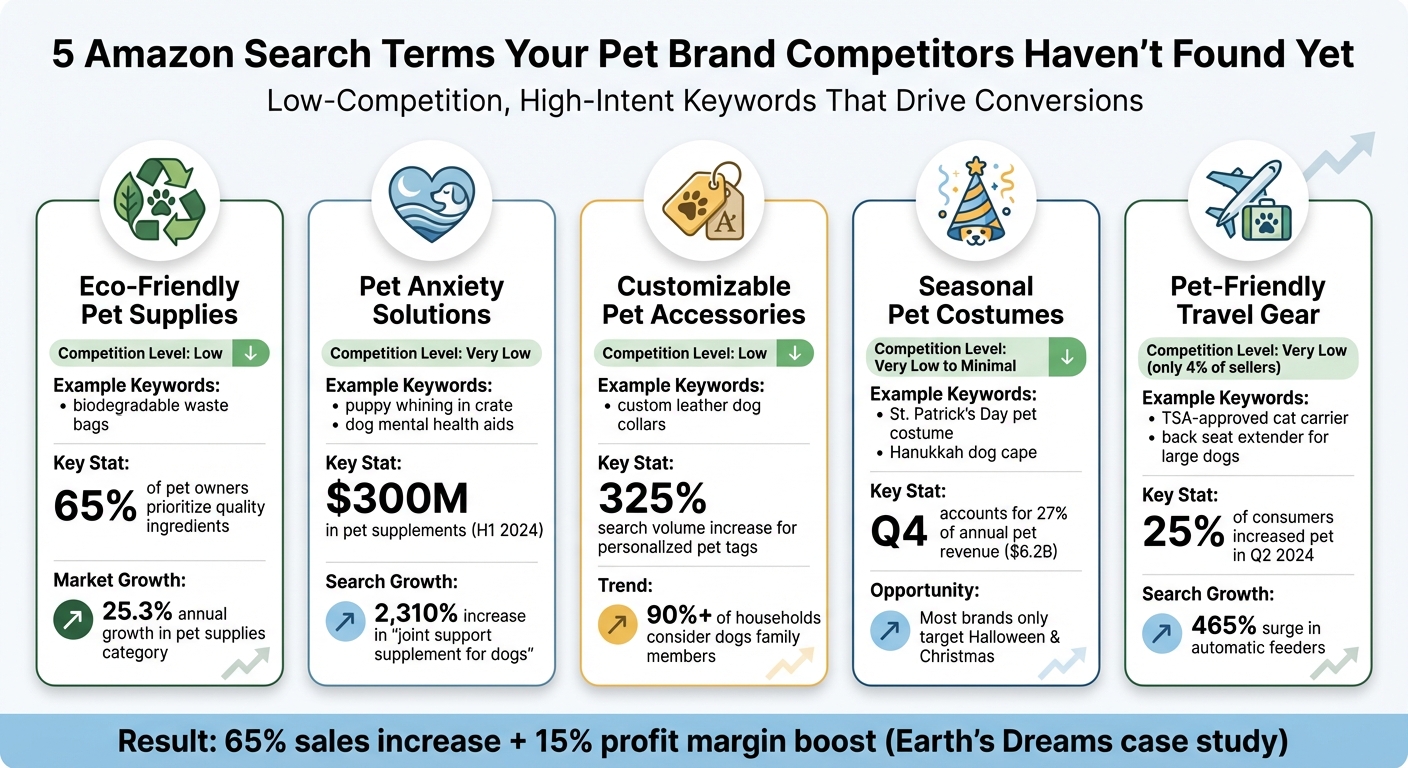
- Eco-Friendly Pet Supplies: Cater to environmentally conscious pet owners searching for sustainable products like "biodegradable waste bags."
- Pet Anxiety Solutions: Address specific needs with terms like "puppy whining in crate" or "dog mental health aids."
- Customizable Pet Accessories: Attract buyers looking for personalized items like "custom leather dog collars."
- Seasonal Pet Costumes: Target niche holidays beyond Halloween and Christmas, such as St. Patrick’s Day or Hanukkah.
- Pet-Friendly Travel Gear: Focus on long-tail keywords like "TSA-approved cat carrier" or "back seat extender for large dogs."
5 Untapped Amazon Pet Product Keywords with Low Competition and High Intent
1. Eco-Friendly Pet Supplies
Low Competition on Amazon
The niche of "eco-friendly pet supplies" is often overlooked by sellers. While keywords like "dog toys" or "pet food" face heavy competition, this specific category remains underexplored by larger, mass-market sellers. This creates a golden opportunity for independent sellers to stand out, as many established brands haven’t fully embraced or optimized eco-friendly offerings. By tapping into this underserved market, sellers can cater to a growing demand among environmentally conscious pet owners.
High Search Intent from Niche Customer Segments
Pet owners looking for eco-friendly products tend to know exactly what they want. They’re on the hunt for non-toxic, environmentally safe items that might be hard to find at their local pet store. With 65% of pet owners prioritizing the quality of ingredients, many are willing to pay higher prices for products that align with their values. Millennials and Gen Z, who make up the largest share of pet owners, are driving this trend. They view their pets as family members and expect products to meet high sustainability standards.
Potential for High Conversion Rates
Search terms like "biodegradable waste bags" often indicate a strong intent to purchase, leading to higher conversion rates. Adding optimized A+ Content that highlights the eco-friendly benefits of products can further boost conversions by 3% to 10%, with some cases even hitting 20%. These advantages align well with the broader shift in consumer preferences toward sustainable options.
Alignment with Emerging Pet Industry Trends
The pet supplies category on Amazon is growing at an impressive 25.3% annually, while global e-commerce for pet care is projected to reach $147.59 billion by 2030. Modern pet owners increasingly see their pets as family and are willing to invest in premium, sustainable products.
"Pet owners don’t just buy products – they invest in their family members".
Sustainability is no longer a trend – it’s becoming the standard expectation for today’s pet parents.
2. Pet Anxiety Solutions
Low Competition on Amazon
Many sellers focus on broad keywords like "dog toys", leaving niche terms like "puppy whining in crate" or "separation anxiety tips" largely untapped. This creates an opportunity for brands to target specific pet anxiety challenges, avoiding the overcrowded general categories that dominate Amazon. By addressing these overlooked needs, sellers can carve out a unique space in the market.
High Search Intent from Niche Customer Segments
Pet owners searching for anxiety solutions are often looking for immediate help. Keywords such as "dog mental health aids" or "how to help your dog deal with separation anxiety" signal that shoppers are ready to buy, not just browse. Products like the Snuggle Puppy, which uses heartbeat technology to comfort pets, demonstrate the power of targeting these high-intent searches. With over 50,000 five-star reviews, it’s clear that meeting these specific needs can lead to massive success. The growing demand for anxiety-related products mirrors the broader evolution of pet wellness.
Alignment with Emerging Pet Industry Trends
The rise in demand for pet anxiety solutions ties into larger shifts in how people care for their pets. The trend of treating pets like family members has reshaped the wellness market. For example, 35% of pet owners now give their pets daily vitamins or supplements, extending the same care to mental health as they do to physical health. In the first half of 2024, pet supplements brought in nearly $300 million, with dog supplements alone accounting for over $250 million of that total. Specific health-related searches are also booming – terms like "joint support supplement for dogs" saw a staggering 2,310% increase in search volume. Even during economic challenges, 25% of consumers spent more on their pets in Q2 2024 than in Q1, showing that pet owners prioritize their animals’ well-being.
"Pet owners don’t just buy products – they invest in their family members." – Owais Ghori, CEO, Amerify
Amazon’s Subscribe & Save program is another key player in this trend, capturing 13% more wallet share when pet owners opt for recurring deliveries of wellness products like calming supplements or anxiety-relief treats. This subscription model not only ensures convenience but also builds long-term customer loyalty.
3. Customizable Pet Accessories
Low Competition on Amazon
When it comes to Amazon, most sellers focus on generic keywords like "dog collar" or "pet accessories." As a result, more niche terms such as "custom leather dog collars" or "personalized pet gear" often go overlooked. This creates a golden opportunity for brands to tap into a less crowded space and gain a competitive edge.
High Search Intent from Niche Customer Segments
Shoppers who search for "customizable pet accessories" are typically ready to make a purchase. They’re not just browsing – they’re looking for products that showcase their pet’s unique personality. Keywords like "custom handmade pet apparel" reflect this intent, and with 65% of pet owners placing quality above price, the demand for premium, personalized items is only growing. This strong intent translates into higher chances of conversion, making this niche especially lucrative.
Potential for High Conversion Rates
Customizable pet accessories tap into what’s often called the "experience economy." Buyers aren’t just purchasing a product – they’re buying something that feels meaningful and personal. This emotional connection leads to better conversion rates, and Amazon’s algorithm tends to favor products that consistently perform well in this regard. For example, search volume for personalized pet tags jumped by an impressive 325% over a recent 90-day period, proving that demand for tailored pet products is on the rise.
"More and more online consumers are participating in the experience economy. They are not just interested in buying a thing, they’re interested in buying the memories that they’ll make with that thing." – Vaso Group
Alignment with Emerging Pet Industry Trends
The growing trend of treating pets as family members is reshaping the pet market. Over 90% of American households now consider their dogs part of the family, fueling the demand for accessories that feel personal and special. Amazon’s pet category is growing at a rate of 25.3% year-over-year, outpacing the platform’s overall growth of 19.9%. Even during times of financial cutbacks, 25% of consumers increased their spending on pets in Q2 2024.
This shift is creating opportunities for emerging brands to challenge established players by offering products that meet specific needs while also allowing for personalization. By focusing on customized search terms, brands can carve out a space in the competitive pet supplies market. The rising interest in personalized pet accessories aligns perfectly with other untapped opportunities on Amazon, making it a smart area for growth.
4. Seasonal Pet Costumes
Low Competition on Amazon
When it comes to pet costumes, most brands stick to the obvious heavy hitters like Halloween and Christmas. But here’s the thing: focusing only on these two holidays leaves a ton of untapped opportunities. While October dominates with a 33.6% year-over-year growth in the pet category, smaller holidays like Mardi Gras, St. Patrick’s Day, Oktoberfest, and Hanukkah are often overlooked. Take a look at a specialized pet costume retailer, for example: Christmas boasts 113 available products, but Hanukkah has just 3, and St. Patrick’s Day only 10. That’s a massive gap for brands willing to explore beyond the usual suspects.
Here’s a quick snapshot of competition levels for some of these niche holidays:
| Holiday | Competition Level |
|---|---|
| St. Patrick’s Day | Very Low |
| 4th of July | Low |
| Oktoberfest | Very Low |
| Hanukkah | Minimal |
The lack of competition during these off-peak times means brands can carve out a space for themselves and connect with shoppers looking for something unique.
High Search Intent from Niche Customer Segments
When someone searches for terms like "Uncle Sam dog hat" or "Hanukkah dog cape", they’re not just browsing – they’re on a mission. These shoppers know exactly what they want and are ready to buy for an upcoming celebration. Michael Waters from Intentwise puts it perfectly:
"Seasonal keywords reach people with high purchase intent".
The key is timing. Start bidding on these niche keywords about a month before the holiday hits. This strategy helps your listing gain traction and organic ranking before the competition – and ad costs – heat up during the peak shopping period. Early positioning captures shoppers while they’re actively comparing options and making decisions.
Tapping into Emerging Pet Industry Trends
The growing trend of treating pets like family extends to holiday celebrations, fueling demand for seasonal costumes year-round. Pet owners now include their furry friends in holiday traditions, creating a steady flow of opportunities beyond just Halloween and Christmas.
Consider this: the fourth quarter alone accounts for 27% of annual pet category revenue – roughly $6.2 billion. And it’s not just about the year-end rush. Events like July’s Prime Day and November’s Black Friday each bring in around $2.1 billion in pet sales. This means there are multiple chances throughout the year to target niche holidays and connect with motivated buyers.
sbb-itb-e2944f4
5. Pet-Friendly Travel Gear
Low Competition on Amazon
Here’s an opportunity you might not expect: only 4% of Amazon sellers list products under the "Luggage & Travel Gear" category, compared to the heavily saturated "Home & Kitchen" space, which claims 35% of sellers. This makes "pet-friendly travel gear" a promising niche with much less competition. Instead of fighting over high-competition keywords like "dog carrier", sellers can focus on long-tail phrases like "pet-friendly travel gear." Even more specific terms, such as "airline-approved dog carrier for Delta" or "back seat extender for large dogs", reveal clear buyer intent. By targeting these niche phrases, brands can attract shoppers without competing with thousands of other listings, paving the way for smarter keyword optimization.
High Search Intent from Niche Customer Segments
Searches like "TSA-approved cat carrier" or "waterproof foldable camping dog mat" signal shoppers who already know what they want. As Bill Nash, CMO of Marketing LTB, explains:
"Shoppers searching long-tail terms already know exactly what they want. They’re not browsing – they’re buying".
These customers are typically in the final stages of their buying journey, ready to make a purchase. By addressing specific pain points – like meeting airline requirements, ensuring car safety, or reducing pet anxiety during travel – sellers can connect with buyers who are primed to convert.
Tapping Into Growing Pet Industry Trends
The rise of pet travel gear ties directly into broader trends in pet spending. With the growing "pet humanization" movement, people are treating their pets more like family, which now extends to travel needs. This shift is driving demand for products ranging from $16.99 sling carriers to $159 multi-functional travel solutions. In Q2 2024, a notable 25% of consumers reported increasing their pet-related spending. Products that combine convenience with technology, like automatic feeders (which saw a 465% surge in search volume), hint at the potential for portable, travel-ready versions to capture consumer interest.
How I Find $100K+ Keywords to Rank #1-14 on Amazon (w/ Search Query Performance Report)
How to Use These Search Terms in Your Listings
Once you’ve pinpointed the right search terms, it’s time to weave them effectively into every part of your listing. Here’s how to do it step by step.
Start with your product title – Amazon’s A9 algorithm gives it top priority. Use a clear structure: Brand, Product Type, Key Feature, Size/Quantity, and Color. For instance, instead of a basic title like "Dog Carrier", aim for something more descriptive: PetBrand Airline-Approved Dog Carrier with Anxiety-Relief Padding Medium 15 lbs Gray. Make sure to place your most important keyword at the very beginning, as mobile devices often cut off titles after the first few words. This strategic approach not only helps your product rank higher but also grabs attention quickly.
Leverage your bullet points (up to 1,000 characters) to showcase key benefits. Start each bullet with a bolded benefit to make them stand out (e.g., Eco-Friendly Material, TSA-Approved Design). Integrate long-tail keywords naturally within these points. For example: Reduces Pet Anxiety: Lavender-infused lining calms nervous dogs during car rides and vet visits. This method reinforces your keyword strategy while highlighting the product’s unique value.
Use the product description (up to 2,000 characters) to tell a story. Instead of just listing features, create relatable scenarios that show how your product solves real problems. For example: "Whether you’re flying cross-country with your anxious cat or camping with your adventure-loving golden retriever, this collapsible travel bowl keeps them hydrated without adding bulk to your luggage." This storytelling approach resonates with customers who are looking for solutions, not just products.
Optimize the backend search terms for maximum reach. Amazon allows 250 bytes for hidden keywords, so use this space wisely. Include synonyms, common misspellings, and alternate names that don’t fit naturally into your main copy. Write these keywords in lowercase, separated by spaces, and skip punctuation. Avoid repeating keywords already used in your title or bullet points. As Growth Jockey explains:
"Amazon’s system automatically ignores duplicated content".
This space is ideal for variations like Spanish translations (e.g., transportador para perros) or abbreviations (e.g., TSA) if "TSA-approved" is already mentioned elsewhere.
Guy Arad, Co-Founder of thefitguy, demonstrated the power of this strategy. By using Amazon Brand Analytics to pinpoint high-performing keywords and aligning his listings accordingly, he achieved a 40% increase in quarterly sales. The takeaway? Treat keyword placement as a deliberate, systematic process where every section of your listing plays a specific role in boosting visibility and conversions.
Conclusion
The five search terms we explored – eco-friendly pet supplies, pet anxiety solutions, customizable pet accessories, seasonal pet costumes, and pet-friendly travel gear – offer a smart way to bypass the crowded, high-volume keywords most sellers chase. These niche terms attract shoppers with specific needs and higher intent to buy, leading to better conversion rates and reduced advertising costs.
And the results speak for themselves. Take the example of Earth’s Dreams, an Amazon seller led by Will. In April 2024, they teamed up with PPC Farm to uncover untapped keywords, which boosted their sales by 65% and increased profit margins by 15%.
But spotting these keywords is just the beginning. The marketplace is constantly evolving – seasonal trends like travel gear in summer or holiday costumes in winter can shift demand. As customer preferences change, new opportunities emerge. Stay ahead by regularly reviewing performance, tracking trends, and updating your listings. Dig into customer reviews to find fresh language, use Amazon’s autocomplete for trending phrases, and rely on Brand Analytics to pinpoint terms that convert. A proactive keyword strategy ensures you remain competitive and continue to grow.
While your competitors are busy chasing obvious, overused keywords, you can stand out by focusing on these overlooked terms. By staying flexible and adapting to market changes, you’ll consistently attract untapped customers – and do so more profitably.
FAQs
How can I find low-competition, high-intent keywords for my pet brand on Amazon?
To find low-competition, high-intent keywords, focus on specific, long-tail phrases that cater to particular needs of pet owners. For instance, instead of using a broad term like "dog bed", try targeting something more precise, such as "orthopedic dog bed for senior dogs." These niche keywords often attract buyers who are closer to making a purchase, resulting in better conversion rates, even if the search volume is relatively modest.
Start by digging into customer reviews and Q&A sections on competitor listings to uncover terms others may have missed. You can also leverage Amazon autocomplete by typing a product-related phrase into the search bar and noting the suggestions that pop up. Additionally, Amazon’s Brand Analytics dashboards, such as the Search Query Performance tool, can help you identify search terms with moderate volume and less competition. If you want to go further, third-party tools like Helium 10 or Sellics are great for spotting keywords with fewer competitors.
Once you’ve gathered potential keywords, prioritize those that show high purchase intent, moderate-to-low search volume, and minimal competition. Incorporate these keywords into your product titles, bullet points, and backend search terms. Make sure to keep an eye on their performance and adjust your strategy as needed.
How can I effectively use these niche keywords in my Amazon product listings?
To make the most of those underused keywords in your Amazon listings, it’s all about placing them where they’ll have the biggest impact:
- Product Title: Start strong by putting your main keyword right at the beginning. This helps improve visibility in search results.
- Bullet Points and Description: Weave in secondary keywords naturally, especially in the first few bullet points and throughout the description. This keeps your content both relevant and easy to read.
- Backend Search Terms: Don’t forget the hidden search-terms field! Add up to five niche phrases (max 250 characters) here, separating them with spaces.
To ensure your keywords are on point, use Amazon’s autocomplete feature to uncover popular variations. Analyzing competitor listings can also help you spot terms they’ve missed. Keep an eye on your performance metrics – like impressions and conversions – and tweak your keywords as needed to stay competitive. By regularly refining your listings, you’ll tap into new customer groups and strengthen your position in the market.
Why should pet brands focus on niche markets like eco-friendly or customizable products?
Focusing on niche markets – like eco-friendly or customizable pet products – can help your brand connect with a deeply engaged audience that bigger competitors often miss. These shoppers are actively looking for distinctive items, which can lead to better visibility, higher conversion rates, and less competition on Amazon.
In the U.S., pet owners increasingly view their pets as part of the family. Many are willing to spend more on products that align with their values, such as items made from sustainable materials or featuring personalized designs. By tailoring your offerings to these preferences, your brand can foster loyalty, justify premium pricing, and build a devoted customer base – all while benefiting from lower advertising costs and steady, long-term sales growth.
Related Blog Posts
- Why 73% of Pet Brands Fail on Amazon Before Year Two (And How to Be the Exception)
- The 3 Listing Mistakes Costing Pet Brands $50K+ in Lost Sales Every Quarter
- The Humanization of Pet Care Is Changing Amazon. Is Your Brand Keeping Up?
- Why the Fastest-Growing Pet Brands on Amazon Are Spending Less on Ads, Not More