

Selling on Amazon internationally can be profitable, but it comes with complex tax challenges. From VAT in the EU to GST in Canada, tax laws vary by region and often depend on where your customers live or where your inventory is stored. Missteps can lead to steep penalties, withheld payments, or even account suspensions. Here’s what you need to know:
- Global Tax Obligations: Many countries now require sellers to pay taxes based on the customer’s location, not the seller’s.
- VAT in the EU: Storing inventory in EU countries or exceeding €10,000 in sales triggers VAT registration. Amazon’s VAT Services can help, but sellers remain responsible for filings.
- GST in Canada: Exceeding CAD 30,000 in sales or using Canadian warehouses requires GST registration. Sellers using Amazon FBA must register under the Regular Regime to recover taxes.
- Tax Nexus: Storing inventory in Amazon fulfillment centers can create tax obligations in multiple regions, even if you don’t sell directly there.
- Penalties: Non-compliance can result in fines, withheld payments, or restricted access to markets. Some countries even block non-compliant sellers online.
To stay compliant, monitor where your inventory is stored, register for taxes before hitting thresholds, and keep detailed records. Proactive compliance ensures smoother global operations and protects your profits.
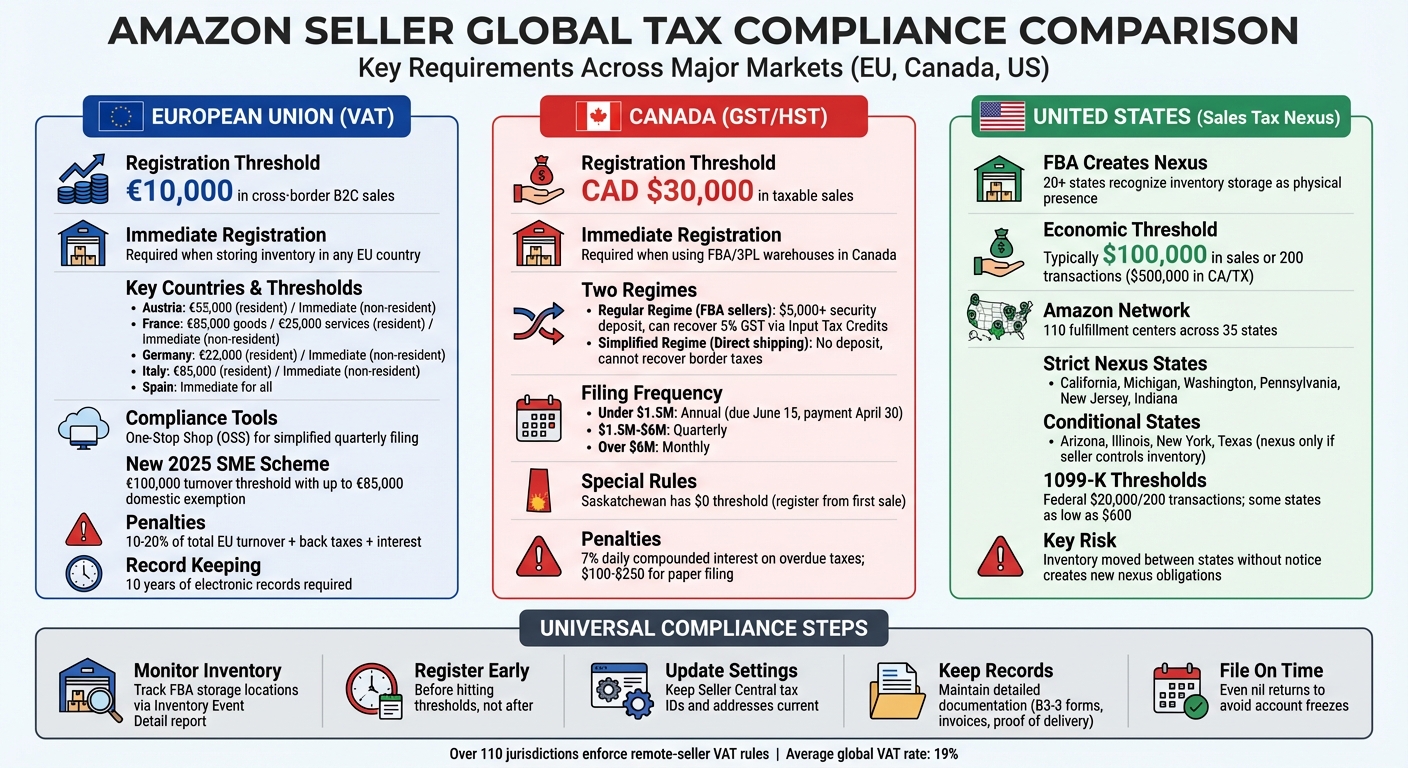
Amazon Seller Tax Compliance Guide: EU VAT vs Canada GST Requirements
How to Use Amazon‘s VAT Services: Simplify Tax Compliance for International Selling!
sbb-itb-e2944f4
VAT Requirements for Amazon Sellers in the EU
The EU follows a destination-based VAT system, meaning taxes are calculated based on where the customer is located. For Amazon sellers, this creates two main triggers for VAT registration: exceeding certain sales thresholds and storing inventory in specific locations.
VAT Registration Thresholds in the EU
As of July 1, 2021, the EU introduced a unified cross-border sales threshold of €10,000 for B2C transactions. If your total EU sales surpass this amount, you must apply the VAT rate of the customer’s country. Before reaching this threshold, you can use your home country’s VAT rate for cross-border sales.
However, storing inventory in another EU country – such as through Pan-European FBA – requires immediate VAT registration in that country, regardless of your sales volume.
To simplify VAT reporting, the One-Stop Shop (OSS) scheme allows sellers exceeding the €10,000 threshold to file a single quarterly VAT return. While OSS makes cross-border VAT reporting easier, it doesn’t replace the need for local VAT registration if you store inventory in other countries.
Starting January 1, 2025, a new Small and Medium Enterprise (SME) scheme will offer relief for smaller businesses. If your total EU turnover remains below €100,000, you may qualify for a domestic exemption threshold of up to €85,000, along with simplified cross-border reporting.
| Member State | Resident Threshold | Non-Resident Threshold |
|---|---|---|
| Austria | €55,000 | No threshold (Immediate) |
| France | €85,000 (Goods) / €25,000 (Services) | No threshold (Immediate) |
| Germany | €22,000 (Previous year) | No threshold (Immediate) |
| Italy | €85,000 | No threshold (Immediate) |
| Poland | PLN 200,000 (approx. €47,000) | No threshold (Immediate) |
| Spain | No threshold (Immediate) | No threshold (Immediate) |
| Sweden | SEK 120,000 (approx. €10,800) | No threshold (Immediate) |
If you store goods in these countries, the non-resident thresholds apply immediately.
These regulations highlight the complexity of VAT compliance for Amazon sellers, particularly those using EU-based fulfillment services.
Amazon’s VAT Services on Behalf (VSOB) Program
To help sellers navigate VAT requirements, Amazon offers the VAT Services on Behalf (VSOB) program. Under this system, Amazon acts as a "deemed supplier" for non-EU sellers and for low-value imports (goods valued at €150 or less shipped from outside the EU). Amazon collects VAT directly from customers and remits it to the appropriate EU tax authorities.
"Amazon will calculate and collect EU VAT from the customer and remit this directly to the respective EU Tax Authorities. Sellers will not receive the EU VAT amount in their disbursements and will not be required to report or remit these VAT amounts to the EU Tax Authorities."
– Amazon
While this service simplifies VAT collection at checkout, it doesn’t eliminate your responsibility to file VAT returns. Accurate VAT calculations rely on proper settings in Seller Central, including assigning the correct Product Tax Codes (PTCs) and specifying accurate ship-from locations. Additionally, you must upload valid VAT registration numbers for every country where you store inventory. Without these, VAT may be charged on Amazon service fees, such as FBA fees and subscriptions.
If you use the OSS scheme, you are required to keep detailed electronic records for 10 years. These records must include information like IP addresses, proof of delivery, and the VAT rates applied to transactions. Failing to maintain proper documentation could result in removal from the OSS scheme, forcing you to register and file VAT in each individual EU country where you operate. This highlights the administrative challenges Amazon sellers face when expanding into EU markets.
Tax Compliance for US Sellers Selling to Canada
Selling to Canadian customers through Amazon comes with tax obligations that many sellers overlook until the Canada Revenue Agency (CRA) steps in. Much like the European Union’s VAT system, sellers need to focus on proper registration and timely filing to avoid penalties. Getting this right not only keeps you compliant but also lets you reclaim the 5% GST paid at the border as an Input Tax Credit (ITC).
GST/HST Thresholds for Canadian Sales
US sellers must register for GST/HST once their taxable sales in Canada exceed $30,000 CAD. This threshold applies either in a single calendar quarter or over the last four consecutive quarters. Importantly, this includes all worldwide taxable supplies, not just sales through Amazon.
If you store inventory in a Canadian warehouse, such as through Amazon FBA, you’re generally considered to be "carrying on business in Canada." This means you must register immediately under the Regular Regime.
When registering, you’ll choose between two regimes:
- Regular Regime: Required for sellers using FBA or third-party logistics (3PL) warehouses in Canada. This regime involves a security deposit starting at $5,000 CAD but allows you to reclaim the 5% GST paid when goods cross the border.
- Simplified Regime: Designed for sellers shipping directly from the US without a physical presence in Canada. While this option doesn’t require a security deposit, you also can’t recover border taxes, making GST a non-recoverable cost.
There’s an exception for Saskatchewan, which enforces a $0 threshold for provincial registration – requiring it from your first sale. Other provinces like British Columbia, Manitoba, and Quebec have their own rules and thresholds, so separate registrations may also be needed.
Once registered, understanding how to file taxes correctly is essential to stay compliant.
Tax Filing Requirements for Cross-Border Sales
After registration, accurate filing ensures you can claim input credits and avoid penalties. While Amazon collects and remits GST/HST, you’re still required to file returns to report these transactions. For those under the Regular Regime, filing is the only way to recover Input Tax Credits for GST paid at the border.
Filing frequency depends on your annual revenue:
- Under $1.5 million CAD: File annually. Returns are due by June 15, with payments required by April 30.
- Between $1.5 million and $6 million CAD: File quarterly.
- Over $6 million CAD: File monthly.
Annual filers can submit Form GST20 to switch to monthly or quarterly filing, which speeds up ITC recovery by up to 15 months.
To claim ITCs and prepare for potential CRA audits, you’ll need the B3-3 Canada Customs Coding Form from your customs broker as proof of tax paid at the border. Without this form, the CRA will deny your claims. For B2B sales under the Simplified Regime, always verify your Canadian customer’s 9-digit Business Number in the CRA GST/HST Registry before exempting them from tax. Charging tax to a B2B client under this regime can result in a 5% to 15% premium they can’t reclaim.
Filing deadlines are strict, with overdue taxes for Q1 2026 carrying a 7% daily compounded interest rate. Filing electronically is mandatory – paper submissions result in a $100 penalty for the first offense and $250 for subsequent ones. Even if you have no sales, file a "Nil return" to avoid non-compliance flags or account freezes.
| Feature | Regular Regime | Simplified Regime |
|---|---|---|
| Requirement | Mandatory if using FBA/3PL in Canada | Direct-to-consumer shipping from US |
| Input Tax Credits | Yes (recover tax paid at border/FBA fees) | No (tax is a permanent cost) |
| Security Deposit | Typically $5,000+ CAD | None required |
| B2B Sales | Charge tax; clients can reclaim it | Charge 0% with valid BN |
| Reporting Currency | CAD only | USD option available |
Tax Nexus from FBA Inventory Placement
How FBA Storage Creates Tax Nexus
Storing inventory in an Amazon fulfillment center creates a physical presence that triggers tax nexus, meaning you’re required to collect and remit sales taxes.
Amazon operates a vast logistics network, with 110 fulfillment centers across 35 U.S. states and 185 facilities worldwide. What complicates things is Amazon’s practice of reallocating inventory without prior notice. For example, your inventory could be moved between fulfillment centers, potentially creating nexus in new states. This process isn’t selective – Amazon might fulfill your orders using identical items from another seller’s stock.
It’s not just traditional fulfillment centers that matter. Goods stored at Crossdock, Sortation, Delivery, or Prime Now hubs may also trigger nexus, depending on how each state defines the use of these facilities. Amazon’s terms make this clear:
"You understand and acknowledge that storing Units at fulfillment centers may create tax nexus for you in any country, state, province, or other localities in which your units are stored."
To monitor where your inventory is stored, download the "Inventory Event Detail" report from Amazon Seller Central. This report includes fulfillment center IDs, which are often tied to nearby airport codes. For instance, "DFW1" represents a center near Dallas-Fort Worth, Texas.
If you’re an international seller, storing inventory in U.S. fulfillment centers creates nexus regardless of federal tax treaties, as these treaties don’t apply to state-level sales taxes. Similarly, in Canada, storing inventory in a fulfillment center is considered "carrying on business", which means you must register for GST/HST under the Regular Regime.
This constant movement of inventory can lead to tax obligations across multiple jurisdictions.
Nexus Triggers Across Major Markets
Each state approaches FBA inventory differently when determining nexus. Over 20 states, including California, Michigan, Washington, Pennsylvania, New Jersey, and Indiana, explicitly recognize that marketplace inventory creates a physical presence nexus – even when Amazon collects sales tax on your behalf. Washington’s Department of Revenue explains:
"The fact that goods owned by the Taxpayer were physically stored in Washington until sale, even briefly via digital reassignment of ownership, is sufficient to establish substantial nexus."
Other states take a more conditional stance. For example, in Arizona, Illinois, New York, and Texas, marketplace inventory doesn’t automatically create nexus if the seller has no control over its movement. In states like Arkansas, North Dakota, and Oklahoma, nexus is only triggered if the seller directly controls where the inventory is stored.
However, there are exceptions. In September 2022, the Pennsylvania Commonwealth Court ruled that FBA inventory does not establish sales tax nexus simply because sellers lose control of their goods once Amazon takes possession. This ruling is one of the few outliers.
| Market | Physical Nexus (Inventory) | Economic Threshold | Marketplace Collection |
|---|---|---|---|
| US (Strict States) | FBA inventory always creates nexus | Typically $100,000 in sales or 200 transactions; $500,000 in CA/TX | Amazon collects in most states |
| US (Conditional States) | No nexus if the seller lacks control and inventory is used solely for marketplace orders | Same as above | Amazon collects |
| Canada | FBA storage equates to physical presence | $30,000 CAD in taxable sales | Sellers must configure tax collection and file returns |
Before registering in every state, consider whether your tax liability justifies the effort. For example, if monthly sales in a state are under $250, the cost of compliance might outweigh the risk of an audit. Larger sellers, on the other hand, often choose to register in all states where Amazon operates fulfillment centers to ensure full compliance from the start.
Tax Enforcement Trends and Penalties
Penalties for Non-Compliance with Tax Obligations
Tax authorities are cracking down harder than ever on non-compliance. For instance, Amazon now shares quarterly tax data of China-based sellers with the State Administration of Taxation (SAT) under State Council Order No. 810. China’s "Golden Tax System Phase IV" takes this a step further by cross-checking platform data with bank records and filings. If sellers fall short, they could face a 25% corporate income tax penalty.
In the EU, failing to register after surpassing distance-selling thresholds can lead to fines ranging from 10% to 20% of your total EU turnover, plus back taxes and interest. France has particularly steep penalties, charging €15,000 for each incorrect or missing e-invoice, while Poland imposes fines that can go up to €50,000.
The immediate consequences can be severe. Sellers may face account suspensions or payment holds on platforms like Amazon if they fail to verify their business address or tax identity. Listing Amazon as the Importer of Record (IOR) incorrectly could result in shipments being refused and returned at the seller’s expense. Some countries, including Egypt, France, Mexico, and Kazakhstan, have even implemented or explored "kill switch" policies, allowing authorities to block internet access for non-compliant remote sellers.
Tax enforcement is also becoming more collaborative. For example, Illinois started sharing U.S. sales data from audited sellers with neighboring states in the Great Lakes region in 2025, effectively acting as an enforcement hub. Additionally, tax authorities are leveraging payment service provider data to flag cross-border sellers receiving over 25 payments per quarter.
How to Stay Compliant with Tax Regulation Changes
With penalties ramping up, staying ahead of tax regulations is more important than ever. Start by keeping your Seller Central settings updated. Regularly check your "Business Address" under Settings > Account Info and review your "Tax Calculation Settings" to ensure sales are accurately tied to the correct tax jurisdictions. Uploading valid VAT, GST, or local tax IDs – like Mexico’s RFC – can help you avoid maximum withholding rates and incorrect VAT charges.
Responding quickly to pre-audit surveys is another crucial step. States like Washington, Massachusetts, and New York are increasingly sending these surveys, and ignoring them can escalate into full-scale audits. As Kelley Birrell, Marketing Manager at LedgerGurus, puts it:
"It’s not the states’ responsibility to prove you’re in compliance – it’s yours".
Failing to respond might lead to requests for up to three years of sales data from unregistered businesses.
Monitoring sales thresholds is also essential. While the federal 1099-K reporting threshold remains at $20,000 and 200 transactions, some states have significantly lowered theirs. For example, Massachusetts, Maryland, Vermont, Virginia, DC, and North Carolina now require reporting for sales over $600. Illinois and New Jersey have set thresholds at $1,000, while Missouri’s threshold is $1,200. Filing late 1099-K forms can result in penalties ranging from $60 to $330 per form, but intentional disregard could cost at least $660 per form or 10% of the reported income, with no cap.
If you’ve fallen short in the past, consider Voluntary Disclosure Programs (VDPs) in places like Saudi Arabia, Singapore, or Nigeria. These programs might offer penalty relief if you act before an audit begins. For sellers in the EU, adopting structured e-invoicing (such as Factur‑X or Peppol) is mandatory for sales to France and Poland by September 2026.
Globally, the push toward mandatory e-invoicing is gaining momentum. Over 60 countries are moving in this direction, driven largely by the EU’s "VAT in the Digital Age" (ViDA) initiative. Matt Hammond, General Manager of E‑Invoicing at Avalara, emphasizes:
"E‑invoicing is no longer a passing trend, it’s a fundamental shift in how global businesses manage compliance".
Currently, more than 110 jurisdictions have adopted remote-seller VAT rules, with the global average VAT rate hovering around 19%.
Conclusion
Global tax compliance isn’t just about meeting regulations – it’s a cornerstone of long-term success for Amazon sellers. Mary Van Leuven, Director of Washington National Tax at KPMG LLP, explains it well:
"Voluntary and timely compliance remains the most cost-effective approach, considering that VAT should be economically borne by the consumer and not the remote seller".
Tax authorities worldwide are stepping up enforcement. With over 110 jurisdictions enforcing remote-seller VAT rules and an average global VAT rate of 19%, sellers face increasing scrutiny. On top of that, tax authorities often have a five-year statute of limitations, giving them plenty of time to investigate past non-compliance.
For sellers working with tight margins, a single tax audit could erase a year’s profits. But compliance isn’t just about avoiding penalties – it safeguards your account, keeps you competitive in key markets, and enables smooth expansion into new regions. These benefits highlight the importance of staying ahead with proactive compliance.
To build on these insights, focus on key steps: track where your FBA inventory is stored, register for VAT before hitting thresholds, automate compliance processes, and seek advice from local experts in complex markets. Whether you’re targeting growth in Japan, the Middle East, or established regions like North America and Europe, treating compliance as a business priority – not an afterthought – can make all the difference between thriving and struggling as an Amazon seller.
FAQs
How can I see which countries or states my FBA inventory is stored in?
To find out where your FBA inventory is stored, head over to Amazon’s FBA inventory reports in Seller Central. These reports give you detailed information about inventory locations, including the specific countries or states where your items are stored. It’s a straightforward way to access this data and stay informed about your inventory’s whereabouts.
When should I use EU OSS vs local VAT registrations?
If your cross-border B2C sales across multiple EU countries stay below the local VAT registration thresholds, you can use the EU OSS (One Stop Shop) system to simplify tax compliance. However, if you’re storing inventory in specific countries or surpassing their VAT thresholds, you’ll need to register for VAT directly in those locations.
Do I need to file returns if Amazon collects VAT/GST for me?
If Amazon handles VAT/GST collection on your behalf, they usually take care of reporting and remitting these taxes as well. This means you likely won’t need to file separate VAT returns. That said, it’s always a good idea to double-check your specific tax obligations based on where your business operates and the rules set by your local tax authority.