

Chewy has mastered the art of connecting with pet owners by prioritizing emotional bonds over transactions. Unlike Amazon‘s focus on price, speed, and scale, Chewy builds loyalty through personalized gestures, empathetic customer service, and tailored subscription models. Key takeaways:
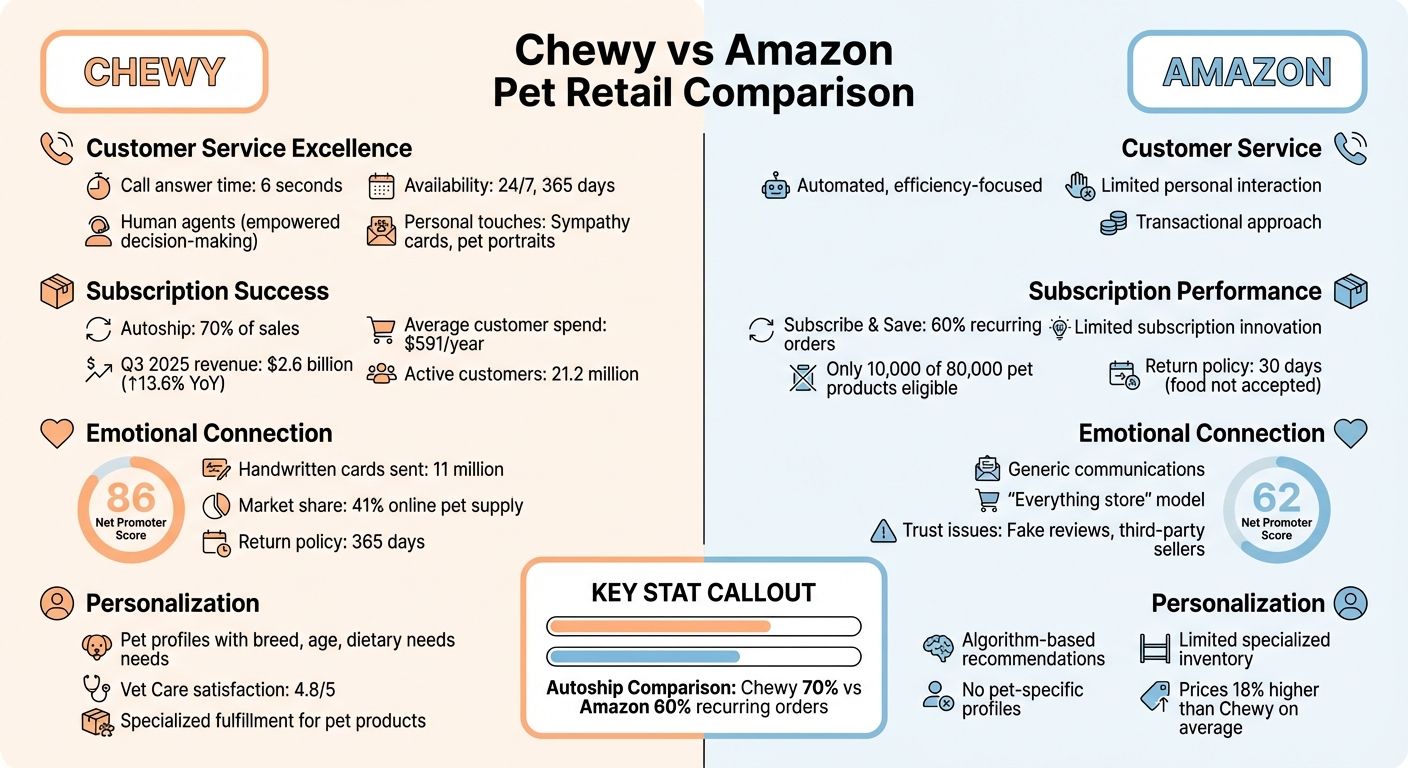
- Customer Service: Calls answered within 6 seconds by empowered human agents. Examples include sympathy cards and pet portraits for grieving customers.
- Subscription Success: Autoship accounts for 70% of sales, with Chewy+ memberships driving higher retention and spending.
- Emotional Touches: 11 million handwritten cards sent annually, personalized communication, and surprise gifts like pet portraits.
- Market Impact: 41% share of the online pet supply market, with an average customer spending $591 per year.
Amazon sellers can learn from Chewy by adding personal touches, improving subscription options, and focusing on customer care to build stronger relationships.
Chewy vs Amazon: Pet Customer Service and Loyalty Comparison
1. Chewy
Customer Service
Chewy’s customer service team is known for its exceptional responsiveness, answering calls within just 6 seconds, 24/7, every day of the year. Importantly, these calls are handled exclusively by human agents, who are empowered to make decisions without waiting for manager approval. This freedom allows them to create unforgettable customer experiences. For instance, in January 2021, a grieving pet owner contacted Chewy to return prescription food after their dog passed away. The agent immediately processed a refund, suggested donating the food to a local shelter, and later sent a handwritten sympathy card along with a hand-painted portrait of the dog. This heartfelt act resonated deeply, going viral on Facebook and sparking widespread organic support for the brand.
"We empower our [customer service representatives] to go above and beyond for our customers… we embrace the opportunity to ‘WOW’ our customers each time." – Chewy IPO Prospectus
Chewy’s “refund and donate” policy is a perfect example of turning a difficult moment into a meaningful connection. When a pet passes away, Chewy often sends flowers or sympathy notes, further solidifying customer loyalty. Kelli Durkin, Chewy’s VP of Customer Service, summed up the company’s philosophy: "When [Cohen] went into the boutique pet shop in Miami, [an employee] would greet him at the door, [they] would smile, [they] would ask about Tylie. And he just knew there was a way to bring that online."
This level of personalized service sets the tone for Chewy’s seamless subscription offerings.
Subscription Models
Chewy’s Autoship program has become a cornerstone of its success, accounting for 83% of net sales and reaching $2.6 billion in Q3 2025 – a 13.6% year-over-year increase. This subscription model ensures that customers receive essential pet supplies on a recurring schedule, creating consistent revenue while encouraging regular shopping habits. Additionally, the Chewy+ membership, priced at $79 per year as of October 2025, encourages customers to shop more frequently and explore a wider range of products.
CEO Sumit Singh explained the impact of these programs: "These are separate programs that essentially compound [net sales per active customer] curves, increase retention, cohort retention, reduce churn, and drive both top line as well as greater efficiency."
With 21.2 million active customers spending an average of $591 annually, Chewy has turned its loyal customer base into subscribers with minimal additional acquisition costs.
Emotional Connection
Chewy goes above and beyond to create emotional bonds with its customers. The company has sent 11 million handwritten cards, including over six million holiday cards, spending around $100,000 on postage alone. Many cards include personal touches like the pet’s name or even birthday wishes. Chewy also surprises customers with hand-painted pet portraits, reinforcing the idea that pets are cherished family members.
Andrew Tseng, an analyst at The Motley Fool, noted: "Chewy is tugging on customer heartstrings with its handwritten cards, paintings, and sympathy flowers, and is almost establishing a personal relationship with the customer that Amazon hasn’t attempted."
This approach has paid off. Chewy now holds an estimated 41% share of the online pet supply market and has donated over $183 million in pet food and supplies to shelters through its "Chewy Gives Back" initiative since 2012.
Personalization
Chewy takes personalization to the next level by using detailed pet profiles to offer tailored product recommendations and reorder reminders. These profiles include information like breed, age, size, and dietary needs. Communication is often personalized, addressing pets by name and providing breed-specific advice, ensuring every customer feels uniquely cared for.
Chewy’s fulfillment network is designed to meet the needs of pet owners, stocking specialized items like 30-pound bags of food and prescription diets that general retailers might not carry. The distribution system is highly efficient, reaching 80% of the U.S. population overnight and nearly 100% within two days. Will Billings, Chewy’s Chief Accounting Officer, highlighted this strategy: "We are attracting high-quality customers and are quickly converting them into Autoship, Chewy+ and health programs, which deepens loyalty and increases lifetime value."
On top of this, Chewy’s Vet Care service offers free tele-triage and boasts a customer satisfaction score of 4.8 out of 5, further strengthening its reputation as a trusted partner in pet health. This personalized approach underscores Chewy’s commitment to treating every pet as a valued member of the family.
2. Amazon Sellers
Customer Service
When it comes to customer service, Amazon sellers prioritize speed and efficiency, but this approach often lacks the personal touch that pet owners value. While Amazon’s infrastructure is well-suited for general merchandise, it doesn’t cater to the emotional connection that comes from small gestures, like handwritten notes. This difference is reflected in the Net Promoter Score: Amazon scores 62, while Chewy reaches an impressive 86. The gap highlights the difference between Amazon’s transactional approach and the emotional engagement Chewy provides.
This transactional mindset also contrasts with Chewy’s subscription-based strategy, which plays a key role in its customer loyalty.
Subscription Models
Amazon’s Subscribe and Save program has remained largely unchanged over the years. As Rick Watson notes:
"There are many elements of Amazon’s consumer site which seem stuck in a 10-year time warp. Subscribe and Save is one of them".
The numbers tell the story. About 60% of dog and cat food orders on Amazon are recurring, while Chewy has pushed that figure to 70% with its Autoship program. One of Amazon’s challenges is its product selection. While the platform offers over 80,000 pet products, only 10,000 are eligible for Subscribe and Save. This limited selection, combined with restrictive return policies – Amazon generally doesn’t accept pet food returns and limits other pet supply returns to 30 days – makes it less appealing compared to Chewy’s generous 365-day return window.
But the challenge for Amazon goes beyond subscriptions. Building emotional loyalty with pet owners remains a hurdle.
Emotional Connection
Amazon’s "everything store" model, while convenient, leaves limited room for specialized pet products. Fulfillment centers prioritize a wide variety of items, which means less space for larger bags of pet food or bulk items that dedicated pet owners often seek. Adding to this, issues like fake reviews and unreliable third-party sellers can damage trust, making it harder for Amazon to build lasting relationships with pet owners.
Personalization
Personalization is another area where Amazon falls short. Unlike Chewy, which thrives on personal interactions, Amazon relies on automated recommendations. These algorithms aim to simplify the shopping experience but often fail to meet the emotional needs of pet owners. For instance, an algorithm can’t replicate the warmth of a customer service representative who remembers your pet’s name or shows genuine empathy during a difficult time.
Adding to these challenges, a survey revealed that Amazon’s pet product prices are, on average, 18% higher than Chewy’s. Without offering the emotional value to justify the higher cost, Amazon is left competing primarily on convenience – a strategy that rarely fosters long-term customer loyalty.
All these factors make it clear why Amazon struggles to create the same level of emotional connection and loyalty with pet owners as Chewy does.
Lessons A Pet Company Teaches Every E-Commerce Business Owner
sbb-itb-e2944f4
Pros and Cons
Chewy and Amazon sellers approach pet owners with vastly different strategies, each with its own strengths and limitations.
Chewy’s standout feature is its ability to forge a deep emotional connection with customers. The company’s impressive Net Promoter Score of 86 far surpasses Amazon’s 62. This loyalty stems from personal touches like handwritten holiday cards and 24/7 customer support, where representatives aim to answer calls within six seconds. However, this level of personalization comes at a price. For instance, during a 46% surge in demand in Q1 2020, Chewy faced $20 million in additional shipping costs as its specialized fulfillment system struggled to keep up.
On the other hand, Amazon sellers thrive in logistics and scalability, offering unparalleled speed and convenience. But this comes at the expense of specialization. Chewy’s infrastructure allows it to stock bulky items, such as 30-pound bags of dog food, while Amazon’s fulfillment centers often lack the space for such niche products. Rick Watson, CEO of RMW Commerce Consulting, highlights one of Amazon’s challenges:
"There are many elements of Amazon’s consumer site which seem stuck in a 10-year time warp. Subscribe and Save is one of them".
The subscription services of both companies also reflect their differing approaches. Chewy’s Autoship program generates 70% of its sales by providing a seamless, pet-focused experience. Meanwhile, about 60% of Amazon’s pet food orders are recurring, though they lack the same tailored touch.
Conclusion
Chewy has redefined the customer experience by shifting the focus from simple transactions to genuine emotional connections. With an impressive Net Promoter Score of 86, it’s clear that their approach – centered on personalized gestures and empathy-driven policies – resonates deeply with pet owners, making them feel truly valued.
For Amazon sellers, there’s a lot to learn from Chewy’s playbook. Start by customizing post-purchase messages with details like pet names or specific needs instead of sticking to generic templates. Train customer support teams to go the extra mile with thoughtful touches – such as sending a sympathy card during tough times. Additionally, consider flexible subscription models that simplify decision-making while still giving customers control. These strategies provide a roadmap for enhancing subscription services.
Large platforms often struggle to achieve this level of deep personalization. As Andrew Tseng from The Motley Fool aptly puts it:
"Chewy is winning over more and more pet owners by making the relationship more emotional and less transactional".
This is where specialized services shine. Companies like Emplicit help bridge the personalization gap by enhancing customer engagement, streamlining post-purchase processes, and leveraging data insights – empowering sellers to compete on care and connection, not just on price.
FAQs
How does Chewy build emotional connections with pet owners through customer service?
Chewy’s customer service goes far beyond simple transactions, focusing on building genuine emotional connections with pet owners. Their team is known for thoughtful gestures like sending handwritten bereavement cards, custom pet portraits, or even flowers when a beloved pet passes away. These heartfelt actions honor the special bond between pets and their families, leaving customers feeling appreciated and understood.
The team at Chewy is also trained to actively listen and pick up on personal details, such as a pet’s birthday or other milestones. They often surprise customers with meaningful gifts or messages, like holiday cards or even suggestions to donate unused pet food to shelters. These personalized touches turn everyday interactions into unforgettable moments, earning the trust and loyalty of their customers. Chewy has positioned itself as more than just a retailer – it’s a compassionate partner in the lives of pet owners.
Why is Chewy’s subscription model so effective for pet owners compared to Amazon’s?
Chewy’s Autoship program is more than just a "subscribe-and-save" deal – it’s a service crafted with pet owners in mind. It lets customers set up automatic deliveries for the exact products their pets need, combining convenience with savings through exclusive discounts. This approach clearly works, as recurring orders make up about 70% of Chewy’s sales, highlighting its success in fostering customer loyalty.
What really makes Chewy stand out is its personalized approach. Customers can create profiles for their pets, which allows Chewy to offer tailored product recommendations and services. Beyond that, the company goes the extra mile with thoughtful touches like handwritten notes, surprise gifts, and even sending condolences when a pet passes away. These small yet meaningful gestures transform routine transactions into heartfelt connections, inspiring long-term loyalty and enthusiastic word-of-mouth referrals.
Unlike one-size-fits-all subscription services, Chewy’s Autoship program is built specifically for pet parents. This specialized focus leads to stronger engagement and customer retention, making it a more impactful option compared to broader, less tailored programs offered by larger retailers.
Why is personalization so crucial for pet supply retailers like Chewy?
Personalization is at the heart of Chewy’s success, transforming routine transactions into genuine, relationship-focused interactions. By offering tailored product recommendations, customizing autoship schedules, and even sending heartfelt handwritten notes, Chewy creates a bond with pet owners that feels personal and meaningful. This connection builds trust and emotional loyalty, making customers more likely to stick around.
These small but impactful gestures also encourage higher spending. Pet parents are more inclined to consolidate their shopping with a retailer that seems to truly "get" them. In a crowded market where competitors often prioritize price and speed, Chewy’s focus on personalization not only sets it apart but also minimizes customer churn and turns satisfied shoppers into passionate advocates for the brand.