

Localization can make or break your global ecommerce success. Simply translating your website isn’t enough. To succeed, you need to tailor the entire shopping experience for each market – currency, payment methods, product descriptions, and even cultural expectations.
Here’s why it matters:
- 70% of consumers prefer websites in their native language.
- 40% avoid non-localized content.
- Showing prices in local currency can boost conversions by 24%.
Scaling localization is tough but achievable with the right tools and strategies. This guide breaks down how to:
- Identify high-potential markets using data like demand signals and regulations.
- Adjust content, visuals, and messaging to resonate with local audiences.
- Set up technical infrastructure (like multi-language support and tax compliance) for seamless scaling.
- Test thoroughly to avoid costly mistakes and ensure a smooth user experience.
Done right, localization helps businesses enter multiple countries quickly without overwhelming resources. Whether you’re launching in your first international market or expanding further, this checklist ensures a scalable, low-risk approach.
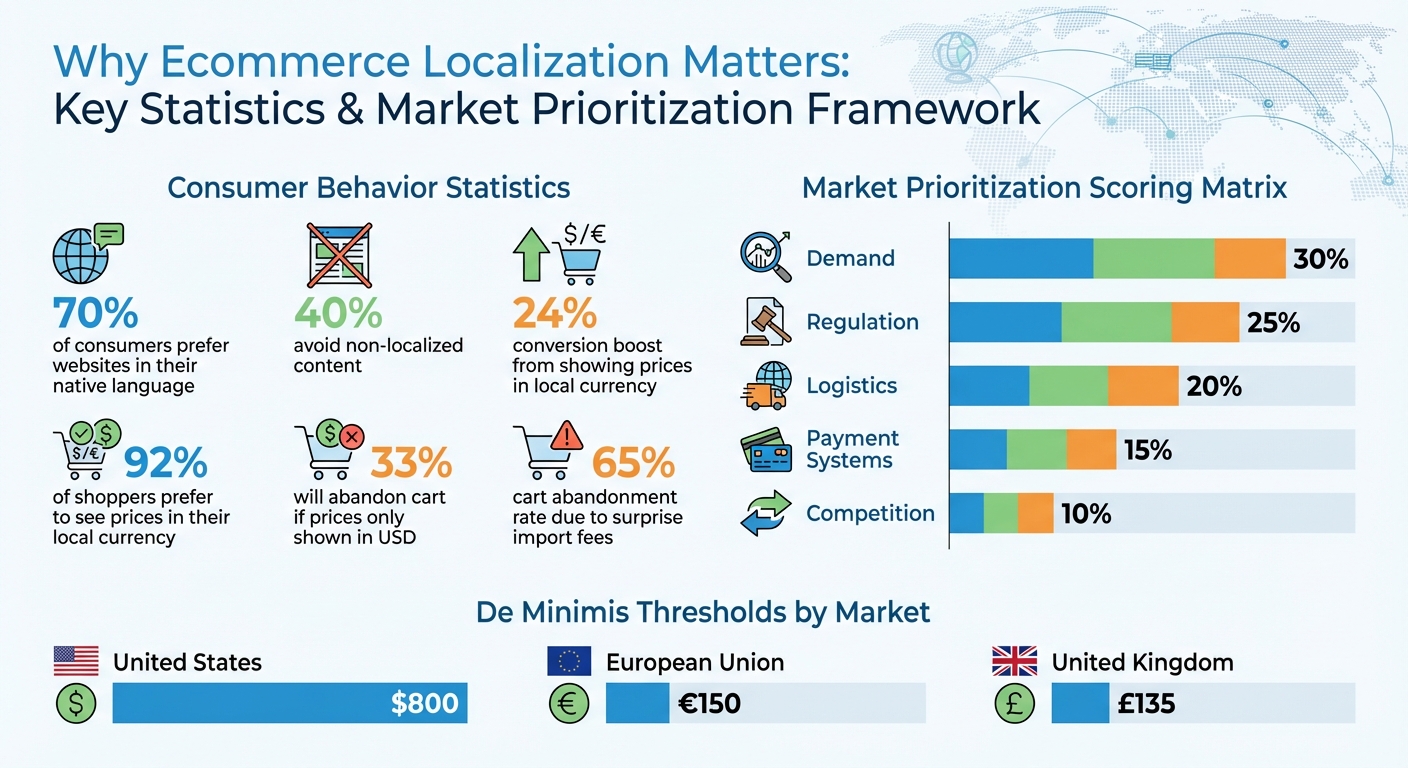
Ecommerce Localization Statistics and Market Prioritization Framework
How to Localise Your eCommerce Site: Step-by-Step Guide to Boost Global Sales
sbb-itb-e2944f4
Pre-Localization Planning
Before diving into localization, it’s crucial to have a solid plan in place. This will save you from wasting resources and help you avoid compliance headaches.
Identify Target Markets and Goals
Start by analyzing existing demand signals. Tools like Google Analytics can show you which countries are already visiting your site organically. Similarly, check your social media demographics to see where your followers are based, and review sales data for international orders – even if you haven’t actively pursued those markets yet.
Consider using a weighted scoring matrix to prioritize markets:
- 30% demand
- 25% regulation
- 20% logistics
- 15% payment systems
- 10% competition
This method helps you focus on markets with the best balance of opportunity and accessibility, rather than just chasing the largest audience.
Next, research the "de minimis" threshold for each market. This is the maximum value of goods that can enter a country without customs duties. For instance, the U.S. has a threshold of $800, while it’s €150 in the EU and £135 in the UK. If your products typically exceed these limits, you might want to explore local warehousing or Delivered Duties Paid (DDP) shipping. Why? Because surprise import fees lead to a staggering 65% cart abandonment rate.
"Companies try to replicate a successful model from one country into another without taking into account any of the legal stipulations that come with it. It can lead to major problems down the line."
– Daniel Chabert, CEO and Co-founder, Purple Fire
Localization also means aligning with local search engines and payment preferences. For example, Baidu dominates in China, Yandex in Russia, and Naver in South Korea. Payment methods vary too – iDEAL accounts for 57% of transactions in the Netherlands, while Brazil leans heavily on Pix.
Once you’ve identified your target markets, decide which parts of your brand should stay consistent and which need to adapt to local preferences.
Develop a Localization Strategy
Not everything about your brand should change when entering a new market. Elements like your core values, brand voice, and product quality should remain consistent. However, messaging, imagery, and even product positioning may need adjustments to connect with local audiences.
"Our biggest learning is that you can’t just copy-paste the same message everywhere and expect it to resonate."
– Fiona Parfrey, Cofounder, Riley
Take a phased approach to localization:
- Test demand with local ads and marketplace experiments.
- Move to full localization with professional translations and compliance adjustments.
- Scale your efforts using a repeatable playbook.
Before expanding, ensure your domestic operations are running smoothly. Aim for a 90%+ "Ideal Order Ratio", where at least 90% of orders are accurate, delivered on time, and meet customer satisfaction standards. Any inefficiencies at home will only become bigger challenges when scaling internationally.
Conduct Market-Specific Keyword Research
Translation alone isn’t enough for effective localization. For example, what Americans call "sneakers" might be "trainers" in the UK, "zapatillas" in Spain, or "tenis" in Mexico. Each term has its own search volume and user intent.
To get it right, immerse yourself in local communities. Dive into subreddits, forums, and social media to understand the language and terms your audience uses. While tools like SEMrush and Ahrefs are helpful, region-specific tools like Baidu Keyword Planner (China) or Yandex Wordstat (Russia) can provide deeper insights.
Organize your keywords into clusters based on themes and intent, rather than focusing on single terms. This approach helps you cover broader topics and capture more relevant traffic. Don’t forget to consider local trends and seasonal differences. For instance, Singles’ Day on November 11 is huge in China, while Boxing Day sales dominate the UK. And if you sell winter coats, remember that January is summer in Australia.
Looking ahead, search engines and AI platforms like Google SGE and ChatGPT are focusing more on semantic relevance than exact keyword matches. To stay ahead, structure your content to explain the "why" and "how", not just the "what", and emphasize the relationships between concepts. This will help your content align with evolving search priorities.
Content and Messaging Adaptation
Once you’ve pinpointed your target markets and completed keyword research, the next step is adapting your content. This involves transcreation, which means reshaping tone, message, and intent to align with the local culture. A tagline that resonates in the U.S. might fall flat – or even offend – in another region.
Localize Product Descriptions and Marketing Copy
Product descriptions need to reflect local shopping behaviors. This includes converting measurements (like inches to centimeters) and adjusting size charts to match regional standards, such as U.S. sizes to EU equivalents. Technical details should also meet local expectations.
Marketing copy requires a careful touch. Humor, metaphors, and emotional hooks don’t always translate the same way across cultures. For example, what feels confident in one culture could come off as arrogant in another.
"When you get to countries like France, you’re missing 60% of overall shoppers [if you don’t localize content]."
– Sean Frank, CEO, Ridge
Adapting content goes beyond just translating words. The tone, structure, and even the format should align with local preferences. Visual elements, too, must reflect cultural nuances.
Adapt Visuals and Trust Signals
Visuals are just as important as words when it comes to localization. Images and design choices carry cultural meaning. For instance, white is associated with purity in Western cultures but signifies mourning in some parts of Asia. Similarly, purple may symbolize wealth in the Middle East. Avoid generic stock photos and instead use visuals that feature local models, settings, and scenarios that feel relatable to your audience.
Icons and symbols also require attention. Gestures like a thumbs-up, positive in some cultures, can be offensive in others. For right-to-left languages like Arabic or Hebrew, the entire user interface (UI) should be mirrored, including navigation, buttons, and text flow.
Trust signals play a huge role in building buyer confidence. Display payment methods familiar to the region (like iDEAL in the Netherlands or Pix in Brazil), show prices in the local currency – this alone can boost conversions by 24% – and include local contact details, such as phone numbers and address formats.
"The number of product reviews published by your customers in their local language can also help to boost the amount of confidence that purchasers have in your site’s products."
– Dan Lee, Head of Marketing, Sealions
Once your content and visuals are fully adapted, it’s crucial to address legal and regulatory requirements.
Ensure Compliance with Regional Regulations
Tailoring your content and visuals is only part of the equation. Ensuring compliance with local laws is essential for long-term success. Start with a compliance audit to cover privacy rules, cookie policies, consumer rights, invoicing, and returns. Legal requirements vary by region: the EU enforces GDPR, a 14-day right of withdrawal, and a minimum 2-year warranty. California has CCPA for data privacy, Brazil implements LGPD, and China enforces strict data localization laws through its Cybersecurity Law.
Tax compliance is another key area. Register for the necessary tax systems, such as the EU’s One Stop Shop (OSS), which simplifies VAT registration across all 27 EU markets. Offering Delivered Duties Paid (DDP) shipping can also help reduce cart abandonment, as unexpected fees at checkout account for 65% of abandoned carts.
For essential legal documents like privacy policies, terms of service, and return policies, enlist native legal experts to ensure translations are accurate and compliant. Mistakes in these areas can lead to fines or even a store shutdown.
"Selling to EU consumers without VAT registration exposes you to significant fines and potential store shutdowns."
– Digital Applied
Technical Implementation for Localization
With your content tailored and compliance accounted for, the technical setup becomes the backbone of successful localization. A well-planned infrastructure can save both time and money while ensuring a smooth scaling process.
Choose the Right Domain Structure
Your domain structure plays a critical role in SEO and operational efficiency. For most ecommerce businesses, subdirectories (e.g., example.com/fr/) are the ideal choice. They centralize link authority under a single domain, meaning any backlink to a regional site benefits the entire website. One brand using subdirectories saw a 100% increase in organic traffic and a 30% boost in conversion rates.
On the other hand, country-code domains (ccTLDs) like example.de provide strong local trust signals but come with higher costs and require building SEO authority for each market from scratch. Subdomains (e.g., fr.example.com) fall between these two options but can dilute your main domain’s authority since Google treats them as semi-independent sites.
"Local domain names tend to do better because Google Search promotes content local to the user."
– John Mueller, Search Advocate, Google
To ensure search engines display the correct language version, implement reciprocal hreflang tags. Automating this process through your CMS or localization platform is highly recommended – manually adding tags often leads to errors, with 75% of international websites experiencing issues when done by hand. Don’t forget to include an x-default tag to handle users from markets you’re not explicitly targeting.
By carefully selecting your domain structure and optimizing hreflang implementation, you lay the groundwork for seamless multi-language and multi-currency support.
Enable Multi-Language and Multi-Currency Support
Did you know that 92% of shoppers prefer to see prices in their local currency, and 33% will abandon their cart if prices are only shown in U.S. dollars? Displayed prices must match the charged amounts to avoid losing customers at checkout.
For instance, in 2025, fashion retailer Fairfax & Favor adopted Shopify Payments’ Multi-Currency Payouts. This automated solution handled currency conversions and uploaded international price books, saving the company over $1 million annually in operations and an additional $50,000 yearly by cutting manual workloads. Similarly, Orlebar Brown, a luxury brand, saw a 66% increase in basket-to-checkout conversions after integrating a payment gateway that managed global currencies and taxes seamlessly.
To enhance usability, implement geo-IP detection to suggest the appropriate language and currency version. However, always provide a manual selector to avoid frustrating users, especially travelers or those with specific preferences. Display language names in their native script (e.g., "Deutsch" instead of "German") and avoid using flags, as they often oversimplify regional identities.
Optimize Layouts for Localization
Once language and currency are handled, it’s time to focus on layout adaptability. Text length and script direction can vary widely across languages. For example, German text tends to be 30% to 35% longer than English, while some Asian languages expand vertically. To accommodate these variations:
- Use flexible layout systems like Flexbox or CSS Grid.
- Implement CSS logical properties to handle right-to-left (RTL) layouts.
- Set a minimum width for buttons rather than fixed dimensions.
- Mirror the interface for RTL languages, ensuring usability.
Ensure your site supports all character sets by using UTF-8 encoding (<meta charset="UTF-8">). For dynamic formatting of dates, numbers, and currencies, leverage the JavaScript Intl API. Additionally, externalize all UI strings into resource files (e.g., JSON or YAML). This approach allows you to update translations without modifying the underlying code.
Testing and Quality Assurance
Just setting up the technical framework isn’t enough – rigorous testing is essential to ensure your localized site performs well in every market. Even small mistakes can erode trust and hurt conversions. Take Amazon’s Swedish marketplace launch in October 2020 as an example. Mistranslated product names, culturally inappropriate terms, and even the wrong national flag led to widespread social media backlash and forced the company to issue a quick public response.
Once the technical localization is in place, thorough testing is key to delivering a smooth user experience across all regions.
Test Conversion Paths
Step through the customer journey in each localized version of your site. Make sure all interactive features – like forms, language switchers, and geolocation redirects – work as intended. Double-check that local formats for ZIP codes, phone numbers, and addresses are correct. Also, ensure error messages, call-to-action buttons, and transactional emails are properly translated and make sense in their context.
For languages like German and Finnish, where text expansion can occur, verify that the design accommodates longer strings without cutting off text or causing layout issues. In right-to-left (RTL) languages like Arabic or Hebrew, confirm that the interface is fully mirrored, including navigation, form alignment, and button placement. And, of course, check that currencies are displayed correctly – for instance, $1,000.00 in the U.S. should appear as €1.000,00 in Germany. Once these functional tests are complete, move on to linguistic, visual, and technical quality checks.
Run Localization QA Checks
Verify that grammar, spelling, and terminology match your glossaries and style guides, and ensure the tone is appropriate for each market. Make sure there are no untranslated strings left behind. Test interactive elements on multiple devices to catch any compatibility issues.
Leverage pseudo-localization early in the process. Replace source text with expanded, accented characters (30%-40% longer) to identify hardcoded strings or layout problems.
"A translation can be perfectly accurate and still produce a broken UI".
Conduct live or staging reviews of localized elements to spot visual or contextual errors that automated tools might miss.
Automate Quality Assurance Processes
Scaling testing across several markets is much easier with automation. Build automated QA checks into your CI/CD pipeline to catch errors before they make it to production. Use tools to validate JSON/YAML syntax and placeholder usage, and rely on specialized software to ensure glossary and terminology compliance. For visual regression testing, tools like Playwright or Applitools Eyes can compare screenshots across locales to detect layout shifts or text overflows.
To maximize efficiency, run tests in parallel across different browser and operating system combinations using cloud-based Selenium Grid services. This allows you to test across more than 20 languages simultaneously. Automated checks can also confirm that number formats, date conventions, and currency displays are correct – for example, making sure $1,000.00 in U.S. format appears as 1.000,00 in European locales.
"Automated quality assurance checks act as a first line of defense, catching common issues before human review".
Post-Launch Monitoring and Scaling
Launching your localized site is just the beginning. To succeed, you’ll need to keep a close eye on performance, fine-tune strategies that work, and expand thoughtfully.
Monitor Key Performance Metrics
Use tools like GA4 to break down analytics by region and language. This helps you compare how localized pages perform against your main site. Keep an eye on conversion rates in each market to see if your localization efforts are boosting sales. Watch cart abandonment rates too – globally, these are around 70%, often due to issues like missing local payment options or unexpected shipping costs. If you notice high bounce rates or short session durations, it could mean your content isn’t connecting with users, whether because of language issues or a lack of cultural alignment.
Make sure your hreflang tags are working properly to send users to the right language version of your site. Also, check customer support tickets by language – these can highlight areas where your localized content might be unclear or confusing.
Use all this data to fine-tune your ad strategies and improve the user experience.
Optimize Listings and PPC Campaigns
Review search term reports for each market to weed out irrelevant keywords that waste your ad spend. Check your campaign structures, ad copy, and budgets – surprisingly, 72% of companies haven’t reviewed their ad campaigns in over a month, which can lead to unnecessary losses. Ensure your localized ads match the content on their landing pages. For example, if your ad mentions "cloud backup software", make sure that exact phrase appears on the landing page.
Run A/B tests on localized ad elements like language, visuals, and offers to see what resonates with each audience. Don’t forget to audit your Merchant Center feeds to confirm that shipping settings and currencies align with your website. Displaying total landed costs upfront is key to avoiding surprises at checkout.
Once your campaigns are running smoothly, you’ll be ready to scale your efforts.
Plan Iterative Market Expansions
Use the insights from your performance data and refined ad strategies to expand into new markets methodically. Start small – validate demand with a low-budget test before fully localizing content and ensuring compliance. Once demand is confirmed, scale your marketing efforts, streamline fulfillment processes, and create a repeatable playbook to simplify future expansions.
Google Search Console can help you identify untapped demand by filtering organic impressions by country. Use a pre-tested scoring matrix to decide which markets to prioritize next. In your second year, consider investing in tools like multi-currency ERPs and international 3PL networks to reduce entry costs. Automating tax compliance with tools like TaxJar or Avalara will also save time and effort as you grow.
For brands juggling multiple platforms like Amazon, Walmart, or TikTok Shops, Emplicit provides tailored support. From PPC optimization to listing management, their USA-based account managers help streamline market expansion, making it easier to replicate success without starting from scratch each time.
Conclusion
Expanding into international ecommerce isn’t just about translating your website; it’s about creating a localization strategy that views each market as its own business. This means tailoring content, ensuring tax compliance, offering payment methods suited to the region, and crafting messaging that resonates locally. When done right, this approach simplifies market launches and lays the groundwork for sustainable growth.
Successful global brands take a calculated approach. They confirm demand before committing significant resources, automate compliance processes to prevent operational hiccups, and use insights from early markets to refine their strategies for future expansions. Take Australian retailer Petal & Pup as an example: by customizing content for New Zealand, the UAE, and Canada, they grew international sales to account for 20% of total revenue. This shows how localization can directly impact ROI.
"Cross-border eCommerce success in 2026 comes down to treating each international market as its own business unit – with dedicated localization, compliant tax infrastructure, optimized logistics, and market-appropriate marketing." – Digital Applied
With global ecommerce predicted to reach $7.9 trillion by 2027, the opportunity is immense – but so are the challenges. The brands that scale profitably are those that invest in the right infrastructure. Using subdirectories to strengthen domain authority, offering DDP shipping to avoid unexpected fees, and leveraging AI for scalable content creation (while keeping human oversight for critical areas) are key steps to staying competitive.
For brands managing multiple sales channels, working with a seasoned localization partner like Emplicit can make all the difference. Emplicit provides services like PPC optimization, listing management, and account health monitoring across platforms such as Amazon, Walmart, and TikTok Shops. This allows you to apply proven strategies to new markets without starting from scratch. By following these principles, you can position your brand for lasting success in the global ecommerce arena.
FAQs
Which countries should I localize for first?
Focus on markets where demand is strong, growth potential is evident, and entry barriers are reasonable. Look for countries that show clear signs of consumer interest, have simple and transparent regulations, and offer dependable logistics systems. These factors are key to building a scalable and successful international ecommerce operation.
How can I avoid surprise duties and taxes at checkout?
To prevent unexpected duties and taxes from catching customers off guard, consider using Delivered Duties Paid (DDP) shipping. With DDP, customs duties are collected upfront during checkout, so shoppers know the total cost, including import taxes. This approach not only enhances transparency but also helps reduce cart abandonment.
Displaying prices in local currency and providing local payment options can further build trust with international customers. These small adjustments make the shopping experience more seamless and reliable.
For businesses shipping to the EU, compliance programs like the One-Stop Shop (OSS) can simplify VAT and customs processes, making international transactions smoother for both you and your customers.
What’s the best URL structure for multilingual ecommerce SEO?
A well-organized URL structure is key to optimizing multilingual ecommerce sites. Using a clear hierarchy that incorporates language or region codes makes a big difference. For instance, formats like example.com/en/ or example.com/us/ allow both search engines and users to quickly recognize and navigate localized content. This approach improves indexing, boosts visibility, and enhances the browsing experience for users across various markets.