
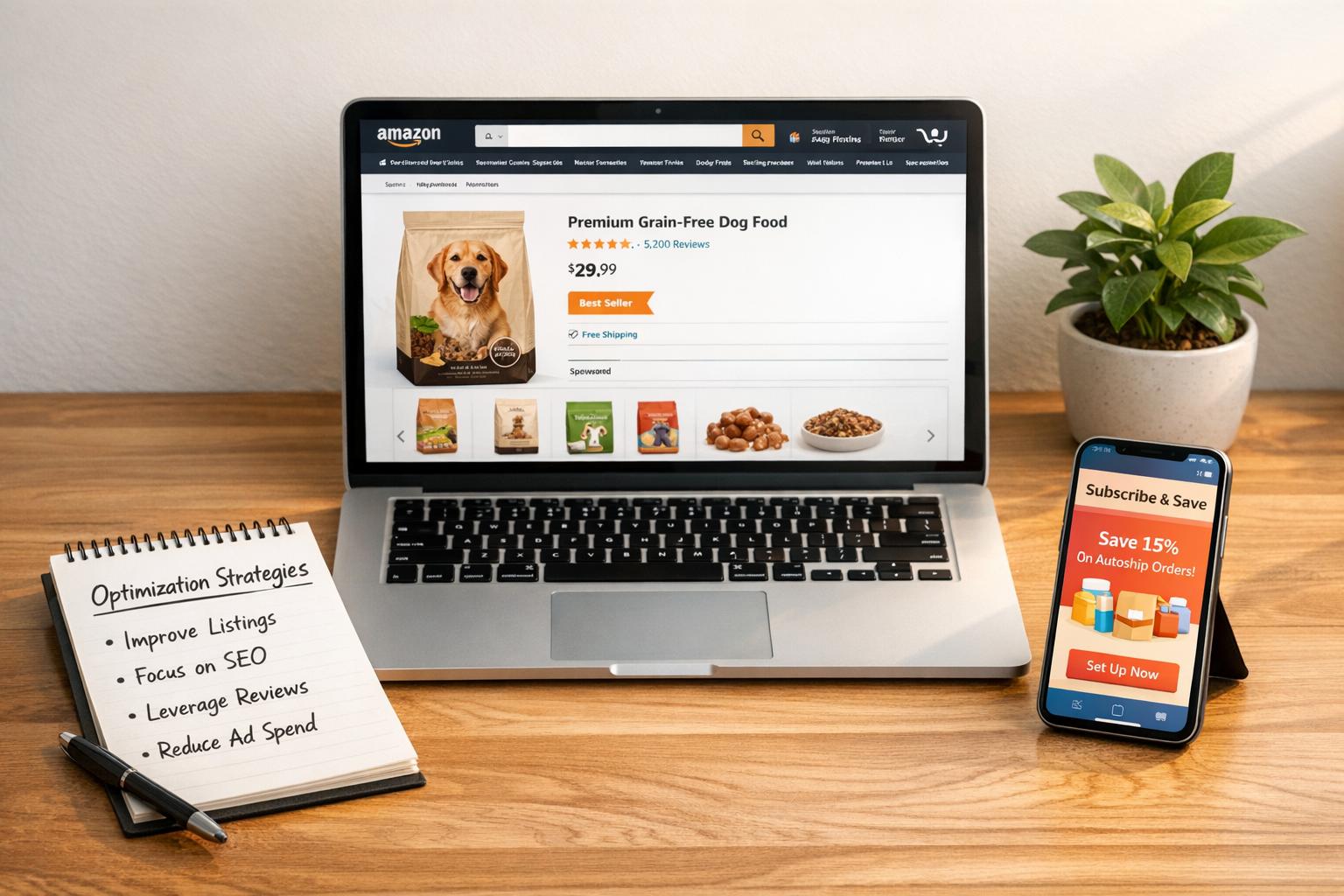
Pet brands on Amazon are cutting ad budgets due to skyrocketing costs and shrinking returns. With average cost-per-click (CPC) exceeding $3.50 and peak season spikes of 20%-50%, many brands find that ads often cannibalize organic sales. Instead, they’re focusing on strategies like:
- Boosting organic visibility: Optimizing product titles, backend keywords, and long-tail search terms.
- Improving listings: Using high-quality images, mobile-first designs, and A+ Content to increase conversions.
- Building loyalty: Leveraging programs like Subscribe & Save, reviews, and customer retention initiatives.
This shift helps brands grow profitably by reducing reliance on paid ads while driving sustainable sales through smarter methods.
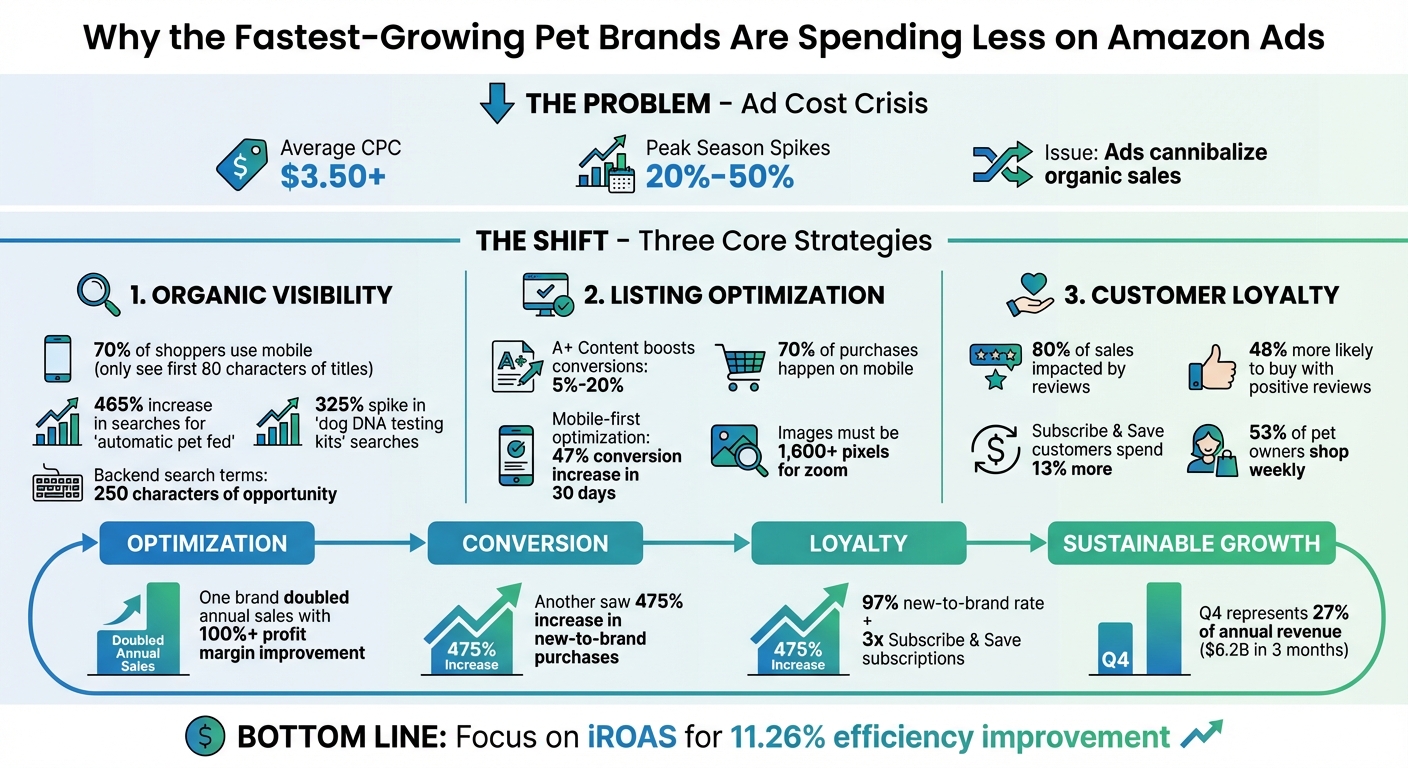
Why Pet Brands Are Reducing Amazon Ad Spend: Key Statistics and Strategies
Using Organic Search to Drive Traffic Without Ads
Keyword Optimization for Product Listings
Top-performing pet brands approach keyword optimization with precision. They focus on placing high-intent keywords within the first 80 characters of their product titles. Why? Because 70% of mobile shoppers – and most Amazon purchases now happen on mobile – only see those initial characters before titles get cut off. A truncated title can mean lost visibility and fewer clicks. Beyond titles, brands should also leverage backend search terms to expand their keyword reach.
The backend search term field offers 250 characters of opportunity, yet many brands fail to use it effectively. This space is perfect for synonyms, abbreviations, and common misspellings. But here’s the catch: don’t repeat keywords already in your titles or bullet points. Amazon ignores duplicates, so reusing them wastes valuable space. For instance, if you’re selling automatic pet feeders, your backend terms could include variations like "auto dog feeder", "timed cat feeder", or "programmable pet bowl."
Another winning strategy is targeting long-tail keywords – phrases like "grain-free salmon dog food for sensitive stomachs." These terms capture highly specific shopper intent, which often leads to better conversions. Consider this: searches for "automatic pet feeders" shot up 465%, and "dog DNA testing kits" spiked 325% in just 90 days. Spotting these trends early can give your brand a serious edge.
Using Amazon Brand Analytics for Data
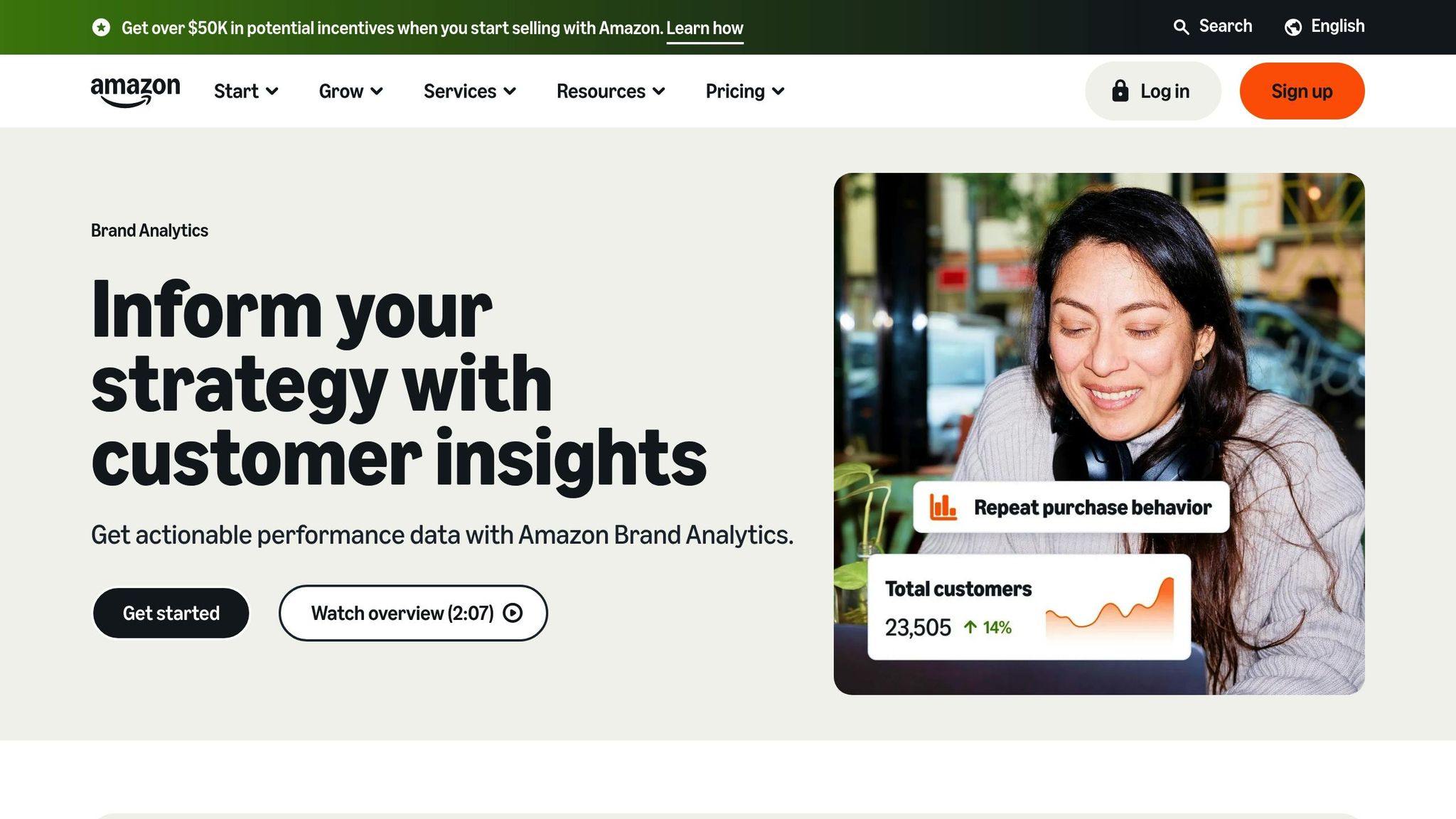
Brands enrolled in Amazon’s Brand Registry gain access to Amazon Brand Analytics, a treasure trove of free, actionable data. The fastest-growing pet brands rely heavily on this tool. For example, the Search Query Performance dashboard reveals which keywords are driving traffic to your listings and how your performance stacks up against competitors. Meanwhile, the Top Search Terms dashboard highlights the most-searched keywords across Amazon and shows the top three clicked products for each term.
"Quarterly sales jumped over 40% after optimizing for best search terms using the Amazon Brand Analytics Search Terms and Search Query Performance dashboard."
Guy Arad, Co-Founder of thefitguy, experienced this firsthand. His team used the data to identify gaps where customers were searching but not finding their products. By optimizing their listings to fill these gaps, they saw impressive results.
Another smart move? Dig into your PPC (Pay-Per-Click) data. The Search Term Report from your advertising campaigns reveals the exact phrases shoppers typed before clicking and purchasing. These are proven, high-converting keywords that should be immediately added to your product titles and backend search terms.
sbb-itb-e2944f4
Selling Pet Supplements on Amazon FBA: Top 10 Launch Hacks
Improving Product Listings to Increase Conversions
Improving product listings doesn’t just boost conversions – it also helps reduce dependency on expensive advertising. By focusing on engaging content and tailoring listings for mobile shoppers, pet brands can drive organic growth without inflating their ad budgets.
Creating Content That Connects With Pet Owners
Pet owners prioritize trust and quality when choosing products. In fact, 65% of pet owners rank ingredient quality as their top concern when selecting pet food, making it crucial for your listings to build trust right away. Successful brands are achieving this by leveraging A+ Content (formerly Enhanced Brand Content) to craft a compelling narrative rather than merely listing features.
A+ Content can increase conversion rates by 5% to 10%, with the best executions seeing as much as a 20% boost. The key? Use comparison charts, lifestyle images featuring pets enjoying the product, and benefit-driven bullet points. Start each bullet with attention-grabbing phrases like "SUPERIOR JOINT SUPPORT", followed by specific features. A great example is Jungle Creations’ "Washable Pee Pads for Dogs." They maximized their listing by using all seven image slots – six photos and one video – to highlight use cases like puppy playpens and whelping boxes. This strategy earned them over 400 positive reviews in under a year and significantly improved their Best Seller Rank.
Once you’ve nailed engaging content, the next step is ensuring it’s optimized for mobile users.
Optimizing for Mobile Shoppers
Compelling content is only part of the equation. Optimizing for mobile shoppers is critical, given that 70% of Amazon purchases now occur on mobile devices. Despite this, most sellers still design listings with desktop users in mind. Mobile shoppers typically see just the main image, the first 80 characters of the title, the price, and the star rating before deciding whether to click or move on. That means you have about 5 seconds to capture their attention.
One Amazon consultant applied mobile-first strategies for a client by focusing on those initial 80 characters and simplifying the main image for smaller screens. The result? A 47% increase in conversion rate within 30 days – without adjusting the price or ad spend. To make your main image stand out, ensure it’s bold and clear, featuring real pets instead of logos or shadows. Images should be at least 1,600 pixels on the longest side to enable zoom functionality, which helps build trust and conveys quality.
"70% of purchases now happen on mobile devices. Yet 90% of sellers still optimize for desktop." – Hymie Zebede, Amazon Expert
Think of your image stack as a series of visual bullet points. Mobile shoppers swipe through quickly, so each image should answer a question or address a concern. Use infographics to showcase key benefits and optimize ALT text with 100 characters of keywords to improve mobile search rankings. Regularly test your listings on both iPhone and Android devices by taking screenshots to spot title truncation or image clarity issues before they impact your sales.
Building Customer Loyalty for Long-Term Growth
With ad spending on the decline, many brands are shifting their focus to creating genuine connections with their customers. For pet brands, building a loyal customer base is a proven way to ensure recurring revenue. On platforms like Amazon, reviews play a massive role in influencing purchases – around 80% of sales are directly impacted by them. By combining a strong review strategy with programs designed to encourage repeat purchases, brands can build a growth engine that reduces their reliance on paid advertising.
How Reviews Drive Organic Growth
Reviews do more than just validate a product – they build trust and improve search visibility. Amazon’s A9 algorithm prioritizes products with a higher number of positive reviews, giving them better placement in search results. And here’s the kicker: shoppers are 48% more likely to buy a product with positive reviews from identifiable users. That’s a powerful way to convert browsers into buyers without spending a dime on ads.
The Amazon Vine Program is an effective tool for building credibility quickly. For $0 to $200 per parent ASIN (only charged after the first review is published), brands can enroll new products with fewer than 30 reviews to receive feedback from trusted reviewers. This program not only boosts trust but also enhances visibility. To keep the momentum going, automated tools can help maintain a steady flow of reviews.
A great example comes from Bark, which used review data to refine its product development. By analyzing competitor reviews, they identified gaps and opportunities to create better offerings.
"We used what we could learn from the category players already doing business on Amazon to reverse-engineer our product development." – Matt Meeker, CEO, Bark
But reviews don’t just stop at improving visibility – they also pave the way for stronger customer engagement.
Encouraging Repeat Purchases
Once you’ve nailed your review strategy, the next step is encouraging repeat purchases. Retaining customers is key to maximizing revenue over time. Programs like Amazon’s Subscribe & Save make this easier by locking in recurring orders. Pet owners who use Subscribe & Save spend 13% more on average, and with 53% of pet owners shopping for pet products weekly, the potential for long-term revenue is huge – and it comes without the added cost of reacquiring customers.
Take Merrick Pet Care as an example. In 2020, they launched a full-funnel approach that included initiatives like their "BBQ 4 Good" campaign and Streaming TV ads to promote their natural pet food. By targeting audiences through remarketing and focusing on Subscribe & Save customers who previously bought from competitors, Merrick saw a 475% increase in new-to-brand purchases. Additionally, their participation in Amazon’s Whole Foods Market beta program led to over 20% of purchases coming from new-to-brand customers.
"Pets are like family. Therefore marketing to pet owners needs to create an emotional connection while reinforcing the quality nutrition message." – Barbara Liss, VP of Marketing, Merrick Pet Care
Similarly, Honest Paws adopted a strategic approach in late 2021, leveraging Amazon’s Brand Referral Bonus and Attribution tools to drive external traffic to their listings. The results? A 97% new-to-brand rate and a 3x increase in monthly Subscribe & Save subscriptions, cementing long-term customer loyalty. Their success highlights the importance of making Subscribe & Save enrollment prominent in both listing copy and packaging.
These strategies for building customer loyalty are essential for driving sustainable growth without relying heavily on ad spend.
How Emplicit Helps Pet Brands Scale Efficiently
Growing a pet brand on Amazon while keeping ad costs under control requires a partner with both technical know-how and a deep understanding of the industry. Emplicit steps in by refining Amazon listings, managing PPC campaigns, and streamlining operations – all to drive organic growth and long-term success.
Emplicit’s Listing Optimization and PPC Management
Emplicit focuses on fully optimizing product listings by updating titles with high-intent keywords and tailoring descriptions to match real customer search behavior. This approach not only improves organic search rankings but also opens up opportunities to expand product lines strategically. For instance, adding complementary product categories helps brands reach broader audiences without increasing advertising budgets.
By combining optimized listings with smart PPC management, Emplicit accelerates sales and boosts organic rankings. Over time, this increased visibility translates into more profitable, organic sales, reducing the need to rely heavily on paid ads. One example? A nutrient-rich dog food brand that adopted this strategy between May 2023 and May 2025 doubled its annual sales and improved profit margins by over 100%, all while fine-tuning ad spending and encouraging more customers to use Subscribe & Save.
Emplicit also uses Amazon Brand Analytics to uncover high-performing keywords. In one case, this data-driven technique increased a brand’s keyword rankings from 20 to 50 per listing. Premium A+ Content, featuring lifestyle images and comparison tables, further enhances conversion rates – some listings have seen improvements ranging from 3% to 20%. Together, these strategies not only enhance search visibility but also strengthen customer loyalty, helping pet brands grow sustainably without over-relying on ad campaigns.
Inventory and Account Health Management
Scaling a brand isn’t just about better listings and ads – operational efficiency plays a huge role too. Emplicit handles backend essentials like seasonal inventory forecasting and account health monitoring, ensuring brands stay profitable even as costs rise and ad budgets tighten. For pet brands, this is especially critical during Q4, which accounts for 27% of annual revenue – roughly $6.2 billion in just three months.
Strategic bundling also plays a big role in boosting Average Order Value (AOV). By offering both physical and virtual bundles, brands can test product combinations without committing to expensive packaging changes. Emplicit further optimizes Subscribe & Save, a program that captures 13% more wallet share by encouraging recurring deliveries. With 53% of pet owners shopping for pet products at least once a week, maintaining healthy accounts and steady inventory ensures brands can tap into this consistent demand.
When challenges arise, Emplicit acts fast. Take the example of a recycled litter brand that faced a major setback in 2024 when its best-selling ASIN, responsible for 81% of its revenue, became ineligible for Sponsored Product ads. Emplicit quickly shifted gears, implementing a "Hero ASIN" strategy through Amazon’s Demand Side Platform (DSP) and targeting competitors who had exited the market. The result? A 46% year-over-year revenue increase and over 8 million ad impressions.
Conclusion: Growing Pet Brands With Smarter Methods
The most successful pet brands on Amazon thrive by creating growth strategies that reduce dependence on paid ads. They focus on organic search optimization, conversion-driven product listings, and customer loyalty programs like Subscribe & Save. This approach sparks a self-reinforcing cycle – once the engine starts, it keeps running with less external input.
The numbers back this up: A large share of paid revenue often overlaps with organic sales, meaning ad dollars don’t always bring in new customers. By prioritizing incremental return on ad spend (iROAS) over total ad spend, brands can improve efficiency by 11.26%.
"Maximize revenue per search. Not ad revenue – total revenue." – Hymie Zebede, Amazon Expert
Amazon’s algorithm favors products that convert well, encourage repeat purchases, and have low return rates – not just those with the highest bids. As organic sales grow, Total Advertising Cost of Sales (TACoS) naturally decreases, further improving profitability.
The takeaway? Focus on the basics: boost organic visibility, enhance the customer experience at every touchpoint, and use ads as a launchpad, not a crutch. When your products consistently convert, inspire repeat purchases, and maintain low return rates, they’ll flourish without relying heavily on paid advertising.
FAQs
What are the best ways for pet brands to improve organic visibility on Amazon?
To improve organic visibility on Amazon, pet brands should prioritize optimizing their product listings. Start with keyword-rich titles that emphasize the product’s main features and benefits. Use concise bullet points to highlight what sets your product apart and include detailed descriptions to provide all the essential information shoppers need. Make sure to fill out the backend search terms completely to capture additional search traffic.
Visuals play a big role too. Use professional-quality images that showcase product details and how the product fits into a pet owner’s lifestyle. Incorporate A+ content to elevate the shopping experience with engaging visuals and informative text. Lastly, focus on earning positive customer reviews by delivering top-notch products and service – reviews are key to building trust and improving your product’s ranking.
How can pet brands build customer loyalty on Amazon?
Pet brands can build loyal customers on Amazon by focusing on strategies that extend beyond just advertising. One key approach is to feature genuine customer reviews, photos, and videos directly on your product pages. When potential buyers see positive user-generated content, it not only builds trust but also creates a sense of belonging, inspiring repeat purchases.
Another smart tactic is enrolling your products in Amazon’s Subscribe & Save program. This program offers discounts for automatic deliveries, making it easier for customers to reorder while enhancing their overall experience. By emphasizing subscription perks – like cost savings and guaranteed availability – in your product titles and descriptions, you can attract buyers looking for convenience and value, all while increasing their lifetime loyalty.
Lastly, leverage A+ Content to craft a compelling brand narrative. Incorporate high-quality visuals, detailed ingredient information, and helpful usage tips to resonate with pet owners. By combining these elements – authentic reviews, subscription options, and engaging content – you can strengthen customer loyalty and reduce dependence on advertising.
Why is mobile optimization important for pet brands selling on Amazon?
With most shoppers turning to their smartphones to browse and shop on Amazon, mobile optimization is no longer optional for pet brands – it’s a must. A mobile-friendly product page creates a smooth shopping experience, allowing customers to easily scroll through images, read product descriptions, and complete their purchases without any hassle.
But that’s not all. Optimizing for mobile can also give your Amazon search rankings a lift. Amazon favors listings that perform well on all devices, so prioritizing mobile-first design, clear and concise product details, and fast-loading pages can make a big difference. For pet brands, this means better customer engagement, more sales, and staying ahead in a marketplace that’s increasingly dominated by mobile users.
Related Blog Posts
- Why 73% of Pet Brands Fail on Amazon Before Year Two (And How to Be the Exception)
- The Humanization of Pet Care Is Changing Amazon. Is Your Brand Keeping Up?
- The Pet Brands Winning on Amazon in 2025 Aren’t Playing the Same Game You Are
- The Unsexy Amazon Metric That Predicts Which Pet Brands Will Exist in 3 Years