
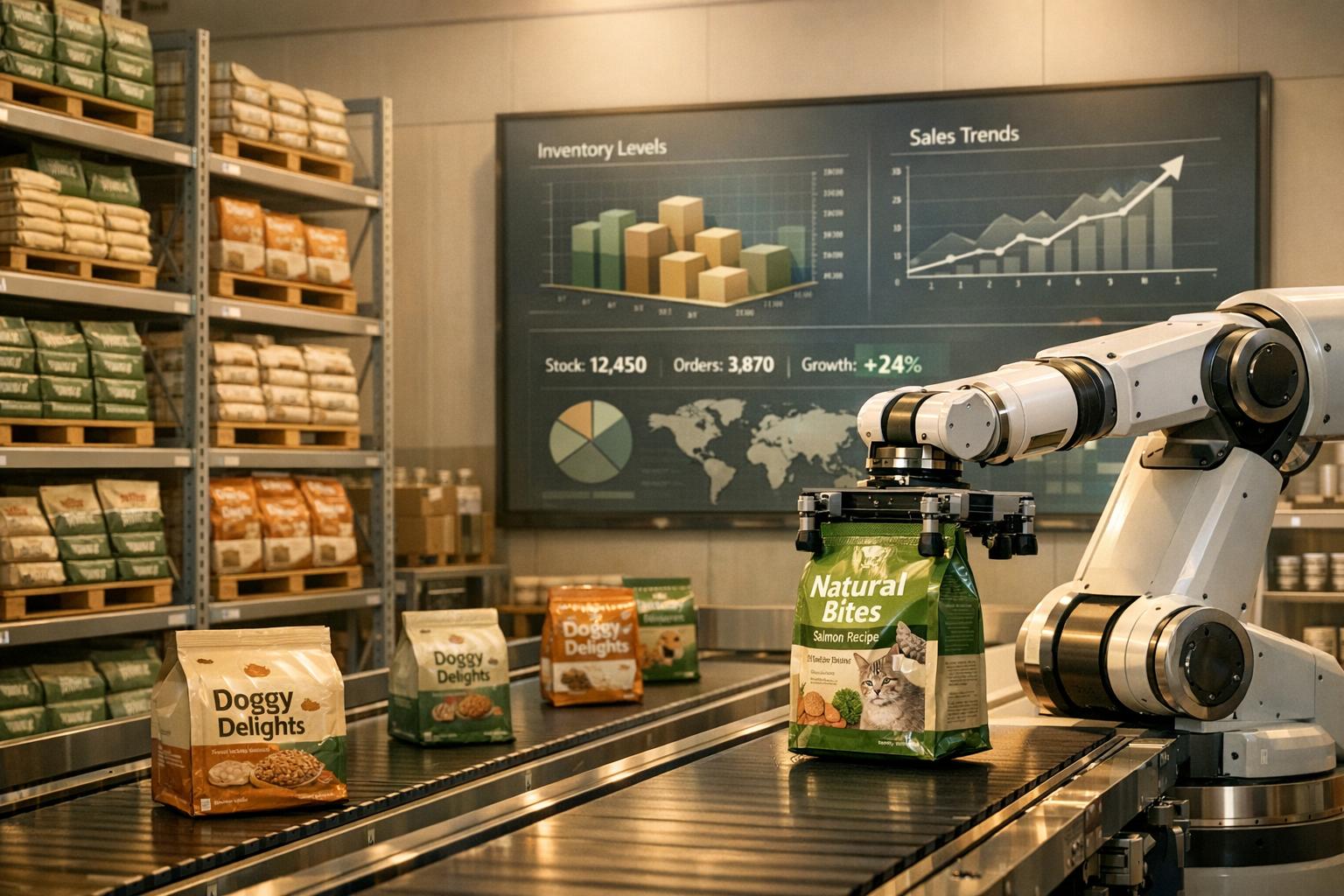
In 2025, Amazon‘s pet category is thriving, growing 25.3% year-over-year to become a $22.6 billion market. Leading brands like PETKIT, HawaiiPharm, and Hartz are dominating by focusing on premium products, leveraging advanced tools, and prioritizing customer experience. They use AI for precise ad targeting, predictive analytics to avoid stockouts, and niche marketing to connect with specific audiences. Key trends include rising demand for smart pet tech, supplements, and convenience-driven items like automatic feeders and self-cleaning litter boxes. Winning isn’t just about listing products – it’s about executing a data-driven, customer-focused strategy.
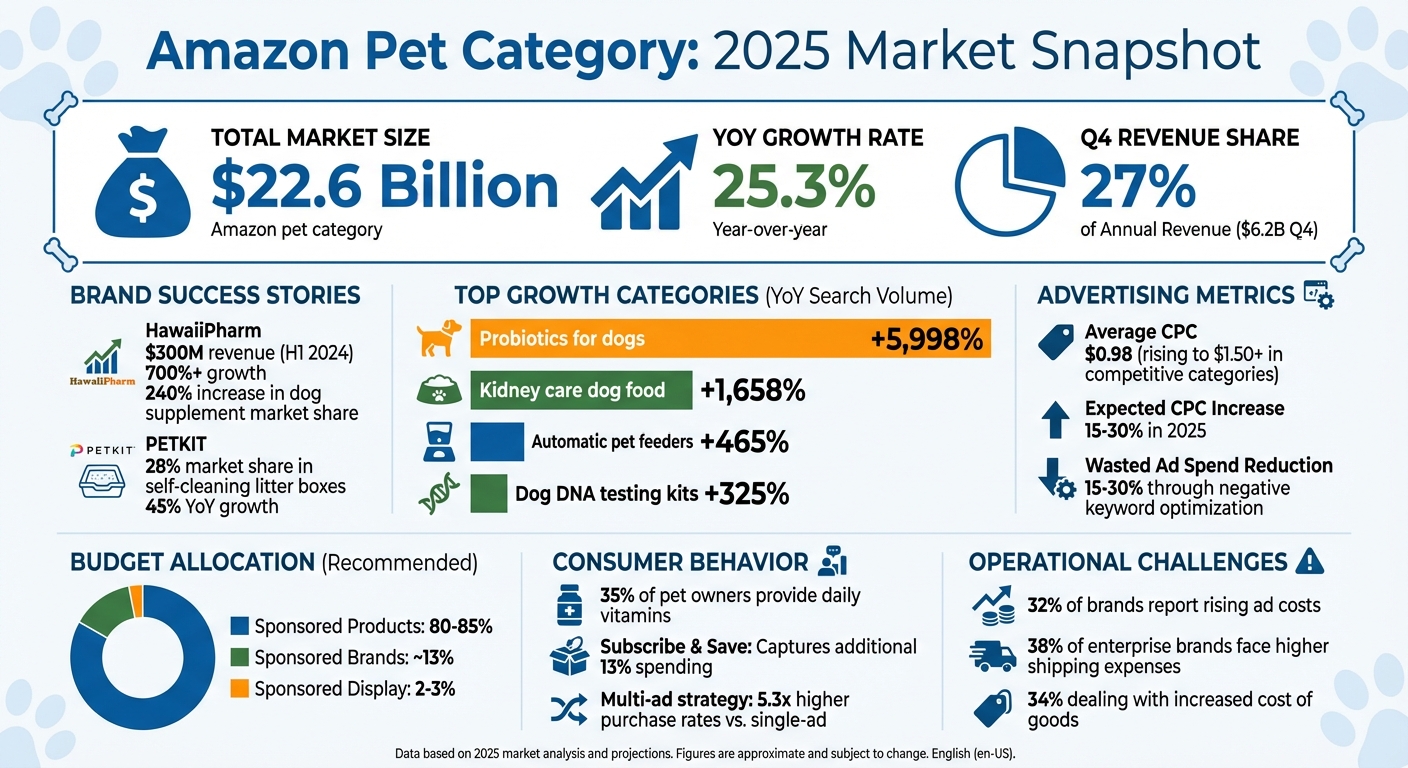
Amazon Pet Category Market Growth and Key Performance Metrics 2025
How Can I Sell My Pet Product On Amazon [and WIN]
PPC Strategies That Drive Pet Brand Sales
Pet brands thriving on Amazon know the power of leveraging AI to fine-tune their ad campaigns. Tools like Helium 10 Ads AI and AiHello automatically sift through automatic campaigns to find high-performing search terms. These terms are then shifted into manual campaigns – whether exact, phrase, or broad match – allowing them to get dedicated budgets and bidding strategies. This approach ensures that successful keywords don’t have to compete with a sea of others, giving them the attention they need to perform even better.
AI also plays a key role in adjusting bids dynamically. By analyzing performance data in real time, AI can increase bids for high-converting keywords during peak activity times, such as evenings and weekends when pet owners are more likely to shop. Conversely, it lowers bids during slower periods to maintain a healthy ACoS (Advertising Cost of Sale). This automated dayparting ensures your ads are visible when it matters most. As Destaney Wishon, CEO of btr media, puts it:
"We use AI to support strategy, not replace it. It helps us move faster, test quicker, and manage more complexity, but only when it’s paired with strong fundamentals".
AI doesn’t stop there. Machine learning can now predict which shoppers are most likely to convert based on their behavior – even before they search for a product. This predictive targeting helps brands reach pet owners who are already in the market for items like premium food or supplements, capturing demand early.
AI-Powered PPC Campaign Optimization
Top-performing pet brands use AI to pinpoint the top 100 search queries for each ASIN and allocate them to manual campaigns with higher budgets. This method ensures that the best-performing keywords receive the resources they need to thrive.
Another advantage is identifying competitive gaps. By combining first-party data from Amazon’s Search Query Performance reports, AI can spot areas where competitors have an edge and create campaigns to reclaim market share. With CPC rates expected to rise by 15-30% in 2025, this level of precision is vital for staying profitable.
On the creative side, Amazon’s Creative Studio uses generative AI to produce lifestyle images and videos tailored to pet products. For example, a grooming tool brand can create multiple lifestyle shots featuring different dog breeds to test which visuals drive the most clicks – all without the cost of traditional photo shoots.
Negative Keyword Strategies for Pet Product Ads
Optimizing bids and isolating top queries is just one part of the equation. To truly maximize ROI, brands must also refine keyword relevance. Irrelevant clicks can drain your ad budget fast, so implementing a strong negative keyword strategy is essential. Sellers can cut wasted ad spend by 15-30% simply by auditing search terms weekly or bi-weekly to identify high-spend keywords with no conversions (typically more than 5–20 clicks without a sale).
For premium pet brands, filtering out price-sensitive searches is critical. Terms like "cheap", "discount", "free", or "lowest price" often attract bargain hunters who are unlikely to convert. As beBOLD Digital advises:
"If you’re selling premium organic dog food, you’ll want to exclude terms like ‘free dog food,’ ‘DIY recipes,’ or ‘cheap kibble’ since those searchers are unlikely to convert".
Similarly, research-focused queries – such as those containing "how to", "guide", "comparison", or "DIY" – can waste your budget. For instance, a pet supplement brand might exclude terms like "DIY dog supplements" or "homemade joint support" to avoid clicks from users who aren’t ready to buy.
| Negative Match Type | Pet Category Example | Blocked Searches | Allowed Searches |
|---|---|---|---|
| Negative Exact | "Purina Pro Plan" | "Purina Pro Plan" | "Purina dog food", "Pro Plan alternatives" |
| Negative Phrase | "DIY dog food" | "DIY dog food recipes", "best DIY dog food" | "organic dog food", "dog food" |
| Negative Broad | "cheap" | "cheap cat toys", "cat toys cheap" | "premium cat toys", "durable cat toys" |
For example, if you sell an automatic pet feeder without a camera, adding "with camera" as a negative keyword can prevent irrelevant clicks. Similarly, if your dog harness is designed for small breeds, excluding terms like "for large dogs" ensures you avoid mismatched expectations and potential negative reviews.
How to Use Sponsored Brands and Display Ads
Once your campaigns are optimized with AI and negative keywords, the next step is strategic ad placements. Sponsored Products typically take up 80-85% of a pet brand’s ad budget, but Sponsored Brands and Sponsored Display ads offer unique opportunities to boost visibility and conversions.
Sponsored Brands are great for top-of-funnel visibility, allowing you to showcase multiple products at once. For example, you can feature a bundle of food, treats, and bowls to encourage larger basket sizes. Sponsored Brands Video is particularly effective, using engaging visuals of pets to capture attention. With search volume for automatic pet feeders up 465% and dog DNA testing kits up 325%, video ads can significantly boost conversion rates.
Sponsored Display ads, on the other hand, focus on retargeting and defending your listings. Setting up a 30-day look-back window allows you to re-engage shoppers who viewed but didn’t buy your products, such as pet supplements or premium food. You can also use these ads for ASIN defense by targeting your best-selling pages to block competitors. Considering that up to 30% of customers searching for a specific brand end up buying from a competitor, this strategy can protect your market share.
| Ad Type | Primary Goal | Suggested Budget Allocation |
|---|---|---|
| Sponsored Products | Individual product sales/ROI | ~80-85% |
| Sponsored Brands | Brand awareness & multi-ASIN coverage | ~13% |
| Sponsored Display | Retargeting & listing defense | ~2-3% |
Amazon DSP takes things a step further by allowing you to retarget shoppers across the web. This is especially valuable during peak seasons like Q4, which accounts for 27% of annual pet category revenue (about $6.2 billion). Capturing these conversions can make a significant impact on your bottom line.
Data-Driven Inventory Management to Prevent Stockouts
Running out of stock on Amazon can do more than just hurt sales – it can lower your organic ranking and hand market share to competitors. Pet brands that thrive in 2025 are prioritizing smarter inventory management by leaning on predictive analytics. This allows them to anticipate demand spikes and ensure products are available when customers are ready to buy. It’s a forward-thinking approach that not only avoids stockouts but also fine-tunes ad spending for better results.
Amazon’s Demand Forecasting tool is a game-changer here. It uses a probabilistic model to predict sales up to 40 weeks in advance, analyzing factors like seasonality, pricing, and shopper behavior (including add-to-cart rates and wishlists). By incorporating historical sales trends, shipment lead times, and warehouse distribution data, it provides a clear picture of future demand. As Brij Purohit, Co-Founder of SellerApp, puts it:
"Amazon Demand Forecasting… projects future sales (up to 40 weeks out) to help you stock smartly, avoid overages, and protect your bottom line."
This data-driven approach extends beyond inventory. Leading brands sync their advertising with these forecasts, increasing ad budgets 2–3 weeks before anticipated demand surges. For example, if flea collars typically see a spike in April, boosting bids in mid-March ensures you’re capturing early interest without overspending or risking stockouts.
Predictive Analytics for Demand Forecasting
Amazon’s AI-powered "Unmet Demand Insights" tool gives brands a competitive edge by identifying gaps in the market before others catch on. It pinpoints situations where customers are searching for unavailable items and generates demand forecasts for potential new products.
To minimize risk, many brands test regionally before committing to a nationwide rollout. For instance, launching a seasonal product in the Northeast first allows you to gather real-time demand data without overextending resources. Mary Beth Westmoreland, Amazon’s VP of Worldwide Selling Partner Experience, explains:
"Launching with less inventory while maintaining fast speeds… help lower costs, lift sales, and provide fast and accurate signals of new product success."
Search Query Performance (SQP) reports also play a crucial role. These reports track the top 100 queries for each product, helping brands identify whether they’re effectively converting on high-demand seasonal terms. If "flea collars" ranks high but your conversion share is low, it could signal a visibility or inventory issue rather than a lack of demand. Regularly reviewing these reports can help you address potential problems early.
Managing Inventory During Peak Seasons
Predictive analytics are invaluable, but during peak seasons, strategic inventory adjustments are just as critical to making the most of those insights.
The fourth quarter alone accounts for 27% of annual pet category revenue, translating to around $6.2 billion in just three months. Missing even a few days of availability during this time can result in major revenue losses. To prepare, top brands use seasonality multipliers based on historical data to adjust reorder points well in advance.
For example, if November sales are expected to be 3.2 times the baseline, reorder points should be adjusted as early as August. A typical formula is: (Daily Unit Sales × Lead Time Days) + Safety Stock (usually 20–30%). So, for a dog supplement selling 50 units daily with a 30-day lead time, you’d need 1,500 units plus a 300-unit safety buffer, totaling 1,800 units.
Maintaining a strong Inventory Performance Index (IPI) score – 680+, ideally 750+ – is essential for avoiding storage caps during the holiday season. To optimize your IPI, divide your SKUs into three categories: "Top Sellers" (always in stock), "Seasonal" (ordered ahead of demand), and "Slow Movers" (liquidated to free up space).
| SKU Profile | FBA Total Cost | FBM Total Cost | Best Choice |
|---|---|---|---|
| Small/High-Velocity (<1 lb) | $4.50 + storage | $6.20 + 3PL | FBA |
| Oversized/Seasonal (>20 lbs) | $18.70 + $0.87/mo | $12.40 + $0.40/mo | FBM |
| Medium/Steady (2–10 lbs) | $7.80 + storage | $8.10 + handling | Hybrid Strategy |
A hybrid fulfillment approach can provide flexibility during these high-demand periods. Use FBA for your top 20% high-velocity SKUs to maximize Prime conversions, while relying on FBM or third-party logistics for seasonal items, oversized products, or when FBA storage limits are tight. Some brands even run dual listings – using both FBA and FBM for the same product – to avoid stockouts caused by delays in FBA processing.
Finally, align your advertising strategy with inventory levels. Reduce ad budgets for SKUs running low on stock to avoid wasting clicks or frustrating customers with unavailable items. There’s no point in driving traffic to a listing that’s about to sell out – it only burns through your budget and leaves shoppers disappointed.
sbb-itb-e2944f4
Niche Audience Targeting in Pet Product Categories
Pet brands leading the charge in 2025 are no longer trying to appeal to everyone. Instead, they’re zeroing in on specific, niche audiences to connect with pet owners who know exactly what they want. While the pet product market is expanding at an impressive 25.3% year-over-year, the real growth is happening in these specialized niches, where precision targeting yields higher conversions. For instance, a dog owner searching for "hypoallergenic cat food with free delivery" is far more likely to buy than someone simply typing "cat food" into a search bar.
Why does this matter? With average CPCs at $0.98, and climbing above $1.50 in some competitive categories, wasting ad dollars on broad, low-intent traffic can quickly drain budgets. Smart brands are focusing on long-tail keywords and addressing specific customer needs, such as "indestructible chew toys for aggressive chewers" or "calming chews for thunderstorms". These terms may not generate massive search volumes, but they attract buyers who are ready to spend – and often willing to pay premium prices. Let’s explore how targeted campaigns are driving results in these niches.
Targeted Campaigns for Specific Pet Owners
The most successful pet brands today are tailoring their campaigns by pet type, health needs, and lifestyle preferences. Search data reveals where the opportunities are: "Kidney care dog food" saw a staggering 1,658% increase in searches year-over-year, while "Probiotics for dogs" skyrocketed by 5,998%. HawaiiPharm capitalized on this trend by focusing exclusively on pet supplements, generating nearly $300 million in the first half of 2024 alone. By targeting health-conscious pet owners, they avoided competing in the crowded pet food market and achieved over 700% growth, increasing their dog supplement market share by 240%. This success is rooted in a key insight: 35% of pet owners now provide daily vitamins to their pets, creating a huge market for condition-specific supplements.
Tech-savvy pet owners are another lucrative segment. PETKIT, for example, captured 28% of the self-cleaning litter box market and achieved 45% year-over-year growth by catering to convenience-driven cat owners who value automation.
Eco-conscious shoppers also represent a high-value audience. A recycled litter brand, working with Brandwoven from January to August 2024, used Amazon DSP to target customers of a discontinued competitor. The campaign delivered over 8 million impressions, boosted revenue by 46% year-over-year, and increased units sold by 30%. Notably, 18% of total sales came from "Brand Halo" effects, where DSP ads influenced purchases beyond the directly targeted products.
Using Amazon DSP for Precision Targeting
While targeted campaigns are great for driving conversions, advanced DSP strategies take things a step further by expanding reach across the web. Amazon DSP (Demand-Side Platform) allows brands to target niche audiences using first-party behavioral data. Unlike Sponsored Products, which rely on keywords, DSP focuses on people – their browsing habits, purchase history, and product views – even if they’ve never clicked on your ad.
One key advantage of DSP is retargeting using lookback periods. Brands can engage shoppers who viewed competitor pages in the past 30, 60, or 90 days but didn’t make a purchase. This is especially effective for capturing customers from brands that have gone out of business or products that are frequently out of stock. By targeting these displaced shoppers, you’re not just building awareness – you’re offering solutions to customers already primed to buy.
Amazon Marketing Cloud (AMC) further enhances this strategy by providing insights into "Brand Halo" effects, showing how DSP campaigns influence Sponsored Product conversions. This full-funnel perspective helps brands measure the true ROI of niche targeting, beyond just last-click attribution. For brands facing ad suppression on top-performing ASINs due to profitability concerns, DSP campaigns offer an alternative way to maintain visibility and drive traffic to parent pages without relying solely on Sponsored Products.
| Type | Use Case | Method |
|---|---|---|
| Sponsored Products | Drive sales and ranking | Keywords and competitor ASINs |
| Sponsored Brands | Build brand awareness | Keywords with custom headlines |
| Sponsored Display | Retarget and upsell | Audience interests and product views |
| Amazon DSP | Expand niche reach | First-party behavioral data (on and off Amazon) |
Some brands are going even further by leveraging predictive AI models like "Performance+" and "Brand+" to identify high-intent shoppers. For example, Thorne, a wellness brand, used Amazon DSP "Brand+" in late 2024 and achieved a 1.5x increase in unique reach and 1.9x more attributed purchases by targeting these high-intent customers. Similarly, Blueair implemented "Performance+" throughout 2024, unifying its Amazon and direct-to-consumer efforts to achieve a 176% lift in ROAS and a 50% reduction in cost per acquisition.
Emplicit‘s Full-Spectrum Approach for Scaling Pet Brands
Scaling pet brands on Amazon in 2025 requires a well-rounded strategy that balances advertising, inventory management, and compliance. The challenges are significant: 32% of brands report rising ad costs, regulatory hurdles are becoming more complex, and operational demands call for specialized solutions. Emplicit’s marketplace management strategies are built to address these challenges head-on.
Integrated Marketplace Management for Pet Brands
Managing inventory during peak sales periods can be a headache for pet brands, especially when demand spikes unexpectedly. Emplicit’s Growth and Enterprise plans tackle this with predictive analytics and a hybrid fulfillment approach. They combine Fulfillment by Amazon (FBA) for high-performing products and Fulfillment by Merchant (FBM) for seasonal or oversized items.
When it comes to advertising, a one-size-fits-all approach doesn’t cut it. Brands that use a mix of Sponsored Products, Sponsored Brands, and Sponsored Display campaigns see purchase rates that are 5.3 times higher than those sticking to a single-ad strategy. Emplicit’s U.S.-based account managers help brands identify untapped niches – like cat-repellent instead of dog-repellent – where lower CPCs make it easier to test keywords and improve ROAS. Beyond Amazon, Emplicit ensures brands tap into other platforms like TikTok Shops, Walmart, and Target, leaving no revenue stream unexplored.
Custom Solutions for Pet Brand Challenges
Emplicit goes beyond standard marketplace management by tailoring solutions to the unique challenges pet brands face. For example, shipping and production costs are climbing – 38% of enterprise brands report higher shipping expenses, while 34% are dealing with increased costs of goods. To counteract these pressures, Emplicit optimizes inventory forecasting with over 85% accuracy for key products, helping brands avoid stockouts during critical sales events like Prime Day or Black Friday.
Compliance is another major hurdle. Pet brands must navigate California’s fur product bans, adhere to strict labeling rules for animal-related shipments, and meet Amazon’s verification requirements for veterinary diets. Emplicit’s account health management team ensures brands stay compliant while scaling, minimizing the risk of account suspensions. For brands struggling with PPC performance, Emplicit deploys advanced tools like Amazon DSP and Sponsored Brand Video to recover lost traffic and boost conversions across the entire sales funnel.
Conclusion: Key Takeaways for Pet Brands on Amazon in 2025
The pet brands thriving on Amazon in 2025 have mastered the art of integration. They bring together AI-powered PPC, predictive inventory management, and niche targeting to create a seamless system. These brands rely on AI-driven PPC to make real-time adjustments, predictive tools to avoid stockouts during high-demand periods, and precise targeting to connect with buyers in emerging markets like tech-enabled pet products and pet supplements. This approach ties directly to the strategies discussed earlier in PPC, inventory planning, and niche marketing.
The pet supplies category on Amazon is booming, representing a $22.6 billion market with an annual growth rate of 25.3%. Brands like HawaiiPharm and PETKIT are leading the charge, showing significant growth in areas like pet supplements and self-cleaning litter boxes. Programs like Subscribe & Save are also playing a major role, capturing an additional 13% of customer spending.
"Success comes from building an integrated strategy where each element reinforces the others, creating what Amazon calls the ‘flywheel effect.’" – Chuck Kessler, Content and SEO Manager, Canopy Management
Top-performing brands are tackling rising ad costs by leaning into AI automation, using negative keyword strategies, and leveraging DSP to improve efficiency. They’re also optimizing for mobile shoppers, driving organic rankings with external traffic, and crafting listings to encourage Subscribe & Save sign-ups.
For pet brands looking to scale, Emplicit offers comprehensive marketplace management services, including PPC optimization and inventory forecasting. These strategies, outlined throughout this guide, are the foundation for success on Amazon in 2025. With U.S.-based account managers, Emplicit helps brands navigate Amazon’s ecosystem and seize growth opportunities across platforms like TikTok Shops, Walmart, and Target.
FAQs
How are pet brands using AI to improve their advertising on Amazon?
Pet brands are tapping into Amazon’s AI tools to run smarter, more effective ad campaigns. These tools sift through massive amounts of marketplace data – like search terms, pricing trends, and conversion rates – to pinpoint top-performing keywords and adjust bids on the fly. The result? Lower ad costs and better returns.
Amazon’s AI doesn’t stop there. It offers predictive insights, helping brands anticipate which ad strategies will work best before they even spend a dime. Plus, with Amazon’s AI-powered DSP platform, brands can zero in on highly specific audience segments. By analyzing shopper behavior and pet-related signals, they can fine-tune campaigns and automatically test creative assets.
The payoff? Pet brands can simplify ad management, boost conversions, and spend more time focusing on growing their brand and creating new products.
How does predictive analytics improve inventory management for pet brands on Amazon?
Predictive analytics is reshaping how pet brands handle their inventory on Amazon by converting customer data into accurate demand forecasts. With the help of advanced AI models, tools like Amazon’s predictive systems can analyze real-time shopping patterns and purchasing trends to predict what customers are likely to buy and when. This means brands can gear up for peak demand periods – think Amazon Pet Day – avoiding the headaches of running out of stock or overstocking.
On top of that, Amazon Brand Analytics offers detailed insights into repeat purchases, frequently bought-together products, and search trends. For instance, if a certain dog food is often purchased alongside a dental chew, predictive models can highlight potential spikes in demand and prompt timely restocking. By tapping into these tools, pet brands can move away from reactive inventory management and adopt a smarter, data-driven approach. This not only helps them maintain optimal stock levels but also improves cash flow and positions them to thrive in Amazon’s competitive pet product market.
Why is targeting niche audiences crucial for pet brands on Amazon?
Targeting specific niche audiences gives pet brands a chance to shine on Amazon’s crowded platform by addressing the distinct needs and preferences of particular pet-owner groups. Take eco-conscious pet parents, for example. Brands that tailor their messaging, packaging, and product features to highlight sustainability can create a deeper connection with this audience, paving the way for stronger loyalty and positive reviews.
Amazon shoppers often know exactly what they’re looking for, which makes hyper-targeted advertising a smart strategy. By customizing campaigns based on location, demographics, interests, or even specific pet types, brands can effectively reach buyers who are already primed to make a purchase. This not only cuts down on wasted ad spend but also increases conversion rates. Considering that many U.S. pet owners shop for supplies weekly – and a large number rely on Amazon as their go-to source – hitting the right audience at the right time can lead to repeat purchases and boost customer lifetime value.
By honing in on niche markets, pet brands can align their offerings with key customer priorities like sustainability, health, or convenience. This approach not only improves ad performance but also helps build a loyal customer base in Amazon’s fast-moving pet category.
Related Blog Posts
- 5 Amazon Search Terms Your Pet Brand Competitors Haven’t Found Yet
- Most Pet Brands Optimize for Amazon Keywords. The Best Ones Optimize for This Instead.
- Amazon Just Changed How Pet Food Ranks. Most Brands Won’t Notice Until It’s Too Late.
- The Unsexy Amazon Metric That Predicts Which Pet Brands Will Exist in 3 Years