

Amazon‘s 2025 policy updates introduce major changes that affect sellers’ profits, operations, and compliance requirements. Key updates include shorter claims windows, reduced reimbursements, stricter inventory limits, and new fees for high-return products. These shifts demand immediate attention to avoid financial losses and maintain account health. Here’s a quick breakdown:
- Reimbursements Based on Manufacturing Cost: Sellers now recover only production costs, cutting payouts by over 75% in many cases.
- Shorter Claims Window: Filing deadlines for lost or damaged inventory dropped from 18 months to just 2 months.
- Holiday Return Window Extended: Returns for Q4 purchases can be made until January 31, 2026, delaying revenue finalization.
- Fees for High Return Rates: Products exceeding return thresholds now incur additional charges.
- Stricter Inventory Limits: Storage capacity reduced from 6 to 5 months, with penalties for low or excess stock.
- Ban on Keyword-Stuffed Titles: Titles must follow strict character limits and formatting rules to avoid suppression.
- No Prep Services for Sharp Items: Sellers must package sharp products themselves with rigid, puncture-resistant materials.
These updates highlight the growing need for precise record-keeping, faster response times, and efficient inventory management. Sellers who adjust quickly can minimize risks and maintain profitability.
Quick Comparison
| Policy Change | Effective Date | Key Impact |
|---|---|---|
| Reimbursements on Manufacturing Cost | March 31, 2025 | Payouts reduced by 75%+; sellers must input costs in Seller Central. |
| Shorter Claims Window | October 23, 2024 | Claims period cut to 60 days; missed deadlines result in permanent losses. |
| Holiday Return Window | November 1, 2025 | Q4 returns accepted until January 31, 2026, delaying revenue reconciliation. |
| Fees for High Return Rates | June 1, 2024* | Return fees added for products exceeding thresholds; FBM fees start in 2025. |
| Stricter Inventory Limits | May 2025 | Capacity reduced to 5 months; penalties for low or excess stock. |
| Ban on Keyword-Stuffed Titles | January 21, 2025 | Non-compliant titles suppressed; sellers must follow strict formatting rules. |
| No Prep Services for Sharp Items | April 14, 2025 | Sellers must handle packaging; non-compliance leads to item disposal. |
*Policy began in 2024 but remains highly relevant for 2025.
These changes require sellers to stay vigilant, update workflows, and meet deadlines to avoid penalties or revenue loss.
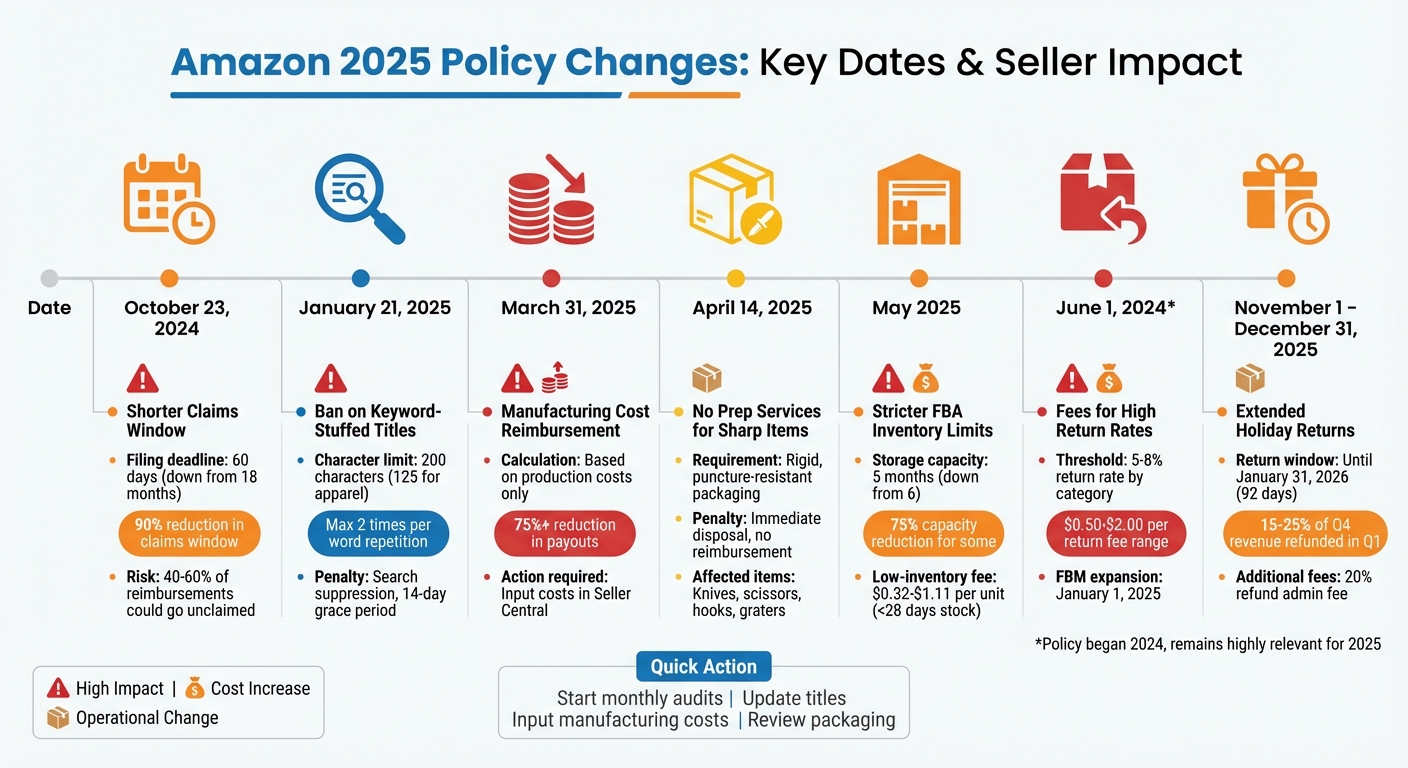
Amazon 2025 Policy Changes Timeline and Impact for Sellers
Amazon‘s New Rules for 2025: What Sellers Must Know NOW!
1. FBA Reimbursement Based on Manufacturing Cost
Starting March 31, 2025, Amazon will change how it reimburses sellers for lost or damaged FBA inventory. Instead of basing reimbursements on the retail price of an item, Amazon will now calculate them using the manufacturing cost. This means sellers will only be compensated for raw materials and direct labor. Costs like shipping, handling, customs, labeling, and prep fees are no longer included. This shift will undoubtedly impact profit margins, as shown below.
Impact on Seller Profitability
This change significantly reduces potential earnings for sellers. For instance, imagine a product that retails for $27.99 but costs $5.40 to manufacture. Under the new policy, the reimbursement would drop to around $6 – representing a reduction of more than 75%. Previously, sellers could receive reimbursements that included some profit margin, but now they’ll only recover the production costs. Products with higher margins, particularly those that rely on branding, design, or customization to justify their price, will feel the brunt of this change.
Operational Adjustments Required
To adapt, sellers must provide their actual manufacturing costs in the "Manage Your Manufacturing Cost" section within Seller Central’s Inventory Defect and Reimbursement portal. If sellers fail to input this data, Amazon will estimate costs based on comparable products. These estimates are often 20% to 30% lower than the seller’s actual costs. To avoid undervaluation, sellers should maintain thorough records, including supplier invoices, bills of materials, labor cost breakdowns, and purchase receipts in PDF format. Prioritizing high-volume or high-value ASINs is also essential to minimize potential losses. This level of diligence will be critical for managing account health under the new policy framework.
Timeline for Implementation
The new reimbursement policy officially begins on March 31, 2025, but sellers will be able to upload their manufacturing cost data starting in January 2025. However, there’s an exception: for items lost or damaged after a customer places an order, reimbursements will still be calculated based on the original sales price, minus Amazon’s standard fees.
2. Shorter Claims Window for Lost FBA Stock
One of the most significant changes in Amazon’s 2025 policy updates is the drastic reduction in the claims window for lost or damaged FBA inventory. Starting October 23, 2024, sellers now have just 60 days to file a claim, down from the previous 18 months – a staggering 90% reduction. If sellers miss this tight deadline, they lose their chance for reimbursement. This shift requires sellers to act swiftly and rethink their operational strategies to avoid financial setbacks.
Impact on Seller Profitability
This shortened window poses a serious risk to seller profitability. Reports suggest that 40%–60% of reimbursements could go unclaimed without updated monitoring systems. For instance, one seller reportedly lost $8,000 in potential claims due to infrequent audits. Titan Network highlights the critical nature of this change:
"Missing the 2-month filing deadline on lost FBA inventory means permanent write-offs".
The policy also affects other claim types. For customer returns, the timeframe now ranges between 60 and 120 days, while claims for items lost in transit during removal must be filed within 15 to 75 days.
Operational Adjustments Required
To adapt, sellers must shift from quarterly or annual audits to weekly or monthly reconciliations. Frequent checks of Seller Central’s Inventory Defect and Reimbursement portal are now essential. While Amazon introduced automated reimbursements for some lost items starting November 1, 2024, sellers are still responsible for manually filing claims for any discrepancies the system overlooks. It’s also crucial to keep supplier invoices and shipping documents organized and easily accessible to meet the new deadlines.
| Claim Type | Previous Window | New Window |
|---|---|---|
| Fulfillment Center (Lost/Damaged) | Up to 18 months | 60 days |
| Customer Returns | 60 days – 18 months | 60 – 120 days |
| Removal (Lost in Transit) | 14 days – 18 months | 15 – 75 days |
| Other Removal Claims | Up to 18 months | 60 days |
Data source:
3. Longer Holiday Return Windows
Amazon’s holiday return policy for 2025 offers a 92-day window, covering purchases made between November 1 and December 31, with returns accepted until January 31, 2026 (or January 15 for Apple-branded products). While this flexibility is great for customers, it delays finalizing Q4 sales figures until February[22,23,24]. For sellers, January becomes a hectic month focused on managing returns, which complicates cash flow and inventory management. This extended period forces sellers to rethink their profit forecasts and operational plans.
Impact on Seller Profitability
Holiday returns can account for 15% to 25% of total Q4 revenue being refunded in Q1. In contrast, standard return rates usually range from 1% to 5%, though giftable products often see return spikes of 25% to 50% in January[2,23]. Each return chips away at revenue and profit, while adding costs for processing, shipping, restocking, or even disposing of items. On top of that, Amazon charges a 20% refund administration fee on certain returns, with additional processing fees ranging from $0.50 to $2.00 per return[2,3].
"Holiday returns can represent 15-25% of Q4 revenue returning as refunds in Q1. Model this impact into your working capital planning." – Dan Ashburn, Co-Founder, Titan Network
Returned items often lose value, especially if they’re opened or damaged, which leads many to be liquidated or sold as "used" at discounted prices. The longer return window also increases the risk of fraud, such as "wardrobing", where customers use an item once and then return it. This practice contributes to about 9% of returns.
Operational Adjustments Required
To navigate these challenges, sellers need to make targeted operational adjustments. First, plan for extra capital reserves to handle restocking in Q1, as Amazon typically holds higher payment reserves during this extended return period to cover potential refunds. As Vanessa Hung, CEO of Online Seller Solutions, puts it:
"Q4 doesn’t end on December 31. For operators, January is now part of the same season, one defined by reconciliation, restocking, and rebalancing cash flow." – Vanessa Hung, CEO, Online Seller Solutions
To reduce damage during the high-volume holiday shipping season, improve packaging materials. Audit product listings to ensure accuracy, and consider adding video demonstrations and clear lifestyle photos – this can lower return rates by 23% to 31%. For low-cost items, where return shipping costs exceed 40% of the product’s price, offering "returnless resolutions" can save on logistics fees[2,23]. Additionally, activate the "Returned Item Evaluation" feature in Seller Central to automatically restock items that are still sellable.
These steps can help sellers better manage the financial and operational strain caused by the extended holiday return window.
4. Fees for High Return Rates
Starting June 1, 2024, Amazon introduced returns processing fees for FBA sellers whose products exceed category-specific return thresholds (typically 5%–8%). These fees are calculated using a three-month rolling average. By 2025, the grace periods initially offered in 2024 were removed. FBM sellers will also face similar fees beginning January 1, 2025, unless they ship fewer than 25 units per month. This change reflects Amazon’s broader shift toward having sellers bear more of the costs.
Impact on Seller Profitability
These fees can significantly cut into profits. A Titan Network analysis of a $30 product with a 35% profit margin found that an 8% return rate adds a $1.50 fee per unit. For 500 units sold monthly, that’s an additional $225 per month – or $2,700 annually. On top of that, processing returns typically costs around 30% of the item’s price, plus a 20% refund fee. With returns expected to hit $890 billion in 2025, accounting for 17% of merchandise sales, seller margins are under growing strain. Compounding the issue, 69% of shoppers now admit to "wardrobing" (returning used items), a figure that’s up 39% from 2023.
A Titan Network analyst summed it up:
"Amazon’s return policy changes represent a permanent shift toward seller cost absorption rather than marketplace subsidization."
To manage these challenges, sellers need to adapt their operations effectively.
Operational Adjustments
Here are some strategies sellers can use to minimize the impact of these fees:
- Track Returns Data: Use the Return Insights dashboard in Seller Central weekly. Set alerts for ASINs nearing 80% of their category return threshold.
- Refine Listings: Add 10+ lifestyle images and video demonstrations to listings. This can reduce "not as described" returns by 23%–31%.
- Returnless Refunds: For items under $20, consider offering returnless refunds when return shipping costs exceed 40% of the item’s cost. One Titan Network member saved $4,200 annually by limiting returnless refunds to items priced under $15 with cosmetic-only return reasons.
- Adjust Pricing: Include projected return fees in your pricing. A 3%–5% price increase on high-return ASINs can help offset these costs.
- Improve Packaging: Upgrade packaging to prevent transit damage and include "how-to-use" inserts to reduce returns caused by customer misuse.
Marketplace Valet offers this perspective:
"If you tighten forecasting, ship clean, and keep listings crystal-clear, most of the ‘new fees’ become controllable line items – not profit killers."
Timeline for Implementation
The FBA returns processing fee became effective on June 1, 2024, and the grace periods initially provided have since expired. The FBM high return fee will launch on January 1, 2025, using a similar structure for merchant-fulfilled orders. While apparel and shoes were initially excluded from the FBA fee, sellers should remain vigilant for any policy changes in 2025.
sbb-itb-e2944f4
5. Stricter FBA Inventory Capacity Limits
Starting in May 2025, Amazon introduced tighter restrictions on inventory storage, reducing allowances from six months to five months of forecasted sales. For some sellers, this change slashed their storage capacity by as much as 75%. Additionally, product-level restock limits were reinstated, creating new challenges for managing inventory effectively. These adjustments have direct financial consequences, squeezing seller margins.
Impact on Seller Profitability
The reduced storage capacity comes with significant financial pressures. Amazon imposes a surcharge for inventory exceeding 26 weeks of supply and applies a Low-Inventory Level Fee if stock levels drop below 28 days. Sellers unable to maintain adequate stock for fast-moving items risk losing their Buy Box and Prime placement, which can heavily impact revenue, especially during peak sales periods.
For example, in June 2025, a mid-sized private label brand in the Home and Kitchen category faced restock blocks on 20 of their top-selling items just three weeks before Prime Day. This jeopardized 30% of their projected revenue. By transferring 40 slow-moving SKUs to a third-party logistics (3PL) warehouse, they freed up 25% of their FBA capacity. This strategic move improved their Inventory Performance Index (IPI) from 385 to 430, enabling them to achieve 94% of their Prime Day sales forecast.
To navigate these tighter restrictions, sellers must adopt precise inventory management tactics.
Operational Adjustments Required
Adapting to the stricter limits requires a proactive approach to inventory management. Sellers should run weekly reports to identify products with less than 30 days, 30–60 days, and more than 90 days of supply. High-velocity items should be prioritized for restocking. It’s also important to cancel ghost shipments, as unsent FBA shipments still count toward capacity limits.
Another option is using Amazon Warehousing and Distribution (AWD) for bulk storage. Inventory stored in AWD doesn’t count toward FBA limits and can be automatically replenished into FBA stock. However, AWD storage rates increased to $0.38 per cubic foot per month in 2025.
Sellers can also consider sending smaller, more frequent shipments to FBA by storing bulk inventory with a 3PL. This approach helps stay within ASIN-specific caps. Additionally, the Capacity Manager tool in Seller Central allows sellers to request extra space on the third Monday of each month. While this often requires a reservation fee, performance credits can offset the cost.
Timeline for Implementation
Amazon began rolling out monthly adjustments to FBA capacity limits in May 2025, with the most restrictive changes taking effect in June and July. The primary enforcement tool is a hard shipment block – once a seller reaches their limit, they are unable to create new FBA shipments. Capacity limits are closely tied to IPI scores, and falling below 400 results in immediate restrictions. Sellers should monitor their capacity weekly, as Amazon announces the following month’s limits during the fourth week. These stricter policies demand flexible and efficient inventory management across all aspects of FBA operations.
6. Ban on Keyword-Stuffed Titles
Starting January 21, 2025, Amazon will enforce strict rules to eliminate keyword-stuffed product titles. Under these new guidelines, titles are limited to 200 characters (125 for certain apparel categories), and a single word can appear no more than twice – except for common prepositions, articles, and conjunctions. Additionally, special characters like !, $, ?, and _ are prohibited unless they are part of a registered brand name. These changes are expected to reshape search visibility and, potentially, seller revenue.
Impact on Seller Profitability
This policy shift is likely to create a trade-off between search visibility and conversion rates. Cleaner, more concise titles can improve customer trust and click-through rates, but sellers who previously relied on keyword repetition for indexing may see a temporary decline in organic traffic. This update builds on earlier changes to inventory and return processes, signaling a more rigid operational framework for 2025. Listings that fail to comply with the new rules may be suppressed from search results, cutting off revenue streams. If sellers don’t update their titles within a 14-day grace period, Amazon’s system will automatically revise them – often removing key selling points.
Operational Adjustments Required
Sellers need to act quickly to ensure compliance, starting with an audit of their catalogs. Prioritize high-performing ASINs first, as outlined in earlier sections. For instance, instead of repeating the keyword "pan" multiple times, use alternatives like "bakeware" or "cookware" to maintain relevance without violating the rules. For larger catalogs, bulk updates via CSV uploads can help address widespread issues efficiently. Sellers should also regularly check the "Review Listing Updates" section in Seller Central for alerts about non-compliance.
"If you edit your title to include repeat words or excess characters after the update, Amazon’s system might block those changes outright." – Weby Corp
Timeline for Implementation
To prepare sellers for these changes, Amazon hosted an "Ask Amazon" event on January 8, 2025, where they addressed common questions about the new policy. When the rules went into effect on January 21, 2025, Amazon began scanning all product titles for violations. Sellers have a 14-day window to fix flagged titles before the system automatically updates them. Brand owners registered with Amazon’s Brand Registry program get an added advantage – they receive override suggestions first, giving them slightly more control over final title adjustments.
Potential for Penalties or Fees
Non-compliance comes with steep consequences. Beyond search suppression, repeated violations can damage seller health metrics, and in extreme cases, Amazon may remove non-compliant listings altogether. Automated title replacements can strip away optimized messaging, undermining brand identity. Since product titles also appear in Amazon PPC ads, these changes may directly affect ad performance and campaign ROI, jeopardizing both organic and paid traffic during crucial sales periods. Up next, we’ll explore how updates to prep services are shaping seller operations further.
7. No Prep Services for Sharp Items
Starting April 14, 2025, Amazon will no longer provide in-house prep services for sharp products. Sellers must now handle all packaging requirements before shipping these items to fulfillment centers. This applies to products like knives, scissors, fishing hooks, hunting knives, scalpels, and graters. Importantly, these items must be packaged in rigid, puncture-resistant materials – bubble wrap and standard cardboard boxes no longer meet the requirements.
Impact on Seller Profitability
This change shifts the entire burden of packaging costs – both materials and labor – onto sellers. Items that fail to meet the new standards and arrive after the April 14 deadline will be disposed of immediately at the seller’s expense, with no reimbursement. For high-volume sellers, these disposal fees can add up quickly. Beyond the financial hit, repeated non-compliance could result in account warnings or even suspension from Amazon’s FBA program.
Given these risks, sellers need to act quickly to adjust their processes and avoid unnecessary costs.
Operational Adjustments Required
To comply with the new rules, sellers should immediately review their inventory to identify products that fall under the "sharp" category. This includes items that might not be obvious, like trekking poles or sheet rock knives. Packaging for these products must meet Amazon’s updated standards, which require hardened plastic, blister packs, or double-walled corrugated boxes that are rigid, six-sided, and puncture-resistant. Additionally, items must be secured inside their packaging to prevent movement during transit.
For sellers sourcing products from overseas, it’s crucial to coordinate with manufacturers now to ensure compliance before shipping.
"Sellers are now solely responsible for ensuring all sharp products are appropriately packaged before sending them to Amazon’s fulfillment centers." – Online Seller Solutions
Potential for Penalties or Fees
Neglecting these packaging updates comes with steep consequences. Improperly packaged sharp items not only risk disposal fees but could also lead to legal liability if they cause injuries to Amazon warehouse staff. Sellers may face permanent account deactivation for such violations. Once an item fails inspection, it is destroyed, leaving no opportunity for recovery or reimbursement.
This policy reflects Amazon’s broader push in 2025 to make sellers fully accountable for meeting updated marketplace standards. Sellers must adapt to these changes to protect their profitability and standing on the platform.
Policy Changes Comparison Table
Each policy update for 2025 brings unique challenges to sellers’ operations. From tighter deadlines to stricter packaging requirements, staying informed is crucial to maintaining compliance and protecting profit margins. Here’s a quick-reference table summarizing the key changes, their effective dates, and how they impact sellers.
| Policy Change | Effective Date | Seller Impact |
|---|---|---|
| Shorter Claims Window | January 9, 2025 | The claims filing period is reduced to 2 months (from 18 months). Sellers must perform monthly reconciliations to avoid permanent write-offs. |
| Manufacturing Cost Reimbursement | March 10, 2025 | Reimbursements now reflect actual manufacturing costs, which could cut recovery by over 75% for certain products. Sellers must manually input costs into Seller Central. |
| No Prep Services for Sharp Items | April 14, 2025 | Amazon will no longer prep sharp items. Products arriving without rigid, puncture-resistant packaging will be destroyed immediately, with no reimbursement options. |
| Fees for High Return Rates | June 1, 2024* | ASINs with return rates exceeding category thresholds (typically 5–8%) incur fees of $0.50–$2.00 per return. |
| Holiday Return Window | November 1 – December 31, 2025 | Purchases during the holiday period can be returned until January 31, 2026. This delays Q4 revenue finalization and increases Q1 returns. |
| Stricter FBA Inventory Capacity Limits | Active throughout 2025 | Storage capacity has been reduced from 6 months to 5 months of forecasted sales. Low-inventory fees of $0.32–$1.11 per unit apply when stock drops below 28 days. |
*Although this policy began in 2024, it remains a major operational concern for sellers in 2025.
"The 2025 reimbursement update is a quiet margin killer if you’re not paying attention".
- Lisa J, Amazon Strategist at Seller Labs
For sellers of sharp products, the April 14 deadline was particularly strict. Any items arriving without proper, puncture-resistant packaging after this date were immediately destroyed, leaving no opportunity for recovery or reimbursement.
Use this table to reassess your processes and ensure compliance with these updates. Adapting quickly could save you from costly mistakes.
Conclusion
The seven policy updates discussed above signal important shifts for Amazon sellers. With stricter claims windows and reimbursements tied to manufacturing costs, sellers are likely to experience tighter profit margins and more administrative responsibilities.
However, there’s still room for growth for those willing to adapt. FBA and referral fees are frozen through 2025, providing some stability during this period. Plus, with increasing traffic on the platform, sellers who stay compliant and active have the chance to capture a larger share of the market. These changes highlight the importance of evolving operational strategies to remain competitive.
To navigate these adjustments, sellers should prioritize monthly inventory audits and set up internal alerts for key compliance deadlines to avoid costly account suspensions. Staying proactive with monitoring and documentation will be critical for managing these transitions effectively.
For sellers managing more complex operations, services like Emplicit can offer valuable support. Their USA-based account managers specialize in ensuring compliance and handling documentation, helping brands protect profits and avoid errors that could prove expensive in 2025.
As AMZ Sellers Attorney® aptly stated:
"Understanding and adapting to these new regulations is not merely advantageous – it’s essential for survival in an increasingly regulated e-commerce environment".
Sellers who treat compliance as a strategic advantage will position themselves for success well into 2025 and beyond.
FAQs
What’s the best way for sellers to handle Amazon’s new 60-day claim window for lost FBA inventory?
To stay ahead of Amazon’s tighter 60-day claim window, make reimbursement tracking a part of your daily routine. A real-time inventory dashboard can be a game-changer, helping you keep tabs on inbound and fulfillment center stock and flagging any discrepancies right away. Keep essential documents like invoices and packing slips well-organized and easily accessible to avoid unnecessary delays when filing claims.
Automating the claims process is another way to streamline this task and cut down on errors. Automation tools can scan shipment reports, compare them to your cost data, and file claims for lost or damaged inventory as soon as an issue arises. This ensures you meet the deadline without extra hassle. Since Amazon now bases reimbursements on manufacturing costs rather than selling prices, having accurate cost tracking in place is more critical than ever.
If you’d prefer a more hands-off approach, a full-service ecommerce agency like Emplicit can take the reins. Their team of experts can handle everything from inventory monitoring to cost verification and claim submissions, letting you focus on growing your business while ensuring you don’t miss out on any eligible reimbursements.
How can sellers reduce the impact of Amazon’s new reimbursement policy based on manufacturing costs?
To reduce the impact of Amazon’s move to manufacturing-cost-based reimbursements, sellers should prioritize these three actions:
- Keep your cost data precise: Maintain thorough records of your cost of goods sold (COGS), including supplier invoices, production costs, and labor expenses. Make sure to upload these details to Amazon’s "Manage Your Manufacturing Cost" portal by the March 31, 2025 deadline. If you don’t, Amazon may use its own – often lower – estimates.
- Act quickly on claims: Amazon now gives you just 60 days to file claims for most FBA issues. Regularly check your inventory to spot discrepancies early. When submitting claims, include your cost documentation to ensure reimbursements match your actual manufacturing costs.
- Consider expert tools or services: Tools or professional services, such as Emplicit, can simplify managing cost records, tracking claims, and keeping your account in good standing – freeing up your time to focus on business growth.
By staying organized, hitting deadlines, and using the right resources, sellers can safeguard their profits under this updated policy.
What steps should sellers take to meet Amazon’s new packaging rules for sharp items?
To meet Amazon’s new packaging rules for sharp items, sellers need to start using cut- and puncture-resistant materials such as hardened plastic or blister packs that completely cover sharp edges. These materials replace bubble wrap or regular cardboard, which are no longer acceptable. All packaging updates must be in place by April 14, 2025, to avoid possible disposal fees. These adjustments aim to improve safety during handling and comply with Amazon’s product safety standards.