

Shoppers rarely buy on their first visit. Amazon’s video retargeting ads solve this by re-engaging potential buyers using first-party data like searches, page visits, and "add to cart" actions. Unlike traditional methods, this strategy relies on real purchase intent, not casual browsing.
Key takeaways from the case study:
- Brand: Healthy Pet (ökocat cat litter) aimed to improve ad performance and conversions.
- Challenge: High ad spend with low conversions due to ineffective targeting.
- Solution: Video ads through Amazon DSP, targeting high-intent shoppers and lookalike audiences.
- Execution: Mobile-first video designs with bold text for silent playback, tailored messaging for different audience behaviors, and frequent creative updates.
- Results:
- CTR increased from 1.2% to 2.8%.
- Conversion rates rose from 8% to 14%.
- Brand recall improved by 347%.
- Cost per click dropped by 67%.
This approach shows how precise targeting, tailored ads, and continuous testing can drive measurable growth on Amazon. Video ads outperformed static formats, engaging shoppers effectively and boosting sales.
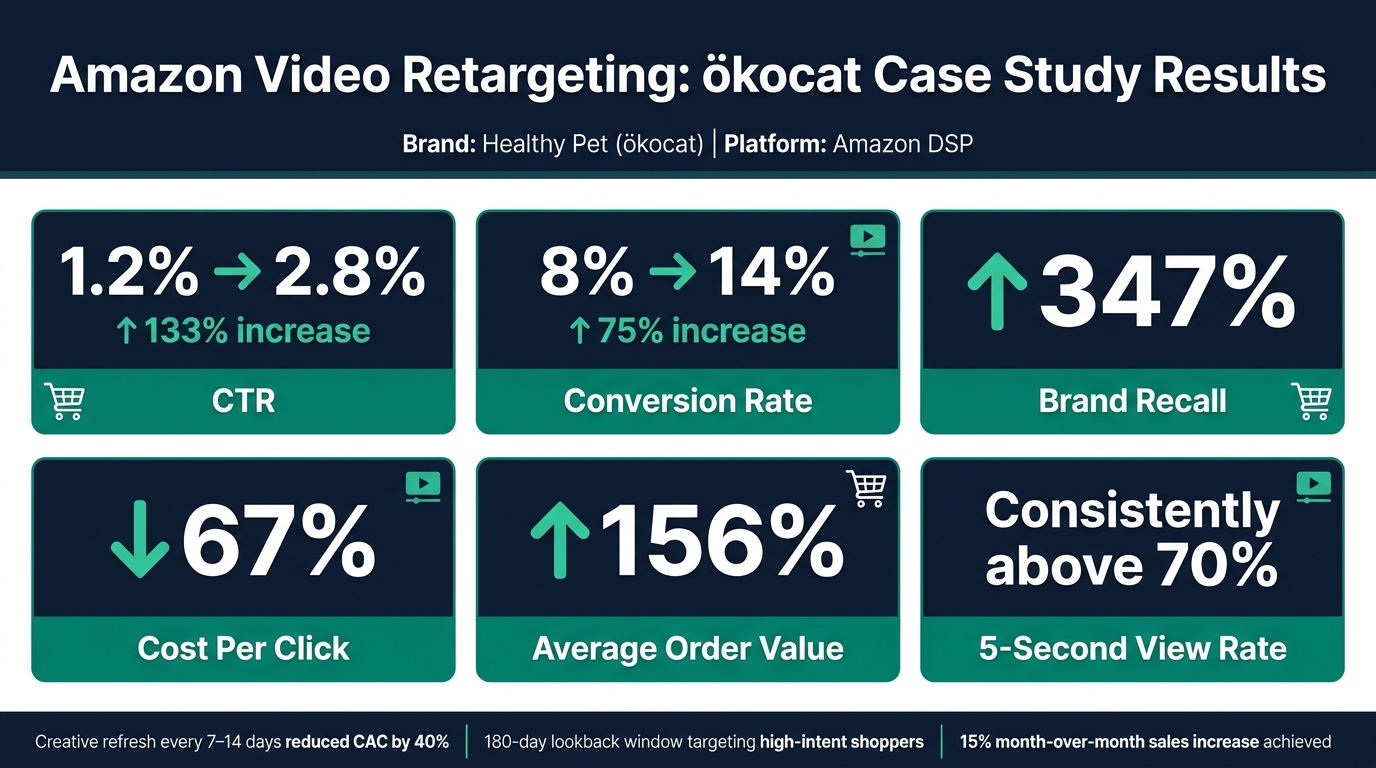
Amazon Video Retargeting Results: ökocat Case Study Key Metrics
Background: The Brand and Its Challenges
The Brand’s Profile
Meet Healthy Pet, the company behind ökocat, a natural cat litter available on Amazon. Designed for eco-conscious pet owners, ökocat offers a plant-based alternative to traditional clay litters. Since cat litter is a consumable product, repeat purchases are a major revenue driver, making customer retention a top priority.
While Healthy Pet had established a solid presence on Amazon, their advertising performance had been hit-or-miss. Leslie Ellis, Marketing Consumer Communications Manager at Healthy Pet, shared their experience:
"Before Nectar, we worked with another Amazon agency for advertising management but the performance was inconsistent."
Challenges in Driving Conversions
ökocat faced two key hurdles: retaining shoppers who showed interest and attracting new customers. Many visitors would check out the product detail page but leave without making a purchase. This not only wasted ad spend but also missed opportunities for retargeting. Without a data-driven strategy, a significant chunk of their budget was spent on audiences unlikely to convert, which pushed their Advertising Cost of Sales (ACOS) higher than necessary. It became clear that they needed a smarter, more engaging ad approach.
Why Video Ads Over Static Display Ads
Static ads simply weren’t cutting it. For a product like natural cat litter, video ads offer a unique advantage: they can quickly address common questions and highlight the product’s benefits in a way static images cannot. This builds trust and confidence, encouraging shoppers to hit "Add to Cart."
Videos also have a broader reach. In a related campaign for Play-Doh, 6.7 million unique shoppers were reached through video ads – an audience that static display ads completely missed. For ökocat, combining Amazon’s behavioral data with the storytelling power of video ads became the perfect recipe for re-engaging past visitors and converting them into loyal buyers. Video’s ability to inform and connect made it the ideal solution for both increasing engagement and driving conversions.
Campaign Strategy: Building the Video Retargeting Plan
Audience Segmentation and Targeting
To create precise audience segments, the campaign leveraged Amazon DSP and Amazon Marketing Cloud (AMC), tapping into real shopper behavior. The focus was on shoppers who already showed clear buying intent – those who visited ökocat’s product detail page, added items to their cart without checking out, or searched for related keywords.
A 180-day lookback targeting strategy was implemented, honing in on shoppers who interacted with the brand in the past 180 days but hadn’t made a purchase in the last 90 days. This approach prioritized individuals already familiar with the brand, increasing the chances of conversion.
Additionally, AMC enabled lookalike modeling, which helped identify new-to-brand shoppers with similar behavioral traits to ökocat’s most loyal customers. This expanded the campaign’s reach while maintaining precise targeting.
Ad Formats and Placement
With the audience segments clearly defined, the campaign focused on selecting the right ad formats and placements. Display ads with video were chosen – a format that stands out from Sponsored Brands video because it operates both on and off Amazon. This allowed ökocat’s ads to follow shoppers across various platforms, including the Amazon homepage, product detail pages, Twitch, IMDb, and thousands of third-party websites through Amazon Publisher Services. This network covers over 60% of Comscore‘s top 250 web domains. By appearing across a wide range of sites, the campaign ensured consistent brand visibility during shoppers’ browsing and entertainment activities.
| Format | Primary Placement | Campaign Goal |
|---|---|---|
| Sponsored Brands Video | Amazon search results | Awareness and discovery |
| Display Ads with Video | Amazon pages, Twitch, IMDb, third-party sites | Retargeting and conversion |
Budget Allocation and Campaign Controls
Once the ad formats were chosen, the budget was allocated strategically to target each audience segment effectively. Funds were split between upper-funnel retargeting via Amazon DSP and bottom-funnel capture through Sponsored Ads. High-value segments, such as branded keyword searchers, were prioritized using bid multipliers, ensuring they received greater ad exposure. To avoid oversaturating audiences, frequency capping was applied to keep impressions efficient and prevent ad fatigue.
Another key measure was excluding existing purchasers from the campaign. This ensured the budget was redirected toward acquiring new customers or encouraging cross-sell opportunities, rather than spending on audiences who had already converted.
Execution: Creative Development and Testing
Video Creative Approach
With audience segments clearly defined, the next step was crafting video ads designed to grab attention. The strategy centered around a mobile-first design. Considering that about 85% to 90% of Amazon video ad views occur on mobile devices with the sound off, every detail was tailored for silent playback. This meant using bold, high-contrast text overlays with concise phrases like "ODOR CONTROL" or "DUST-FREE." These were centrally placed to avoid being cropped by the Amazon app interface.
To maximize screen visibility, videos were created in 9:16 or 1:1 aspect ratios. Instead of starting with a logo, each video launched right into the action to immediately capture attention. A slow fade-in? That’s a surefire way to lose viewers before delivering your key message.
Messaging by Audience Segment
The messaging strategy was customized to align with the audience’s position in the shopping funnel. Three distinct approaches targeted specific behavioral signals for each segment:
| Audience Segment | Behavioral Signal | Messaging Focus |
|---|---|---|
| Product Page Viewers | Visited PDP but didn’t add to cart | High-fidelity product demo proving core benefit |
| Cart Abandoners | Added to cart, didn’t check out | Objection handling (e.g., free returns, satisfaction guarantee) |
| Lookalike / New-to-Brand | Similar traits to existing buyers | Awareness-led demo with brand credibility cues |
For shoppers who had already explored the product page, the focus was on detailed product demonstrations. These videos highlighted how ökocat’s litter delivered on its promises, prioritizing clarity over lifestyle visuals. Research shows high-fidelity demos outperform lifestyle-focused content by a 3:1 margin in bottom-of-funnel placements. This made product demos the ideal choice for retargeting, where shoppers are often weighing multiple options.
Cart abandoners required a different approach. Since they were close to purchasing but hesitated, the messaging addressed potential concerns directly. Instead of rehashing product features, the creative leaned on trust-building elements like free returns and satisfaction guarantees.
Testing and Optimization Process
Once the creative assets and messaging were finalized, the campaign moved into a rigorous testing phase. A 14-day no-interference period was implemented for new creatives. This hands-off window ensured Amazon’s attribution model could accurately account for delayed conversions, which are common in complex shopping journeys. After this period, performance data was analyzed to guide creative adjustments.
The primary metric? The 5-second view rate. If too many viewers dropped off in the opening seconds, the video’s hook was re-edited – tightening the first frame or substituting a more compelling visual. To avoid ad fatigue, creatives were refreshed every 7–14 days. This rotation strategy reduced Customer Acquisition Cost (CAC) by an average of 40%, keeping the campaign fresh while gathering actionable data for scaling successful versions.
"Interactive ads transform passive viewing into immediate action. And that action translates into results at every stage of the funnel." – Maggie Zhang, Head of Global Video Measurement GTM, Amazon Ads
sbb-itb-e2944f4
Amazon DSP Video Ads EXPLAINED: #1 Video Ad Strategy

Results: Campaign Performance and Key Insights
After refining the creative approach, the campaign delivered measurable improvements across key metrics.
Performance Metrics and Benchmarks
Video retargeting clearly outshone static ads in this campaign. The click-through rate (CTR) jumped from 1.2% to 2.8%, while conversion rates rose from 8% to 14%. Brand recall saw a massive 347% boost, and average order value increased by 156%. Even with premium ad placements, the cost per click dropped by 67%. Additionally, the 5-second view rate for 15-second spots consistently surpassed the 70% completion mark, highlighting the success of the mobile-first creative strategy.
Optimizations Made During the Campaign
Midway through the campaign, data revealed opportunities for further improvements. Testing different hooks led to a CTR increase from 1.8% to 3.7%, while reducing the cost per click from $67 to $35. This underscored the critical role of capturing attention within the first five seconds. Tracking Total Advertising Cost of Sales (TACoS) instead of just Advertising Cost of Sales (ACoS) provided more valuable insights into organic ranking gains. This deeper understanding justified maintaining the budget during moments when direct ROAS experienced slight dips.
Key Takeaways for Video Retargeting
Three major insights stood out from the campaign. First, audience segmentation requires ongoing refinement to remain effective. Second, tailoring messages to specific stages in the sales funnel consistently outperformed generic creative, offering clear direction for future campaign planning. Third, Ursa Major‘s retargeting campaign demonstrated the power of precision targeting. By focusing on shoppers who clicked an ad within the last 180 days but hadn’t purchased in 90 days, the campaign achieved a 15% month-over-month sales increase and a 22% lift in branded conversion rates.
"Tinuiti’s advertising expertise… has helped us achieve our goal of bringing new customers into the brand while maintaining a healthy RoAS. These are the kind of results that evolve a marketing strategy." – Dillon Wright, Senior Director of Marketplace Growth, Ursa Major
Amazon video retargeting isn’t a "set-it-and-forget-it" strategy. Brands that see the best results are those that treat creative updates, audience timing, and metric tracking as ongoing priorities. This campaign underscores the value of precise targeting and dynamic creative updates in driving meaningful conversions on Amazon.
Conclusion: Using Video Retargeting to Grow on Amazon
This campaign’s results highlight how effective video retargeting can be on Amazon when done right. By leveraging precise segmentation, tailored creative, and strategic bidding, brands can see real, measurable growth. For example, one campaign achieved an impressive 5X ROAS, with new-to-brand sales playing a major role in its success.
The real game-changer lies in how brands apply these tools. Those using Amazon Marketing Cloud (AMC) to create custom retargeting audiences, fine-tune video first-frames, and align ad timing with reorder patterns consistently achieve better outcomes. The combination of focused targeting, mobile-friendly creative, and adaptive bidding – key elements of this campaign – consistently drives strong performance on Amazon.
"The right partnership between content creators and Amazon advertising experts can unlock unprecedented performance metrics." – Daniel Barry, Author
The strategies are clear, and the results speak for themselves. Ready to take the next step? Partner with Emplicit to simplify video retargeting and achieve measurable growth.
FAQs
When should I retarget Amazon shoppers with video?
Retargeting Amazon shoppers with video ads is a smart way to reach users who are already showing strong purchase intent or are on the verge of completing a transaction. These ads can grab their attention, encourage engagement, and help turn their interest into actual conversions.
How do I build retargeting audiences in Amazon DSP and AMC?
To build retargeting audiences in Amazon DSP, you can use the platform’s audience creation tools. These tools let you define audience segments based on specific user actions, such as:
- Website visits
- Product views
- Cart additions
For more advanced options, Amazon Marketing Cloud (AMC) allows you to create custom audiences. By using SQL queries or pre-built templates, you can analyze user behavior and engagement patterns in greater depth. Once you’ve identified your audience segments, you can activate them in either Amazon DSP or the Ads Console to run targeted retargeting campaigns.
One key tip: Regularly update your audience segments to ensure your campaigns stay relevant and effective.
What makes an Amazon video retargeting ad work with sound off?
Amazon video retargeting ads work well even without sound, thanks to their use of clear, high-quality visuals, captions, and concise text headlines. These elements ensure the message is communicated effectively, keeping the ad engaging and informative, even in silent settings.