

Pet food brands are missing a huge opportunity with Amazon’s Subscribe & Save feature. While 58% of dog food revenue on Amazon comes from subscriptions, many companies fail to optimize key settings, leading to customer frustration and lost sales. The biggest mistakes? Wrong delivery schedules, poor discount strategies, and inventory issues.
- Delivery Frequency: A rigid 30-day cycle doesn’t fit all pets. Flexible options like 30-, 60-, or 90-day deliveries based on feeding habits can reduce cancellations.
- Discounts: Discounts between 10%-15% drive sign-ups without hurting profits. Tiered discounts (e.g., 10% for monthly, 5% for bi-monthly) encourage loyalty.
- Inventory Planning: Stockouts kill trust – 40% of pet subscription customers cancel after a missed delivery. Strong inventory systems are critical.
Brands that fix these issues see big results. For example, Yumwoof boosted subscription revenue by 24% and cut churn by 35% in two months. With the right strategies, pet food companies can turn one-time buyers into loyal subscribers and grow recurring revenue.
Drive Repeat Purchases with Amazon‘s Subscribe and Save
The Most Common Subscribe & Save Configuration Errors
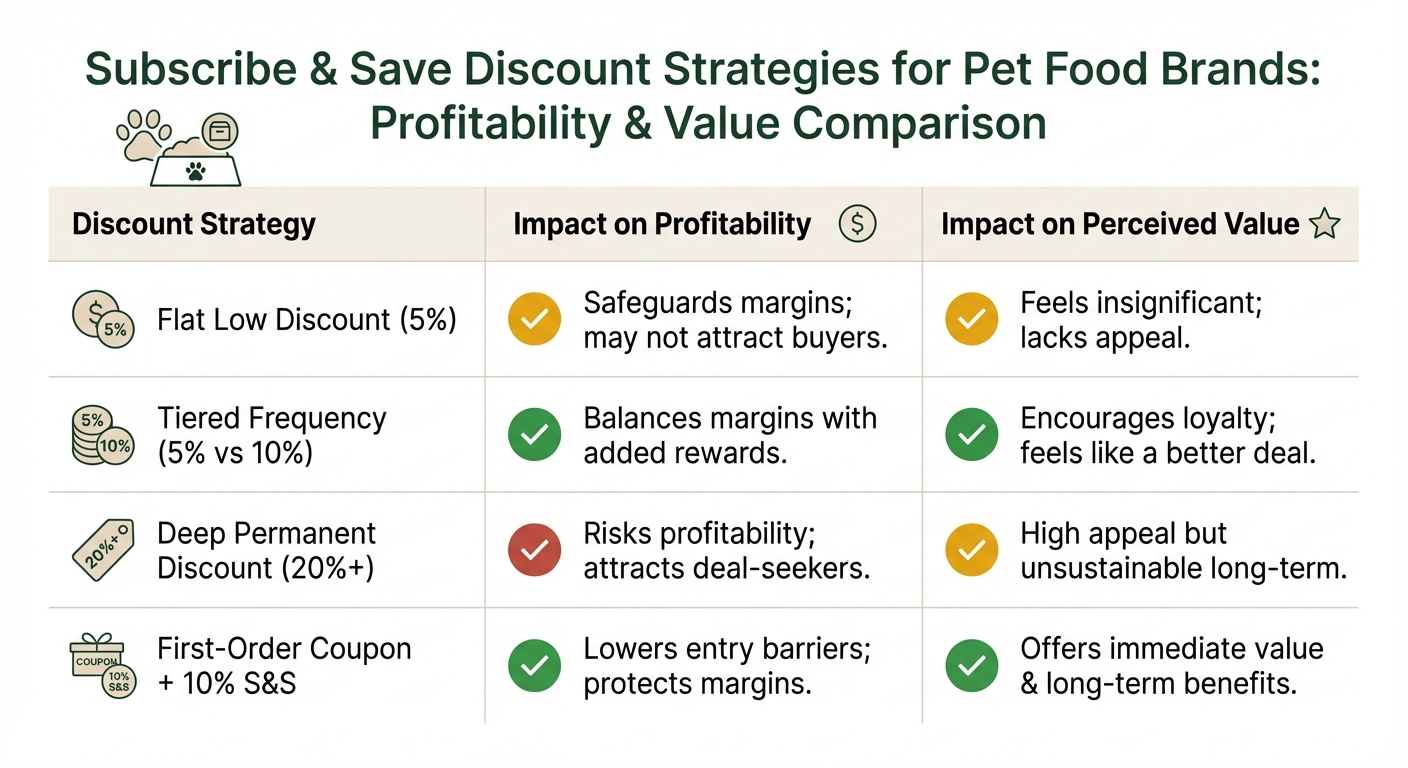
Subscribe & Save Discount Strategies: Impact on Profitability and Customer Value
Setting the Wrong Delivery Frequency
One common mistake brands make is mismatching delivery intervals with how quickly customers use their products. For pet owners, this can mean running out of food too soon or ending up with spoiled leftovers.
"Generally speaking, you don’t want to buy an enormous bag of dog food for a smaller dog. Excess food may spoil before your dog gets a chance to eat it." – Dr. Carly Fox, Animal Medical Center
A one-size-fits-all approach, like defaulting to a 30-day delivery cycle, ignores the fact that a Chihuahua and a Great Dane have completely different feeding requirements. What starts as a convenience quickly becomes a frustration, leading to cancellations. A better approach is to align delivery options with real consumption patterns. Offering flexible options like 30-, 60-, or 90-day supplies, based on standard feeding guidelines, can help meet the needs of different customers.
Now, let’s look at how discounting strategies can also impact the success of these programs.
Using Poor Discount Structures
Discounts are a powerful tool, but getting the balance right is tricky. Too small a discount might not attract customers, while overly generous discounts can hurt profitability.
Research shows that products offering discounts in the 10–15% range can achieve up to 1.8x higher conversion rates compared to those with minimal or no discounts. However, simply increasing the discount isn’t always the best solution. For example, flat 5% discounts protect profit margins but might not appeal to price-sensitive buyers. On the other hand, permanent discounts of 20% or more can lead to unprofitable subscriptions.
Here’s a quick look at how different discount strategies perform:
| Discount Strategy | Impact on Profitability | Impact on Perceived Value |
|---|---|---|
| Flat Low Discount (5%) | Safeguards margins but may not attract buyers | Feels insignificant; lacks appeal |
| Tiered Frequency (5% vs 10%) | Balances margins with added rewards | Encourages loyalty; feels like a better deal |
| Deep Permanent Discount (20%+) | Risks profitability and attracts deal-seekers | High appeal but unsustainable long-term |
| First-Order Coupon + 10% S&S | Lowers entry barriers while protecting margins | Offers immediate value and long-term benefits |
Effective discount strategies are important, but they won’t make up for inventory issues.
Poor Inventory Planning for Recurring Orders
Inventory management is just as critical as getting delivery schedules and pricing right. While Subscribe & Save programs create predictable revenue streams, they also require brands to stick to strict delivery timelines. A missed delivery due to stockouts can completely undermine customer trust.
"Nothing kills subscription momentum faster than being out of stock when customers expect their delivery." – Aliaksandr Vlasenka, Head of Marketplace Growth, Netpeak Agency
Amazon, for example, requires brands to maintain an 85% in-stock rate to remain eligible for Subscribe & Save. Falling below this threshold not only risks removal from the program but also drives customer churn – nearly 40% of pet subscription customers cancel when deliveries are disrupted due to poor inventory planning. To avoid this, brands need robust inventory systems that account for recurring demand and include buffer stock to prevent missed shipments. A well-coordinated supply chain is essential to keeping customers happy and maintaining the program’s effectiveness.
How to Fix Your Subscribe & Save Settings
Match Delivery Frequency to Pet Feeding Habits
To make subscriptions work better for your customers, align delivery schedules with how pets actually consume their food. Since pets follow consistent daily eating routines, it’s easy to predict when they’ll need more supplies. Instead of sticking to a rigid 30-day cycle, offer flexible options like 30-, 60-, or 90-day supplies that fit standard feeding guidelines.
Providing feeding charts and product visuals can help customers decide which option works best for their pet. For example, if a 30-pound bag of food lasts a 50-pound dog about 60 days, make that clear. This way, customers won’t run out of food unexpectedly or end up with too much stock on hand.
Another way to improve the experience is by bundling related products. Pairing essentials like dry food with treats or dental chews in a single subscription can not only increase the average order value but also ensure all items arrive when they’re needed. Additionally, tools like Amazon Marketing Cloud can help you analyze customer preferences and fine-tune default delivery frequencies to better match their habits.
Once delivery schedules are sorted, the next step is to refine your pricing strategy to keep customers coming back.
Set Up Better Pricing and Discounts
Offering discounts in the range of 10%-15% can significantly boost subscription sign-ups. But instead of applying the same discount across the board, try tiered pricing. For instance, you could offer a 10% discount for monthly shipments and a 5% discount for deliveries every two months. This approach rewards customers who stick with more frequent deliveries.
To maintain healthy profit margins, consider bundling high-margin products like supplements or treats with everyday essentials. This not only increases the overall order value but also offsets the cost of the subscription discount.
Keep an eye on cancellation patterns, especially around the third delivery, which is a common drop-off point. Offering a one-time loyalty perk at this stage can help retain customers. The goal is to provide enough value through discounts without encouraging customers to delay orders just to snag a deal.
With pricing strategies in place, the final piece of the puzzle is ensuring your inventory can support reliable deliveries.
Improve Your Inventory Management
Managing inventory effectively is key to a successful subscription program. Subscriptions give you a predictable baseline for demand. For example, if 1,000 customers are signed up for a September delivery, you already know how much stock you’ll need ahead of time. Use tools like Amazon’s Subscription Dashboard to track forecasts and identify any missed deliveries caused by stockouts, which are a major reason for cancellations in the pet category.
Set minimum stock levels (par levels) and adjust them based on supplier reliability and seasonal trends. For fast-moving products like dry kibble or cat litter, having a safety stock can help you handle supplier delays or unexpected spikes in new subscriptions.
As Sean Weeks puts it, "Subscriptions give you a built-in baseline. If 1,000 people are signed up for the September box, you already know the floor."
Regularly review your subscription inventory to ensure you’re not offering items that are difficult to keep in stock. For high-volume products, partnering with a third-party logistics provider can simplify the process of managing and shipping heavier items like large bags of food. This ensures your customers receive their orders on time, keeping satisfaction levels high.
sbb-itb-e2944f4
Results from Brands That Fixed Their Subscribe & Save Settings
Retention and Revenue Growth Numbers
Pet food brands that fine-tuned their Subscribe & Save settings have seen noticeable gains in both customer retention and revenue. For instance, dog food stands out with 58% of its Amazon revenue coming from subscriptions, while cat food follows closely at 45.9%. These numbers translate into meaningful business growth.
Take Yumwoof, a dog food brand, as an example. Between 2022 and 2024, they revamped their subscription process and achieved a 24% increase in monthly subscription revenue alongside a 35% drop in monthly subscriber churn – all within just 60 days. Over a year, they reported an impressive 87% year-over-year growth in monthly recurring revenue and a 20% "save rate" for subscribers within three months. Jaron Lukas, Founder & CEO of Yumwoof, emphasized the importance of subscriptions for their business:
"Subscriptions are a critical part of our dog food company and the ability to customize our order flows with a trial and provide a good customer experience are really important parts of our business."
Other big names in the industry share similar success stories. Chewy‘s Autoship program, for example, brought in $4.9 billion in sales in 2020, accounting for nearly 70% of the company’s total net sales. CEO Sumit Singh highlighted how the program’s predictability helped the company manage demand more effectively during supply chain disruptions. Additionally, pet brands offering subscription discounts of 10-15% often see up to 1.8x higher conversion rates compared to one-time purchases. Loyal customers in the pet category also spend 67% more on average than first-time buyers.
These results clearly show how well-optimized subscription systems can drive growth and loyalty, paving the way for tailored solutions.
How Emplicit Helps Brands Succeed
Tackling common issues in Subscribe & Save setups can directly lead to these kinds of measurable improvements. With proven boosts in retention and revenue, having the right expertise is essential. Optimizing Subscribe & Save involves a mix of skills, including pricing strategies, inventory forecasting, and marketplace management. That’s where Emplicit steps in. Their comprehensive ecommerce services help pet food brands get their subscription configurations right from the start. From PPC campaign management and listing optimization to inventory control and account health monitoring, they cover all the bases across platforms like Amazon, Walmart, and Target.
Emplicit’s team of US-based pet food specialists develops tailored strategies to align delivery schedules with actual pet feeding habits, create profitable discount structures, and prevent stockouts that could lead to subscription cancellations. Their marketplace management services ensure your Subscribe & Save program runs seamlessly, boosting customer retention and profitability at the same time.
Conclusion
Key Takeaways for Pet Food Brands
To make the most of Subscribe & Save, focus on three key areas: match delivery schedules to pets’ needs, offer a discount in the 10%–15% range to encourage sign-ups, and maintain strong inventory management to prevent stockouts. For instance, if a pet typically consumes a 30-day supply of food, your subscription cycle should reflect that – offering a 60-day delivery option could lead to mismatched expectations and lost sales. These adjustments can turn one-time buyers into loyal subscribers, creating steady growth without constantly chasing new customers.
These are practical steps you can act on right away.
Next Steps to Implement These Strategies
Start by reviewing your current Subscribe & Save offerings. Remove items that aren’t replenishable and ensure consumable products – like dry and wet food, treats, and litter – are included with appealing discounts in the 10%–15% range. Update your product pages with feeding charts and cost comparisons to clearly show the value of subscribing.
Leverage the Amazon Subscription Dashboard to keep an eye on forecasted demand and identify "missed deliveries" caused by stockouts. Analyze your profit margins across different discount levels, and if needed, adjust pack sizes or create bundles that better match how customers actually use your products.
Emplicit’s team of US-based pet food experts can help you implement these strategies effectively, ensuring your Subscribe & Save campaigns drive both retention and profitability.
FAQs
How can pet food brands set the right delivery intervals for different pet sizes?
Pet food brands can fine-tune delivery schedules by considering how much food pets typically consume based on their size. For instance, small dogs generally eat about 5 lbs of food monthly, medium dogs go through roughly 10 lbs, and large dogs consume around 15 lbs. Using this data, brands can align bag sizes with consumption rates – like offering 15-lb bags for small dogs, 30-lb bags for medium dogs, and 50-lb bags for large dogs – and recommend delivery intervals that last between 1 and 3 months.
Amazon’s Subscribe & Save feature provides sellers with the flexibility to offer delivery intervals ranging from 1 to 6 months. A 3-month interval is often suggested for bundling discounts, but brands can tailor these options to better fit customer preferences. For example, they might recommend 1-month intervals for smaller bags, 2-month intervals for medium-sized bags, and 3-month intervals for larger bags. Keeping an eye on reorder trends can further refine these intervals, ensuring customers always have their pet food stocked without the risk of running out.
What are the best discount strategies for pet food subscriptions?
Maximizing the success of pet food subscriptions often comes down to two key strategies: delivery frequency-based pricing and stackable discounts. These approaches not only provide value for customers but also help businesses improve retention and profitability.
One effective method is offering bigger discounts for more frequent deliveries. For instance, a 10% discount for monthly deliveries versus a 5% discount for bi-monthly deliveries encourages regular purchases. This strategy aligns perfectly with how often pet owners typically need to restock food, ensuring consistent reordering while rewarding loyal customers.
Another powerful tool is Amazon’s Subscribe & Save program, which allows sellers to offer a base discount of 5% or 10%, with an extra 5% off when customers include five or more items in their order. Discounts in the range of 10–15% have been shown to significantly boost conversions, offering a sweet spot where customers feel they’re saving money without cutting too deeply into seller profits.
By blending these tactics, pet food brands can craft a subscription experience that not only keeps customers engaged but also supports steady and sustainable growth.
Why is effective inventory management important for Subscribe & Save programs?
Effective inventory management plays a critical role in the success of Subscribe & Save programs. These programs generate predictable, recurring demand, making it essential to accurately forecast inventory needs. When done right, it prevents stockouts that could disappoint loyal customers and potentially lead to cancellations.
By ensuring consistent product availability, you build trust with your customers, encouraging them to return for repeat purchases. This approach not only keeps customers satisfied but also boosts profitability by reducing missed sales opportunities and avoiding the pitfalls of overstocking.
Related Blog Posts
- What Chewy Knows About Pet Customers That Most Amazon Sellers Ignore
- After Managing $50M in Pet Brand Sales, Here’s What Actually Moves the Needle on Amazon
- Amazon Subscribe & Save Isn’t a Feature. It’s a Strategy. Most Pet Brands Treat It Like a Checkbox.
- The Unsexy Amazon Metric That Predicts Which Pet Brands Will Exist in 3 Years