

Selling pet products on Amazon is a massive opportunity – but 73% of brands fail within two years. Why? It boils down to avoidable mistakes like poor product listings, mismanaged ads, inventory issues, account health problems, and failing to stand out in a crowded market.
Here’s what you need to know:
- Amazon’s pet marketplace is booming, projected to hit $22.6 billion by 2024, growing 25.3% annually.
- Key challenges include high shipping costs, strict regulations, and intense competition.
- Success hinges on optimized listings, effective ad campaigns, smart inventory management, proactive account monitoring, and clear product differentiation.
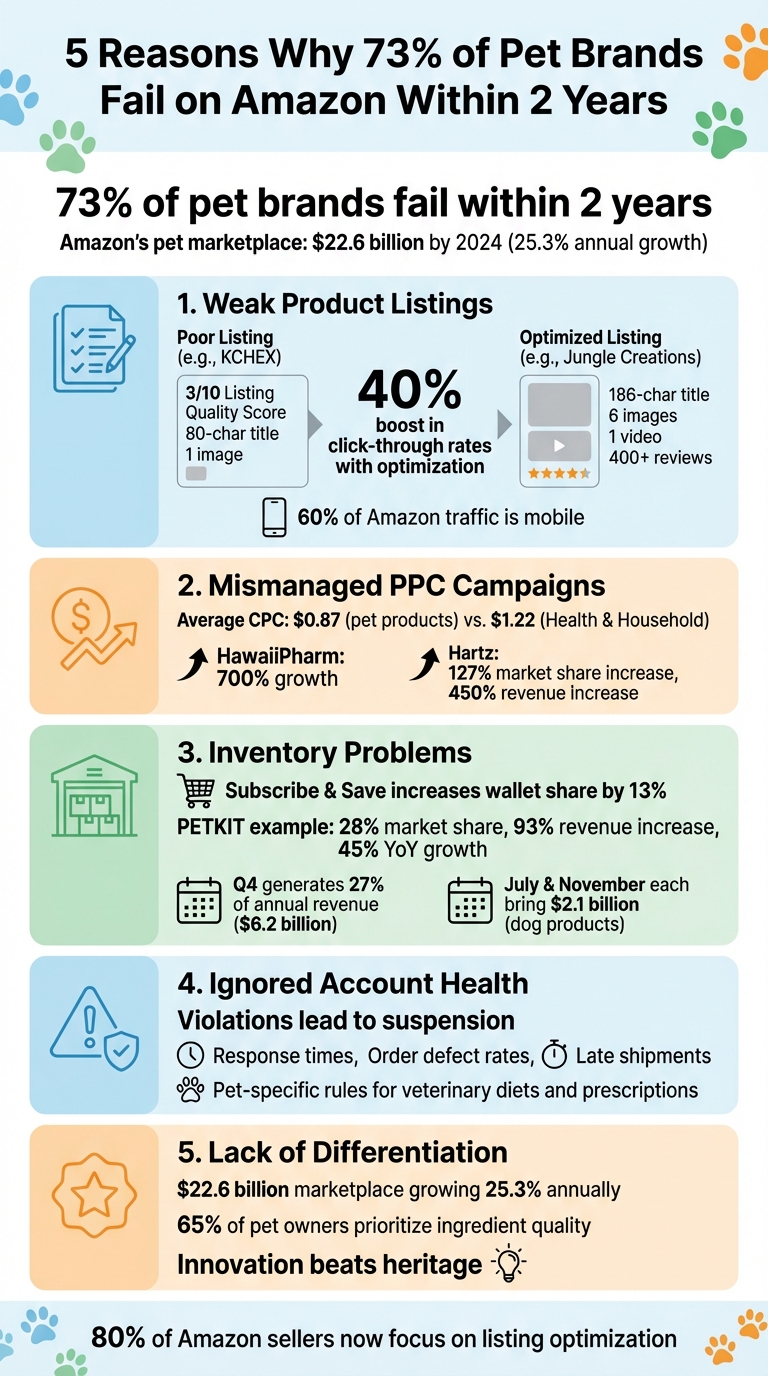
5 Reasons Why 73% of Pet Brands Fail on Amazon Within 2 Years
From Struggles to Success: The Story Behind Cologio Pet Products on Amazon
Why Pet Brands Fail on Amazon
The difference between brands that succeed and those that fade away often boils down to five critical missteps. These errors don’t just exist in isolation – they build on each other, creating a snowball effect that’s tough to reverse once it starts.
1. Weak Product Listings
A product listing isn’t just a description – it’s a crucial factor in how Amazon’s algorithm determines visibility. Chuck Kessler from Canopy Management explains it well:
"Miss the mark on conversion rates, click-through rates, or customer satisfaction in your first weeks, and you’ll spend months fighting for visibility you could have earned upfront."
Let’s compare two examples. KCHEX, a seller of pet housebreaking pads, scored only 3 out of 10 on its Listing Quality Score. Why? They used an 80-character title, a single poor-quality image, and repetitive bullet points. On the flip side, Jungle Creations reached bestseller status with their washable pee pads by crafting a 186-character optimized title, featuring six high-quality images, a product video, and racking up over 400 positive reviews in under a year.
To improve your listing, avoid stuffing keywords into every corner of your title, bullet points, and backend search terms – Amazon’s algorithm won’t reward redundancy. With 60% of Amazon traffic coming from mobile devices, ensure your main image is clear as a thumbnail and keep bullet points under 100 characters to avoid truncation on smaller screens.
Here’s what works: use all five bullet points with capitalized benefit headings (e.g., "LEAK-PROOF DESIGN"), include at least six images and one video, and add lifestyle shots of pets using the product. These steps can boost click-through rates by up to 40%. With 80% of Amazon sellers now focusing on listing optimization, skipping this step leaves your brand at a disadvantage.
Once your listings are polished, the next hurdle is turning ad spend into actual sales.
2. Mismanaged PPC Campaigns
Even with strong product listings, poor ad management can drain your budget faster than almost anything else. For pet products, the average Cost Per Click (CPC) is around $0.87, but for Health & Household items, it climbs to $1.22. When every click costs this much, wasting money on ineffective ads can be devastating.
One common mistake is a passive approach – brands launch campaigns but fail to review Search Term Reports to see which keywords are actually converting. This leads to paying for irrelevant clicks instead of using negative keywords to filter out unproductive traffic.
Another error is rushing to optimize campaigns. Making adjustments too soon – before gathering at least two weeks of data – can lead to poor decisions. Conversely, waiting too long to act on data can also hurt performance.
Some brands have cracked the code. HawaiiPharm grew by over 700% by targeting the $300 million pet wellness niche, while Hartz increased its cat treats market share by 127% and saw revenue soar by 450%.
The winning strategy: start with automatic targeting campaigns to discover new keywords, then transfer high-performing terms into manual campaigns for better control. Set initial bids 50–100% higher than Amazon’s recommendations to gather data quickly. After two weeks, review your Search Term Reports and add any keyword with more than 10 clicks and no sales to your negative targeting list.
Keep in mind, even the best PPC campaign won’t save a poorly optimized listing. If your images and descriptions aren’t up to par, all the traffic in the world won’t lead to sales.
3. Inventory Problems
Inventory management is a balancing act. Running out of stock can tank your search rankings, while overstocking ties up cash and racks up storage fees. Amazon’s algorithm favors products that are consistently available, and regaining visibility after a stockout can take months.
For pet brands relying on Subscribe & Save – a program that increases wallet share by 13% through recurring deliveries – stockouts are especially damaging. If a subscription can’t be fulfilled, customers may cancel permanently, leading to lost recurring revenue.
A smart example is PETKIT, which captured a 28% market share in the self-cleaning litter box category in 2025. The brand achieved a 93% revenue increase and 45% year-over-year growth by managing inventory effectively. It’s also worth noting that the fourth quarter is crucial for pet brands, generating 27% of annual revenue – or $6.2 billion in just three months. For dog products alone, July (Prime Day) and November (Holiday shopping) each bring in $2.1 billion.
Amazon uses the Inventory Performance Index (IPI) to track inventory health. A low IPI can result in restricted storage limits and higher fees, while a high IPI unlocks premium services and extra capacity. Exceeding limits or failing to fulfill orders can even lead to account suspension.
To stay ahead, use historical sales data and seasonal trends to forecast demand, maintain a buffer of safety stock, set up automated reorder points, and monitor your inventory health reports for stranded or aging stock.
4. Ignored Account Health
Many brands overlook account health until it’s too late. Amazon tracks everything from customer service response times to order defect rates and late shipments. Falling short can lead to restricted selling privileges or account suspension.
Often, brands only notice problems after receiving a suspension notice. By then, the reinstatement process can take weeks or even months, during which no sales are made and rankings plummet.
Common violations include failing to respond to customer messages within 24 hours, shipping late, or accumulating negative reviews due to quality issues. For pet products, Amazon has strict rules around veterinary diets and prescription items – violations can result in immediate suspension.
The solution? Be proactive. Check your Account Health dashboard daily, set up alerts for metrics nearing Amazon’s thresholds, respond to customer messages promptly, address negative feedback quickly, and review Amazon’s guidelines thoroughly – especially for pet food ingredients and health claims. Staying ahead of account health issues is key to avoiding costly disruptions.
5. Lack of Differentiation
In a $22.6 billion marketplace growing at 25.3% annually, blending in is a recipe for failure. Too many brands launch products that look just like their competitors’, hoping that slashing prices will win customers. This rarely works.
Pet owners aren’t just hunting for bargains – they want products that solve specific problems for their pets. Brands that clearly communicate their unique benefits through better product quality, standout features, and compelling value are the ones that earn customer loyalty.
How to Succeed on Amazon
Now that you’ve seen the common pitfalls, let’s shift gears and explore what actually drives success. The brands that thrive on Amazon don’t just avoid mistakes – they actively implement strategies that create momentum and fuel long-term growth.
1. Optimize Your Product Listings
Well-optimized listings can increase conversion rates by up to 40%.
Start with your product title. As of January 21, 2025, Amazon requires titles to stay under 200 characters, avoid special characters like "Start with your product title. As of January 21, 2025, Amazon requires titles to stay under 200 characters, avoid special characters like "$" or "?", and refrain from repeating any word more than twice [12]. Include the most important keywords and benefits upfront, especially those that resonate with pet owners.quot; or "?", and refrain from repeating any word more than twice. Include the most important keywords and benefits upfront, especially those that resonate with pet owners.
Take full advantage of the seven image slots. Use a main image with at least 1,600 pixels to enable zoom functionality, which can boost sales by 64%. Add lifestyle images that show pets using your product – this helps buyers see how the product fits into their lives.
For bullet points, focus on benefits rather than features. Use all five slots, starting each bullet with a capitalized benefit (e.g., "LEAK-PROOF DESIGN"). Keep in mind that 65% of pet owners prioritize ingredient quality.
Don’t overlook backend keywords. Stay within the 250-byte limit and, if eligible, use A+ Content to include enhanced visuals and brand stories, which can increase conversions by up to 20%.
Brian Connolly from Jungle Scout emphasizes:
"Listings will make us or break us as Amazon sellers, which means investing the time to make it the best it can be is extremely important."
Lastly, consider the Subscribe & Save program for consumable items like food, treats, and supplements. This feature can capture 13% more wallet share by encouraging recurring purchases.
2. Run Effective PPC Campaigns
Once your listings are in top shape, it’s time to drive traffic. But beware – ads without a strategy can quickly drain your budget.
Start with automatic campaigns to discover which keywords convert, then move high-performing terms into manual campaigns for better control. Use Single Keyword Ad Groups (SKAGs) to assign each keyword its own ad group, improving bid precision and your Quality Score. Regularly review your Search Term Reports to identify irrelevant keywords and add them to your negative keyword list to avoid wasting money.
Pay attention to placement. Use Placement Reports to see where your ads perform best – whether it’s Top of Search or Product Pages – and adjust bids accordingly. Also, bid on your own brand name using Sponsored Brands to capture high-intent traffic.
One golden rule: never direct PPC traffic to a listing with fewer than 15 reviews or a rating below 3.5 stars.
3. Manage Inventory Properly
Inventory management might not be glamorous, but it’s critical. Running out of stock can hurt your rankings, while overstocking ties up cash and racks up storage fees – especially during Q4 when oversized items cost $2.40 per cubic foot.
Use Amazon’s Capacity Manager and Restock Inventory tools to forecast demand based on sales trends and seasonal spikes. Plan 3–6 months ahead for peak seasons like Prime Day and Q4 to avoid supplier delays and shipping bottlenecks.
Keep an eye on your Inventory Performance Index (IPI). A high score unlocks more storage space, while a low score can lead to overage fees. Use the "Fix Stranded Inventory" tool to reactivate listings stuck in Amazon’s warehouses.
If stock runs low, adjust your advertising spend or pricing to moderate demand and avoid a complete stockout, which can harm your organic rankings and Best Seller Rank.
Nancy McLaughlin from Tinuiti explains:
"Sound management of forecasting, purchase order management, and ASIN-level performance will allow for maximum ROI for advertising."
4. Maintain Account Health
Monitoring your Account Health is non-negotiable. Amazon tracks metrics like customer service response times, order defect rates, late shipments, and policy violations. Falling short in any of these areas can lead to restricted selling privileges or even suspension.
Respond promptly to customer messages and negative feedback. Set alerts for critical metrics to catch potential issues before they escalate.
For pet brands, it’s particularly important to follow Amazon’s guidelines, especially for claims about sensitive items like veterinary diets or prescription products. Non-compliance can lead to costly disruptions.
5. Make Your Brand Stand Out
Blending in on Amazon’s rapidly growing marketplace – where the annual growth rate is 25.3% – is a recipe for failure. Pet owners aren’t just looking for low prices; they want products that solve specific problems.
Define a clear value proposition that highlights what sets your product apart. Whether it’s premium, human-grade ingredients or a solution for a specific pet need, make sure this is communicated in your product title, bullet points, and A+ Content.
Build social proof through customer reviews. Automate the "Request a Review" process to encourage feedback. One pet brand gained over 400 reviews in under a year using this strategy. Engage with customers by answering questions in the Customer Q&A section.
Owais Ghori, CEO of Amerify, sums it up:
"Innovation beats heritage in the Amazon ecosystem."
Success on Amazon comes down to solving real customer problems, communicating your value effectively, and executing consistently across every aspect of your business. By standing out at every touchpoint, you set the stage for sustained growth.
sbb-itb-e2944f4
Pet Brands That Succeeded on Amazon
These case studies showcase how pet brands tackled challenges on Amazon and transformed them into growth opportunities. By refining their strategies in listings, advertising, and content, these brands managed to overcome obstacles and achieve impressive results.
1. Startup to Bestseller
A pet supply brand specializing in slow-feeder dog bowls faced stagnant sales due to poorly ranked listings and underperforming ad campaigns. To turn things around, they teamed up with My Amazon Guy to revamp their approach. The team restructured ad campaigns by separating exact, broad, and phrase-match keywords into distinct campaigns and optimized backend keywords. This boosted the number of indexed organic terms from 898 to 1,487. The results? A 40% year-over-year increase in sales, reaching $754,119, a 915% surge in impressions to over 35 million, and an improved click-through rate of 0.53%.
2. Scaling Through PPC
A recycled litter brand hit a roadblock when its top product, responsible for 81% of revenue, became ineligible for Sponsored Product ads. Instead of giving up, they partnered with Brandwoven to implement a full-funnel Amazon DSP strategy. By targeting customers of a competitor that had recently shut down, they captured a significant portion of that market. This strategy led to a 46% year-over-year revenue increase, a 30% rise in units sold, and over 8 million ad impressions.
"We have seen triple-digit growth since partnering with Brandwoven",
said an Ecommerce Business Development Manager at the brand.
3. Creating Repeat Customers
A U.S.-based brand selling dog leashes and harnesses through Amazon Vendor Central faced rising negative reviews due to sizing confusion, which led to high return rates and lower rankings. Between 2019 and 2020, they collaborated with Purple Cow to address these issues. The team enhanced their listings with high-resolution images, clear size guides, and revamped A+ Content featuring comparison charts. Within just 60 days, their conversion rates increased by 33.62%. By the end of 2020, the brand saw 88.5% year-over-year revenue growth and a 27.4% drop in negative reviews. Their Chief Digital Officer shared:
"Working with Purple Cow gave our Amazon presence a serious upgrade. The A+ content, keyword targeting, and inventory insights turned our listings into high-converting assets. We saw our average order value grow by 15%".
These examples highlight how thoughtful strategies in advertising, content, and listing optimization can drive sustainable growth on Amazon.
Conclusion
Main Points
The high failure rate of pet brands on Amazon isn’t just bad luck – it’s the result of specific, avoidable errors. Common pitfalls include poorly optimized product listings, PPC campaigns that burn through budgets without delivering results, inventory mismanagement that hurts rankings, overlooked account health metrics, and a failure to stand out in a crowded marketplace.
To succeed on Amazon, brands need to prioritize execution over relying on legacy or reputation. With the rapid growth of the market – cat food brands alone increased by 13% year-over-year – competition is fiercer than ever. Winning brands make the most of every listing element to build trust and encourage repeat purchases. Staying competitive means closely monitoring SKU-level data, adjusting pricing strategically, and strictly adhering to Amazon’s policies.
Now that the challenges and strategies are clear, it’s time to take action.
What to Do Next
Start by auditing your Amazon operations. Review your product listings, PPC campaigns, inventory turnover, and account health to pinpoint and address weaknesses. For example, if your ACoS is over 35%, it’s a sign that your campaigns need optimization. Ensure your product images genuinely showcase pets interacting with your products, and make sure your backend keywords match high-intent search terms.
With 75% of online product searches beginning on Amazon, managing your account passively is a recipe for failure. The most successful brands treat Amazon as a dynamic platform for testing and learning, using shopper behavior to refine their strategies. Look for underserved niches – especially in tech-driven products like smart feeders and self-cleaning litter boxes. Consider enrolling in Amazon Brand Registry to safeguard your intellectual property and access advanced tools. Build a sustainable strategy by focusing on subscriptions, maintaining consistent inventory, and turning one-time buyers into loyal, repeat customers.
FAQs
What are the best strategies for optimizing Amazon listings for pet brands?
To make your Amazon listing stand out as a pet brand, start by conducting thorough keyword research. Look for phrases pet owners frequently search, such as “grain-free dog food” or “natural cat litter.” Use these terms to craft a clear, benefit-focused title that stays under 200 characters. Highlight your product’s main features in five concise bullet points, focusing on aspects like health advantages, ingredient transparency, usage tips, size specifications, and a call-to-action like “Subscribe & Save.” Then, expand on these details in the product description with engaging, easy-to-read copy that resonates with pet owners.
Don’t underestimate the power of visuals. Include high-quality images that showcase your product in action – like a dog happily chewing a toy or a cat relaxing on a comfy bed. Add lifestyle photos, close-ups of key ingredients, and infographics to quickly convey benefits. If you have access to A+ (Enhanced Brand) content, use it to feature richer visuals, comparison charts, and a compelling brand story that sets your product apart.
Lastly, focus on building trust through customer reviews. Encourage buyers to leave feedback after their purchase, and actively monitor reviews to address concerns about issues like allergies or safety. By blending optimized copy, eye-catching visuals, and a proactive approach to reviews, your pet brand can carve out a strong presence in Amazon’s competitive marketplace.
How can pet brands optimize their PPC campaigns to avoid wasting money?
Pet brands looking to avoid overspending on Amazon PPC campaigns need to focus on structured, strategic management. Start by organizing your campaigns effectively. Use Sponsored Products ads to spotlight key items and rely on automatic targeting to uncover profitable search terms. Once you identify high-performing keywords, transfer them to manual campaigns. This allows you to set precise bids and use negative keywords to filter out irrelevant traffic.
Keep a close eye on keyword performance. Remove terms that aren’t converting and shift your focus to long-tail, high-intent keywords for better cost efficiency. Base your daily budgets on each product’s profit margin, and track key metrics like ACOS (Advertising Cost of Sale) and ROAS (Return on Ad Spend). For ads that perform well, consider increasing bids, while scaling back or pausing those that underperform.
It’s also important to align your PPC strategy with seasonal trends. For instance, during flea season or holiday shopping periods, increase bids to capture peak demand, and scale back during slower times. Experiment with ad copy and images to see what resonates most with shoppers, then reinvest in the top-performing variations. By combining disciplined budgeting, regular optimizations, and data-driven tweaks, pet brands can cut down on wasted spending while driving consistent growth on Amazon.
How can pet brands keep their Amazon seller accounts healthy and avoid suspensions?
To keep your Amazon seller account in good standing and steer clear of suspensions, you’ll need to stay on top of monitoring and compliance. Make it a habit to check your Account Health Dashboard daily. Look out for warnings, order defect rates, or alerts about late shipments and cancellations. If any issues pop up, tackle them immediately. When it comes to your listings, accuracy is key – use correct titles, high-quality images, and detailed product descriptions that align with Amazon’s pet-product safety rules.
Managing your inventory is just as important. Stockouts or overselling can hurt your account, so keep a close watch on your inventory levels, whether you’re using FBA or a reliable third-party shipping partner. And don’t underestimate the power of great customer service. Respond to inquiries and resolve issues within 24 hours to avoid negative feedback and protect your account’s health.
It’s also smart to keep an eye on product reviews. Address unhappy customers quickly and audit your listings regularly to ensure they meet Amazon’s guidelines. By staying proactive, managing your stock carefully, and offering stellar service, pet brands can maintain a strong presence and succeed on Amazon’s competitive platform.
Related Blog Posts
- Amazon’s Pet Category Is Getting Crushed by Cheap Imports. Here’s How Premium Brands Fight Back.
- The Pet Brands Winning on Amazon in 2025 Aren’t Playing the Same Game You Are
- The Unsexy Amazon Metric That Predicts Which Pet Brands Will Exist in 3 Years
- The Subscribe & Save Setting Most Pet Food Brands Have Wrong