
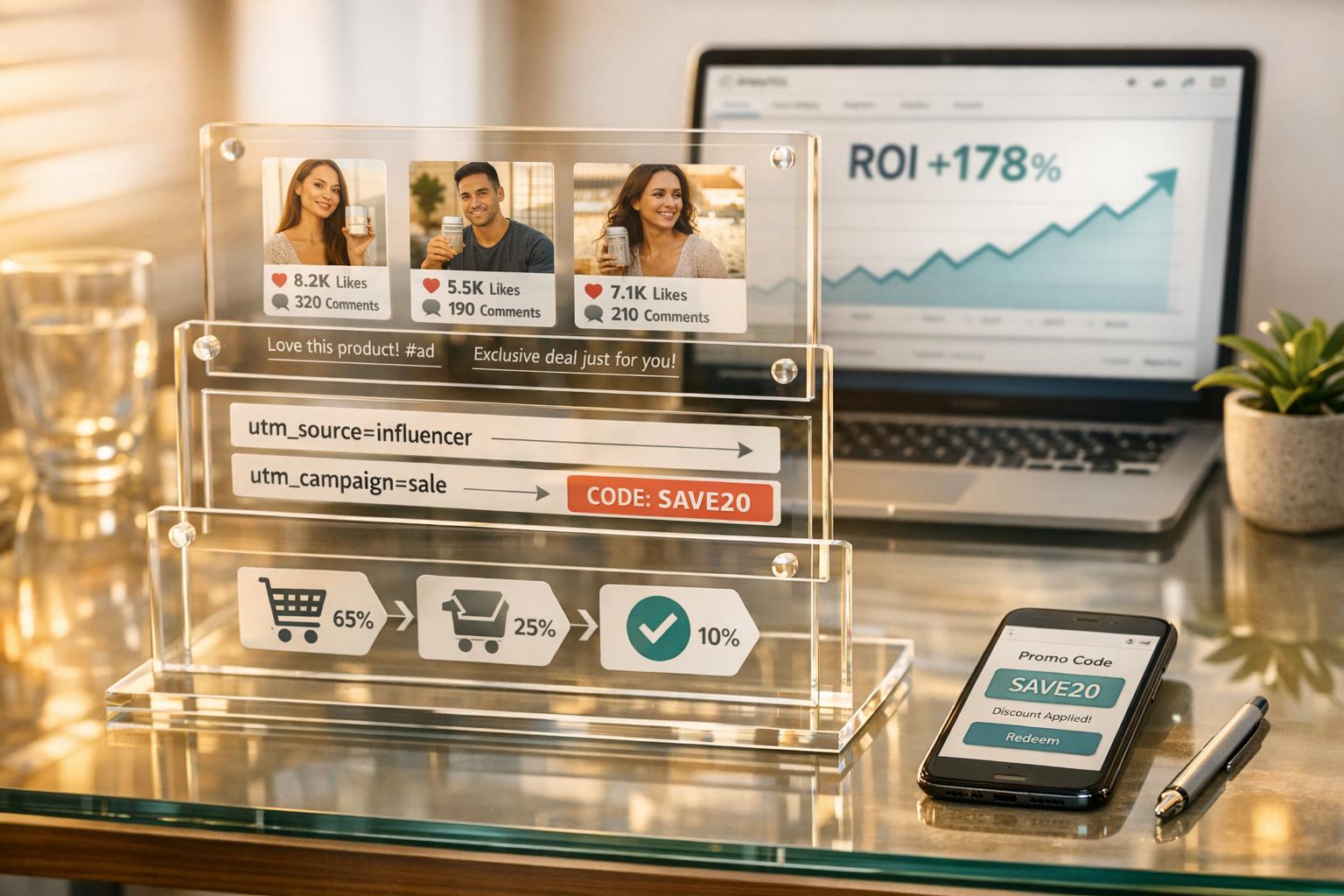
Influencer marketing delivers strong returns, with brands earning $5.78 for every $1 spent. Micro-influencers, with 10,000–500,000 followers, are reshaping marketing strategies by offering higher engagement (up to 60% more) and lower costs. Success stories include fitness brand STRIG achieving a 4.6x ROI and Blueland generating $129,000 in revenue with a 13x ROI.
To measure ROI effectively:
- Use the formula: (Revenue – Campaign Cost) ÷ Campaign Cost × 100.
- Focus on engagement, conversion, and revenue metrics instead of vanity metrics.
- Overcome challenges like attribution by using tools such as UTM links, unique discount codes, and multi-touch attribution.
Key Takeaways:
- Micro-influencers drive better results due to higher engagement rates.
- Successful campaigns often involve clear tracking methods and repurposing content.
- Platforms like Amazon and TikTok Shops amplify results by improving rankings and simplifying purchases.
Start small, track performance, and scale with high-performing influencers to maximize ROI.
$100K+ (5.7X ROAS) YouTube Influencer Campaign Case Study | Session 9.2
sbb-itb-e2944f4
How to Measure ROI in Influencer Marketing
To build on successful case studies, accurately measuring ROI in influencer marketing is essential. The formula is simple: (Revenue Generated – Campaign Cost) ÷ Campaign Cost × 100. For example, if you invest $10,000 in a campaign and it generates $50,000 in revenue, your ROI equals 400%. Achieving these results means tracking the right metrics and addressing the challenges of attribution.
It’s worth noting that 60% of marketers struggle to measure meaningful results from influencer campaigns. This often happens because they focus on vanity metrics that don’t connect to actual revenue. The brands that succeed prioritize performance data that directly ties to sales. Let’s break down the metrics and attribution methods that are critical for measuring ROI effectively.
Metrics That Matter
The metrics that truly count fall into three categories: engagement, conversion, and revenue.
- Engagement Metrics: These include likes, comments, shares, and saves. To calculate engagement rate, use this formula: (Likes + Comments + Shares) ÷ Followers × 100. In 2026, Instagram benchmarks for engagement are 3-4%, with 5% or more considered excellent. For TikTok, video completion rates (VCR) of 60-70% are solid, while 75% or higher is exceptional.
- Conversion Metrics: These include Click-Through Rate (CTR) (how many people clicked your link), Conversion Rate (conversions ÷ clicks), and Cost Per Acquisition (CPA) – with anything under $20 being a good target for most industries.
- Revenue Metrics: Key figures include Average Order Value (AOV) and Customer Lifetime Value (LTV). LTV is particularly important for B2B influencer campaigns, where ROI can reach up to 1,000% when calculated based on LTV rather than immediate sales.
Another metric gaining attention is the authenticity score. Focus your budget on influencers with a score of 85 or higher. Scores below 70 often indicate bot activity. Warning signs include sudden spikes in followers, generic comments like "Nice!", and engagement from countries outside your target market.
Once you’ve defined your metrics, the next step is understanding how to attribute these results to your campaign’s impact.
Attribution Challenges
Attribution is tricky because customer journeys often involve multiple touchpoints. For example, someone might see a product on TikTok, research it on Instagram, and then purchase via Google. The question is: which influencer gets the credit?
- Last-Click Attribution: This method, common in ecommerce, gives full credit to the last interaction. However, it overlooks the earlier awareness and interest generated by other influencers.
- Multi-Touch Attribution: This approach spreads credit across the customer journey. A common breakdown is 40% for the first touch, 35% for mid-touch, and 25% for the last touch.
A great example of tackling attribution challenges comes from Nestlé. In January 2026, their marketing analytics team used StatSocial to analyze campaigns for DiGiorno and Hot Pockets. They matched audiences exposed to influencer content with point-of-sale data over 150 days. The findings were fascinating: audiences exposed to social content spent 9.3% more (DiGiorno) and 25.3% more (Hot Pockets) than those who weren’t exposed. Influencer Ross Smith contributed a 0.8% sales lift. Daniel Davidson, who led the project, shared:
"While understanding these results has been hugely impactful for the team, the biggest takeaway from partnering with StatSocial was the ability to finally measure the direct sales impact resulting from our campaign–a capability that other marketing channels have been able to do for years."
With the phase-out of third-party cookies, brands are turning to first-party data like email signups, purchase history, and loyalty programs. By linking these to influencers through unique discount codes or dedicated landing pages, brands can track campaign performance more precisely. Use UTM parameters for every influencer link to monitor traffic sources, and set a 30-day attribution window to account for delayed purchases without inflating results. Additionally, incrementality testing with control groups helps isolate the true ROI of a campaign.
Case Studies: Influencer Partnerships Driving ROI
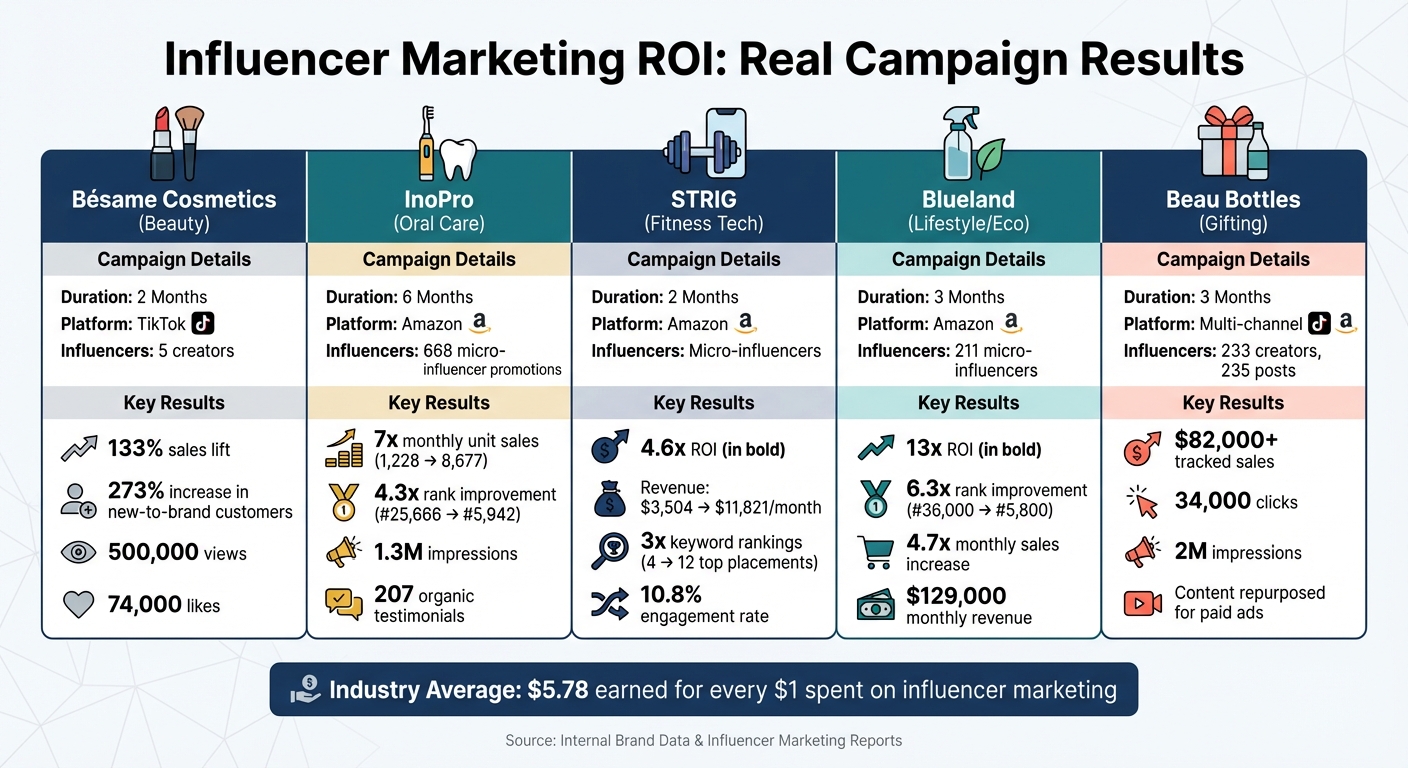
Influencer Marketing ROI Case Studies: Performance Metrics Across Industries
Real-world data highlights how influencer collaborations can deliver measurable outcomes across various industries. Below are examples from the fashion, technology, and food sectors, each showcasing tailored strategies and results.
Fashion and Beauty Brands: Visual Content and Micro-Influencers
Fashion and beauty brands have found success by teaming up with micro-influencers who create engaging visuals. For instance, Bésame Cosmetics launched a TikTok campaign in early 2022 featuring five creators producing 30-second videos for their cake mascara. The results? A 133% boost in sales for the product and a 273% increase in new-to-brand customers on Amazon. The campaign also garnered nearly 500,000 views and 74,000 likes.
Another success story is InoPro, an oral care brand. Over six months, they ran 668 micro-influencer promotions, driving Amazon sales significantly. Monthly unit sales jumped from 1,228 to over 8,677, and their Amazon bestseller ranking improved 4.3x, moving from #25,666 to #5,942 in the Health & Household category. The campaign also generated 1.3 million impressions and 207 organic product testimonials.
Beau Bottles, a luxury bottle wrap brand, executed a three-month campaign in late 2025. By collaborating with 233 creators who produced 235 posts, they achieved over $82,000 in tracked sales, 34,000 clicks, and nearly 2 million impressions. By securing usage rights upfront, they were able to repurpose high-performing content into paid social ads.
Technology and Gaming: Product Reviews and Demonstrations
Tech and gaming brands often rely on influencers for detailed product demonstrations and reviews. For example, STRIG, a fitness tech company, used micro-influencers to promote a massage device during a two-month campaign in 2025. This strategy delivered a 4.6x ROI, with monthly revenue climbing from $3,504 to $11,821. Their Amazon keyword rankings also tripled, increasing top 1-3 page placements from 4 to 12, while maintaining a 10.8% engagement rate.
Meanwhile, Immersive Gamebox, a gaming entertainment brand, focused on gifting group gaming experiences rather than physical products. Between May 2025 and January 2026, they partnered with over 400 local influencers in the US and UK. This effort reached 12 million followers, generated 1.6 million impressions, and resulted in $28,800 Earned Media Value. Peter Nettesheim from Influencer Hero emphasized the importance of:
"Focusing on long-term relationships, localized targeting, and data-driven decisions that turn short-term content into lasting value."
Food and Lifestyle Brands: Experience-Based Content and Targeted Audiences
Food and lifestyle brands shine when influencers highlight authentic experiences. For example, Blueland, an eco-friendly cleaning brand, activated 211 micro-influencers over three months in 2026. This campaign led to a 6.3x improvement in Amazon seller rank (from #36,000 to #5,800) and a 4.7x increase in monthly unit sales.
Similarly, TokyoTreat, a Japanese snack subscription service, scaled rapidly through an affiliate influencer program. By assigning unique discount codes and tracking commissions for each new subscriber, they expanded their creator community by 30x in one year, ensuring they only paid for measurable results.
Summary of Key Outcomes
| Brand | Industry | Campaign Duration | Key Result | ROI/Metric |
|---|---|---|---|---|
| Bésame Cosmetics | Beauty | 2 Months | 273% New-to-Brand Customers | 133% Sales Lift |
| InoPro | Oral Care | 6 Months | 7x Monthly Unit Sales | 4.3x Rank Boost |
| STRIG | Fitness Tech | 2 Months | $23,642 Total Revenue | 4.6x ROI |
| Blueland | Lifestyle | 3 Months | 4.7x Monthly Sales | 13x ROI |
| Beau Bottles | Gifting | 3 Months | $82,000+ in Sales | 34,000 Clicks |
These examples highlight the importance of aligning influencer strategies with industry needs. Fashion and beauty brands thrive with visually engaging content, tech brands benefit from detailed demonstrations, and food and lifestyle companies succeed through experience-driven storytelling.
Strategies for Maximizing ROI with Influencer Partnerships
Building on the earlier discussion of metrics and attribution, here are some practical ways to get the most out of your influencer partnerships.
Selecting the Right Influencers
When it comes to influencer marketing, follower count isn’t everything. What’s more important today is engagement rates. For instance, a creator with 500,000 followers but only 1% engagement is likely to drive fewer sales than someone with 50,000 followers and an 8% engagement rate. Smaller, highly engaged audiences tend to convert better.
Take nano-influencers (10,000–100,000 followers), for example. They often deliver 3.5 times higher engagement than mega-influencers. Similarly, micro-influencers can generate up to 60% more engagement compared to their macro counterparts. A great case study involves a D2C skincare startup that spent $5,000 on 15 nano-influencers with 25,000–50,000 followers each. The campaign resulted in an 8.2% engagement rate and 340 direct purchases, bringing in $12,000 in revenue – a 2.4x ROI.
But it’s not just about engagement. You’ll also want to check for authenticity scores (aim for above 85%; anything below 70% may indicate a bot-heavy audience) and save-to-comment ratios, which can signal buying intent. The ultimate goal is to find influencers whose personal brand aligns with your company’s voice and values. As Steven Lammertink from The Cirqle explains:
"Choosing an influencer whose persona aligns with the brand’s voice and values ensures authentic content that resonates with the target audience."
Improving Campaign Performance Over Time
Start small and scale up. Begin with 5–20 influencers to test the waters and identify high performers. Once you’ve found the most effective creators, focus on building long-term partnerships with them. For example, many successful campaigns repurpose top-performing influencer content for other channels, such as email marketing, product pages, or paid social ads. In fact, 66% of brands now reuse micro-influencer content across various platforms.
To track performance, use unique promo codes and UTM parameters for each influencer. This will give you a clear picture of how much revenue each partnership generates. For TikTok campaigns, aim for a video completion rate of 60–70%, while Instagram benchmarks hover around 3–4% engagement, and TikTok engagement typically ranges between 5–8%. It’s also a good idea to review influencer content drafts to ensure the messaging stays consistent without stifling their creative input.
Using Ecommerce Platforms to Expand Reach
Directing influencer traffic to platforms like Amazon, TikTok Shops, or Walmart not only boosts sales but also improves organic search rankings. For example, when external traffic flows to Amazon listings, the platform’s algorithm rewards you with better rankings – this is often referred to as the "Flywheel Effect".
TikTok Shops, on the other hand, simplify the buying process by keeping users within the app. Since 49% of TikTok users say the platform influences their purchase decisions, this seamless shopping experience can lead to higher conversion rates. Additionally, affiliate models with unique referral codes ensure you only pay influencers based on actual sales, making the process more cost-effective.
William Gasner, CMO of Stack Influence, highlights the benefits of this approach:
"Micro-influencer marketing can significantly boost Amazon performance – improving search rank, driving sales, and supplying user-generated content for reuse."
Conclusion
The case studies we’ve looked at highlight how influencer partnerships, when executed thoughtfully, can yield impressive results. For example, Blueland saw a 13x ROI and added over $129,000 in monthly revenue after running a three-month micro-influencer campaign. Similarly, Caraway credits 13% of its total revenue to its ambassador program . These successes are driven by careful planning, accurate tracking, and ongoing adjustments.
A key factor in these outcomes is the use of data-driven strategies. Tools like unique promo codes, affiliate links, and post-purchase surveys allow brands to identify which influencers are driving actual conversions rather than just creating awareness.
Micro-influencers stand out for their ability to deliver higher engagement and better cost efficiency compared to larger influencers. The same precision that drives success with influencer campaigns also applies to platforms like Amazon and TikTok Shops, where refined metrics enhance performance.
The main takeaway? Start small, track everything, and scale based on what works. Whether your goal is to drive traffic to Amazon, TikTok Shops, or your own website, focus on influencers with strong engagement and genuine connections to their audience. Secure content usage rights upfront and rely on data insights to fine-tune your strategy over time. By combining smart measurement with seamless platform integration, you can maximize ROI. With brands earning an average of $5.78 for every $1 invested in influencer marketing, the potential is undeniable. Success comes to those who experiment, analyze, and build on what works.
For more guidance on blending influencer marketing with streamlined ecommerce management, check out Emplicit‘s comprehensive solutions.
FAQs
What costs should I include when calculating influencer ROI?
To figure out influencer ROI, make sure to account for all related costs. This includes influencer fees, campaign management expenses, content creation costs, and any platform or promotional charges. Including these ensures you get a clear picture of your total investment.
How can I attribute sales when customers see multiple influencers before buying?
Multi-touch attribution is the way to go when you want to track sales influenced by multiple influencers. It gives credit to every touchpoint in the customer’s journey, including all the influencer interactions along the way. This method helps you see how each influencer contributes to the final purchase, offering a more complete picture of their impact.
When should I scale from a small test to long-term influencer partnerships?
When your campaigns consistently deliver positive results, show strong engagement, and provide measurable ROI, it’s time to consider scaling up to long-term influencer partnerships. These signs indicate that the audience genuinely trusts the influencers you’re working with and that there’s potential for sustained growth for your brand.