
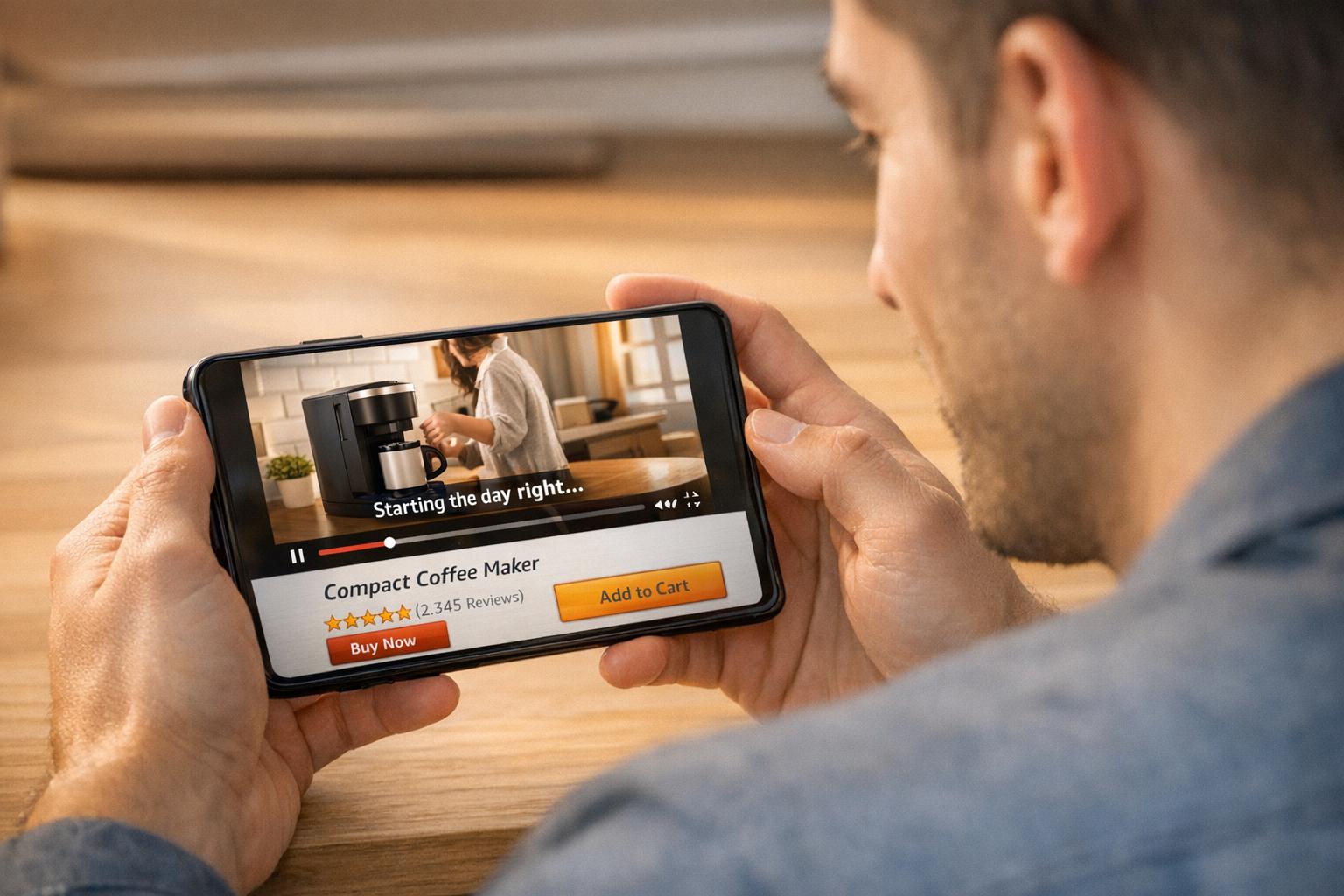
Video ads with storytelling deliver better results on Amazon. They stand out in a crowded marketplace by building emotional connections, boosting click-through rates (CTR), and increasing return on ad spend (ROAS). Here’s why this approach works and how to implement it effectively:
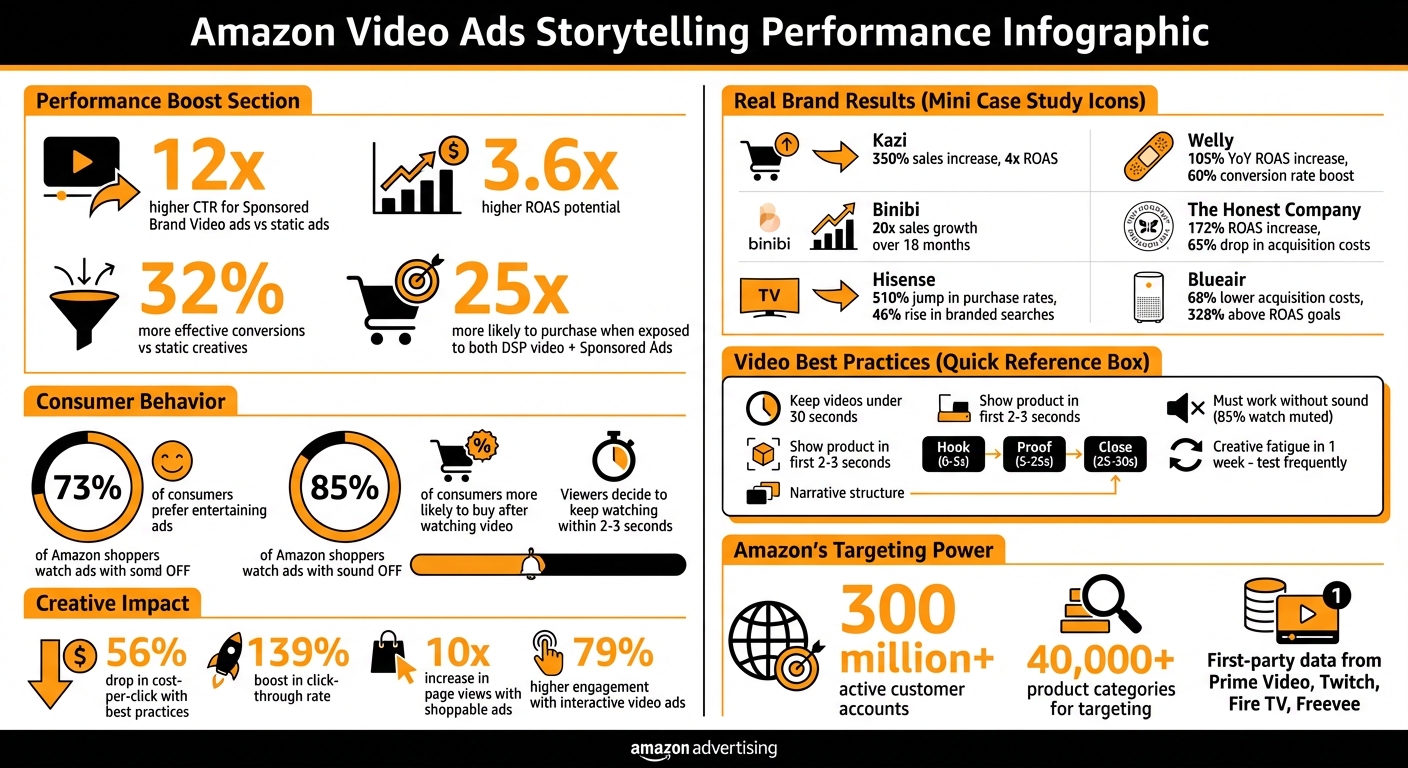
- Performance Boost: Sponsored Brand Video ads have a CTR 12x higher than static ads and can deliver up to 3.6x higher ROAS.
- Why It Works: Stories entertain and engage. 73% of consumers prefer entertaining ads, and relatable scenarios resonate more than product specs.
- Proven Success: Campaigns like Booking.com’s "Travel the Screen" and Lancôme’s romantic-themed ads achieved significant increases in brand awareness and impressions.
- Amazon’s Advantage: With access to first-party customer data, Amazon ensures ads reach the right audience across platforms like Prime Video, Twitch, and Fire TV.
- Best Practices: Use a 3-part narrative (hook, proof, close), keep videos under 30 seconds, and ensure they work without sound. Tailor stories to your audience and highlight benefits visually.
- Targeting Tools: Leverage Amazon’s advanced targeting features, like Audience Overlap Reports and behavior-based segments, to reach high-value customers.
- Real Results: Brands like Kazi, Hisense, and Welly have seen exponential growth by combining storytelling with Amazon’s ad tools.
Key takeaway: Emotional, story-driven video ads paired with Amazon’s targeting tools can transform your campaign results. Focus on engaging visuals, concise storytelling, and precise audience targeting to maximize impact.
Amazon Video Ads Performance Statistics: CTR, ROAS, and Storytelling Impact
Fly By Jing: Visual Storytelling | Rising Stars by Amazon Ads
sbb-itb-e2944f4
How to Build Effective Story-Based Video Ads
Creating a video ad that grabs attention and holds it requires a structured approach. For Amazon video ads, a 3-part narrative formula works wonders: the hook (0–5 seconds), the proof (5–25 seconds), and the close (25–30 seconds). The hook is where you grab attention by highlighting a relatable problem or "before" moment. The proof showcases your product solving that problem, and the close delivers the "after" moment with a clear visual of the product’s benefit.
Keep your video under 30 seconds to avoid losing viewers. Start by showing your product within the first 2–3 seconds – this ensures it’s seen before someone scrolls away. Since 85% of Amazon shoppers watch ads with the sound off, your story must be crystal clear through visuals and text alone. Use bold, easy-to-read text and graphics that work well on small screens, and always include captions or overlays to pass the "mute test."
Creating a Story That Holds Attention
The best video ads follow a problem-solution framework and use visuals to communicate instantly. For instance, a cracked surface can symbolize dry skin in seconds, making the issue immediately clear. Instead of elaborate production, focus on micro-demos – quick, clear clips showing your product in action. Brands that adopt these creative practices have seen a 56% drop in cost-per-click and a 139% boost in click-through rate.
Keep Amazon guidelines in mind by avoiding branding in the first 5 seconds, but ensure your logo and a clear call to action appear later. Hook your audience early by frontloading important details and using a "heartbeat" structure – multiple emotional peaks throughout the ad keep viewers engaged better than a slow build. Finally, tailor the story to match your brand’s personality.
Matching Your Story to Your Brand
Your video should reflect your brand’s values and resonate with your audience. For example, show a messy kid’s room to connect with parents or highlight cutting-edge tech for gadget enthusiasts. Tone matters: humor appeals to younger viewers, while straightforward tutorials work better for older audiences.
"You’re building a story, you’re building a way to connect to the actual end user so when they go back on Amazon they’re not typing in the keyword, they’re typing in the brand name to go find that product again. That’s the way to long-term LTV and long-term conversion." – Trevon Heath, Head of Growth at Sequence Commerce
Address potential objections right in the narrative. If your product seems complicated, show how easy it is to use – whether it’s folding a tent or setting up a device. This approach removes hesitation and nudges viewers toward a purchase.
Using Video and Sound to Strengthen Your Message
Visuals are the backbone of engaging ads, especially since viewers decide whether to keep watching within the first 2 to 3 seconds. With most videos autoplaying on mute, visuals need to tell the entire story. Use striking visual metaphors to stop the scroll more effectively than lengthy text.
For sound, choose music and voiceovers that amplify the emotion you want to convey. But remember, 64% of consumers are more likely to buy a product after watching a video, and most of those views happen without sound. Experiment with different formats – micro-demos, lifestyle clips, or FAQ-style comparisons – to see what resonates with your audience. These strategies are just the starting point for refining your video ads to drive better engagement and results.
Reaching the Right Customers with Amazon’s Targeting
Amazon’s targeting system transforms video ads into precision tools by leveraging a wealth of first-party data from over 300 million active customer accounts. This includes real-time insights into shopping habits, browsing activity, and streaming preferences across platforms like Prime Video, Twitch, and Freevee. Instead of relying on outdated historical data, Amazon uses live behavioral signals to track what customers are doing at any given moment – whether they’re searching for running shoes, watching a cooking show, or filling their cart.
With access to a taxonomy of over 40,000 product categories, advertisers can align their storytelling content with highly specific customer interests. For instance, if you’re promoting digital watches, you can target shoppers who’ve recently looked at watch wristbands. This data even captures offline shopping habits, creating well-rounded audience segments. Customers exposed to both Amazon DSP video ads and Sponsored Ads are 25 times more likely to make a purchase. This precise targeting ensures your message connects with the audience most likely to engage, enhancing the impact of your storytelling.
Using Amazon’s Customer Data for Targeting
Amazon’s Audience Overlap Reports help brands uncover unexpected but relevant customer groups. Take the example of TVS Motor Company, which collaborated with FCB Six in April 2023 to promote its Jupiter and Raider models. By analyzing overlap reports, they identified Prime Video viewers of family content – many of whom were parents – as an ideal audience for their two-wheelers. By pairing this insight with GIF-based creatives instead of static images, the campaign achieved a 3x higher click-through rate and a 30% boost in website visits.
"We went beyond the existing targeting cohorts and created customized audience cohorts specifically for TVS to reach the relevant audiences." – Ankit Banga, CBO, FCB Six
Brands can also utilize lookalike segments to find new prospects based on their most valuable customers. For example, Japanese beverage company Kagome applied this strategy in 2023–2024, combining it with lapsed buyer targeting through Amazon Marketing Cloud (AMC). Their Twitch video ads reached these refined segments, leading to a 190% year-over-year increase in total sales and a 149% rise in new-to-brand sales during Q4 2024. Retargeting is another powerful tool – brands can automatically re-engage shoppers who viewed product pages or videos but didn’t purchase. One brand achieved an 8x return on ad spend in just one month using this approach.
Automated Audience Segments and Behavior-Based Targeting
Amazon takes targeting a step further with automated audience segments. Using machine learning, Amazon refines audience groups based on customer behavior patterns. The Amazon Marketing Cloud (AMC) enables brands to create custom, rule-based segments using SQL-based logic and first-party data. For example, The Honest Company tackled a 25% cart abandonment rate between April and July 2023 by creating automated segments for three product lines – Diapers, Wipes, and Beauty. They delivered tailored video ads to each segment, resulting in a 172% increase in return on ad spend and a 65% drop in new-to-brand customer acquisition costs.
Similarly, Swedish air purifier brand Blueair teamed up with Tinuiti in early 2024 to target "Cart Abandoners" using AMC. They expanded this into a full-funnel video ad strategy to engage high-value audiences. The campaign reduced new-to-brand customer acquisition costs by 68% and surpassed return on ad spend goals by 328%. Automated segments are most effective when paired with customized creative – avoid generic videos. Instead, craft different storytelling assets for distinct behaviors, such as separate ads for cart abandoners and lapsed buyers.
"For us, using a crawl, walk, run approach for our AMC Audience strategy was critical to developing meaningful insights and driving performance." – Jonathan Cole, Commerce Media Lead and Senior Manager, Tinuiti
Tracking Performance: What the Numbers Show
Key Metrics: Views, Clicks, and Sales
When evaluating storytelling video ads, focus on three main metrics: View-Through Rate (VTR), Click-Through Rate (CTR), and conversion rates. These numbers reveal how well your ad resonates with your audience. A high VTR means viewers are engaged and watching instead of skipping. CTR measures whether your story encourages immediate action, while conversion rates confirm if those actions lead to purchases. Tools like Amazon Marketing Cloud (AMC) make it easier to connect video exposure to actual sales.
Storytelling ads perform best when part of a full-funnel strategy. For instance, Sponsored Brands video ads have been shown to convert 32% more effectively than static creatives in certain accounts. Tailoring your message to your audience’s intent is key: emotional storytelling works well for new-to-brand shoppers, while repeat customers respond better to reviews or urgency-driven messaging. Another metric to watch is branded search growth, which indicates how well your story builds consumer recall and interest. These numbers provide a clear picture of how your campaigns perform in real-world scenarios.
Campaign Results: Performance Data from Real Brands
Real-world examples highlight how storytelling ads can lead to impressive results. By tracking metrics like VTR, CTR, and conversions, brands have achieved measurable growth on Amazon.
Take Kazi, a home goods brand. Between June 2023 and June 2024, they used Sponsored Brands video ads to share their mission of supporting African artisans with fair wages. Founder Alicia Wallace paired this storytelling approach with a "hero product" strategy, leading to a 350% increase in annual sales and a ROAS of 4 by March 2024.
"By effectively utilizing the tools on Amazon Ads in tandem with our new line of hero products, Kazi has flipped a year of tough sales into the most successful year ever on Amazon." – Alicia Wallace, Founder, Kazi
Similarly, Binibi, a bilingual book brand, showcased how product interaction videos can drive growth. From January 2023 to June 2024, co-founders Ana Guzman and Luciana Yarhi used display video ads featuring children playing with their "Sol Solecito" sound book. This strategy resulted in 20x sales growth over 18 months, a 2x improvement in ROAS, and a 10x increase in new-to-brand customers during 2023.
Electronics brand Hisense took advantage of Prime Video ads during major events like UEFA EURO 2024 and the Olympic Games. Working with the agency Cosmo5, they targeted sports fans using Amazon DSP. The result? A 510% jump in purchase rates, a 46% rise in branded searches, and a 12% improvement in ROAS. María López de Garayo, Head of E-Retail at Cosmo5 Spain, pointed out that viewers exposed to both video and sponsored ads were far more likely to convert.
Even with limited resources, brands like Welly have found success. Facing an 80% budget cut in 2023, Welly relied on Sponsored Brands video ads and Amazon Marketing Cloud insights to target high-intent shoppers. They exceeded Q1 sales projections by 103%, achieved a 105% year-over-year increase in ROAS, and boosted conversion rates by 60%. Notably, combining Amazon DSP with Sponsored Products led to a 5x increase in conversion rates compared to using Sponsored Products alone.
What’s Next: Storytelling in Amazon Ads Through 2026
Amazon is taking its ad experience to the next level, blending storytelling with cutting-edge technology to create more engaging and personalized interactions.
Voice Shopping and Interactive Video Features
Amazon is stepping up its game by making ads more interactive and action-driven. Instead of sticking to passive video formats, they’re introducing features like shoppable carousels, pause ads, and brand trivia games that encourage viewers to engage directly with products while watching Prime Video. Imagine being able to add a product to your cart with a single click – without ever leaving the video.
These interactive formats are proving to be game-changers. For instance, shoppable ads have led to a 10x increase in product page views and conversions, while interactive video ads deliver a 79% higher engagement rate compared to standard formats. Ads featuring "add-to-cart" options have also boosted perceptions of innovation by 11 points and convenience by 9 points. And by 2026, Amazon plans to deepen voice integration with Alexa, enabling shoppers to discover and buy products using voice commands while browsing or watching content. AI-powered pause ads will even adapt to the context of the scene – like showcasing kitchenware during a cooking scene.
"The line between entertainment and shopping is blurring." – Adsmurai
These advancements are making ad experiences more immersive and responsive than ever before.
AI-Driven Personalization for Video Content
Amazon is also leveraging AI to bring a new level of personalization to video ads. With advanced tools, a single product image can now be transformed into six professional video variations in just minutes. This means ads can be tailored to match specific search queries – like creating a chocolate-themed video for "chocolate protein" searches or a vanilla-themed one for "vanilla" searches.
A great example of this is Bird Buddy’s Father’s Day campaign in June 2025. Partnering with BTR Media, they used Amazon’s AI ad creation tool in Creative Studio to cut their production time from a month to just three days. The results? Their Sponsored Brands video campaign delivered a 3x higher click-through rate (CTR), a 121% return on ad spend (ROAS), and 89% of purchases came from new customers.
"Using the tool allowed us to create a video in just three days." – Nick Amos, Retail Media Advertising Specialist at BTR Media
Brands can now upload up to five feature videos for Sponsored Products, and AI will automatically select the most relevant clip based on the shopper’s search habits and preferences. This keeps the content fresh and perfectly aligned with what each customer is looking for.
Conclusion: What You Need to Know About Storytelling in Amazon Video Ads
Storytelling isn’t just a creative approach – it’s a strategy backed by results. Data consistently shows that video ads with compelling narratives outperform those focused solely on product features. Take the example of I’m The Chef Too!: during Black Friday Cyber Monday 2025, their founder-led storytelling campaign drove a 150% year-over-year revenue increase and boosted subscribers by 220%, all without relying on direct product shots. This highlights how emotional connections and trust often lead to higher conversions than technical details alone.
When crafting video ads, focus on sensory and emotional engagement over purely technical content. For instance, a pet accessory brand tackled negative reviews by producing a 3D video that walked customers through product assembly. This not only increased sales but also reduced complaints. Similarly, Jeep Italy’s "The Women Era" series captivated audiences, achieving a 93.1% video completion rate, far exceeding the 75% industry benchmark, by creating a narrative world that viewers didn’t want to leave. These stories emphasize the importance of precision and creativity in messaging, paving the way for successful testing.
Testing frequently is key. With creative fatigue limiting an ad’s effectiveness to just a week in some cases, brands like I’m The Chef Too! generate over 150 creative variations each month to stay ahead. Pair this with Amazon’s advanced targeting tools to ensure your story reaches the right audience at the right time.
Measuring success is just as important. Keep a close eye on metrics like ROAS, ACOS, video completion rates, and new-to-brand purchases to assess performance. Brands that integrate video strategies – such as combining Prime Video ads with Amazon DSP and Sponsored Ads – often see better results. For example, Hisense aligned their storytelling with major events, achieving a 510% increase in purchases and a 12% improvement in ROAS. When strategy, testing, and measurement align, the results can be transformative.
The takeaway: Authenticity wins over polish, emotions outperform features, and consistent testing beats guesswork. Whether you’re building a startup or expanding a global brand, storytelling on Amazon can build trust, ease decision-making, and drive meaningful growth.
FAQs
How do I write a strong hook for an Amazon video ad?
To grab attention with an Amazon video ad, start with a visually striking element that stops viewers in their tracks. This could be bold colors, surprising imagery, or an unexpected motion. From there, highlight a key product benefit or address a common pain point right away. The goal is to spark curiosity or tap into an emotional response.
A well-crafted hook should make viewers pause, feel intrigued, and want to keep watching. This approach not only boosts engagement but can also lead to higher click-through rates and, ultimately, more conversions.
What Amazon audiences should I target for story-driven ads?
When crafting story-driven Amazon ads, focus on connecting with women aged 25–54. This strategy proved successful in Jeep’s campaign, which centered on themes of women’s empowerment and storytelling. By aligning your narrative to appeal to this audience, you can boost engagement and achieve better results.
How can I prove storytelling ads boosted sales on Amazon?
To showcase how storytelling ads drive sales on Amazon, you’ll need to rely on performance data and specific metrics like sales uplift, click-through rates (CTR), and conversion rates. These numbers provide a clear picture of how well storytelling resonates with audiences.
Case studies are also a great way to illustrate the power of storytelling. For instance, campaigns that achieved measurable outcomes – such as reducing Advertising Cost of Sales (ACoS) or improving brand perception – serve as strong examples of success.
By focusing on key performance indicators and diving into campaign analytics, you can effectively demonstrate the role storytelling plays in boosting sales and enhancing brand visibility.