
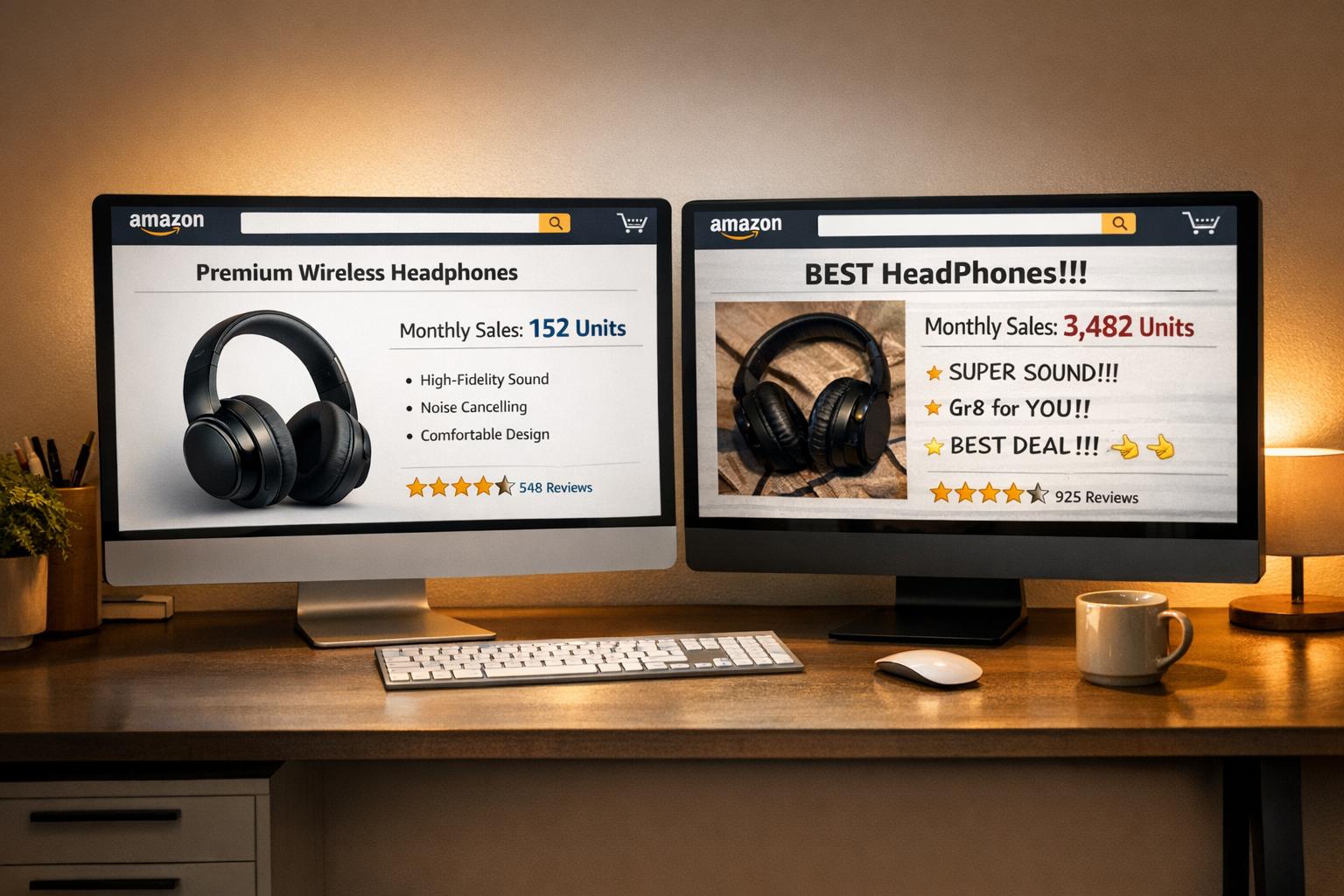
Your competitor’s Amazon listing might look outdated, but it’s outselling yours for one reason: it’s optimized for Amazon’s algorithm, not aesthetics. While you focus on perfecting visuals, they’re targeting what matters – visibility, conversions, and pricing.
Here’s why their "ugly" listing wins:
- Keywords drive visibility: Amazon ranks listings based on keyword relevance, not design. If your competitor’s title and backend keywords match shopper searches, they’ll rank higher.
- Mobile-friendly design: Over 80% of Amazon shoppers browse on mobile. Simple, clear images and text-heavy infographics work better than polished visuals on smaller screens.
- Reviews build trust: Buyers trust listings with more reviews, even if the design is subpar. A product with 1,000 reviews will outsell one with 50, regardless of aesthetics.
- Competitive pricing: Lower prices attract more clicks and conversions, which Amazon rewards with higher rankings.
The takeaway? Amazon is a transactional platform, and its algorithm prioritizes sales velocity and conversion rates over polished design. To compete, focus on keyword optimization, review volume, and pricing strategies instead of just visuals.
How to beat the Amazon algorithm in 11 minutes
The Problem: What Sellers Get Wrong About Amazon Sales
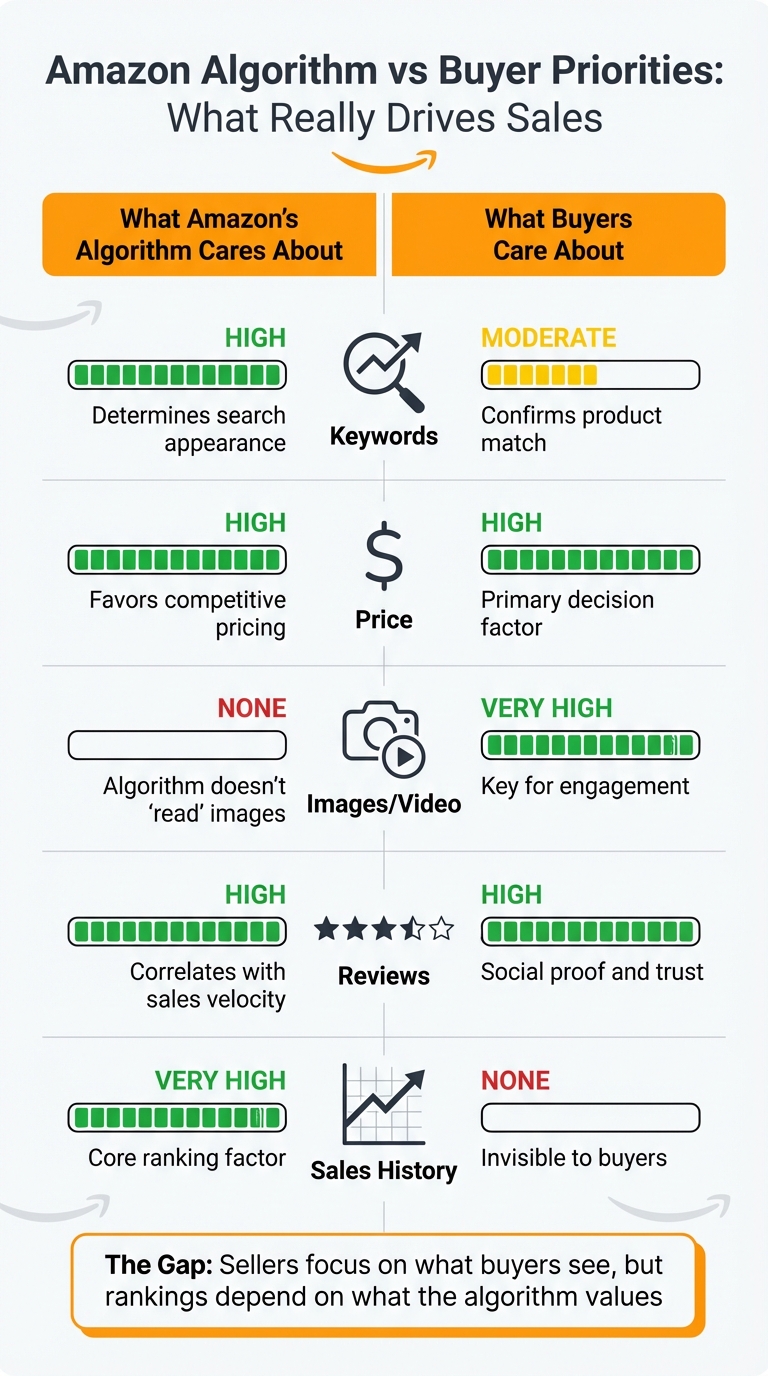
Amazon Algorithm vs Buyer Priorities: What Really Drives Sales
Many sellers approach Amazon as if it’s their brand’s personal website, pouring resources into visuals and design. But here’s the catch: Amazon isn’t about showcasing beauty – it’s a transactional search engine. Its algorithm cares more about purchase likelihood than polished imagery.
Here’s where sellers often miss the mark: while 80% of them focus on keyword optimization, many still treat it as secondary to design. They assume that attractive visuals will drive sales. But without the right keywords in your title or backend, your product becomes invisible to shoppers – no matter how stunning your photos are.
With Amazon ad costs climbing by 48%, organic visibility is more important than ever. Yet, sellers continue to prioritize aesthetics over the metrics that actually influence rankings. This misstep highlights a deeper issue: design alone won’t cut it on Amazon.
Why Good Design Doesn’t Guarantee Sales
Take this example from January 2025: Jungle Scout analyzed a "Pet Housebreaking Pad" listing that scored only 3 out of 10 on their Listing Quality Score. Despite being in a high-demand category, the seller made crucial mistakes – they used just 80 characters in the title (out of 200 allowed), uploaded a single image that couldn’t be zoomed, and wrote one bullet point that repeated the title. The outcome? Nearly zero visibility on the first page, no matter how good the product was.
The takeaway? Keywords bring visitors, and design converts them. Your competitor’s listing might look outdated, with blurry images, but if it’s packed with high-intent keywords and optimized for mobile, it’s winning the visibility game before shoppers even see your sleek design.
"Amazon’s algorithm prioritizes purchase likelihood above all else, making it fundamentally different from Google’s information-focused approach." – Hai Mag, Eva
How Amazon’s A9 and A10 Algorithms Work
Amazon’s search algorithms don’t care about your beautifully curated images or cohesive color schemes. Instead, they focus on text-based elements like titles, bullet points, and backend search terms. Rankings are then determined by sales velocity and conversion rates.
Amazon’s primary goal? Maximizing revenue per customer. The algorithm rewards products that consistently convert searches into purchases with higher placements. If your listing isn’t driving sales for specific keywords, it sinks – no matter how visually appealing it is.
The transition from the A9 to A10 algorithm made this even clearer. While A9 emphasized keyword matching, A10 introduced "Seller Authority" – factors like feedback scores, fulfillment speed (FBA status), and organic sales history. Sellers who focus solely on design miss these critical elements, which are essential for ranking. This explains why a competitor’s less polished listing can outperform one that’s aesthetically flawless.
Here’s a side-by-side look at what matters to Amazon’s algorithm versus what buyers actually care about:
| Factor | What Amazon’s Algorithm Cares About | What Buyers Care About |
|---|---|---|
| Keywords | High (Determines search appearance) | Moderate (Confirms product match) |
| Price | High (Favors competitive pricing) | High (Primary decision factor) |
| Images/Video | None (Algorithm doesn’t "read" images) | Very High (Key for engagement) |
| Reviews | High (Correlates with sales velocity) | High (Social proof and trust) |
| Sales History | Very High (Core ranking factor) | None (Invisible to buyers) |
Here’s the reality: an optimized listing can boost conversion rates by 25-40%. But optimization isn’t about making things prettier – it’s about aligning your listing with Amazon’s algorithm while also addressing how shoppers make decisions, often on small screens.
"At the end of the day, Amazon is a platform for getting people products that they want, really fast… It’s conversion relative to keyword, and that is really the core of why sales velocity is most important." – Nancy-lee McLaughlin, Director of Marketplace Search, Tinuiti
Why Ugly Listings Win: The Data Behind the Success
Listings that might appear less polished often dominate Amazon by excelling in three critical areas: keyword optimization, review volume, and pricing strategies. While you’re busy perfecting your brand’s visuals, your competitor is focusing on what really matters – visibility and conversions. Let’s break down how these factors work together to create results.
Keyword Optimization Beats Design Every Time
On Amazon, keywords are everything. They’re the bridge between your product and the shoppers searching for it. Amazon’s algorithm doesn’t care about your glossy images or sleek design – it’s all about the text. If your listing isn’t keyword-rich, it won’t even show up in search results. Meanwhile, your competitor’s less polished listing, packed with the right keywords, is getting all the clicks.
Here’s the reality: most shoppers don’t scroll beyond the first page. With over 65% of Amazon traffic coming from mobile devices, buyers tend to skim through the first few words of a title. Take these two examples:
- "Stainless Steel Dog Food Bowl Large Breed Non-Slip 64oz"
- "Premium Pet Dining Experience"
Which one do you think shows up for someone searching "dog food bowl large"? The answer is obvious. The first listing speaks directly to the search query, while the second one is too vague to get noticed.
"We’ve all seen a product with bad reviews, terrible photographs, and non-existent descriptions ranking well for one reason: they’re selling lots." – Dave Bryant, Ecommerce Expert
Once a listing starts generating clicks, it gains sales momentum, which further boosts its ranking. This creates a snowball effect: more clicks lead to more sales, and more sales tell Amazon’s algorithm to rank the listing higher. That’s how a less polished listing outperforms a visually appealing one [6,13].
Reviews Build Trust, Not Aesthetics
While keywords get shoppers to your listing, reviews are what seal the deal. A high number of reviews builds trust faster than any premium design ever could. Top-selling listings typically have 30 times more reviews than their less successful counterparts. A product with 1,000 reviews will always appear more trustworthy than one with just 50, even if the products are of similar quality.
Interestingly, the difference in average star ratings between high-ranking and low-ranking listings is minimal. A 4.2-star product performs almost as well as a 4.5-star one. However, the listing with hundreds or thousands of reviews will always have the upper hand. Given that only 1% to 3% of Amazon buyers leave reviews, reaching 1,000 reviews means selling anywhere from 33,000 to 100,000 units. That’s why those "ugly" listings are winning – they’ve been prioritizing conversions and building trust from the start.
"Good reviews trump price and prime." – Dave Bryant, Ecommerce Expert, EcomCrew
Reviews also directly impact your Best Seller Rank (BSR), which increases organic visibility. As your competitor racks up reviews, their improved BSR pushes their listing higher in search results. Meanwhile, a beautifully designed listing with few reviews struggles to gain traction.
Pricing: The Silent Game-Changer
Price often determines whether a shopper clicks "Add to Cart." The top three listings for any search term are, on average, 20% cheaper than the category average. Your competitor isn’t just outranking you – they’re underpricing you. While you’re justifying premium pricing with premium design, they’re winning buyers with affordability.
Here’s a quick look at how pricing correlates with ranking:
| Ranking Position | Price vs. Category Average |
|---|---|
| Top 3 | 20% Lower |
| #4 – #20 | 6% Lower |
| #21+ | 1% – 4% Higher |
Aggressive pricing creates sales velocity, which leads to more reviews and better rankings. Once a listing dominates the top spot and builds trust, the seller can gradually increase prices. But that initial willingness to sacrifice margin is what gets them there [5,13].
Psychological pricing and trust signals also play a huge role. That "ugly" listing likely uses tactics like psychological pricing (e.g., $19.99 instead of $20), money-back guarantees, and Prime shipping through FBA. In fact, 95% of bestseller listings use FBA. These strategies reduce buyer hesitation and drive conversions. It’s not about looking good – it’s about making smart, practical moves that lead to sales.
"Whether you call it buying behavior, sales velocity, sales, or conversions, what product people ultimately buy the most is what is going to rank the best on Amazon." – Dave Bryant, Ecommerce Expert
sbb-itb-e2944f4
How to Beat Ugly Competitors at Their Own Game
Outshining poorly optimized competitors starts with understanding what truly drives sales. Once you pinpoint their strategies, the path to surpassing them becomes much clearer.
How to Analyze Your Competitors’ Listings
The first step is figuring out what makes your competitor successful. Tools like reverse-ASIN lookups can help you uncover the high-traffic keywords that fuel their sales. Platforms such as Helium 10 or Jungle Scout allow you to input their ASIN and reveal the search terms they rank for – whether organically or through paid ads.
Dive deeper by reviewing their Best Seller Rank (BSR) history on sites like camelcamelcamel.com. This can help you determine if their success stems from temporary PPC campaigns or consistent, organic sales. If their BSR is strong but their Listing Quality Score (LQS) is low – indicating poor images, weak titles, or lackluster descriptions – you’ve found an opportunity. High demand combined with subpar competition is your chance to step in with a better-optimized listing.
"If you are not doing Amazon competitor research, you are leaving money on the table. Your competitors are already analyzing your listings, so why aren’t you doing the same?" – Francisco Valadez, VP of Brand Operations, My Amazon Guy
Customer reviews are another goldmine of information. With nearly 91% of shoppers checking reviews before purchasing, you can use this feedback to your advantage. Look at what customers complain about in negative reviews and what they praise in positive ones. This will help you identify product weaknesses and highlight the features that matter most to buyers. Additionally, keep an eye on pricing strategies. Tools like Profasee can monitor price fluctuations, and if your competitors are using coupons or strikethrough pricing, you may need to adjust your pricing to stay competitive.
Once you’ve gathered these insights, update your listing to better align with what buyers actually want.
Optimizing Your Listing for How Buyers Actually Shop
Using competitor data, fine-tune your listing to match buyer preferences. Start by including important keywords in the first 80 characters of your title. Rewrite bullet points to focus on customer benefits rather than just listing features. Phrases like "so that" or "allowing you to" are great for turning technical details into emotional solutions. For instance, instead of saying "non-stick coating", you could write, "non-stick coating so you spend less time scrubbing and more time enjoying your meals".
Your images should do more than look good – they should work as visual explanations. Include graphics that show product dimensions, comparison charts, or even trust-building elements like guarantees or top reviews. Sellers who made at least 25% of their product images zoomable (1,000px or larger) saw a 64% increase in sales, while using four or more images led to a 59% sales boost within a week.
Don’t forget about your backend search terms. Amazon gives you 250 bytes to include keywords that don’t naturally fit into your public-facing copy, like synonyms, regional variations, or uncommon search terms. Avoid duplicating keywords already in your title or bullet points – Amazon’s algorithm prefers variety over repetition.
Using Emplicit‘s PPC and Listing Optimization Services
A well-optimized listing can significantly increase conversions, and Emplicit is here to help you maintain that competitive edge. From PPC management to listing optimization, inventory oversight, and account health monitoring, Emplicit offers the tools and expertise you need to grow your business.
Their PPC management ensures your ads target the right keywords at the right price, driving traffic to your enhanced listings. Meanwhile, their listing optimization services go beyond basic keyword research by employing data-driven strategies to improve titles, bullet points, images, and backend search terms, maximizing both visibility and conversions. They also handle inventory management and account health, allowing you to focus on scaling your brand.
With USA-based account managers and personalized strategies tailored to your business, Emplicit provides hands-on marketplace management to keep you ahead of the competition.
"Listings will make us or break us as Amazon sellers, which means investing the time to maximize your listing’s efficiency is extremely important." – Brian Connolly, Ecommerce Expert, Jungle Scout
Conclusion: Focus on What Actually Drives Sales
Eye-catching design might get attention, but it’s conversions that keep your business afloat. If your competitor is outperforming you, it’s likely because they’ve mastered the essentials: keyword optimization, customer reviews, and smart pricing strategies. While you’ve been perfecting visuals, they’ve been diving deep into how Amazon’s A10 algorithm works and what truly influences shopper behavior.
The data speaks for itself. Most shoppers don’t venture beyond the first page of search results, and 91% rely on reviews before making a purchase. Sellers who prioritize these fundamentals often experience a 25% to 40% boost in conversion rates after making strategic updates.
"A good listing doesn’t just look polished – it performs. Every element plays a role in buyer confidence, and every optimization compounds your results." – Nformed
Start by studying your competitors’ keyword strategies with reverse-ASIN tools. Revamp your titles to ensure critical search terms are within the first 80 characters. Use bullet points to address customer concerns, fill all image slots with informative visuals, and refine backend search terms to capture more traffic. These changes aren’t just surface-level – they directly impact your revenue.
Keep your focus on the factors that truly drive conversions, not just appearances. Emplicit’s team is ready to help you implement these tactics and reclaim your market share. From PPC campaigns targeting high-converting keywords to optimizing listings based on shopper behavior, their USA-based account managers bring the expertise to help you outpace competitors and grow your sales.
FAQs
Why is my Amazon listing not performing as well as my competitor’s, and how can I improve it?
Your Amazon listing might not be performing as well as it could because it’s not fully aligned with both Amazon’s algorithm and how shoppers browse. To make your listing more effective, pay attention to keyword usage, eye-catching visuals, pricing strategies, and customer reviews.
Start by identifying high-traffic keywords and weaving them into your title, bullet points, and description in a natural way. Use clear, benefit-focused language to emphasize what makes your product special. For visuals, ensure your images are high-resolution, include lifestyle shots, and clearly display key features. Pricing plays a big role too – consider offering discounts or coupons to make your product more enticing. Lastly, encourage happy customers to leave positive reviews and respond quickly to any questions or concerns. These efforts can help your listing stand out, driving more visibility and sales.
Why do reviews matter more than a polished design on Amazon?
Reviews play a huge role in succeeding on Amazon because they offer social proof – the kind of trust-building evidence shoppers need. In fact, more than 75% of U.S. consumers lean toward highly-rated products when shopping online. Reviews don’t just influence decisions – they often seal the deal. Positive feedback gives buyers confidence that a product delivers on its promises, making them more likely to hit "Add to Cart."
Sure, a sleek product design can grab attention, but without solid reviews, it won’t necessarily translate into sales. Shoppers want to know what others think before committing, and Amazon’s algorithm favors listings with better ratings, pushing them higher in search results. Unlike design tweaks that might need constant updates, reviews are evergreen – they keep building trust and driving sales over time.
If you want to outpace competitors, aim to collect genuine, high-quality reviews. A strong review profile consistently has more impact on sales than visual upgrades, helping you stand out in the crowded Amazon marketplace.
How can I use pricing strategies to boost my Amazon sales?
Pricing on Amazon isn’t just about slashing numbers to beat the competition – it’s about being strategic and adaptable. A key factor is keeping a close eye on the Buy Box, as winning it can make or break your sales. To stay ahead, be prepared to tweak prices swiftly when needed. Tools like dynamic pricing software can be a lifesaver, automatically adjusting your prices based on competitor activity, seasonal trends, or changes in Amazon’s algorithm. This way, you stay competitive without cutting too deeply into your profit margins.
Another essential piece of the puzzle is psychological pricing. For instance, using charm pricing – like $19.99 instead of $20.00 – can make your product feel like a better bargain. Bundling related products together is another smart move. It lets you charge more while avoiding direct price comparisons with competitors. Short-term discounts, such as coupons or Lightning Deals, are also effective. They create urgency and boost your product’s visibility without permanently lowering your price. Offering tiered discounts, like "buy 2, get 10% off", can encourage customers to buy in larger quantities.
By combining these pricing strategies, you can strike a balance between driving sales and keeping your profits intact.