

Counterfeit goods cost businesses billions annually, but marketplaces and brands are fighting back with smarter strategies and tech. This article dives into five real-world examples of copyright enforcement, showing how companies are tackling infringement and protecting their brands.
Key Takeaways:
- Amazon blocked 99% of infringing listings in 2024 using AI, investing over $1.2 billion in brand protection.
- Temu launched an AI-powered IP Portal, reducing takedown times and banning repeat offenders.
- Napster‘s legal battle set the stage for modern copyright enforcement, holding platforms accountable for user activity.
- SHEIN and Temu’s DMCA conflict highlights how copyright claims can be weaponized in competitive disputes.
- Vietnam’s first criminal copyright case demonstrated the power of international collaboration against piracy.
These case studies reveal how combining technology, legal action, and collaboration can help brands stay ahead of counterfeiters. Whether it’s automated tools or stricter policies, the focus is on early detection and swift responses to protect brand integrity.
Copyright Enforcement Statistics: 5 Major Marketplace Case Studies
Trademark enforcement: Dealing with infringement on social media and e-commerce platforms
Case Study 1: Temu‘s Action Against 20 Infringing Domains
Temu faced a mounting challenge: counterfeit products were flooding its platform, and manual efforts to remove them simply weren’t cutting it. The company realized it needed a more robust system to tackle infringement effectively.
To combat the issue, Temu developed a centralized IP Portal where rights owners could report infringements by providing detailed information, such as registration numbers and URLs. In addition, Temu worked with global organizations like INTA and IACC to identify suspicious activities. Once a violation was confirmed, it was added to an internal database designed to track and monitor repeat offenses. This system became the foundation for a faster, AI-powered approach to resolving infringement cases.
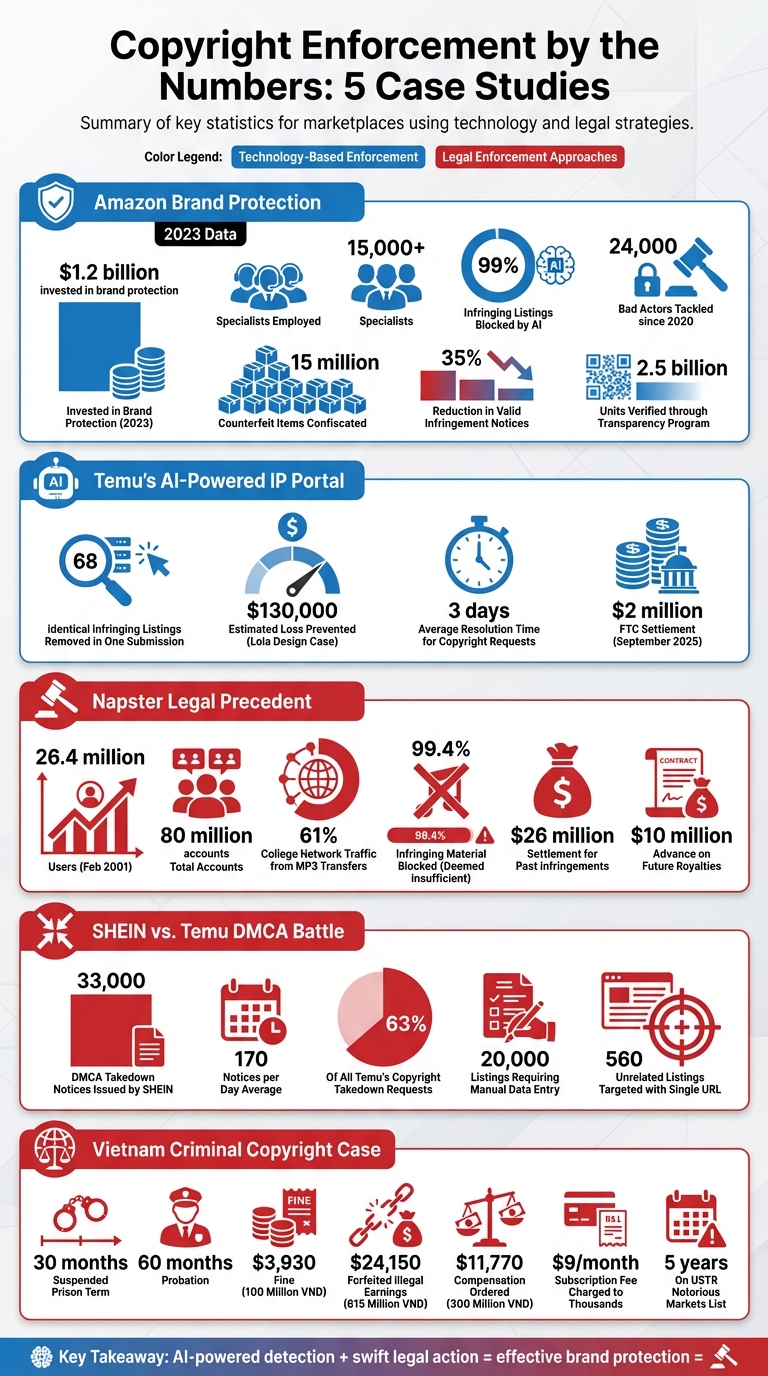
The results were impressive. In October 2025, Lola Design, a York-based firm co-founded by Amanda Mountain, took part in a trial of Temu’s AI-driven system. During the trial, Ms. Mountain discovered that a decade’s worth of her greeting card designs had been copied, leading to an estimated loss of $130,000 – about 13% of the company’s annual revenue. The new automated system allowed a single publisher to remove 68 identical infringing listings in one go through a single submission. The AI technology not only registered original designs as protected images but also proactively blocked products using those designs before they could even be listed for sale.
"The system will then use AI to log the designer’s original creation as a protected image. It will then block any products using that design before they appear for sale." – BBC/Greeting Card Association
Building on this progress, Temu introduced a Repeat Infringer Policy to permanently ban habitual offenders. Following a settlement with the FTC in September 2025 that included a $2 million civil penalty, Temu also added telephonic reporting to its tools. This new feature ensured that most copyright removal requests were resolved within three days.
Case Study 2: Napster and Copyright Enforcement History
Back in the early 2000s, Napster found itself at the center of a major copyright battle. By February 2001, the platform had amassed a staggering 26.4 million users and 80 million accounts. It was so popular that college dorm networks reported up to 61% of their traffic was tied to MP3 transfers. These numbers made it clear that stronger copyright controls were desperately needed.
The legal showdown that followed became a cornerstone for modern copyright enforcement. A&M Records and the RIAA sued Napster on three key counts: direct copyright infringement by its users, contributory infringement for enabling illegal file sharing, and vicarious infringement for profiting from this activity while having the ability to stop it. Napster’s centralized file index made it possible for the platform to monitor and block infringing content, a fact that played a significant role in the case.
Despite Napster’s efforts to block 99.4% of infringing material, the District Court found this insufficient. As Professor Lawrence Lessig observed:
"When Napster told the district court that it had developed a technology to block the transfer of 99.4 percent of identified infringing material, the district court told counsel for Napster 99.4 percent was not good enough. Napster had to push the infringements ‘down to zero’".
Ultimately, Napster was forced to settle, paying $26 million for past infringements and a $10 million advance on future royalties. However, the financial strain was too great, and the company filed for bankruptcy in June 2002. This case set a powerful precedent, shaping how digital platforms are now required to actively combat infringement.
The Napster case made it clear that platforms with the ability to monitor user activity cannot simply sit back. This principle continues to influence enforcement practices today, particularly on ecommerce platforms like Amazon and TikTok Shops. These platforms must now use real-time monitoring and automated tools to filter out infringing content to comply with legal requirements. The case also introduced the "inducement theory", later reinforced in MGM v. Grokster, which holds platforms accountable if they actively encourage infringement – whether through marketing tactics or other actions that promote unauthorized content.
Case Study 3: SHEIN vs. Temu DMCA Legal Conflict
The ongoing legal skirmish between SHEIN and Temu sheds light on how copyright enforcement can be wielded as a competitive weapon. By late 2023, SHEIN had issued over 33,000 DMCA takedown notices targeting Temu’s listings – averaging around 170 notices per day. According to Temu, these notices made up 63% of all copyright takedown requests it received. Temu accused SHEIN of using these notices as a deliberate strategy to overwhelm its compliance teams, claiming many of the notices lacked merit and were part of an intimidation tactic. This conflict underscores how aggressive use of DMCA notices can lead to unintended consequences.
Temu also highlighted several procedural hurdles allegedly caused by SHEIN. For instance, Temu claimed that SHEIN submitted takedown requests via unclickable PDFs and incorrect links, forcing manual data entry for nearly 20,000 listings. In one instance, a single URL was cited to justify takedown notices for over 560 unrelated listings. Temu further argued that SHEIN selectively enforced copyright claims, targeting images on Temu while ignoring identical content on platforms like Amazon.
On February 9, 2025, Judge Timothy J. Kelly denied Temu’s motion for a preliminary injunction, stating that Temu had not demonstrated irreparable harm – damage that could not be resolved through monetary compensation. Judge Kelly explained:
"Temu has not shown that any harm it may suffer is certain, great, actual and not theoretical, and cannot be later remediated with money damages."
The court also noted that Temu, as a subsidiary of the multi-billion-dollar PDD Holdings, continued to grow despite the takedown efforts, indicating that its survival was not at risk. However, the legal battle was far from over. On September 30, 2025, the court allowed Temu’s Section 512(f) claims to proceed, citing plausible allegations of willful negligence in SHEIN’s repeated submission of erroneous notices. The court remarked:
"A mistake repeated hundreds or thousands of times is quite plausibly not a mistake."
This case illustrates the challenges platforms face when attempting to curb aggressive DMCA tactics. To secure an injunction, companies must prove that a competitor’s actions pose a genuine existential threat, not just financial harm. It also highlights the potential of Section 512(f) as a tool to counter bad-faith takedown notices, though resolving such disputes often requires significant time and resources.
sbb-itb-e2944f4
Case Study 4: Vietnam’s First Criminal Copyright Case
In April 2024, Vietnam took a major step in enforcing digital copyright laws by sentencing Le Hai Nam, the operator of BestBuy IPTV, to a 30-month suspended prison term along with 60 months of probation. Nam was also fined 100 million VND (about $3,930), ordered to forfeit 615 million VND (roughly $24,150) in illegal earnings, and required to pay 300 million VND (approximately $11,770) in compensation. This case marked Vietnam’s first criminal prosecution for online copyright infringement, setting a significant precedent in a country that, in 2022, ranked highest globally per capita for accessing and sharing pirated online videos.
The case highlighted the importance of collaboration between Vietnamese authorities and international organizations. The Football Association Premier League and the Alliance for Creativity and Entertainment (ACE) played pivotal roles by providing formal complaints and detailed financial evidence. This evidence demonstrated that BestBuy IPTV charged thousands of subscribers around $9 per month for unauthorized streams of Premier League matches and movies. With this data, authorities were able to establish criminal intent and meet the "illicit profit" requirement under Vietnam’s 2015 Penal Code, avoiding the need to rely on the previously ambiguous "commercial scale" standard.
International pressure also played a key role. BestBuy IPTV had been listed on the USTR Notorious Markets List for five consecutive years. Judge Le Hai Yen emphasized the importance of the ruling as a deterrent, stating:
"It is necessary to apply a strict penalty on the defendant to educate and reform offenders and for general deterrence and prevention".
Nguyen Van Vien of Frasers Law Company further commented:
"This verdict demonstrates the State’s political determination to protect rights on an equal basis with public interest".
This case underscores the value of strong public-private partnerships in addressing copyright infringement. It also highlights the importance of integrating tools like international watchlists and conducting detailed financial audits to tackle persistent offenders. For marketplaces, the lesson is clear: providing precise financial data – such as subscriber numbers, transaction details, and profit metrics – can strengthen criminal cases against repeat infringers. Shifting from civil to criminal prosecution creates a stronger deterrent, especially in regions where intellectual property enforcement has traditionally been weak. Monitoring resources like the USTR Notorious Markets List can help identify high-risk entities that may require criminal investigation rather than just routine takedowns.
Case Study 5: Starbucks Trade Dress Protection Case

Back in 1997, Starbucks found itself in a legal battle when Wolfe’s Borough Coffee, operating under the name Black Bear Micro Roastery, introduced products called "Mister Charbucks" and "Charbucks Blend." Starbucks quickly issued a cease and desist letter, setting off a legal dispute that lasted 12 years, finally concluding in November 2013. This case highlights the importance of acting promptly to safeguard a brand’s identity. Interestingly, the defendant admitted that the names were intended to play off the "coffee wars" association with Starbucks. Despite this, Starbucks ultimately lost its dilution claim in court.
The legal argument centered on "dilution by blurring", where a brand’s distinctiveness is weakened through association, even if consumers aren’t directly confused. In a 2005 survey commissioned by Starbucks, 30.5% of respondents linked the name "Charbucks" to Starbucks, but only 3.1% believed that Starbucks itself sold a product with that name. The Second Circuit Court of Appeals emphasized the importance of context in such cases, stating:
"To be probative, consumer surveys should present the marks at issue as they appear in commerce".
This case also sheds light on the distinction between trademarks, which cover brand names and logos, and trade dress, which protects the overall visual design of a product, including elements like shape, color, and texture. Marketplaces require sellers to provide precise, non-functional descriptions of trade dress elements. Starbucks, for example, reinforces its brand protection with 56 trademarks registered across its stores and website.
For sellers, this case underscores a few critical lessons: keep an eye out for even subtle similarities that could exploit your brand’s reputation, act quickly by issuing cease and desist notices to establish your enforcement efforts, and collect evidence showing how products are presented to consumers. Even brands as well-established as Starbucks must prove actual dilution of their brand’s distinctiveness – not just consumer association – to succeed in court. Protecting your brand’s identity requires timely, well-documented actions and a clear focus on how your brand is perceived in the marketplace.
Key Lessons and Technology for Copyright Enforcement
The five case studies highlight a recurring theme: early detection and proactive technology consistently outperform reactive legal measures. Take Amazon, for instance. In 2023, the company poured over $1.2 billion into brand protection efforts and employed more than 15,000 specialists dedicated to this cause. Their AI-driven systems were able to block over 99% of suspected infringing listings before brands even needed to step in. By using advanced tools like machine learning and computer vision, Amazon can scan massive data sets to spot visual infringements – such as logos, patterns, and shapes – with remarkable accuracy. Since its launch in 2020, Amazon’s Counterfeit Crimes Unit has tackled more than 24,000 bad actors and confiscated over 15 million counterfeit items globally. This has led to a 35% reduction in valid infringement notices. However, as enforcement technology becomes more advanced, counterfeiters are also stepping up their game.
These bad actors are now leveraging platforms like TikTok and Instagram to evade detection. One popular method involves using "hidden links" on social media. Here’s how it works: a generic product is shown on a marketplace, but what actually gets shipped is a counterfeit luxury item. This highlights the growing need for cross-platform monitoring to combat such schemes effectively.
In light of these evolving challenges, brands need to step up their protection strategies. Lessons from recent enforcement efforts show that proactive, tech-driven programs are essential to safeguard brand integrity. For businesses operating on platforms like Amazon and TikTok Shops, robust brand protection tools are a must. Programs like Amazon Brand Registry provide automated safeguards and self-service options for removing counterfeit listings. Additionally, serialization tools such as Amazon’s Transparency program – which has verified over 2.5 billion units as authentic – allow for real-time verification at the individual unit level. To further strengthen these efforts, services like Emplicit offer brand management and account health solutions, helping businesses stay compliant and enforce protections across various marketplaces.
FAQs
How does AI make copyright enforcement more effective on marketplaces?
AI has transformed how copyright enforcement works on platforms like Amazon and TikTok Shops. By automating the detection process, machine learning tools can scan millions of listings in real-time. These tools compare product images, descriptions, and even audio or video content against registered brand assets. When a match is found, the system can flag or remove the listing almost immediately, cutting down the need for time-consuming manual reviews.
With advanced features like image recognition and natural language processing, these tools can even catch subtle counterfeit variations or misleading keywords – helping brands stay one step ahead of infringers. For businesses managing operations across multiple platforms, Emplicit offers AI-powered solutions as part of its ecommerce services. This integration allows brands to protect their intellectual property more effectively, maintain customer trust, and ensure their operations run smoothly.
What are the risks of misusing DMCA takedown notices in online marketplaces?
Misusing DMCA takedown notices isn’t just unethical – it can land you in serious legal and financial trouble. According to 17 U.S.C. § 512(f), filing false copyright infringement claims knowingly can make you liable for damages, including attorneys’ fees, and may even result in statutory penalties. Courts have also linked baseless DMCA claims to issues like unfair competition, defamation, and even antitrust violations, which only heighten the potential risks.
Take Amazon, for instance. The company has taken legal action against sellers who misused its Brand Registry by submitting fabricated DMCA requests, seeking not only damages but also injunctive relief. In other cases, false counterfeit claims have led to defamation lawsuits, where businesses successfully pursued compensation for reputational harm. These examples illustrate how dishonest DMCA tactics can backfire, leaving brands with both financial losses and damaged reputations.
To steer clear of these pitfalls, it’s crucial for brands to ensure their copyright enforcement strategies are lawful and in line with U.S. regulations. Working with seasoned e-commerce advisors, like Emplicit, can provide the guidance needed to navigate these challenges and protect your business the right way.
How does international collaboration help combat digital piracy?
Tackling digital piracy effectively requires a united front, bringing together expertise, legal authority, and resources from across the globe. Take, for instance, the combined efforts of marketplaces, brands, and law enforcement agencies. By working together, they can dismantle counterfeit supply chains that operate across multiple countries. What might seem like isolated incidents can transform into comprehensive, global solutions. A great example of this is platforms like Amazon and TikTok Shops, which have used shared intelligence and enforcement protocols to achieve impressive results – removing millions of infringing products and videos in just one year.
For brands operating on international platforms, partnering with organizations that understand both local laws and global enforcement strategies – such as Emplicit – can make a huge difference. These partnerships simplify the process of taking down counterfeit listings, monitoring cross-border activity, and improving collaboration with platform intellectual property teams. By tapping into shared databases and standardized reporting tools, companies can better safeguard their revenue and brand reputation in the face of a counterfeit market valued at over $450 billion annually. Unified, multinational efforts not only make it harder for counterfeiters to escape consequences but also ensure faster removal of infringing content and stronger brand protection on a global scale.