

Most retargeting waste comes from four leaks: bad tracking, one-size-fits-all ads, weak frequency control, and messy attribution. If I want better ROI, I need to fix those four areas first – not just spend more.
Here’s the short version:
- Only 2%–4% of ecommerce visitors buy on the first visit, so retargeting matters.
- Reported ROAS can overstate sales by 30%–60% when platforms double-count the same conversion.
- Tracking loss after privacy changes cut visibility by 40%–60% for many brands.
- Generic ads can convert 3–5x worse than product-led ads matched to shopper intent.
- Ad fatigue often starts around the 7th weekly impression.
- Many brands push frequency 200%–400% past the best range across channels.
- After lift testing, reported retargeting ROAS can drop from about 4.2x to 1.0x–1.5x.
If I had to boil the article down into action steps, I’d do this:
- Fix event tracking first: Product View, Add to Cart, Initiate Checkout, and Purchase.
- Use server-side tracking to patch data loss and improve match rates.
- Segment by intent and recency instead of one big retargeting pool.
- Match ads to funnel stage: browse, consider, cart, and win-back.
- Set lookback windows and frequency caps by audience type.
- Exclude recent buyers so spend doesn’t hit people who already converted.
- Set budget by audience intent, not by platform habit.
- Use holdout tests to measure lift, not just platform claims.
- Pull reporting into one view so one sale doesn’t get counted three times.
A simple way to think about it: retargeting works best when data, message, timing, spend, and measurement all line up. If even one part is off, CAC tends to climb while dashboard ROAS still looks fine.
The rest of the article explains how to tighten each part of that system without making the setup more complex than it needs to be.
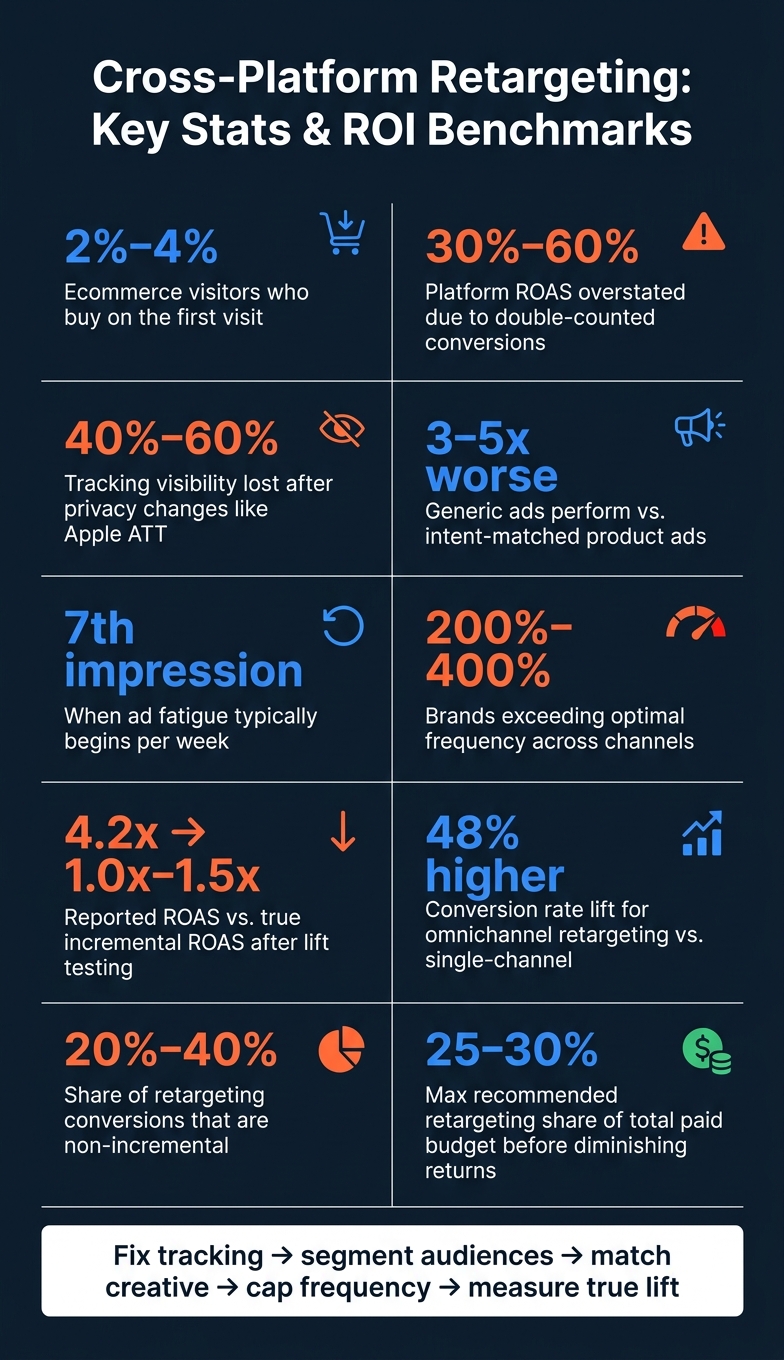
Cross-Platform Retargeting: Key Stats & ROI Benchmarks
Problem 1: Misaligned Audiences and Incomplete Tracking
Problem: Fragmented Pixels, Tags, and Marketplace Signals
When channel data is split up, audience quality is usually the first place ROI starts to leak.
Here’s why: cross-platform retargeting falls apart when one shopper shows up as different people across devices, channels, and accounts. Older tracking setups often count the same person more than once, which means ad spend gets burned on duplicate or misread audiences.
Apple’s App Tracking Transparency (ATT) rollout, along with other browser-level limits, reduced visibility into off-site activity by 40% to 60%. For many mid-market DTC brands, pixel match rates dropped from 70%–80% to 30%–50%. And once events like Add to Cart or Initiate Checkout go missing, things get worse. Platforms can’t tell the difference between a casual visitor and someone who was one step from buying.
Solution: Standardize Event Tracking and Build Behavior-Based Segments
Start with the basics: make sure core events fire the right way on every platform. At a minimum, track:
- Product View
- Add to Cart
- Initiate Checkout
- Purchase
If even one of these is missing or firing the wrong way, your audience pools are incomplete and your budget choices are built on shaky signals.
Pixels by themselves don’t cut it anymore. Add server-side tracking alongside your pixels to improve audience accuracy. One example comes from Iris&Romeo, which spent four months rebuilding its tracking setup before launching new ads. After that work, its Meta CAPI match rate went from 38% to 71%.
"Our CAPI match rate went from 38% to 71%. That’s the foundation everything else runs on." – Drew Fallon, Co-founder, Iris&Romeo
Once event tracking is clean, build segments based on intent and recency instead of tossing everyone into one large retargeting bucket. A shopper who added to cart yesterday is not in the same mindset as someone who viewed a product 90 days ago.
| Recency Window | Audience Intent | Recommended Angle |
|---|---|---|
| 1 day | Peak purchase intent | Cart abandonment, urgency |
| 7 days | Active consideration | Social proof, reviews |
| 30 days | Cooling interest | New angle, product benefit |
| 90 days | Passive lapsed | Brand reminder, new collection |
Source: Adlibrary
If your pixel fires fewer than 2,000 events per week, keep it simple and use one 30-day window. Audiences under about 1,000 unique users can fall below platform delivery thresholds, which can lead to under-delivery or noisy data that’s hard to trust.
How Operational Support Can Improve Audience Accuracy
Brands running both marketplace retargeting and owned-channel retargeting usually need tight coordination across systems to keep tracking clean. Emplicit helps brands check tracking and line up marketplace and ecommerce signals so retargeting audiences match actual shopper behavior.
sbb-itb-e2944f4
Problem 2: Generic Creative and Poor Message Sequencing
Problem: One Message for Every Audience
Once audiences are grouped by intent, the next job is simple: show each group the right message. If tracking is clean but every shopper sees the same ad, ROI slips fast.
That happens because a cart abandoner and a lapsed customer are not in the same mindset. One may need a small nudge, like free shipping. The other may need a stronger reason to come back. Treating them the same usually leads to wasted spend.
Frequency makes this worse. Ad fatigue starts around the 7th weekly impression, and negative sentiment shows up after the 15th. On top of that, generic ads convert 3 to 5x worse than intent-matched creative that shows the exact product a shopper already viewed.
Solution: Use Dynamic Product Ads and Stage-Based Messaging
The fix is to match the message to the moment.
A casual browser often needs trust signals, product context, or a reason to care. A cart abandoner usually needs urgency or a cost offset, such as free shipping. That shift sounds small, but it changes how the ad lands.
A good place to start is a 14-day sequence:
- Days 1–3: social proof
- Days 4–7: product benefits
- Days 8–14: a specific offer or discount
This gives you a simple structure for four shopper stages: browse, consider, cart, and win-back. Each stage gets a message that fits where the shopper is, instead of one recycled ad trying to do every job.
At the bottom of the funnel, Dynamic Product Ads (DPAs) do a lot of the work. They automatically show the exact items a shopper viewed. That matters because relevance drives clicks. DPAs outperform generic retargeting by 3x to 6x on CTR and 2x to 4x on ROAS.
Static creative still has a place. It’s useful for brand storytelling, social proof, and win-back campaigns. But it needs to be rotated often, or performance starts to fade.
| Feature | Static Creative | Dynamic Product Ads (DPA) |
|---|---|---|
| Best Use Case | Brand storytelling, social proof, or win-back for lapsed customers | Cart abandonment and specific product page viewers |
| Strengths | High control over aesthetics; can look like organic UGC | Highly personalized; automatically shows viewed items |
| Limitations | High manual effort to update; lower relevance for multi-SKU stores | Requires a clean product feed and technical setup |
| Expected ROI Impact | Strong for awareness and consideration stages | 3x–6x higher CTR and 2x–4x higher ROAS vs. generic ads |
Solution: Keep the Offer Consistent but Adjust the Format by Platform
After the message sequence is set, the next step is delivery. Keep the offer the same across channels. Change the format to fit the platform.
TikTok and Instagram tend to work best with short-form video that feels native to the feed. Google Search and Shopping reach shoppers who are already in research mode, so product-led display and RLSA campaigns tend to fit better there. Brands that run omnichannel retargeting across display, search, and social see 48% higher conversion rates than brands using a single channel.
A simple way to think about it:
- TikTok supports discovery
- Meta supports social proof
- Google supports conversion
That doesn’t mean building one ad and pasting it everywhere. It means using one offer, then shaping the asset for the job each channel needs to do. Even a strong ad can lose ROI when timing is off or frequency gets too high.
Cross Channel Remarketing Strategies
Problem 3: Poor Timing, Frequency, and Budget Controls Inflate CAC
After audience targeting and creative sequencing, the next ROI test is delivery discipline. Once you have the right audience and the right message, timing and frequency often become the biggest CAC leak.
Problem: Ad Fatigue and Inefficient Retargeting Windows
Overexposure gets expensive fast. When the same shopper sees your ad too many times, they stop paying attention. At that point, you’re buying impressions without getting more action.
Not every audience loses intent at the same pace. A cart abandoner from two hours ago is in a very different buying stage than a homepage visitor from three weeks ago. If you use the same lookback window and the same frequency for both, you spend too much on the lower-intent group and not enough on the people most likely to buy.
Research shows that 73% of brands exceed optimal frequency by 200–400% when measured across platforms without coordination. That’s not a small miss. It’s a budget leak built into the system.
Solution: Set Frequency Caps, Exclusion Rules, and Intent-Based Lookback Windows
The fix is simple in theory: match your retargeting window and frequency to the intent level of each segment.
Cart abandoners tend to have a short peak window. Their purchase intent is highest in the first 72 hours and then falls off hard. Homepage visitors are still early in the process, so they can stay in the pool longer, but they need far fewer impressions each week.
Exclusion rules matter just as much. Exclude recent purchasers for 30 days, or 60 days for high-ticket items, to cut wasted spend and avoid irritating people who already converted.
| Audience Segment | Optimal Lookback Window | Weekly Frequency Cap | Conversion Potential |
|---|---|---|---|
| Cart Abandoners | 3–7 Days | 7–10 impressions in 3 days | Highest |
| Product Viewers | 7–14 Days | 5–7 | High |
| Category Browsers | 14–30 Days | 3–5 | Moderate |
| Homepage Visitors | 30–60 Days | 2–3 | Low |
You also need frequency analysis to spot the point where more impressions stop adding ROAS. Amazon Marketing Cloud‘s Optimal Frequency Analysis is one tool for finding that cutoff.
Solution: Allocate Budget by Intent Level, Not by Platform Habit
Once you’ve ranked intent, fund the highest-intent pools first.
A common mistake is setting retargeting budget as a fixed share of total ad spend, then splitting it across platforms based on habit instead of results. That’s how teams end up putting too much money into one channel while starving the segments most likely to convert.
Budget should fit the size of the retargeting pool, not the platform. If your cart abandoner audience is small, pushing a big budget into it will burn through the pool fast and send frequency up. Scaling retargeting past 25–30% of total paid budget often backfires because it pulls dollars away from acquisition, which is what keeps the retargeting pool full.
Bidding should also match intent level:
- Target ROAS works well for high-intent groups like cart abandoners because the signal is strong and the goal is revenue.
- CPM fits broader, lower-intent segments when the goal is cheap reach, but it also brings a bigger risk of ad fatigue if frequency caps are loose.
| Bidding Model | Best-Fit Scenario | Benefits | Tradeoffs |
|---|---|---|---|
| CPC | High-intent search (RLSA) | Pay only for active interest | Can be expensive in competitive niches |
| CPM | Broad reach / Awareness (DSP) | Lowest cost for high volume | High risk of ad fatigue and wasted spend |
| Target CPA | Lead gen or specific actions | Predictable acquisition costs | May limit scale if target is too aggressive |
| Target ROAS | Ecommerce (DPA) | Optimizes for high-value orders | Heavily reliant on accurate pixel/signal data |
And when you measure impact, don’t stop at dashboard ROAS. Use holdout tests. Excluding 10–20% of a retargeting audience as a control group helps you measure true incremental lift instead of leaning on platform-reported numbers, which can overstate how much revenue the campaign actually drove. Without that check, it’s easy to keep spending on campaigns that look good in the dashboard but aren’t adding conversions you wouldn’t have gotten anyway.
Problem 4: Siloed Reporting and Channel Operations Hide True ROI
You can fix audience targeting, tighten up creative, and cap frequency – and still not know if retargeting is pulling its weight. The usual reason? Your reporting is split across platforms, and each one reports the sale in a way that makes itself look good.
Problem: Last-Click Reporting Hides Assisted Revenue
A shopper might first find your brand on one channel, come back through another, and then convert somewhere else. But with last-click reporting, more than one platform can end up taking credit for that same sale. That makes retargeting ROAS look better than it is and pushes spend toward bottom-funnel campaigns while upper-funnel channels get shortchanged – even though they helped bring those shoppers in to begin with. Over time, that hurts the whole system because fewer new people are entering the funnel, which means the retargeting pool gets smaller.
On paper, reported retargeting ROAS averages 4.2x. After incrementality is factored in, that number often drops to 1.0x–1.5x. Once attribution gets split up like this, every budget call that comes after starts to feel shaky.
Solution: Centralize Reporting, Catalog Data, and Test Cycles
The first step is simple in theory, but it takes discipline: pull channel data into one attribution layer. That gives you one shared view of performance instead of a pile of self-reported platform numbers that don’t line up.
Then move beyond last-click. Multi-touch attribution gives you a better read on how conversion paths work. For example, a position-based model assigns 40% of credit to the first touch, 40% to the last touch, and spreads the remaining 20% across the middle. That gives awareness channels credit for starting the journey while still giving retargeting credit for closing the sale.
Product data matters too. If a retargeting ad sends shoppers to an out-of-stock product page, that spend is wasted on the spot. Feed management tools with hourly updates can keep ads in sync with what’s in stock. That gets tough to manage by hand when a brand sells on Amazon, Walmart, TikTok Shop, and its own site at the same time. Emplicit’s marketplace management, listing optimization, and inventory management services help keep product data accurate and consistent across channels.
Once reporting and catalog data are cleaned up, test what’s actually driving lift. A holdout test is a good place to start:
- Randomly exclude 10% to 20% of your retargeting audience
- Compare that group’s conversion rate with the exposed group
- Measure the lift instead of relying on platform claims
Brands that do this often find that 20% to 40% of retargeting conversions were non-incremental.
Conclusion: The Highest-Impact ROI Fixes to Prioritize First
The last big ROI fix is treating measurement as part of the retargeting engine, not as a reporting chore you handle later. Cross-platform retargeting only works when tracking, creative, timing, budget, and reporting all work together. When you run retargeting as one connected system instead of a bunch of separate campaigns, ROI becomes something you can measure – not just something you assume.
FAQs
How do I know if my retargeting ROAS is inflated?
Your retargeting ROAS may be inflated if it’s far higher than your blended ROAS, or if platform-reported conversions add up to more than your actual total revenue.
This tends to happen because ad platforms often use last-click or view-through attribution and give themselves full credit for a conversion. So the dashboard can look great on paper while your internal numbers tell a different story.
A simple gut check helps here: compare each platform’s reported results with your own source of truth. That might be your Shopify data, CRM, or back-end revenue reports. A 30% to 60% gap is common.
What should I fix first if my tracking is incomplete?
First, shift from client-side pixels to server-side event tracking like Meta Conversions API and Google Enhanced Conversions. This can help win back data that gets lost because of browser limits and privacy changes like iOS 14.5+.
It also helps to standardize your UTM parameters and match time zones across platforms. If one tool logs a conversion at 11:00 p.m. and another records it after midnight, your reporting can get messy fast. Keeping those settings in sync makes your data more consistent and supports a reliable single source of truth.
How often should people see my retargeting ads?
There’s no one-size-fits-all frequency cap. The right level depends on user intent, the channel, and the length of your sales cycle.
A simple way to think about it: use more frequent exposure during short, high-intent periods, and lighter exposure for broader or older audiences.
For example:
- High-intent users might see two to four impressions per day
- Warmer audiences may be capped at two to five impressions per week
Push it too far, though, and it can backfire. Too much exposure can hurt brand perception and drive up costs.