

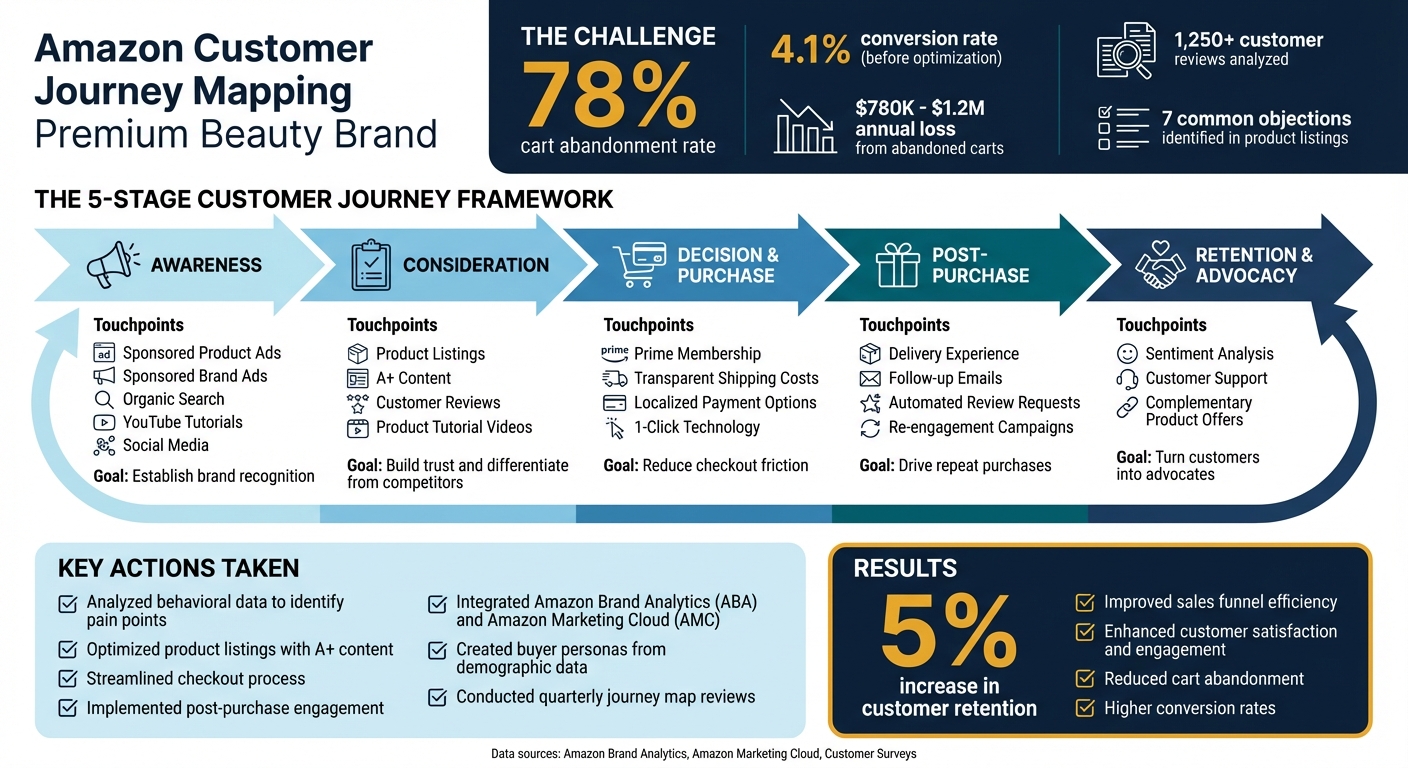
Amazon‘s customer journey is shaped by every interaction – from ads to post-purchase follow-ups. This case study explores how a premium beauty brand tackled a 78% cart abandonment rate and fragmented data issues on Amazon. By mapping customer touchpoints and refining their approach, they achieved a 5% increase in customer retention and improved sales funnel efficiency. Key actions included:
- Analyzing behavioral data to identify pain points, like customers leaving Amazon for product comparisons.
- Optimizing product listings with detailed descriptions, A+ content, and customer reviews to address doubts.
- Streamlining checkout with clear shipping costs and localized payment options.
- Post-purchase engagement through follow-up emails, automated review requests, and re-engagement campaigns.
The brand’s success highlights the importance of connecting data, tracking key metrics, and continuously refining the customer journey to reduce friction and boost conversions. Partnering with experts like Emplicit helped them manage these efforts efficiently.
Amazon Customer Journey Mapping: 5-Stage Framework with Key Metrics and Results
The Brand and Its Amazon Challenges
Problems on Amazon
This case study examines a premium beauty brand generating monthly Amazon sales between $220,000 and $350,000. While these numbers are impressive, the company faced a major hurdle: a 78% cart abandonment rate. Shoppers were adding items to their carts but stopping short of completing their purchases.
"Getting shoppers to view products is only half the battle. The more difficult challenge? Converting those browsers into buyers – particularly when they’ve already shown their interest by adding products to their cart."
To understand the issue, the team analyzed over 1,250 customer reviews and uncovered seven common objections that weren’t addressed in the product listings. Shoppers expressed doubts about the effectiveness of ingredients, concerns over the stability of natural components, and uncertainty about whether the products were suitable for their skin types. These unresolved questions contributed to a low conversion rate of just 4.1%.
Behavioral data revealed another challenge: many customers were leaving Amazon to compare products on other platforms before making a decision. This cross-platform comparison shopping was a significant barrier, especially since Amazon doesn’t offer native tools to recapture these potential buyers. The result? The brand was losing an estimated $780,000 to $1.2 million annually due to abandoned carts.
On top of that, siloed data and inconsistent insights made it difficult to pinpoint exactly where customers were dropping off in their purchase journey.
Faced with these challenges, the brand knew it needed to streamline the customer experience and address these pain points head-on.
What the Brand Wanted to Achieve
The obstacles on Amazon pushed the brand to rethink its approach to customer engagement.
Their main goal was simple: reduce friction throughout the buying process and turn more browsers into buyers. To do this, they needed to go beyond surface-level metrics and uncover a deeper understanding of how shoppers interacted with their products.
The brand set out to identify the precise moments where customers hesitated or abandoned their carts. This required moving from fragmented data to an integrated system that could map every customer touchpoint – from the first ad impression to post-purchase follow-ups. By understanding these interactions, the brand could address customer concerns at each stage of the journey.
Their objectives included boosting conversion rates, lowering cart abandonment, and retaining more customers by improving engagement at key points. Similar companies had seen a 5% increase in customer retention through strategies like journey mapping and predictive modeling, and this brand aimed to achieve comparable outcomes. By creating a seamless customer journey, they hoped to turn lost opportunities into lasting loyalty.
sbb-itb-e2944f4
How Amazon Customer Journey Mapping Drives Sales and Loyalty – Know Your Customers First
How the Brand Mapped Customer Touchpoints
To address high cart abandonment and fragmented insights, the brand turned to a data-driven approach to map every customer interaction on Amazon. This framework, built from multiple data sources, became the foundation for deeper, actionable analytics.
They began by utilizing Amazon Brand Analytics (ABA) to uncover which products attracted the most interest and which audience segments were most engaged. This provided clarity on customer preferences and allowed them to fine-tune their advertising strategies. To understand how different ad interactions influenced conversions, they incorporated Amazon Marketing Cloud (AMC) and Amazon Ad Server, enabling full-funnel tracking from the first ad impression to the final purchase.
However, numbers alone couldn’t tell the whole story. To get a better grasp of customer frustrations, they gathered qualitative insights through user studies, surveys, and feedback from their support team. These efforts revealed recurring pain points that weren’t evident in the analytics dashboards, reinforcing their focus on understanding shopper needs at a deeper level.
Using demographic and behavioral data, the team developed buyer personas to segment the journey and uncover the motivations behind customer actions at each stage. Key metrics such as conversion rate, sales velocity, review scores, Inventory Performance Index (IPI), and Order Defect Rate (ODR) were tracked to measure performance. AI-driven insights played a key role in maintaining inventory stability.
The result was a visual journey map that outlined the customer’s experience across five stages: Awareness, Consideration, Purchase, Retention, and Advocacy. This map detailed specific touchpoints – like Sponsored Brand ads, product detail pages, and post-purchase follow-ups – along with the emotions, actions, and decisions customers made at each stage. By continuously refining this journey map, the brand was able to optimize the customer experience and improve outcomes at every step. It became an essential tool for ongoing enhancements in their approach.
Customer Touchpoints Across the Journey
Using a detailed customer journey map, the brand identified the key points where customers either engaged or dropped off. Each stage offered specific ways to enhance the shopping experience and boost conversions.
Awareness Stage
The journey started when potential customers first encountered the brand. Sponsored Product and Sponsored Brand ads grabbed attention in search results, while organic search rankings drew in shoppers actively seeking solutions. The brand also tapped into external traffic sources like YouTube product tutorials and social media platforms, introducing their products to fresh audiences. These efforts worked together to establish initial brand recognition and spark curiosity, setting the stage for deeper engagement during the next phase.
Consideration Stage
Once customers were aware of the brand, they entered the research phase. Here, they examined product listings, comparing features, benefits, and prices across multiple options. A+ content, enriched with detailed product descriptions and lifestyle imagery, addressed specific needs and showcased how the product could solve problems. Customer reviews became a critical trust factor, offering real-world insights that validated their choices. Additionally, product tutorial videos proved highly influential, helping shoppers visualize how the product fit into their lives. This stage was all about building trust and standing out from competitors, paving the way for customers to make a confident decision.
Decision and Purchase Stage
At this stage, the checkout experience made or broke the sale. Prime membership eligibility played a huge role, as customers expected fast and free shipping. The brand ensured transparent shipping costs were displayed early to avoid any last-minute surprises that could lead to cart abandonment. They also streamlined the process by offering localized payment options, making it simple for customers to pay using their preferred methods. Any unexpected fees, limited payment options, or a confusing checkout process risked losing the sale. By addressing these issues, the brand reduced friction and improved conversion rates.
Post-Purchase Stage
The journey didn’t end with the sale. A smooth delivery experience and prompt follow-up emails left customers feeling valued and satisfied. The brand used automated review requests to gather feedback, knowing that positive reviews would help future shoppers during the consideration phase. They also launched re-engagement campaigns, promoting complementary products or subscription offers to previous buyers. These efforts not only encouraged repeat business but also turned satisfied customers into advocates, whose recommendations brought new shoppers into the awareness stage, creating a continuous cycle of engagement.
Actions Taken to Improve Touchpoints
PPC and Listing Improvements
The brand overhauled its paid search strategy and fine-tuned product listings to maximize visibility and engagement. They broadened keyword targeting through Sponsored ads and consistently ran A/B tests on ad elements such as copy, product images, and listing titles. These tests helped identify what resonated most with shoppers. Additionally, product descriptions were updated with high-performing keywords to enhance organic visibility. Together, these efforts ensured that every customer touchpoint delivered targeted, relevant content.
Customized Content for Each Touchpoint
With improved visibility in place, the brand created content tailored to each stage of the customer journey. For the consideration phase, they enriched product pages with detailed comparisons and lifestyle imagery that answered common questions upfront. They also introduced an "Ask an Owner" feature, allowing potential buyers to connect directly with previous customers for authentic feedback. At the decision stage, they simplified the checkout process by implementing 1-Click technology and personalized recommendations, reducing friction and guiding customers toward completing their purchase. Post-purchase, the brand leveraged sentiment analysis to quickly address customer concerns and refine messaging, ensuring they stayed engaged with customers even after the sale. This stage-specific content approach provided customers with the support they needed at every step.
Working with Emplicit

To tackle issues like high cart abandonment and fragmented customer insights, the brand partnered with Emplicit. This collaboration focused on translating the brand’s core value proposition into content specifically designed for Amazon shoppers, rather than repurposing existing website copy. Emplicit managed both paid and organic search efforts, ensured account health, and optimized inventory to maintain strong product visibility. They also took an active role in post-purchase engagement, managing seller and product reviews, responding to customer questions in real time, and resolving concerns before they escalated. By conducting an annual review of their Amazon strategy, the brand was able to adapt their approach, launch new products, and refine tactics based on performance insights. This partnership allowed the brand to execute a robust touchpoint optimization strategy without overextending internal resources.
Results and Lessons Learned
Measured Results
The touchpoint mapping initiative brought clear improvements across multiple performance metrics. By connecting previously isolated data and using predictive modeling, the company achieved a 5% increase in customer retention rates. This boost directly impacted repeat purchases and improved the efficiency of the sales funnel throughout the customer journey.
In addition to retention, the brand saw improvements in customer satisfaction and engagement. By strategically refining key touchpoints – from initial ad exposure to post-purchase support – they strengthened customer loyalty and reduced churn. Detailed data tracking highlighted which interventions drove higher conversion rates and increased lifetime value. These insights shaped further strategy adjustments.
"We will continue to measure our programs and the effectiveness of our investments analytically, to jettison those that do not provide acceptable returns, and to step up our investment in those that work best."
- Amazon Annual Report
What the Brand Learned
One of the most important takeaways was that siloed data limits customer insights. By integrating data from advertising, sales, and support, the brand uncovered friction points that had previously gone unnoticed. This unified approach became the cornerstone for all future improvements.
Another key lesson was that journey mapping is an ongoing process, not a one-time task. Customer behavior is constantly evolving, which means journey maps need regular updates. The brand adopted quarterly reviews to reassess touchpoints, update customer personas with fresh behavioral data, and experiment with new optimization strategies. Treating the map as a living document ensured they stayed agile and responsive to changing customer needs, driving sustained improvements over time.
Conclusion
Mapping customer touchpoints on Amazon isn’t just a strategy – it’s a way to build stronger relationships and anticipate what customers truly need. This case study highlights how shifting the focus from isolated transactions to the broader customer experience can drive lasting growth and loyalty.
By breaking down data silos and creating a comprehensive touchpoint strategy, brands saw clear improvements in retention, engagement, and the overall efficiency of their sales funnel. Adapting to changing customer behaviors through ongoing refinement of the journey is key to staying ahead.
"Customer journey mapping on Amazon is not just about selling products; it’s about fostering relationships, anticipating needs, and delivering beyond expectations." – Sravanthi Munagapati, Marketing Manager, SellerApp
These results underscore the importance of unified data, targeted strategies, and constant optimization in achieving long-term customer success. Brands that adopt this customer-focused approach position themselves for enduring success.
For those ready to implement similar strategies, working with experts who understand Amazon’s ecosystem can make all the difference. Emplicit offers marketplace management services, including PPC optimization, listing enhancements, inventory management, and tailored growth strategies. They help brands navigate the complexities of customer journey optimization, not just on Amazon but across other major platforms as well.
FAQs
How do I find the biggest drop-off point in my Amazon funnel?
To figure out where customers are dropping off in your Amazon sales funnel, start by analyzing how your product listings are performing and how shoppers are behaving. A great tool for this is Amazon’s Detail Page Sales and Traffic Report, which lets you track key metrics like Unit Session Percentage (your conversion rate). This data can help you spot problems like low-quality images, vague descriptions, or pricing issues that might be turning customers away.
On top of that, take a closer look at customer touchpoints and traffic patterns. Understanding where potential buyers leave the process can highlight specific areas that need improvement, so you can make changes that keep them moving toward a purchase.
What Amazon data should I connect to map touchpoints end to end?
To fully understand customer interactions, it’s crucial to tie together various Amazon data points. This includes details about customer interactions, ad performance, sales attribution, organic traffic, product reviews, and essential metrics like ROAS (Return on Ad Spend), ACoS (Advertising Cost of Sales), CTR (Click-Through Rate), and conversion rates. By linking these elements, you gain a complete picture of how customers connect with your brand at every stage of their journey.
Which listing changes reduce Amazon cart abandonment fastest?
To cut down on Amazon cart abandonment, focus on improving your product listings. Use clear, benefit-driven descriptions that highlight what makes your product stand out. Make sure your layout is mobile-friendly, as many shoppers browse and buy on their phones. Add dynamic features like comparison charts to help customers make decisions faster.
Consistently test and tweak these elements to see what works best. These small but impactful changes can boost customer engagement and lead to more completed purchases.