

When managing PPC campaigns, your budget choice – daily or total – can directly impact your results. Here’s a quick breakdown:
- Daily Budget: Sets a maximum spend per day, resetting at midnight. Offers steady control, ideal for ongoing campaigns or predictable traffic patterns.
- Total Budget: Allocates a fixed amount over a campaign’s duration. The platform’s algorithm adjusts spending dynamically, making it suitable for short-term promotions or high-impact events.
Key Differences
| Feature | Daily Budget | Total Budget |
|---|---|---|
| Pacing | Even daily spend | Varies by demand |
| Control | High daily oversight | Fixed total spend |
| Best For | Evergreen campaigns | Time-sensitive promotions |
| Algorithm Flexibility | Limited | High |
Takeaway: Use daily budgets for stable, long-term campaigns and total budgets for short-term, goal-driven efforts. Combining both can maximize results while maintaining control.
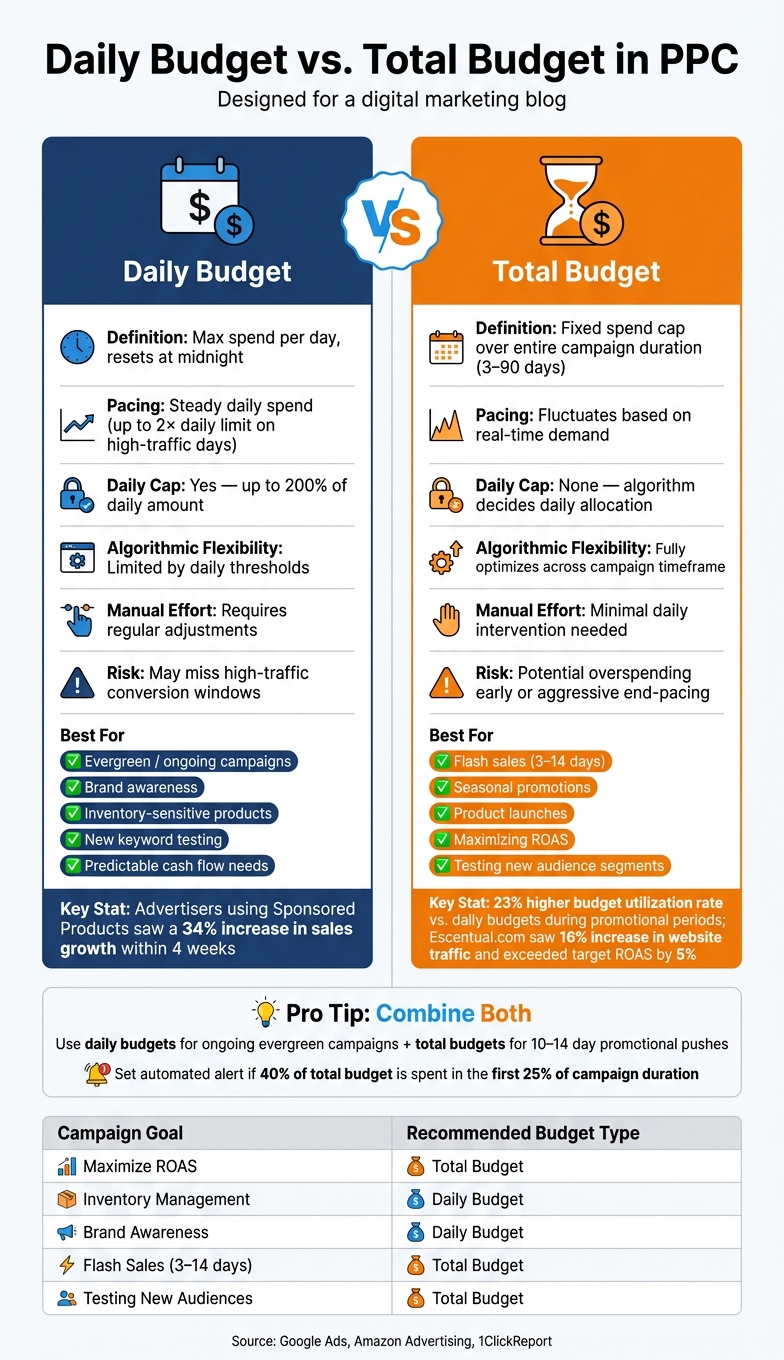
Daily Budget vs. Total Budget in PPC: Side-by-Side Comparison
Daily Budget in PPC: Features, Pros, and Cons
What Is a Daily Budget?
A daily budget sets the maximum amount you’re willing to spend on a PPC campaign each day. It acts as a financial safeguard, limiting daily expenses, though it doesn’t guarantee specific performance outcomes.
Platforms like Amazon calculate monthly spend by multiplying your daily budget (e.g., $10/day equates to roughly $300/month). However, on high-traffic days, they may spend up to 25% more, compensating by spending less on quieter days. It’s worth noting that unused budget doesn’t roll over. For example, if you set a $10 daily budget but only spend $7 on Monday, the remaining $3 vanishes at midnight, and the next day starts fresh. This structure is essential to understanding the benefits and limitations of daily budgets.
Advantages of Daily Budgets
The straightforward nature of daily budgets offers several benefits for advertisers:
Daily budgets allow for precise control over ad spend, making them ideal for businesses that need predictable cash flow. They’re particularly useful for small-scale tests, as you can adjust them anytime without disrupting the campaign. For products with steady demand, daily budgets ensure consistent ad visibility without requiring constant attention. For instance, advertisers using Sponsored Products reported a 34% increase in sales growth just four weeks after implementation.
| Advantage | Why It Matters |
|---|---|
| Granular daily control | Prevents overspending by capping daily costs |
| Clear tracking | Resets at midnight, making it easy to monitor daily spend |
| Low-risk experimentation | Limits financial exposure when testing new keywords or ASINs |
| Consistent visibility | Keeps evergreen campaigns active without interruptions |
Disadvantages of Daily Budgets
While daily budgets offer control, they come with some challenges:
A major issue is the risk of early budget exhaustion. If your campaign hits its daily cap by mid-morning, your ads stop running for the rest of the day, leaving competitors to capture the remaining traffic. This is especially problematic during high-traffic events like Prime Day or weekend sales surges.
Another challenge is pacing. Algorithms may spend aggressively during peak periods, potentially depleting your budget before the most profitable hours. Factors like Top of Search placement boosts can accelerate this issue.
"Running out of ad budget at 2pm is not a budget problem. It is a timing problem." – Off Hours
| Disadvantage | Impact |
|---|---|
| Early budget exhaustion | Ads stop running, giving competitors an edge |
| No rollover | Unspent funds are lost at the end of the day |
| Active management required | High-performing campaigns can hit limits without oversight |
| Traffic surges missed | The 25% buffer may not cover spikes during peak shopping times |
When Daily Budgets Work Best
Daily budgets shine in specific scenarios. For branded search campaigns, they ensure uninterrupted coverage of your brand terms. They’re also effective for new product launches or testing fresh keywords, as they limit financial risk while gathering performance data.
For products with consistent demand, daily budgets align spend with predictable traffic patterns, requiring minimal adjustments. This approach works well for campaigns that prioritize steady, reliable performance. As one principle suggests: "Advertise within your own budget. You’ve got to budget with what makes sense."
Total Budget in PPC: Features, Pros, and Cons
What Is a Total Budget?
A total budget in PPC campaigns sets a firm spending cap for the entire campaign duration – for example, $30,000 over 14 days. Unlike a daily budget, which resets every day, a total budget allows the platform’s algorithm to allocate spending dynamically based on real-time demand. Google ensures that your campaign won’t exceed this set amount and requires campaigns to run between 3 and 90 days with fixed start and end dates. However, once you choose a total budget, you can’t switch to a daily budget within the same campaign – you’d need to create a new campaign.
Starting January 15, 2026, Google expanded total budget functionality, previously limited to Demand Gen and YouTube, into an open beta for Search, Performance Max, and Shopping campaigns.
"Set a total campaign budget over days or weeks, letting Google optimize spend automatically and keep your campaigns on track." – Google Announcement, Jan 15, 2026
This system introduces a flexible way to manage campaign spending, but it’s worth examining its strengths and weaknesses.
Advantages of Total Budgets
Total budgets give the platform’s algorithm the freedom to allocate spending where it’s most effective. Unlike daily budgets that cap spending each day, total budgets allow machine learning models to focus on high-intent periods while scaling back during slower times.
Here’s an example: In January 2026, UK beauty retailer Escentual.com used total budgets for a promotional campaign. By letting the algorithm optimize spending across the entire campaign rather than sticking to daily limits, the company saw a 16% increase in website traffic and exceeded its target ROAS by 5%, all while staying within their fixed budget.
| Advantage | Why It Matters |
|---|---|
| Hard spend ceiling | Ensures total spending doesn’t exceed the set budget |
| Algorithmic optimization freedom | Allows more spending on high-conversion days |
| Less manual effort | Reduces the need for daily adjustments, saving up to 6 hours per week |
| Ideal for launches | Great for testing new products or channels with a fixed budget |
While these benefits are appealing, total budgets aren’t without their challenges.
Disadvantages of Total Budgets
The same algorithmic flexibility that helps capture high-intent opportunities can also lead to uneven spending patterns. For example, the algorithm might spend heavily at the start of a campaign or rush to use the remaining budget near the end, which can inflate cost-per-acquisition (CPA). Additionally, the unpredictability of daily spending can complicate financial planning for businesses.
| Disadvantage | Impact |
|---|---|
| No budget type switching | Switching to a daily budget requires starting a new campaign |
| Aggressive end-pacing | CPA may rise as the algorithm speeds up spending toward the end |
| Daily variance | Daily cash outflows can be unpredictable |
| Stabilization period required | The algorithm typically needs 3–7 days to stabilize, making short campaigns less effective |
When to Use Total Budgets
Total budgets are best for campaigns with clear start and end dates and a fixed spending target. They’re particularly effective for product launches, flash sales, seasonal promotions, and holiday events. A good rule of thumb: aim for campaigns lasting 14–30 days. Campaigns shorter than 3 days don’t give the algorithm enough time to optimize, while those longer than 90 days lose the pacing benefits.
"Use total budgets for any campaign with a clear start date, end date, and fixed budget. Use daily budgets for everything else." – 1ClickReport Guide
However, be cautious with inventory-limited products. If the algorithm front-loads spending and generates a surge in orders, you might run out of stock before the campaign ends. This could turn a performance success into a logistical headache.
Daily Budget vs. Total Budget: Key Differences
Control, Pacing, and Risk: A Side-by-Side Look
The main distinction between a daily budget and a total budget lies in how spending is managed – manually or algorithmically. A daily budget gives you a set spending limit that resets every 24 hours. On days with higher traffic, Google may spend up to twice your daily limit, but your monthly spend will never exceed your daily budget multiplied by 30.4. This calculation ensures consistent financial management.
With a total budget, there’s no daily limit. Instead, the algorithm determines daily spend levels based on real-time demand. For example, it might allocate more funds early in a campaign if strong conversion signals are detected, then taper off later. While this approach can yield better results, daily spending becomes harder to predict.
Grasping these differences allows you to align your budget choice with your campaign’s specific objectives.
| Feature | Daily Budget | Total Budget |
|---|---|---|
| Pacing | Steady, with occasional spikes up to 2x the daily limit | Fluctuates based on demand |
| Daily Cap | Yes (up to 200% of the daily amount) | No daily cap |
| Algorithmic Flexibility | Limited by daily thresholds | Fully optimizes across the campaign timeframe |
| Risk | Potentially misses high-traffic conversion opportunities | Risk of overspending early in the campaign |
| Manual Effort | Requires regular adjustments | Minimal daily intervention needed |
"The formula [30.4] gives you control. It prevents overspend. It keeps finance happy. But it doesn’t account for the week in November when your best-converting audience is 40% more active." – Isaac Rudansky, Founder, AdVenture Media
Matching Budget Type to Campaign Goals
Deciding between these budget types isn’t about which one is "better" – it’s about aligning your choice with the goals of your campaign.
For campaigns focused on steady visibility – like brand awareness, prospecting, or maintaining a constant presence – a daily budget ensures stability without risking rapid overspending. It’s also ideal for inventory-sensitive products, as the daily cap helps prevent order surges that could overwhelm fulfillment.
On the other hand, if your campaign is time-sensitive – like a flash sale, seasonal promotion, or product launch – a total budget provides the flexibility to capitalize on high-intent users when they’re most likely to convert. Campaigns using total budgets have been shown to achieve a 23% higher budget utilization rate compared to those using daily budgets during similar promotional periods.
| Goal | Recommended Budget Type |
|---|---|
| Maximize ROAS | Total Budget |
| Inventory management | Daily Budget |
| Brand awareness | Daily Budget |
| Flash sales (3–14 days) | Total Budget |
| Testing new audience segments | Total Budget |
This tailored approach helps ensure your campaigns are set up for success.
Using Both Budget Types Together
Advertisers can take advantage of both budget types by combining them strategically. Many businesses use daily budgets for ongoing campaigns while layering in total budgets for short-term promotions. This dual approach often delivers better results than relying on just one method.
For example, you could maintain consistent brand and prospecting campaigns with daily budgets while running total-budget campaigns for a 10- to 14-day promotional push. This ensures your evergreen efforts remain steady while the algorithm aggressively optimizes for conversions during the promotion.
To avoid overspending too quickly with total budgets, set up an automated alert to notify you if 40% of the budget is used within the first quarter of the campaign. This safeguard allows you to step in and adjust before the campaign exhausts its funds prematurely, ensuring the budget lasts for the intended duration.
sbb-itb-e2944f4
Applying Budget Strategies with Emplicit

Budgeting for Marketplace Campaigns
Marketplace advertising operates differently across platforms, so what works on Amazon might not work on Walmart or TikTok Shops. For instance, Amazon’s average cost-per-click (CPC) is about $1.18, with conversion rates ranging from 8% to 15%. A useful formula to kick things off is the Max CPC formula:
Max CPC = Average Selling Price × Conversion Rate × Target ACoS.
Using Data to Set and Adjust Budgets
To determine your monthly PPC budget, multiply your revenue goal by your target ad spend percentage. For example, if your goal is $20,000 in monthly revenue and you aim to spend 10% on ads, your budget would be $2,000. Adjust these budgets weekly based on performance data.
One critical metric to monitor is TACoS (Total Advertising Cost of Sales). Unlike ACoS, which focuses purely on ad efficiency, TACoS evaluates how ad spending impacts your entire business, including organic sales.
"If your TACoS is rising while ACoS holds steady, you’re losing organic rank. That’s a listing problem, a pricing problem, or a review problem. You can’t fix it with better PPC." – SupplyKick
A weekly reallocation of funds ensures your budget is optimized. Shift money away from underperforming campaigns and into those with strong conversion rates and lower ACoS. For profitable campaigns that hit budget caps, consider increasing their allocation. Meanwhile, eliminate campaigns that fail to deliver results. Emplicit’s data-driven strategies align PPC investments with inventory needs for seamless execution.
How Emplicit Supports PPC Budget Management
Emplicit manages PPC for over 50 brands using a three-tier campaign structure:
- Auto campaigns: Focused on discovering new opportunities.
- Research campaigns (manual broad): Used to test and validate keywords.
- Performance campaigns (manual exact): Geared toward scaling keywords that consistently perform well.
Budgets are allocated strategically – approximately 15–25% goes to Auto campaigns, 25–40% to Research campaigns, and 25–40% to Performance campaigns. Additionally, a portion is set aside specifically for brand defense.
Emplicit’s approach integrates PPC with inventory planning. For example, ad spend is reduced when inventory levels are low and increased during peak demand periods. This prevents wasted traffic on listings that can’t fulfill orders. The result is a budget strategy that maximizes clicks while safeguarding the overall health of the business.
Amazon PPC Ads – What to Budget & How to Adjust Budgets (Full Guide)
Conclusion: Picking the Right Budget Approach
There’s no one-size-fits-all answer when it comes to choosing between daily and total budgets – it all boils down to your campaign’s goals. Daily budgets work well when you need predictable spending and tighter control, especially for ongoing campaigns or situations where inventory levels are a concern. On the other hand, total budgets shine during short, high-impact periods, like product launches or flash sales, where flexibility and algorithmic optimization can make a big difference.
FAQs
How do I choose between a daily budget and a total budget?
When planning campaigns like product launches or seasonal sales, choosing a total budget works well. This approach lets the platform optimize spending over a specific timeframe. On the other hand, for ongoing campaigns, a daily budget is ideal. It ensures consistent daily spending, helps manage cash flow, and keeps inventory moving steadily. Emplicit provides expert PPC management to help brands make these decisions aligned with their marketplace goals.
How do I stop my daily budget from running out early?
To make sure your daily budget lasts and delivers value, start by determining if your campaign is performing well or wasting money. If it’s profitable, consider increasing the budget gradually. If not, focus on refining your approach. Here’s how:
- Lower bids on broad match or automatic targeting campaigns to control spending.
- Add non-converting keywords to your negative keyword list to avoid wasting money on irrelevant clicks.
- Use ad scheduling to pause ads during hours with low conversion rates.
These steps can help you stretch your budget while focusing on results that matter.
How do I prevent a total budget from spending too fast?
To keep your campaign budget from running out too quickly, it’s smart to plan a daily spending curve that reflects historical performance trends. Set up automated safeguards to help you stay on track. For instance, create alerts if spending hits 40% of your budget early in the day, or pause campaigns if both spend and CPA go beyond your expected limits.
You can also use dayparting to avoid wasting money during hours with low conversion rates. During the learning phase, stick to conservative bids to maintain better control over your spending. These strategies can help you manage your budget more effectively while optimizing results.