

When someone copies your product photos, descriptions, or videos on platforms like Amazon or Walmart, it’s copyright infringement. The DMCA (Digital Millennium Copyright Act) lets you file a takedown notice to remove stolen content quickly – without needing to go to court. Here’s how to protect your content:
- What You Can Protect: Product images, descriptions, and videos are covered under copyright law. Trademarks and patents require different processes.
- Preparation: Confirm you own the copyright, collect evidence (like URLs, screenshots, and timestamps), and find the marketplace’s correct reporting channel.
- Filing a Notice: Include all required details: your contact info, proof of ownership, and a sworn statement under penalty of perjury.
- After Filing: Platforms usually act fast, but if the violator disputes your claim, you might need to escalate legally.
Key takeaway: Filing a DMCA notice can safeguard your content, but proper preparation and documentation are essential to avoid delays or legal risks.
How to Get Back Stolen Digital Content Using a DMCA Notice!
sbb-itb-e2944f4
How to Prepare Before Filing a DMCA Notice
Getting your DMCA notice right from the start is critical. A poorly prepared notice can lead to rejection – or worse, legal trouble. Before you file, make sure you’ve confirmed your rights, gathered solid evidence, and identified the correct contact point. With everything in place, your notice will stand a much better chance of success.
Confirm You Own the Copyright
Copyright is automatically granted to original works, but ownership isn’t always straightforward. If you’ve hired a freelancer or agency to create content, check your contract for a copyright assignment or "work-for-hire" clause. Without this, the creator might legally retain ownership of the work.
The same principle applies to images or stock materials provided by suppliers. If you don’t have written permission for commercial use, especially on e-commerce platforms, your claim could lack legal standing. On platforms like Amazon, uploading content typically grants the marketplace a license to display it. This means other sellers can legally list products on the same detail page, as it aligns with the platform’s policies – not copyright infringement.
"A copyright protects original works of authorship, such as videos, movies, songs, books, musicals, video games, paintings, etc." – Amazon Seller Central
Collect Evidence of Infringement
After verifying your copyright ownership, it’s time to gather evidence. Start by capturing the infringing content’s URL. Screenshots should clearly show the browser address bar and include a timestamp. On Amazon, make sure to document the ASIN (Amazon Standard Identification Number) of the listing, as it’s the key identifier for locating content on the platform.
Pair these screenshots with original files – like RAW images, draft versions, or time-stamped records – to establish that your work predates the infringement. Once your evidence is airtight, double-check that your notice complies with all legal requirements before submitting it.
"Courts have held that you must consider fair use before sending a DMCA notice." – Heimlich Law PC
Find the Right Recipient
Submitting your DMCA notice to the correct contact is essential. Most marketplaces have dedicated IP complaint portals – avoid general customer service channels. For Amazon, registered brands can use the "Report a Violation" tool, while other sellers should file through the Public Notice Form. For Amazon’s Buy with Prime service, complaints should be sent to buywithprime-violations@amazon.com.
If the platform doesn’t list a DMCA agent, check the U.S. Copyright Office directory at copyright.gov. Whenever possible, use the marketplace’s internal reporting tools instead of email. These systems are designed to collect all necessary legal details and often speed up the review process.
| Marketplace / Service | Contact Method | Tool or Email |
|---|---|---|
| Amazon (Registered Brands) | Internal Portal | Report a Violation Tool |
| Amazon (General Sellers) | Web Form | Public Notice Form |
| Amazon Buy with Prime | buywithprime-violations@amazon.com | |
| Other Marketplaces | DMCA Agent | Check "Legal" or "Terms of Service" pages |
Know the Legal Requirements and Risks
Every DMCA notice must include a statement made under penalty of perjury confirming the accuracy of the information and that you’re the copyright owner or authorized to act on their behalf. This isn’t just a formality – it’s a legal commitment.
Submitting a false or intentionally misleading notice can have serious repercussions. Under Section 512(f) of the DMCA, if you knowingly misrepresent infringement, you could be held liable for damages, including the other party’s legal fees. Amazon also has its own penalties:
"The continuous submission of inaccurate or fake notices could lead to the removal of your submission privileges." – Amazon Seller Central
Taking the time to prepare thoroughly not only improves the chances of your notice being processed quickly but also protects you from potential backlash if the situation escalates. A well-prepared notice is your best defense.
Step-by-Step: How to File a DMCA Takedown Notice
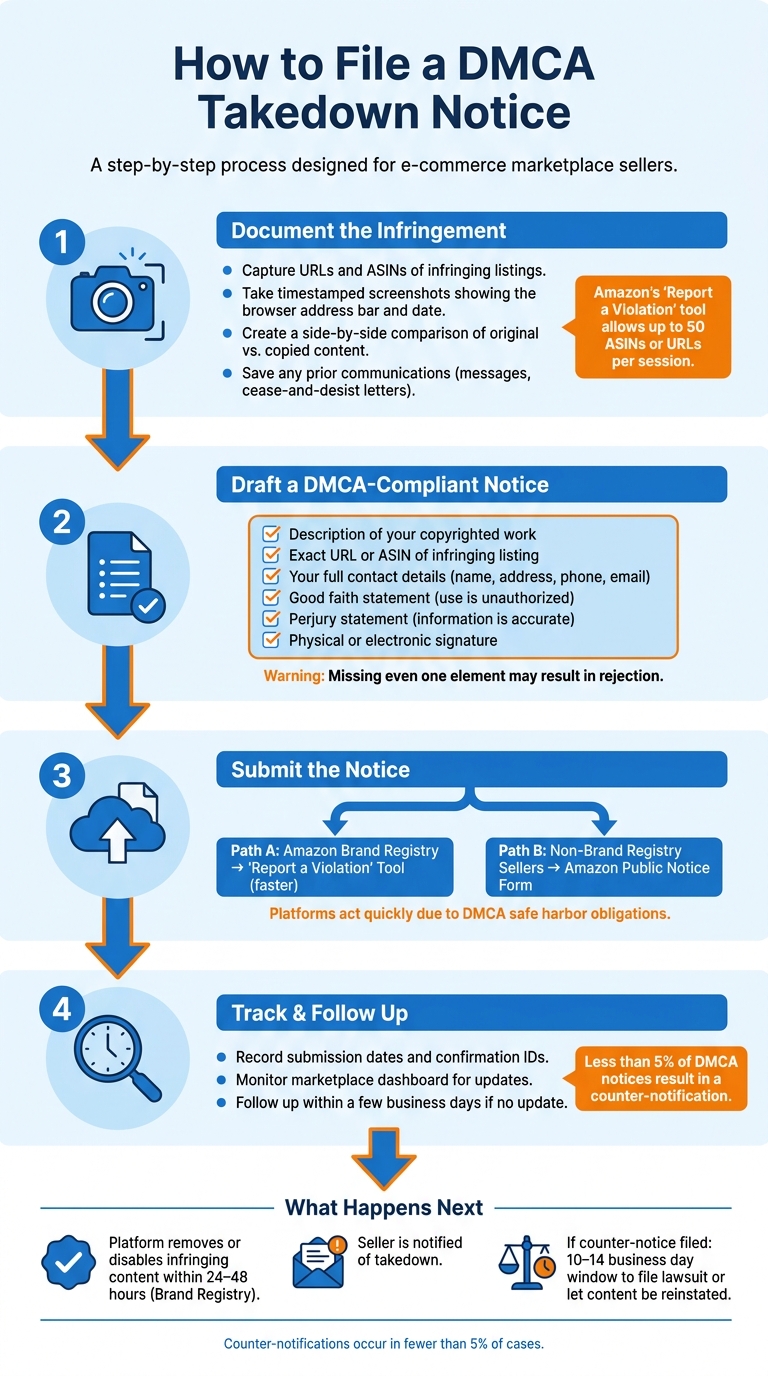
How to File a DMCA Takedown Notice: Step-by-Step Guide for Marketplace Sellers
Now that you’ve prepared, it’s time to dive into the process of filing a DMCA notice. Each step is designed to build on the previous one, so be sure to follow them in order for the best results.
Step 1: Document the Infringement
Start by gathering all the evidence of the infringement. This includes URLs, ASINs, and screenshots that show the infringing content clearly. The screenshots should include timestamps and the browser address bar for added legitimacy. A side-by-side comparison of your original work and the copied material can make the issue crystal clear to reviewers.
If you’ve already communicated with the infringing party – whether through a marketplace message or a cease-and-desist letter – make sure to save those records too. Amazon’s "Report a Violation" tool allows you to document up to 50 ASINs or URLs in one session, which can save you time if multiple listings are involved.
Step 2: Draft a DMCA-Compliant Notice
A proper DMCA notice must include six key elements. Missing even one could result in your notice being rejected.
| Required Element | What to Include |
|---|---|
| Copyrighted Work | A description of your original material, such as product images or written content |
| Infringing Location | The exact URL or ASIN of the infringing listing |
| Contact Details | Your full name, address, phone number, and email |
| Good Faith Statement | A declaration that the use is unauthorized by you, your agent, or the law |
| Perjury Statement | A sworn statement that all provided information is accurate |
| Signature | Your physical or electronic signature |
"A written report should contain… a statement by you, made under penalty of perjury, that the above information in your notice is accurate and that you are the copyright owner or authorized to act on the copyright owner’s behalf." – AMZ Sellers Attorney®
Providing detailed information is critical. Notices that lack precise identifiers or the perjury statement are often dismissed. If you have a copyright registration number, include it – it can speed up the verification process.
Step 3: Submit the Notice
File your notice through the marketplace’s official intellectual property protection channel. If you’re using Amazon and are enrolled in Brand Registry, the "Report a Violation" tool is the best option. This tool is specifically designed for such cases and usually provides quicker results than other submission methods. If you’re not part of Brand Registry, you can still use Amazon’s Public Notice Form.
Marketplaces are generally quick to act on DMCA notices because their safe harbor protections under the law depend on timely responses. Submitting your notice through the correct portal ensures it reaches the right team for review without unnecessary delays.
Step 4: Track Your Submission and Follow Up
Once you’ve submitted your notice, keep detailed records of everything – submission dates, listing details, and any confirmation or reference IDs you receive. Use the marketplace’s dashboard to track the status of your complaint. If you don’t see any updates within a few business days, follow up through the same channel.
"The DMCA places the onus on the copyright holder to provide accurate and complete information in their takedown notice." – PatentPC
Maintaining a clear record of all submissions, responses, and follow-ups is essential. This documentation will be invaluable if the case escalates or if the infringing party files a counter-notification.
What Happens After You File a DMCA Notice
Marketplace Responses and Timelines
Once you’ve filed a valid DMCA notice, the next step is to monitor how the platform responds. Under Section 512, marketplaces are required to act promptly to maintain their "safe harbor" protections. Major platforms like Amazon often process these notices quickly – within 24 to 48 hours for Brand Registry members using tools like "Report a Violation". However, smaller platforms that rely on email submissions might take weeks to address your complaint.
After validating your notice, the platform typically removes or disables the infringing content. In some cases, they may only suppress specific parts of the listing, such as images or text, rather than taking down the entire post. Importantly, the seller responsible for the content is notified of the takedown.
Platforms also keep an eye on repeat offenders. While a first violation may result in a warning, multiple valid complaints against the same seller can lead to account suspension or even permanent removal.
"The safe harbor provision under § 512 shields platforms… from liability for user-posted content, but only if they act on valid notices promptly and maintain a repeat infringer policy." – Heimlich Law
If the seller disputes the takedown, they can initiate a counter-notification process.
How Counter-Notifications Work
Sometimes, a seller accused of copyright infringement may file a counter-notification, claiming the takedown was a mistake. These counter-notices are fairly uncommon, appearing in less than 5% of DMCA cases. When a valid counter-notice is submitted, the platform will send you a copy and initiate a 10–14 business day waiting period. During this time, you must decide whether to let the matter go or escalate it by filing a lawsuit in federal court.
"Please note that per Digital Millennium Copyright Act (DMCA) the complaining party has up to 10 business days from their receipt of your original counter notice to file a lawsuit in response." – Amazon Seller Central
It’s crucial to monitor your email closely after filing a DMCA notice to ensure you don’t miss any counter-notifications. The steps you take after receiving one will depend on the platform’s actions and your own strategy for protecting your content.
What to Do if the Content is Restored
If the platform restores the content due to a counter-notification, you’ll need to act quickly to protect your rights. If no lawsuit is filed within the 10–14 business day window, the platform is required to reinstate the content. To prevent this, you can file an infringement lawsuit in federal court before the deadline. Alternatively, for smaller disputes (up to $30,000), the Copyright Claims Board (CCB) offers a faster and more affordable option.
Once the content is reinstated, keep a close eye on the listing. If the seller reposts the same material elsewhere, you’ll need to file a new DMCA notice. Over time, the platform’s repeat infringer policy may catch up with them, leading to stricter consequences.
If you’re unsure whether to pursue litigation, consult an intellectual property attorney as soon as possible. A counter-notice indicates the seller is ready to contest the claim, which can significantly alter your approach.
How to Protect Your Marketplace Content Long-Term
Taking steps beyond filing DMCA notices is essential for keeping your marketplace content secure over time.
Keep Records of Your Original Content
Maintaining clear, timestamped proof of your work is a must. Save RAW files, high-resolution exports, and version histories that include creation metadata. Also, ensure your contracts explicitly assign copyright ownership or include work-for-hire agreements. Keep invoices and written confirmations from suppliers to reinforce your rights.
"For U.S. works, a copyright registration is required before suing in court for copyright infringement." – U.S. Copyright Office
While copyright registration isn’t necessary for filing a DMCA notice, it offers a huge advantage if you need to escalate. It allows you to claim statutory damages of up to $150,000 per willful infringement in court. For a relatively small fee, this step can significantly strengthen your legal position.
Build Listings That Are Easier to Defend
Creating unique, original listings can make a big difference in protecting your content. Using generic manufacturer images or copied descriptions weakens your case. If multiple sellers are using the same images, proving ownership becomes much harder.
"Taking images from other products can lead to intellectual property based product and account suspensions. When using images that you did not take yourself, make sure to document your ownership or rights to use." – CJ Rosenbaum, Esq., Founding Partner, Amazon Sellers Lawyer
The best solution? Produce original visuals and copy. Take your own product photos, create custom lifestyle images, and write descriptions tailored to your brand. To add an extra layer of protection, include visible watermarks or branded overlays on your images. Embedding ownership metadata into image files before uploading them to a marketplace can also make your rights easier to prove.
These steps won’t eliminate all risks, but they make your listings more distinctive and less likely to be copied convincingly.
Set Up an Internal DMCA Process
Relying solely on reactive enforcement is both time-consuming and costly. To streamline the process, establish a straightforward internal workflow. Start by monitoring your listings regularly on marketplaces. At a minimum, run reverse image searches on key product photos every few weeks to catch unauthorized use early.
When you identify infringement, a pre-drafted DMCA notice template can save time. Ensure your template meets all six legal requirements outlined in 17 U.S.C. § 512(c)(3). Automating this process can cut the time spent on a single notice from 20 minutes of manual work to mere seconds. For sellers managing multiple SKUs or brands, tools like Amazon Brand Registry’s "Report a Violation" portal offer faster submission options.
Keep detailed logs of each notice, including the date, URL, platform, and outcome. This helps track repeat offenders and supports potential account-level actions. Assign a specific person or team to oversee the process, ensuring no steps are missed, especially when responding to counter-notifications within tight deadlines.
Conclusion
Safeguarding your marketplace content is an ongoing task, and the DMCA offers sellers a powerful tool to address infringing listings – provided it’s used correctly. Taking swift, organized action greatly improves your chances of achieving a favorable outcome.
The numbers speak volumes: fewer than 5% of DMCA takedown notices result in a counter-notification. This shows that most valid claims are resolved without the need for further dispute.
"Understanding how to file a takedown request effectively can help you safeguard your business and maintain a competitive edge." – PatentPC
While individual takedowns are important, the real strength lies in creating a reliable system. Producing original content, keeping thorough records, and consistently monitoring for potential infringements can significantly reduce the need for frequent filings. And when an issue does arise, having a structured approach saves time and effort.
FAQs
Is it copyright infringement if another seller uses my Amazon detail page content?
Using your Amazon detail page content without your permission could fall under copyright infringement. If you encounter this issue, you can take action by filing a DMCA takedown notice through Amazon’s established process. This is an effective way to safeguard your intellectual property and ensure that any unauthorized use of your content is promptly addressed and removed.
Should I register my copyright before sending a DMCA takedown notice?
You don’t have to register your copyright to send a DMCA takedown notice. To file one, you’ll need to identify the infringing material, show proof that you own the rights, and include a statement affirming your good faith belief that the content is being used without authorization. Although registration isn’t mandatory, it can give you a stronger legal footing if the situation escalates.
What should I do if the other seller files a DMCA counter-notice?
If another seller files a DMCA counter-notice, you’ll need to take a few key steps. First, provide your contact details and clearly identify the listings that were removed. You’ll also need to include a statement, made under penalty of perjury, affirming that the content was removed in error.
It’s crucial to carefully review the claim and, if needed, consult a legal professional before moving forward. Counter-notices carry legal weight, so understanding the process is essential. Once you’re ready, submit your counter-notice using the platform’s specified procedure – this might be through Amazon’s Account Health section or a similar system, depending on where the issue arose.