
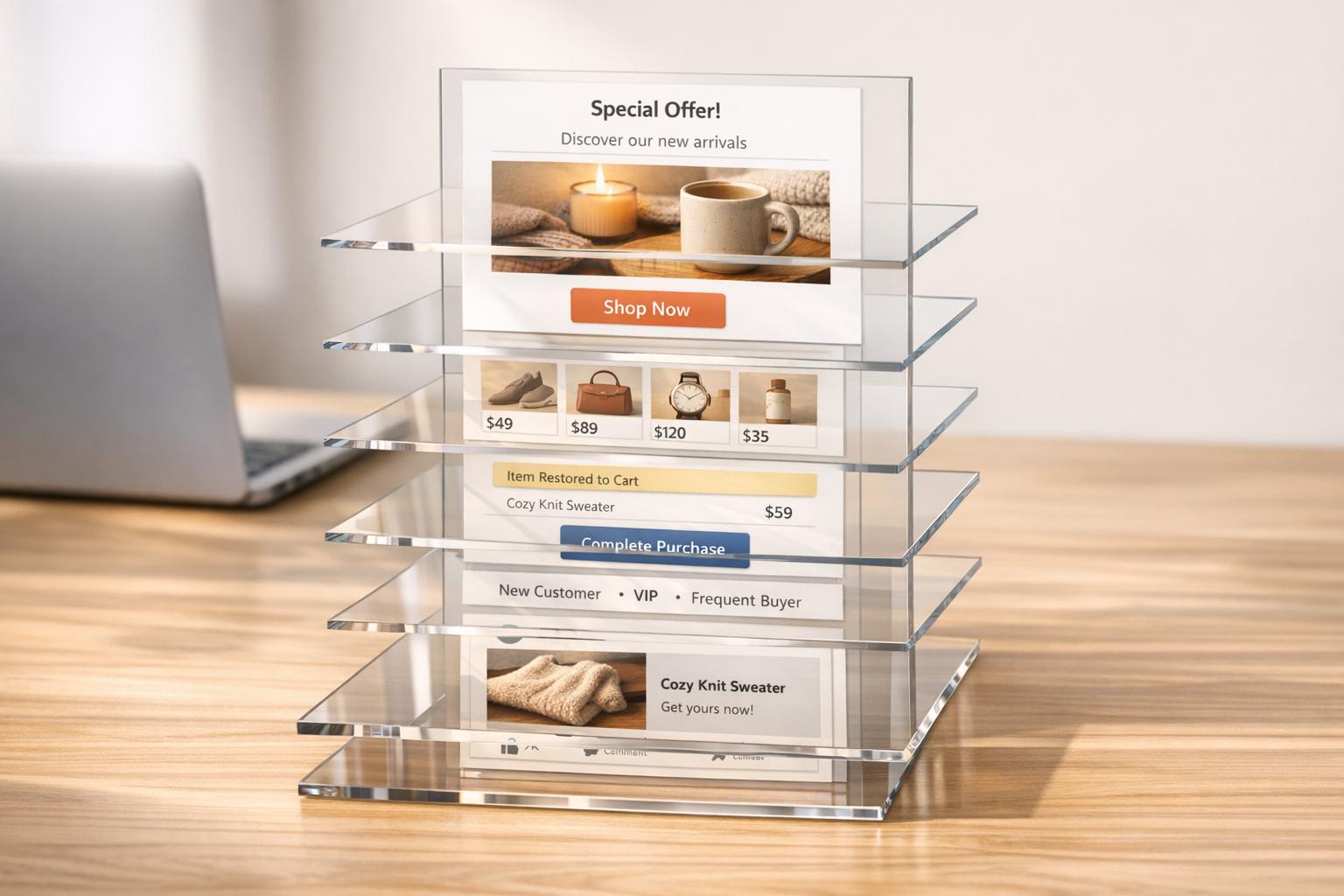
Email marketing is the backbone of any multi-channel sales strategy. Why? It directly connects you to customers, bypassing social media algorithms and marketplace fees. With an ROI of $36–$42 for every $1 spent, email drives repeat purchases, recovers abandoned carts, and keeps your brand top of mind across platforms like Amazon, Walmart, TikTok, and your website.
Key Benefits:
- Direct Access: Own your email list and control communication.
- Higher Revenue: Omnichannel shoppers spend 1.5x more, and multi-channel businesses generate 143% more revenue.
- Personalized Engagement: Tailored emails re-engage customers, build trust, and drive conversions.
How It Works:
- Central Hub: Email ties all sales channels together, ensuring consistent messaging.
- Segmentation: Group audiences by behavior (e.g., new subscribers, VIPs) for targeted campaigns.
- Automation: Trigger timely follow-ups, retargeting ads, and SMS reminders based on email activity.
Email isn’t just a tool – it’s the glue that connects your multi-channel efforts, boosting lifetime value and retention.
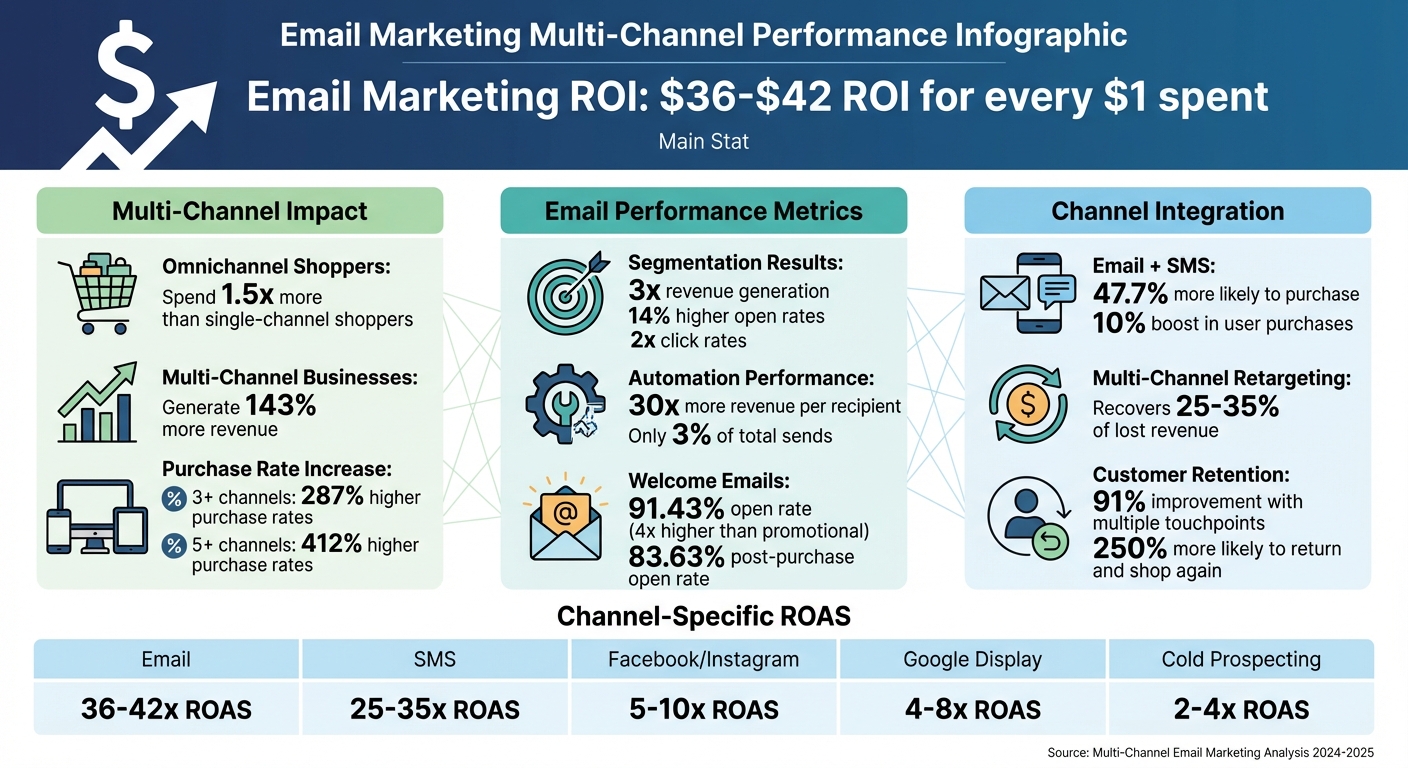
Email Marketing Multi-Channel ROI and Performance Statistics
Email Marketing Isn’t Enough: 5 Multichannel Strategies to Double Sales
sbb-itb-e2944f4
Creating an Email Marketing Strategy for Multi-Channel Sales
Building an effective email marketing strategy starts with understanding that every customer is different. Someone who finds you on TikTok will have different expectations than a long-time Amazon shopper. Your emails must reflect these differences while maintaining a consistent brand voice across every channel.
The cornerstone of this process is unified customer data. If you’re selling on platforms like Amazon, your own website, Walmart, and TikTok Shops, centralize customer information – such as browsing history, purchase habits, and engagement levels – into one system. This consolidated view lets you understand the full customer journey and align your messaging across all platforms.
How to Segment Your Email Audience
Segmentation transforms a generic email list into targeted groups that are more likely to engage. In fact, segmented campaigns generate triple the revenue, achieve 14% higher open rates, and double the clicks. The trick? Focus on behavior rather than just demographics.
Lifecycle segmentation is a great starting point. Divide your audience into categories like new subscribers (no purchases yet), first-time buyers, repeat customers (2–4 purchases), VIPs (5+ purchases), and lapsed customers. Each group requires different messaging. For example, new subscribers need an introduction to your brand, while VIPs appreciate perks like exclusive access or referral rewards. To pinpoint lapsed customers, calculate the average time between purchases for repeat buyers and multiply it by 1.5 for "at risk" or by 2 for "lapsed".
Purchase behavior can also guide segmentation. Look at factors like product category, average order value, and purchase frequency. For instance, someone who spends $200 on premium skincare shouldn’t receive the same emails as a bargain shopper. Instead of creating entirely separate emails, use dynamic content blocks to tailor product recommendations – like skincare versus haircare – based on past purchases.
Engagement levels are another key factor. Divide your list into highly engaged, moderately engaged, and disengaged groups. If a subscriber hasn’t opened any emails after 10–15 sends, suppress them to protect your sender reputation. After all, irrelevant emails are the top reason people unsubscribe from ecommerce mailing lists.
Don’t forget to track acquisition sources. For example, if someone signs up via a TikTok ad promoting sustainable products, your welcome email should reinforce the sustainability message and match the tone of the ad. For smaller lists (under 1,000), use broad lifecycle segments. Larger lists can benefit from more detailed methods like RFM scoring (Recency, Frequency, Monetary value).
| RFM Segment | Description | Email Strategy |
|---|---|---|
| 5-5-5 (Champions) | High recency, frequency, and spend | VIP treatment, exclusive access, referral rewards |
| 5-1-1 (New Customers) | Recent first-time purchase | Welcome series, usage tips, follow-up |
| 1-5-5 (Can’t Lose Them) | High value but inactive recently | Urgent win-back campaigns, premium incentives |
| 1-1-1 (Lost) | Low value, long-lapsed | Suppress or minimal frequency |
These segmentation strategies allow you to create highly personalized campaigns that resonate with each group’s unique preferences.
Personalizing Your Email Campaigns
Once your audience is segmented, the next step is to personalize your emails to reflect their shopping habits and interests. Personalization goes beyond just adding a first name – it’s about creating experiences that feel tailor-made. 65% of marketers say personalized emails have the most impact on their email marketing efforts.
"Truly effective email personalization for eCommerce isn’t just about slapping a name in the subject line. It’s about crafting experiences that make your subscribers feel like you’ve read their minds." – Litmus
Take Bulk Powders, for example. This sports supplement brand used personalized welcome journeys to collect fitness goals and tailor content across 12 countries, converting over 20,000 new subscribers into loyal customers between 2024 and 2025. Similarly, Threadheads, an Australian custom t-shirt company, unified online and offline data to segment their audience and automate email sequences based on unique interests. This approach boosted their annual revenue by 6,400% in under three years.
Incorporate dynamic content to keep emails fresh and relevant. Use weather-based images, location-specific offers, and live countdown timers to create a sense of immediacy. For consistency across channels, align your messaging. For instance, if a customer clicks on an email about a product but doesn’t buy, use that data to retarget them on social media via tools like Meta Pixel.
Stagger your communications to avoid overwhelming your audience. For abandoned carts, you might send an email after one hour, follow up with an SMS after two hours, and launch a dynamic social ad after 24 hours. This approach respects your customers’ attention while maximizing touchpoints. Svenfish, a seafood brand, used predictive analytics to identify high-value customers and target discounts specifically to disengaged segments, attributing 70% of their ecommerce revenue to this integrated strategy.
Different channels serve different purposes. Use email for storytelling and product launches, while SMS is ideal for urgent updates like flash sales or shipping notifications. Loop Earplugs took this multi-channel approach to the next level by consolidating email, SMS, and WhatsApp data into a single system. This strategy delivered a 46x ROI within two quarters.
When and How Often to Send Emails
Timing is everything in email marketing. For example, welcome emails should be sent immediately after signup, as they achieve an average open rate of 91.43% – four times higher than typical promotional emails. Many platforms now use AI-driven send-time optimization to determine when each subscriber is most likely to open an email, boosting open rates by 10–15%.
For automated sequences, certain timing patterns work best:
- Abandoned cart emails: First reminder after 1–2 hours, second after 24 hours, and third after 48–72 hours. Sending three reminders can significantly increase revenue compared to just one.
- Product recommendations: Send 24–48 hours after browsing.
- Post-purchase follow-ups: Wait 5–7 days to ask for feedback or share usage tips.
Avoid overwhelming your audience by balancing your content. A good rule of thumb is the 60/30/10 or 70/20/10 ratio: 60–70% educational or valuable content, 20–30% soft sells, and 10% hard promotions. If unsubscribe rates exceed 0.5% per campaign, scale back your frequency or refine your content to better match subscriber interests. Offering a preference center where users can choose how often they hear from you – weekly, bi-weekly, or monthly – can also help maintain engagement.
Coordinate your email timing with other channels. For instance, make sure automated welcome series don’t overlap with big sales campaigns to avoid overwhelming subscribers. Since over 60% of emails are opened on mobile devices, prioritize mobile-friendly designs with concise subject lines (around 41 characters) and large, easy-to-click CTA buttons.
Connecting Email with Other Sales Channels
Building on earlier strategies around segmentation and personalization, connecting email with other sales channels can supercharge your results. Email works best when it’s part of a bigger picture. Multi-channel marketing campaigns that span four or more channels can outperform single- or dual-channel efforts by an impressive 300%. Plus, most customers need around six touchpoints before they’re ready to make a purchase. As Tabish Bhimani, Principal Strategist at Mastrat, puts it:
"The purchasing journey is significantly more fragmented today than it was 10 years ago. People’s lives are simply busier."
Combining email with paid ads, SMS, and social media ensures you’re reaching customers wherever they are. Each channel has its strengths: email is great for storytelling and detailed product info, SMS creates urgency, social media builds community and visual engagement, and retargeting ads help bring back lost visitors. Together, they create a seamless brand experience.
Using Email Data for Retargeting Ads
Your email engagement data isn’t just for emails – it’s a goldmine for retargeting ads. Platforms like Google Ads and Meta let you upload email lists to create targeted audiences, such as Customer Match or Custom Audiences. For example, someone who clicks on a product link in an email but doesn’t buy can later see ads for that exact product.
Luxury skincare brand Tata Harper saw a 43% revenue increase by combining email and SMS data. Similarly, apparel brand Linksoul and beauty brand Laura Geller achieved big results by using targeted, integrated strategies. These examples highlight how email data can drive broader retargeting success.
In fact, multi-channel retargeting can recover 25–35% of revenue that might otherwise be lost.
| Retargeting Channel | Average ROAS | Best For |
|---|---|---|
| Facebook/Instagram | 5–10× | Cart abandoners, product viewers |
| Google Display | 4–8× | Product viewers, broad audiences |
| 36–42× | Captured leads, cart abandoners | |
| SMS | 25–35× | High-urgency, time-sensitive offers |
| Cold Prospecting | 2–4× | New audience acquisition |
Pairing Email with SMS Marketing
Email and SMS aren’t competitors – they’re teammates. Each has its own role: email handles detailed product launches, brand storytelling, and in-depth content, while SMS is perfect for urgent updates like flash sales or shipping alerts. When used together, the results are striking. Shoppers who receive both are 47.7% more likely to make a purchase than those who only get one.
A smart approach is to send an email first, followed by an SMS 4–6 hours later. For example, an SMS saying, “Hey, did you see our email?” can increase open rates by 20–30% and recovery rates by 30–50%.
Coffee Beanery saw 12% year-over-year growth in flow revenue during Q4 2024 by using email and SMS together for abandonment messages and replenishment reminders. Similarly, an e-commerce brand led by Lucas Grant used SMS follow-ups on browse-abandonment emails to triple their email list and boost revenue by 41%.
"Adding an SMS at the end acts as a safety net for the sale. You know it’s going to get right in front of your customers and create urgency." – Savannah Mazola, Onboarding Implementation Consultant, Klaviyo
SMS works best when used selectively. Offer VIP perks like early access or exclusive discounts, and always ensure you have separate consent for SMS and email.
Promoting Social Media Through Email and Vice Versa
Social media is another powerful partner for email, creating a full-funnel marketing approach. Cross-promoting between the two channels can expand your reach while keeping customers engaged. Use social media to capture leads – through sign-up forms or shoppable posts – and then nurture those leads with email campaigns. At the same time, email can drive subscribers to your social platforms, encouraging them to engage with user-generated content.
Jones Road Beauty demonstrated this during Black Friday Cyber Monday, where their integrated campaign drove 38.4% of total revenue. Similarly, Sanzo, after partnering with Disney/Marvel for Shang-Chi and the Legend of the Ten Rings, achieved 6× e-commerce revenue growth by building a VIP email list and offering perks like free shipping and recurring order discounts.
Promoting exclusive sales or early access on social media for email subscribers creates a sense of exclusivity while boosting your email list. Maintaining a consistent brand voice and visual identity across channels strengthens brand recall and keeps customers moving smoothly through the sales funnel.
"Integrated marketing is the CRM strategy that sits on top as a binding agent, so that all campaign assets look and feel similar." – Tiff Regaudie, Writer and Content Consultant, Klaviyo
With most interactions happening on mobile, make sure your emails and social landing pages are optimized for smaller screens. Using tools like product recommendation quizzes on social media can also capture customer preferences, syncing that data with your email platform for precise targeting. The payoff? Customers who interact with a brand on multiple channels are 250% more likely to return and shop again.
Setting Up Automated Multi-Channel Campaigns
By combining unified customer data with automation, you can amplify the impact of every email you send. Automation takes customer behaviors – like clicks or purchases – and turns them into timely, multi-channel responses. This approach is incredibly effective: automated workflows generate 30x more revenue per recipient, even though they make up just 3% of total email sends. By integrating your systems, you can ensure email actions seamlessly trigger SMS reminders, retargeting ads, or in-app notifications.
A centralized CRM is key to syncing email, ads, and website analytics, creating a shared customer profile across platforms. For example, if someone clicks a link in your email but doesn’t make a purchase, that action can automatically trigger a retargeting ad on Facebook or Instagram featuring the exact product they viewed. Similarly, if a payment fails, automation can send both an email and an SMS immediately. APIs and webhooks enable this level of coordination, ensuring systems communicate in real time.
Let’s explore how email-triggered automations can enhance your multi-channel strategy.
Triggering Actions Based on Email Activity
Email engagement doesn’t have to end in the inbox – it can spark actions across multiple channels. For instance, if a subscriber clicks a product link but doesn’t check out, you can add them to a retargeting audience on platforms like Google or Meta. If a promotional email is ignored, you can follow up with an in-app message or SMS within 4–6 hours.
Take Montirex, a sportswear brand, as an example. They created a multi-channel abandoned cart workflow using Klaviyo, which sends both email and SMS reminders to shoppers who leave high-value items behind. This single workflow now accounts for 30% of the brand’s total Klaviyo-attributed revenue. Similarly, Jones Road Beauty leveraged quiz data from Octane AI during Black Friday Cyber Monday 2023. Using Klaviyo, they sent automated emails based on quiz results, helping prospects find their perfect match, while VIP customers received gifting-focused messages. This strategy attributed 38.4% of their total BFCM revenue to automated campaigns.
To replicate this, start by defining an email trigger – such as a click without purchase – and map it to an automatic action, like adding the user to a retargeting audience or sending an SMS follow-up within a few hours. Advanced platforms also allow for branching journeys. For example, if someone opens your email within an hour, they stay in the email sequence; if not, they’re automatically shifted to SMS or retargeted with an ad within 24 hours.
Automation doesn’t just boost engagement – it builds long-term loyalty, too.
Post-Purchase Automation for Repeat Sales
Post-purchase automation is a powerful tool for driving repeat business. Emails sent after a purchase, such as welcome messages, tend to perform exceptionally well, with an 83.63% open rate. Automating these emails allows you to cross-sell, upsell, and send replenishment reminders based on reorder intervals. For example, include a “Customers also loved” section in order confirmations or send personalized product recommendations 5–7 days after delivery.
For consumable goods, replenishment reminders can make a big difference. Calculate the average time between orders for items like coffee, skincare, or pet food, and schedule an automated email or SMS a few days before the customer is likely to run out. These emails are incredibly effective, boasting a 53.6% click-to-open rate – the highest in e-commerce. You can also automate review requests by sending feedback emails with related product suggestions 5–7 days after delivery.
If you operate both online and physical stores, tools like Shopify POS can unify in-store and online purchase data to trigger digital follow-ups. EVEREVE did just that, connecting 103 physical locations with their online store. This integration led to a 20% year-over-year increase in online conversions and a record sales day with 36% higher revenue than their previous peak.
Tracking and Improving Multi-Channel Performance
Once your automated campaigns are live, keeping a close eye on performance is key to making them better over time. Email marketing, for instance, can generate up to $68 for every $1 spent, though results depend on the campaign type. To refine your strategy, it’s crucial to measure the right metrics.
Key Metrics to Track
Start by focusing on engagement metrics. For example, your open rate indicates whether your subject lines are grabbing attention (the global average is 26.6% in 2024). Meanwhile, your click-through rate (CTR) shows if your content is connecting with readers. Another critical metric is the click-to-open rate (CTOR), which measures how many opens lead to interaction.
Deliverability metrics are just as important since they safeguard your sender reputation. Keep bounce rates below 2%, and regularly monitor unsubscribe and spam complaint rates. For multi-channel campaigns, assess channel-specific performance – like LinkedIn acceptance rates or SMS open rates, which can exceed 90% in the first minute. On top of that, track conversion rate (orders per delivered email) and revenue per email to understand which campaigns are driving actual sales.
For long-term growth, keep an eye on Customer Lifetime Value (CLV) and Customer Acquisition Cost (CAC). Multi-channel strategies can boost purchase rates by 287% and improve customer retention by up to 91% when customers engage across multiple touchpoints. Use multi-touch attribution models – like linear or data-driven attribution – to avoid over-crediting a single channel and to understand how each one contributes to conversions.
| Metric Type | What to Track | Why It Matters |
|---|---|---|
| Engagement | Open rate, CTR, CTOR | Evaluates content effectiveness and audience interest |
| Deliverability | Bounce rate (<2%), unsubscribe rate, spam complaints | Protects sender reputation and inbox placement |
| Conversion | Conversion rate, revenue per email, CLV | Measures real business impact and ROI |
| Multi-Channel | Channel-specific performance, revenue attribution | Pinpoints platforms driving sales |
These metrics help you adjust your strategy across all channels, keeping your campaigns aligned and effective.
Using Data to Improve Your Campaigns
Once you’ve identified the right metrics, use them to sharpen your approach. Dive into audience segmentation to tailor your strategy. For instance, VIP customers might prefer weekly exclusive offers, while new subscribers may respond better to occasional educational content. If your open rates are strong but clicks are low, try replacing text links with bold, contrasting buttons or reposition your call-to-action (CTA) above the fold.
A/B testing should be a continuous process. Test subject lines, send times, and CTAs to see what resonates. Review device-specific metrics to optimize the user experience – if mobile users open emails but conversions happen on desktop, it might be time to enhance your mobile checkout process. For example, in 2025, cycling brand La Machine Cycle Club achieved a 64% open rate and a 7% click rate on automated emails by timing them around major cycling events and offering exclusive discounts to loyal customers.
Leverage unified data platforms to consolidate metrics from separate dashboards (email, SMS, paid ads) into one cohesive dataset. This makes calculating ROI more accurate. Automated campaigns consistently outperform manual ones, with conversion rates up to 2,361% higher for automated emails. Evaldas Mockus, VP of Growth at Omnisend, puts it well:
"An email marketing tool that attributes revenue to multiple channels helps you stop wasting budget on campaigns that don’t convert and double down on those that do".
Establish daily, weekly, and monthly reporting schedules to stay on top of both short-term tweaks and long-term strategies. Keep an eye on leading indicators, like email engagement and segment growth, for immediate adjustments, while tracking lagging indicators, such as revenue and CLV, to measure the bigger picture.
Conclusion
Email marketing serves as the backbone of a successful multi-channel strategy. Why? Because it delivers an average ROI of $36 for every $1 spent. But it doesn’t stop there – email works hand-in-hand with other channels, like social media and SMS, to amplify results across the board.
When channels work together, the impact is undeniable. Brands using three or more coordinated channels see purchase rates jump by 287% compared to single-channel campaigns. Take it further with five or more channels, and that number skyrockets to 412%. Even small integrations make a difference: pairing email with SMS can boost user purchases by 10%, while combining email with mobile push notifications doubles sessions per user.
Real-world examples show just how effective this approach can be. Retailer EVEREVE saw a 20% year-over-year increase in online conversions and achieved a record sales day with 36% higher revenue after syncing their ecommerce platform with 103 physical store locations in 2024–2025. Similarly, AG Jeans streamlined their operations by consolidating legacy systems, which doubled their clienteling penetration from 15% to 30% of total business.
To unlock these kinds of results, precision is key. Sync your email data with retargeting ads, weave in SMS nudges, and automate responses based on customer behavior. Use consistent UTM parameters to track performance accurately, and bring all your metrics together in one dashboard. Brands that connect their channels create seamless customer journeys – from the first click to the final purchase.
FAQs
What emails should I automate first for multi-channel sales?
Start by setting up automated emails to connect with customers at critical moments. For instance, abandoned cart reminders can help recover potential lost sales, nudging shoppers to complete their purchases. Similarly, automated emails for product launch announcements keep your audience informed and excited about new offerings.
Don’t forget post-purchase follow-ups – these can enhance the overall customer experience while encouraging repeat business. You can also use automation to send personalized recommendations, which not only spark engagement but also make shopping feel effortless and tailored. Together, these strategies can create a smoother shopping journey and strengthen customer loyalty across your ecommerce platforms.
How do I unify customer data across Amazon, Walmart, TikTok, and my site?
To bring all your customer data together in one place, consider using a centralized system like a CRM (Customer Relationship Management), OMS (Order Management System), or CDP (Customer Data Platform). These tools are designed to collect and analyze information from various sources, helping you maintain consistent branding, deliver personalized marketing efforts, and create smooth customer experiences.
Additionally, multi-channel tools can simplify managing listings, pricing, and data across platforms. By ensuring accuracy and consistency, they support a fully integrated omnichannel strategy that connects every touchpoint seamlessly.
What KPIs best prove email is driving sales across channels?
Key performance indicators (KPIs) to watch are conversion rates and revenue generated from email campaigns – both give a clear picture of how emails are driving sales. On top of that, customer engagement metrics like open rates and click-through rates provide insight into how email campaigns are shaping the customer experience and contributing to sales across different channels.