

Selling on Amazon isn’t as simple as listing any product you want. Some categories, brands, and even specific products require approval before you can sell them. These are called gated categories, and they exist to ensure product quality, protect customers, and maintain trust in the marketplace.
Here’s what you need to know:
- What are Gated Categories? These are restricted areas on Amazon where sellers must meet specific requirements to list products. Restrictions can apply to entire categories (like Fine Art), specific brands (like Nike), or even individual products.
- Why Does Amazon Gate Categories? To prevent counterfeits, ensure safety and quality, and protect both buyers and brands. For example, categories like Baby Products or Health & Personal Care have strict safety standards.
- Who Needs This Info? New sellers, small businesses, and private label owners. Understanding these restrictions can save you from sourcing unsellable inventory.
- How to Get Approved: Sellers need to provide documentation like invoices, safety certifications, or brand authorization letters. Maintaining strong account health metrics is also critical.
- Benefits and Challenges: Selling in gated categories means less competition and higher trust, but the approval process can be time-consuming and requires investment.
If you’re ready to navigate Amazon’s gated system, review your category restrictions in Seller Central, prepare the right documents, and follow Amazon’s application process carefully. With patience and preparation, you can access these restricted areas and grow your business.
How to Get Ungated on Amazon FBA – Get Approved to Sell Amazon Gated Categories & Restricted Product
sbb-itb-e2944f4
Why Amazon Uses Gated Categories
Amazon’s gating system serves as a protective shield for customers, brands, and the marketplace itself. Here’s how these measures align with Amazon’s focus on product integrity and seller reliability.
Maintaining Product Quality and Safety
Gated categories help ensure that products meet strict quality and safety standards, especially in sensitive areas like supplements, children’s gear, medical devices, and topicals. To sell in these categories, sellers must provide invoices from authorized wholesalers to confirm product authenticity. For example, Fine Jewelry undergoes Amazon’s Quality Assurance Testing to verify material and craftsmanship standards. In regulated categories, sellers need to submit documentation such as Children’s Product Certificates (CPC) for toys or Certificates of Analysis (COA) for supplements before even applying.
Protecting Customers and the Marketplace
These safeguards go beyond quality control – they also shield customers from counterfeit products, which can erode trust. For instance, in the sports memorabilia market, an estimated 50% to 80% of items are counterfeit. Gating acts as a filter, preventing fake goods from entering Amazon’s catalog, particularly in high-risk categories like luxury brands and collectibles.
"Amazon has a very consumer-centric view where protecting its customers is the number one priority. In order for Amazon to maintain its reputation, they limit and verify the sellers of certain products."
– Dillon Carter, Co-Founder, Aura
By vetting sellers in advance, Amazon creates a level of trust similar to high-end retail stores. Customers can confidently purchase expensive or sensitive items without needing to scrutinize seller histories. This system also benefits manufacturers by restricting sales to authorized distributors, preserving brand value and quality perception.
Holding Sellers Accountable
Amazon also enforces strict performance metrics to maintain marketplace integrity. Sellers must meet specific benchmarks, such as keeping their Order Defect Rate (ODR) below 1%, Pre-Fulfillment Cancel Rate (PFCR) below 2.5%, and Late Shipment Rate (LSR) below 4%.
To gain access to restricted categories, sellers need to prove their legitimacy. This includes having professional accounts, established selling histories, and providing commercial wholesale invoices that trace products directly to the original manufacturer or an authorized distributor. This level of transparency significantly reduces opportunities for bad actors, ensuring that only serious, professional sellers can operate in these gated categories.
Types of Gating on Amazon
Amazon Gated Categories: Types, Requirements, and Examples
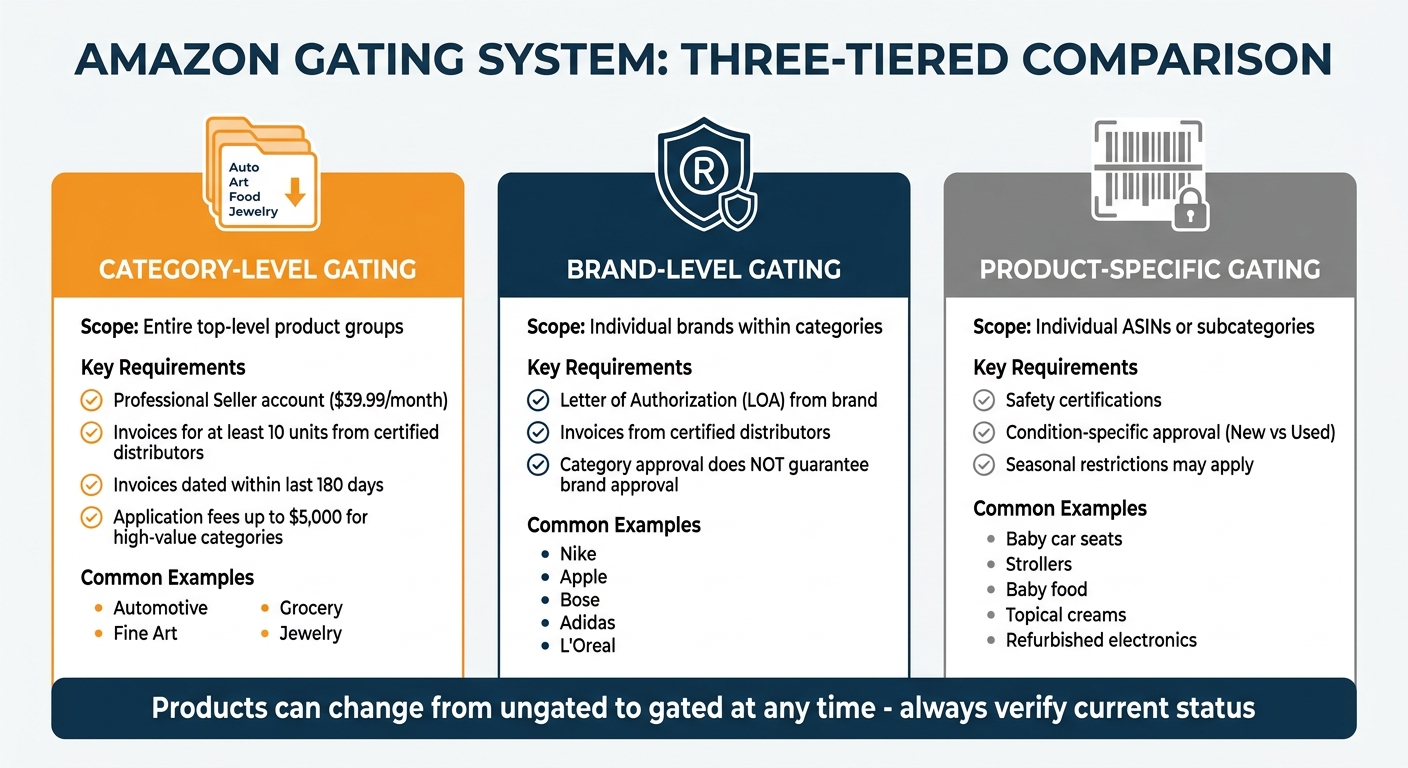
Amazon employs a three-tiered gating system to control seller access and maintain the quality and safety of its marketplace. These methods – category-level, brand-level, and product-specific gating – help regulate product listings and ensure compliance with Amazon’s standards. Let’s break down each type to understand their requirements and how they might apply to your inventory.
Category-Level Gating
This type of gating applies to entire product categories, meaning you’ll need approval to list items within these top-level groups. Amazon uses this approach for categories that involve safety risks, regulatory oversight, or concerns about authenticity. For instance, categories like Automotive, Fine Art, Grocery, and Jewelry require approval at the category level, not just for individual products.
To apply, you’ll need a Professional Seller account ($39.99/month), invoices for at least 10 units from certified distributors, and invoices dated within the last 180 days. High-value categories, such as Fine Jewelry or Collectible Coins, may also impose non-refundable application fees that can go up to $5,000.
Brand-Level Gating
Brand-level restrictions are designed to protect specific brands from counterfeit products. Even if a category is open for selling, individual brands within that category may require additional approvals. Popular brands like Nike, Apple, Bose, Adidas, and L’Oreal often fall under this protection.
Approval for the category doesn’t mean you can sell all brands within it. As one Amazon seller shared:
"If you’re trying to sell regular brand name items… you may still get shut down without an LOA (Letter of Authorization) from the brand that allows you to sell on Amazon"
– Seller_z3XfkorVSmnEY, Amazon Seller Forum
To meet these requirements, sellers typically need a Letter of Authorization (LOA) from the brand or invoices from certified distributors.
Product-Specific Gating
Product-specific gating focuses on individual ASINs, subcategories, or specific product conditions. Even if you’ve gained category approval, certain high-risk items – like baby car seats, strollers, or baby food – might still require separate authorization.
Additionally, some categories, such as Beauty, Grocery, and Baby Products, allow only “New” items while restricting “Used” or “Refurbished” conditions. The Toys & Games category provides another example: while generally open, it becomes restricted for merchant-fulfilled sellers during the holiday season to ensure timely deliveries.
As noted by Glenn_Amazon, an Amazon staff member:
"Products can go from not requiring approval to requiring approval at any time. By ensuring that you have invoices that meet Amazon’s requirements you can protect the long term success of your business."
– Glenn_Amazon
| Gating Type | Scope | Key Requirement | Common Examples |
|---|---|---|---|
| Category-Level | Entire top-level groups | Professional account, invoices, and metrics | Automotive, Fine Art, Grocery, Jewelry |
| Brand-Level | Individual brands | Letter of Authorization (LOA) or invoices | Nike, Apple, Bose, Adidas, L’Oreal |
| Product-Specific | ASINs or subcategories | Safety certifications or condition-specific approval | Baby car seats, topical creams, refurbished electronics |
Having the right documentation is critical for navigating Amazon’s gating system. The next sections will guide you on how to check gate status and submit applications for approval.
Common Gated Categories and Requirements
Examples of Gated Categories
Amazon places restrictions on certain categories to ensure buyer safety and meet regulatory standards. As AMZDOC LLC explains, "Amazon’s primary motivation for gating categories is buyer protection and regulatory compliance".
Take Grocery & Gourmet Food, for instance. This category demands strict oversight because of food safety concerns, expiration tracking, and labeling rules. Similarly, Fine Jewelry & Watches are heavily restricted due to their high value and the risk of counterfeit products, particularly in luxury brands.
Another example is Health & Personal Care, which includes products regulated by the FDA, making it one of the most strictly monitored categories. Automotive & Powersports involves components critical to safety, which must comply with regulatory standards. Medical Devices, too, require stringent FDA oversight because of the potential harm from misuse. Baby Products, such as cribs and car seats, face some of the toughest safety requirements due to the vulnerability of their users. Lastly, Pesticides must meet EPA registration guidelines and adhere to strict legal restrictions on chemical sales.
These restrictions highlight Amazon’s commitment to maintaining product quality and protecting consumers. Below, we’ll explore the specific requirements sellers must meet for these gated categories.
Approval Requirements by Category
Each gated category has its own set of documentation requirements that sellers need to fulfill before listing their products. Here’s a breakdown of the typical requirements for some key categories:
| Category | Why Restricted | Required Documentation |
|---|---|---|
| Grocery & Gourmet Food | Concerns about food safety, expiration, and labeling | Supplier invoices (10+ units), proof of FDA registration |
| Fine Jewelry & Watches | High value and risk of counterfeit luxury goods | Authorized dealer agreements, invoices, and quality assurance testing |
| Health & Personal Care | FDA-regulated items like OTC drugs and ingestible products | Certificates of Analysis (COA), FDA registration, and supplier invoices |
| Automotive & Powersports | Safety-critical parts with regulatory requirements | Professional website, compliant product images, and UPCs for major brands |
| Medical Devices | High-risk items requiring strict FDA oversight | FDA 510(k) clearance, registration numbers, and distributor invoices |
| Baby Products | Strict safety standards due to consumer vulnerability | Safety certifications (CPC), supplier invoices, and packaging photos |
| Pesticides | EPA registration and legal restrictions on chemicals | EPA registration numbers and compliant labeling |
Additionally, Amazon often requires invoices showing the purchase of at least 10 units of a product within the past 180 days for ungating approval. Seller performance metrics also play a key role. Typically, you’ll need to maintain an Order Defect Rate below 1%, a Pre-fulfillment Cancellation Rate under 2.5%, and a Late Shipment Rate under 4% to meet Amazon’s standards.
How to Check If a Category Is Gated
Understanding how to check for category restrictions is a key step in managing your inventory effectively. Here’s how to do it.
Using Amazon Seller Central
Amazon Seller Central offers a straightforward way to check if a category is gated. Use the "Add a Product" tool under the Inventory or Catalog menu. Simply input the product’s ASIN, UPC, EAN, or name, and you’ll see its status.
Amazon provides clear indicators for gated categories:
- If you see a "Request Approval" or "Apply to Sell" button, the product or its category is gated.
- A "Listing Limitations Apply" link will explain why the item is restricted.
- If no approval prompts appear, the product is ungated and ready to list under your account.
It’s important to double-check the gating status before sourcing products. Just because a category seems open doesn’t mean every product within it is unrestricted. To track your application progress, head to Inventory > Add a Product > Selling Application Status.
If the status isn’t clear, you can always test the listing process to identify hidden restrictions.
Testing Through the Listing Process
Another effective way to check for restrictions is by starting the product listing process. During this step, you’ll quickly find out if the category is gated. When you attempt to create a listing, Seller Central will stop the process and prompt you to submit an application if approval is needed.
Don’t forget to review condition restrictions. Some products may only be ungated in "New" condition but require approval for "Used" or "Refurbished" listings. Additionally, watch out for seasonal gating. Categories like Toys & Games often become restricted during the Q4 holiday season, even if they’re open throughout the rest of the year.
Testing the listing process without inventory on hand can help you avoid costly sourcing mistakes.
How to Get Approval for Gated Categories
If you’re ready to tackle Amazon’s gated categories, here’s a straightforward guide to help you navigate the approval process. First, confirm that the category you’re interested in is indeed gated. Then, focus on preparing and submitting your application with precise attention to Amazon’s documentation rules.
Preparing Required Documentation
Amazon requires commercial invoices to confirm legitimate sourcing. These invoices must be dated within the past 180 days and show a purchase of at least 10 units of the product you want to sell. Keep in mind that retail receipts, packing slips, and proforma invoices are not accepted.
Ensure the details on your invoices match the information in your Seller Central account exactly. Even minor discrepancies can lead to rejection. For your first application, it’s best to source from reputable U.S.-based wholesalers or manufacturers. Invoices from overseas suppliers are often flagged and rejected.
You may also need to provide product photos that show all sides of the item, its packaging, the UPC barcode, and any required safety labels. Depending on the category, safety certifications like a Children’s Product Certificate (CPC) for Toys & Games or a Certificate of Analysis (COA) for health and beauty products might be necessary. If the product is brand-restricted, you’ll need an official authorization letter from the manufacturer.
It’s worth noting that 40–60% of first-time ungating applications are rejected due to issues with invoices. Budget anywhere from $50 to $200 for basic ungating inventory or up to $1,000 or more if you’re targeting premium brands like Nike or Apple.
Submitting Your Application in Seller Central
Start by logging into Seller Central and navigating to Inventory > Add Products. Search for your product, and if you see a "Request Approval" or "Show limitations" link, it means the category is gated.
Click "Request Approval" or "Apply to sell" to begin the application process. Upload all required documents, including invoices, certifications, photos, or brand authorization letters. Once submitted, you can track your application status in Seller Central. Amazon typically reviews applications within 2 to 7 business days.
Now, let’s look at some strategies to improve your chances of approval.
Tips for Getting Approved
Before applying, make sure your account health is in good standing. Amazon’s recommended metrics include:
- Order Defect Rate (ODR): Below 1%
- Pre-Fulfillment Cancel Rate (PFCR): Below 2.5%
- Late Shipment Rate (LSR): Below 4%
"Sellers who jump straight to Nike or Hasbro with a new account get rejected 85% of the time."
- Sarah Lindqvist, Director of Marketplace Compliance at Catalist AI
Instead of starting with challenging brands or categories, consider easier options like Grocery & Gourmet Food to build a track record of approvals. Once you’ve gained experience, you can move on to more restricted categories like Watches or Fine Jewelry.
Submitting your application during regular U.S. business hours may also result in faster processing. To speed things up, you can handwrite or digitally annotate the ASIN on your invoice. Additionally, check if your account qualifies for automatic approval. Sellers with strong performance histories sometimes receive instant approval for certain categories without needing extra documentation.
"The biggest mistake sellers make with ungating is submitting invoices from unauthorized distributors. Amazon’s verification system cross-references supplier legitimacy in real time – if the supplier isn’t in their database of recognized wholesalers, the application gets auto-rejected before a human ever reviews it."
- Marcus Chen, Head of Seller Success, Catalist AI
How Gated Categories Affect Sellers
Getting approval to sell in Amazon’s gated categories can fundamentally change how you operate on the platform. These restrictions impact everything from pricing strategies to long-term business planning.
Benefits of Selling in Gated Categories
One clear advantage is reduced competition. Since fewer sellers make it through Amazon’s approval process, the marketplace becomes less crowded. This often leads to fewer price wars and a more stable market environment, which can improve profit margins.
Another perk is the increased trust from customers. Buyers tend to feel more confident purchasing from sellers who have been vetted by Amazon. As Daniel Hannig from Sellerlogic notes, "Buyers have more trust buying from an authorized seller".
Chris Dunne, Digital Marketing Manager at Repricer.com, adds:
"Getting approval to sell in Amazon gated categories might be able to really benefit you as a seller, as you’ll have the confidence in knowing you’re up against other sellers who have their act together – and that means they’re predictable."
Successfully gaining approval creates a competitive moat. This exclusivity makes it harder for new or less-prepared sellers to compete, giving established sellers a significant edge.
Challenges of Gated Categories
However, these benefits come with challenges. The approval process often requires significant investment and patience. For instance, applying for certain categories, like Fine Jewelry, can involve a non-refundable $5,000 fee.
While Amazon typically reviews applications within 3 to 10 business days, rejections are common. Sellers often need to submit multiple applications with improved documentation to succeed. A major risk is submitting fake invoices, which can lead to permanent account suspension, as Dillon Carter, Co-Founder and COO at Aura, warns.
Some top brands, such as Nike, Apple, and LEGO, are "hard gated." This means Amazon may only accept applications accompanied by a direct letter of authorization from the brand. Increasingly, brands are submitting "whitelists" of approved sellers to Amazon, automatically blocking others. Additionally, if Amazon decides to gate a previously open category, sellers could face stranded inventory and financial losses.
How Emplicit Can Help
Navigating these challenges requires expertise, and that’s where Emplicit comes in. Their services focus on ensuring compliance and driving growth in gated categories. Success in these areas depends on maintaining account health, building strong supplier relationships, and adhering to Amazon’s rules.
Emplicit offers marketplace management services, including account health monitoring to help sellers maintain the performance metrics needed for gated category eligibility. Their team also works on listing optimization, inventory management, and custom strategies to expand your presence on Amazon and other platforms like Walmart and Target.
With experienced, USA-based account managers, Emplicit can assist with preparing accurate documentation, sourcing from verified suppliers, and developing long-term strategies to thrive in restricted categories. Whether you’re managing PPC campaigns in newly approved categories or fine-tuning your listings, their full-service approach supports sellers at every stage of growth.
Conclusion
Key Takeaways
Amazon restricts access to certain categories to maintain product safety and quality. These restrictions help ensure the authenticity of products and protect the marketplace from counterfeit goods. For instance, in high-risk areas like sports memorabilia, studies suggest that between 50% and 80% of items sold on other platforms are counterfeit. By gating these categories, Amazon holds sellers accountable and enforces safety compliance.
Restrictions can apply at various levels, including category, brand, ASIN, or even product condition. To gain approval, sellers need to meet specific requirements: maintaining strong performance metrics, subscribing to a Professional Selling Plan (around $40 per month), and providing recent wholesale invoices (typically within 180 days) along with manufacturer authorization letters.
Sellers who successfully navigate these restrictions benefit from reduced competition, better profit margins, and increased buyer trust. With approximately 82% of Amazon sales coming from the Featured Offer, having fewer competitors makes it easier to secure the Buy Box.
These points highlight the importance of understanding and working within Amazon’s gating policies to succeed.
Next Steps for Sellers
To refine your selling strategy, start by reviewing listing restrictions in Seller Central before making bulk purchases. If you’re new to selling on Amazon, consider starting with ungated categories like Books or Home & Kitchen. Building a strong track record in these areas can help establish the performance metrics needed for approval in restricted categories. Also, make sure your supplier invoices match your Seller Central account details to avoid unnecessary rejections.
When you’re ready to tackle gated categories, seeking professional help can save time and effort. Services like those offered by Emplicit can guide you through the approval process. They provide support with documentation, account health monitoring, and custom strategies to help you meet Amazon’s compliance standards and succeed in restricted categories.
FAQs
Can a category become gated after I buy inventory?
Yes, it’s possible for a category to become gated after you’ve already purchased inventory. Amazon can decide to impose restrictions on specific categories or brands at any time. When this happens, sellers are required to get approval before listing products in those categories – even if the category was open when you initially acquired your inventory.
What invoice details most often cause ungating rejections?
When Amazon rejects an ungating request, it’s often tied to problems with the invoice details. Typical issues include missing proof of authenticity, using UPCs that Amazon doesn’t recognize, or submitting invoices that don’t align with Amazon’s strict guidelines for legitimacy. To prevent rejections, double-check that your documents are accurate, properly formatted, and meet Amazon’s specific requirements.
Do I need brand permission even if the category is ungated?
You don’t need a brand’s approval to sell in an ungated category on Amazon. However, for gated categories, you might need to get permission or authorization from the brand before listing any products. Make sure to review Amazon’s guidelines to understand the exact requirements for your chosen category.